
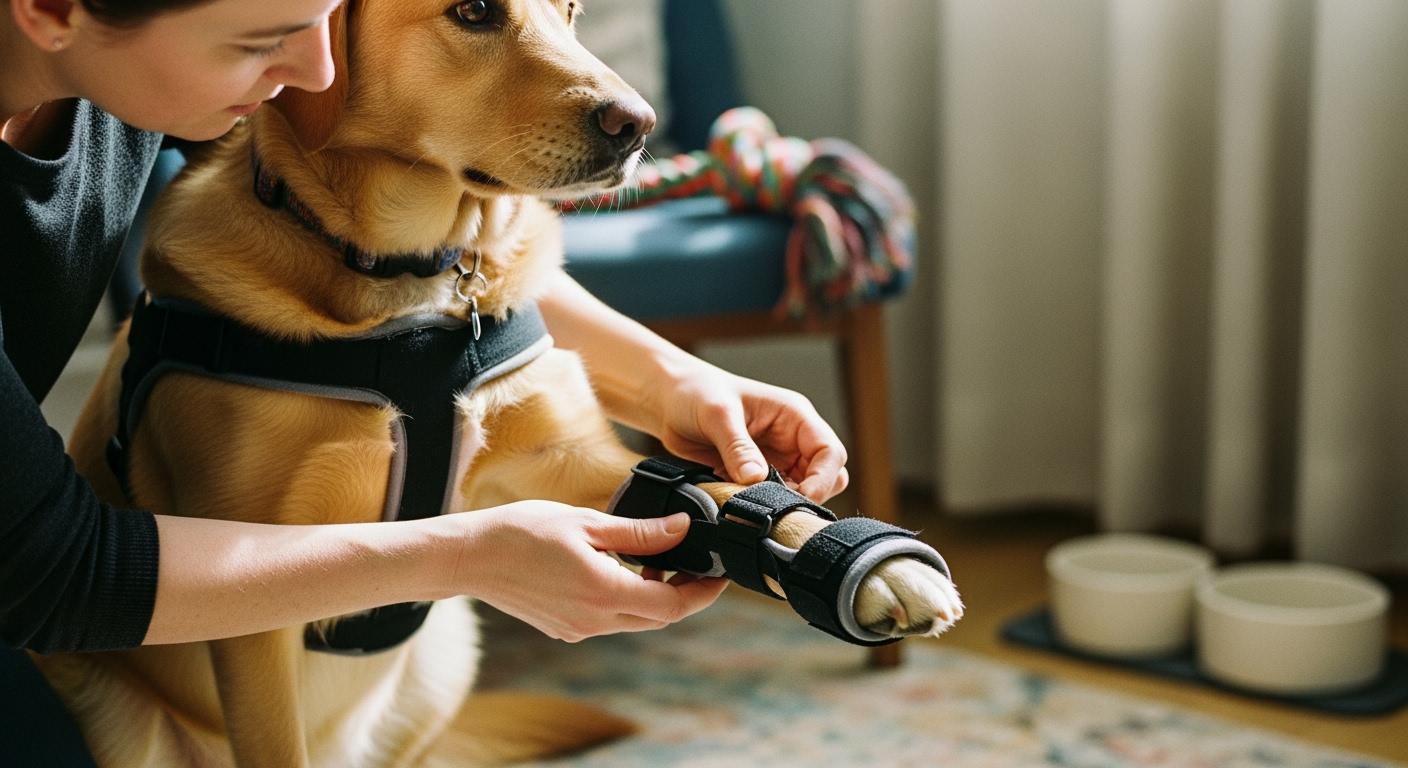
A toe up brace for dogs is a targeted support device for dogs that still move the limb forward but have difficulty lifting the paw or toes during walking. It may be considered when a dog knuckles, scuffs the nails, or drags the top of the paw, but it does not diagnose or treat the condition causing the gait change.
This guide explains how toe-up support differs from broader no-knuckling devices, what to check before fitting, how to run a short walk-test, and when the brace should be removed. For a wider view of available support routes, see the dog knuckling support solution.
Quick answer: Toe-up support is most relevant when the dog can still bear weight and advance the limb but needs assistance with paw clearance. Sudden knuckling, inability to bear weight, severe pain, rapid swelling, an open wound, or rapidly worsening coordination should be assessed by a veterinarian before a brace is fitted.
Key Takeaways
- A toe-up brace provides upward assistance to the paw; it is not a rigid brace for every type of limb instability.
- The dog should still be able to bear weight and move the limb forward before toe-up support is considered.
- Fit is judged during movement: the device should stay aligned without twisting the paw, creating new limping, or rubbing the skin.
- Wear time and walking activity should follow the veterinary or rehabilitation plan rather than a universal schedule.
- A brace may assist paw clearance or reduce repeated scraping, but it does not correct the underlying neurologic or orthopedic cause.
What a Toe-Up Brace Does
Targeted Paw-Lift Assistance
Knuckling describes an abnormal paw position in which the top of the paw, toes, or nails contact the ground. A toe-up brace adds controlled upward tension to support paw lift during the swing phase of a step. The aim is to help the paw clear the surface and return toward a pads-down position without locking the whole limb.
This makes toe-up support narrower than the general term “no-knuckling brace.” Some no-knuckling devices provide active toe lift, while others focus on paw protection or broader lower-limb positioning. The correct category depends on the gait pattern, remaining limb function, skin condition, and support goal.
What to Check During the First Walk-Test
The first walk-test is not a test of recovery. It is a fit and tolerance check. Use a flat, non-slippery surface and observe a short, supervised sequence of straight steps.
| Check | Acceptable Observation | Stop or Refit If |
|---|---|---|
| Paw clearance | The toes clear the surface more consistently. | The paw still folds under or is pulled too high. |
| Paw orientation | The pads return toward the ground during contact. | The brace twists the foot sideways. |
| Device position | Straps and attachment points remain aligned. | The brace rotates, slips, or migrates. |
| Dog response | The dog continues a controlled gait without obvious distress. | New limping, freezing, chewing, or refusal appears. |
A successful first check only shows that the device may be positioned appropriately for that brief session. Ongoing use still requires repeated gait, paw, and skin monitoring.
Understanding Knuckling and Paw Dragging
Knuckling Is a Sign, Not a Diagnosis
Owners may notice the paw folding under, nails scraping, uneven paw placement, stumbling, or increasing wear on the top of the toes. These observations describe a gait problem, but they do not identify its cause. Neurologic, nerve, spinal, orthopedic, pain-related, or rehabilitation-stage problems can produce overlapping signs.
Brace selection should therefore follow an evaluation of the gait pattern and remaining limb function. A diagnosis label alone does not determine whether toe-up assistance, a broader support device, paw protection, or no brace is appropriate.
When a Brace Is Not the First Step
| What You See | Why to Pause | Next Step |
|---|---|---|
| Sudden knuckling or rapidly worsening coordination | The gait change may require prompt assessment. | Contact the veterinary team before fitting support. |
| Inability or refusal to bear weight | Toe-up assistance assumes the dog can still use the limb during gait. | Do not use a walk-test as a substitute for evaluation. |
| Severe pain, rapid swelling, or marked sensitivity | A brace may add pressure or conceal progression. | Seek veterinary guidance. |
| Open wounds, bleeding, or damaged skin under contact areas | Straps and movement may worsen irritation. | Address the wound and obtain fitting guidance first. |
| More than one limb suddenly losing coordination | A broader neurologic or mobility problem may be present. | Pause device selection and contact the veterinarian. |
Do not perform a home paw-flipping or neurologic response test to decide whether a brace is needed. Record when the problem occurs, which limb is affected, what surfaces make it more noticeable, and whether the dog can still bear weight. A short video can help the veterinary or rehabilitation team review the gait pattern.
When Toe-Up Support May Be Considered
A toe-up brace may be discussed when the dog still advances the limb but loses paw clearance or pads-down placement. The decision should be based on function, not simply on the word “knuckling.”
| Observed Pattern | Support Goal | Important Limit |
|---|---|---|
| Toe scuffing or paw dragging while weight-bearing | Assist paw clearance during controlled walking. | Persistent dragging may indicate the support type or tension is unsuitable. |
| Paw folds under during part of the stride | Guide the paw toward a pads-down position. | The brace should not pull the paw into an unnatural angle. |
| Dog advances the limb but has weak toe lift | Add targeted upward assistance. | Toe-up support cannot replace broader limb control when the entire leg is unstable. |
| Supervised rehabilitation after evaluation | Support a defined gait task within the prescribed plan. | Activity level and wear time must remain individualized. |
When standard devices slip, rotate, or cannot accommodate the limb shape, more individualized sizing or product development may be required. The device still needs the same walk-test and skin-monitoring checks.
Toe-Up Brace vs Other Knuckling Support Types
| Support Type | Main Function | Usually Considered When | Key Limitation |
|---|---|---|---|
| Toe-up brace | Adds upward assistance to the paw and toes. | The dog bears weight and advances the limb but has reduced paw lift. | Does not provide full lower-limb stabilization. |
| Broader no-knuckling support | Adds more structured paw or lower-limb positioning. | Simple toe lift is not enough for the observed gait task. | More structure can add bulk, pressure, or movement restriction. |
| Protective boot or paw covering | Covers the top of the paw and nails. | The immediate goal is abrasion protection. | Protection alone may not change paw clearance. |
| Lift or mobility support | Assists balance or weight transfer through the body. | The problem extends beyond toe lift to broader mobility or handling needs. | It does not directly reposition the paw. |
For current product categories, compare the available dog knuckling brace options. Product category alone does not determine suitability; the support area, attachment method, and gait response still need to match the dog.
Choosing the Right Toe-Up Brace
Support Area and Attachment
Before choosing a size, identify where the device will anchor and how the toe-lift line will act during movement. A support that is too loose may fail to assist the paw, while excessive tension may over-lift the toes or change the dog’s stride.
- Confirm the intended limb and paw orientation.
- Check that attachment points sit on intact skin and do not cross a wound or prominent pressure area.
- Choose enough adjustability to refine alignment without compensating by overtightening.
- Confirm that the device can be removed for paw, nail, and skin inspection.
Fit Features to Evaluate
| Feature | What to Confirm |
|---|---|
| Adjustable tension | The paw-lift force can be refined without pulling the foot sideways. |
| Stable attachment | The device remains aligned during straight steps and turns. |
| Low-friction contact areas | Edges and straps do not create rubbing during the planned activity. |
| Low bulk around the paw | The device does not create a new ground-clearance problem. |
| Cleanable components | Contact materials can be cleaned and fully dried between uses. |
Do not describe an adjustable off-the-shelf device as a custom fit unless it has actually been developed from individualized measurements or a custom process.
Fitting and Positioning a Toe-Up Brace
Preparation
- Inspect the paw, nails, and all strap-contact areas before fitting.
- Confirm the device is clean, dry, and intended for the correct limb.
- Place the anchor and toe-lift components according to the product instructions or professional fitting plan.
- Set only enough tension to begin a brief, supervised movement check.
Position and Tension Check
- The paw-lift line should act upward rather than pulling the foot inward or outward.
- Straps should remain secure without digging into the limb or creating a pressure ridge.
- The paw pads should return toward the walking surface during contact.
- The dog should not develop a new limp, exaggerated step, or avoidance response.
For a narrower step-by-step article on home observation, use the no-knuckling brace fit and monitoring guide. That page should remain focused on application checks rather than repeating this Guide’s full selection framework.
Daily Use, Paw Checks, and Cleaning
Do Not Use a Universal Wear Schedule
There is no single wear time that is appropriate for every dog or every toe-up device. Session length depends on the diagnosis, remaining limb function, product design, skin tolerance, activity, and veterinary or rehabilitation plan. Begin only with the instructed supervised use and reassess before extending activity.
What to Check After Use
- Top of the paw and nails: new scraping, broken nails, moisture, or skin damage.
- Strap-contact areas: persistent redness, swelling, pressure marks, hair disruption, or tenderness.
- Gait: increased dragging, new limping, shorter steps, or greater fatigue.
- Device position: slipping, rotation, stretched components, or changes in tension.
Remove the device and seek fitting or veterinary guidance if skin changes persist, a wound develops, the gait worsens, or the dog repeatedly resists the brace. Do not place the device over an open sore unless the veterinary team has provided a specific protection and fitting plan.
Cleaning and Storage
Follow the manufacturer’s care instructions. Where the materials allow, clean straps and contact surfaces with mild soap and water, rinse away residue, and air-dry all components fully before reuse. Do not use a damp brace against the skin, and replace damaged fasteners or stretched components rather than compensating with tighter straps.
Troubleshooting Common Fit Problems
| Problem | Possible Fit Issue | Action |
|---|---|---|
| Toes still scrape | Insufficient lift, incorrect alignment, wrong support type, or gait change beyond the device’s role. | Stop the longer walk, check position, and obtain fitting guidance if the problem continues. |
| Paw is pulled sideways | The toe-lift line or attachment point is misaligned. | Remove and reposition; do not increase tension to compensate. |
| Brace rotates or slips | Incorrect size, unstable anchor, or loose attachment. | Recheck sizing and placement before another walk-test. |
| Dog over-lifts or takes an exaggerated step | Excess tension or excessive device bulk. | Stop, reduce or reset according to the fitting instructions, and reassess. |
| Redness, rubbing, swelling, or a sore | Pressure, friction, moisture, or unsuitable contact placement. | Remove the brace and seek veterinary or fitting advice before reuse. |
| New limping or refusal to walk | Discomfort, poor alignment, or a change in the underlying condition. | Stop use and contact the veterinary team. |
Simple Toe-Up Brace Monitoring Log
| Date | Activity or Session | Paw Clearance | Device Position | Paw and Skin Check | Action |
|---|---|---|---|---|---|
| Example | Short supervised walk | More consistent / unchanged / worse | Stable / slipped / rotated | Clear / red / rubbed | Continue plan / refit / stop and contact team |
Use the log to identify changes in fit or tolerance, not to diagnose progression or set a treatment schedule. Share repeated gait changes, skin problems, or device failures with the veterinary, rehabilitation, or fitting team.
For Brands and Rehabilitation Product Buyers
For buyers evaluating toe-up or no-knuckling support as a product category, the commercial questions are different from the dog-level fitting decision. Product development should define the intended gait task, attachment method, size coverage, adjustment range, contact materials, walk-test criteria, and skin-monitoring instructions before claims or SKU variants are finalized. GaitGuard’s custom dog brace manufacturing page explains the broader development route for pet brands; it does not replace case-specific veterinary selection.
FAQ
How do I know if my dog needs a toe up brace?
A toe-up brace may be discussed when the dog still bears weight and advances the limb but repeatedly scuffs the toes, drags the paw, or loses pads-down placement. A veterinary or rehabilitation assessment is needed to determine whether toe-up assistance matches the gait problem.
Can a toe up brace treat knuckling?
No. Knuckling is a sign with multiple possible causes. A toe-up brace may assist paw lift during selected activities, but it does not diagnose or treat the neurologic, orthopedic, or pain-related cause.
Can a toe up brace be selected from a diagnosis such as hip dysplasia or a knee injury?
Not from the diagnosis label alone. Toe-up support is selected for a specific paw-lift and placement problem. A dog with another condition may or may not have that gait pattern, and combined supports can add bulk or alter movement.
How should I clean a toe up brace?
Follow the product’s care instructions. If the materials are washable, use mild soap and water, rinse thoroughly, and let every component air-dry before the next use. Do not place damp material against the dog’s skin.
How long should a dog wear a toe up brace?
There is no universal daily duration. Wear time should follow the veterinary, rehabilitation, and product-specific plan and should be adjusted according to gait response, skin condition, activity, and device fit.
When should I stop using the brace?
Remove it if the dog develops new limping, refuses to walk, the device twists the paw, skin changes persist, a wound appears, or the gait becomes worse. Contact the veterinary or fitting team before resuming use.
Use boundary: This guide explains product roles, fit checks, and monitoring for toe-up support. It does not replace veterinary diagnosis, rehabilitation planning, or instructions supplied with a specific device.
