
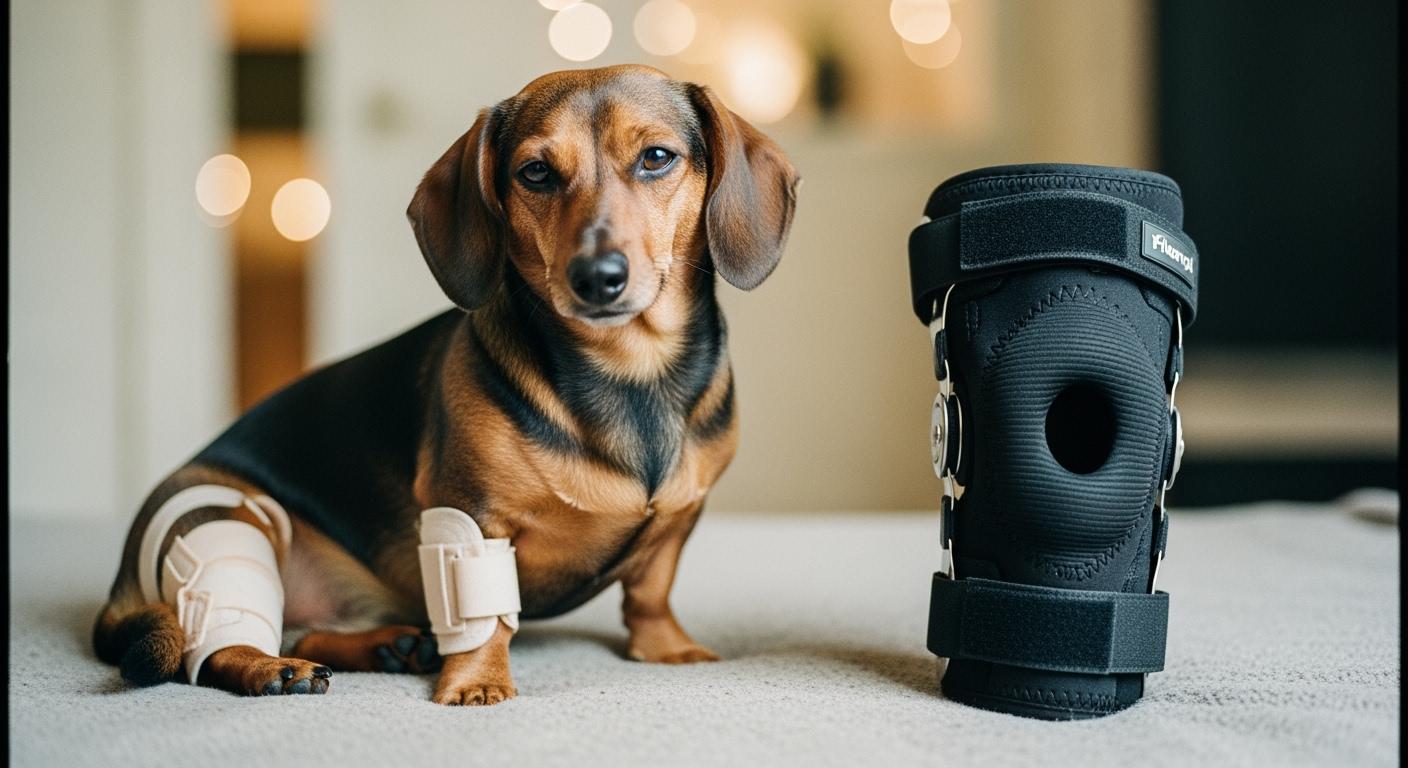
A small dog with luxating patella may skip, lift a hind leg mid-stride, or hesitate before placing the paw. A knee brace may be considered as part of a veterinarian-guided support plan, but a design that is too bulky, poorly aligned, or difficult to anchor can make movement less comfortable instead of more controlled.
The best small dog knee brace for luxating patella is not simply the strongest option. It needs to match the dog’s short limb proportions, joint position, skin tolerance, and movement pattern. This guide explains how brace bulk, strap placement, rotation, rubbing, and dynamic fit can affect comfort and daily use. A brace does not correct the underlying anatomy of luxating patella and should not replace veterinary assessment.
For a broader overview of braces, lift harnesses, anti-lick protection, fit checks, and safe movement during recovery, see the Dog Recovery Support Guide.
The luxating patella knee brace that works best for an individual dog is usually the one that stays aligned during movement without blocking knee flexion, concentrating pressure, or changing the dog’s normal gait.
Where a Knee Brace Can Fail on a Small Dog with Luxating Patella
Small dogs have short limbs, limited space above and below the knee, and less surface area for straps to resist rotation. A brace designed around larger-breed proportions may become bulky when scaled down without changing its strap layout, hinge position, liner thickness, or edge profile.
Excess material behind the knee can interfere with flexion
The back of the knee compresses as the dog bends the joint. A thick hinge housing, dense liner, folded fabric, or strap edge placed in this flexion area may create a pressure point or limit comfortable bending. When the brace resists the dog’s natural movement, it may shift down the leg, rotate away from the kneecap, or cause the dog to shorten the stride.
Do not assume that tightening the straps will solve this problem. Additional tension can increase skin pressure without correcting the underlying alignment. Instead, watch the dog walk, turn, sit, and stand. Then remove the brace and check whether the support area still aligns with the knee and whether the skin shows redness, heat, swelling, hair disturbance, or tenderness.
Brief introductory wear sessions can help reveal fit problems. Stop the session and reassess the brace if the dog freezes, repeatedly lifts the leg, chews at the brace, refuses to walk, or develops visible skin changes.
What low-profile support means for a short stride
Low-profile support means reducing unnecessary bulk around the joint while maintaining appropriate alignment and pressure distribution. The exact material thickness or hinge size that works will vary by dog, brace design, and limb shape; there is no single measurement that is suitable for every small breed.
| Design Feature | Why It Matters | What to Check |
|---|---|---|
| Low-bulk support around the flexion area | Allows the knee to bend with less interference from stacked material | Watch for shortened steps, hip hiking, freezing, or downward brace migration |
| Strap width matched to the leg | Helps distribute pressure without overwhelming a narrow thigh or lower leg | Check for rolled edges, bunching, defined pressure lines, or repeated slipping |
| Separate upper and lower anchor points | Helps resist rotation as the dog turns and changes direction | Confirm that both anchors sit on usable limb segments without crossing the joint |
| Breathable, smooth liner | Reduces moisture and friction during repeated movement | Check the liner and skin after each session and allow the brace to dry fully |
| Rounded, well-finished edges | Reduces concentrated rubbing along narrow strap borders | Run a finger around all contact edges before and after use |
The fit checks for small-dog knee braces should be repeated during real movement. A brace that looks aligned while the dog is standing still may rotate, slide, or block flexion during walking, sitting, or turning.
Why Strap Shape and Width Matter More Than Extra Tightness
Strap tension is only one part of fit. On a small, tapered leg, the strap also needs enough contact area and the correct anchor position to resist rotation without creating a narrow pressure line.
Narrow legs give straps less surface area to resist rotation
When the dog turns or changes pace, lateral force can rotate the brace around the leg. If a strap is too narrow, poorly positioned, or unable to conform to the limb, its edge may roll and the brace may follow. If it is excessively wide, it may bunch behind the knee or overlap another contact area.
After a short supervised walk, compare the strap and brace position with their starting alignment. Minor settling may occur, but repeated migration, visible rotation, or loss of kneecap coverage suggests that the current strap geometry or brace size is not working. Knee braces for luxating patella may slip or rotate when the anchors do not match the dog’s leg shape or when the brace body is being pushed out of position during flexion.
The over-tightening cascade
When a brace shifts, it is tempting to tighten the straps repeatedly. This can compress soft tissue, increase edge pressure, and make swelling or rubbing more likely while the brace continues to rotate. A stable fit should come from appropriate sizing, alignment, strap placement, and contact area—not from maximum tension.
Brace fit for small dogs with luxating patella should be reassessed if the dog develops persistent redness, swelling below the brace, tenderness, repeated licking, or reluctance to move.
Fit check: Remove the brace and inspect the full contact area after each introductory session. Redness that persists, swelling, cool toes, pain, or a sudden gait change are reasons to stop using the brace and contact the veterinary team before resuming.
A small-dog strap system should distribute pressure across smooth contact surfaces, allow normal muscle expansion, and avoid placing hard edges directly in the knee crease. The correct design depends on the individual dog’s anatomy rather than a fixed strap width or universal tension rule.
When a Knee Brace May Not Be the Right Tool
A knee brace provides external support while it is worn. It does not deepen the trochlear groove, realign the limb, tighten joint structures, or permanently correct luxating patella. Whether a brace is appropriate depends on the luxation grade, the dog’s comfort, concurrent injuries, limb alignment, activity plan, and veterinary recommendations.
Situations that require veterinary reassessment
- The kneecap remains displaced most of the time or cannot be comfortably repositioned
- The dog has suspected cruciate ligament injury, marked instability, or another condition requiring a different support approach
- Angular limb deformity or unusual conformation prevents the brace from staying aligned
- The available brace is too bulky for the dog’s limb or cannot be secured without excessive pressure
- The dog shows increasing pain, swelling, reduced weight-bearing, or worsening gait
A luxating patella support solution should be matched to the dog’s specific condition and movement needs. A brace may be used for selected dogs as part of conservative support, rehabilitation, or activity management, but it should not delay veterinary review when symptoms worsen or the fit remains unstable.
Disclaimer: Fit checks are easier on short-coated dogs because skin changes are visible. On thick- or double-coated dogs, use your fingers to check for heat, dampness, swelling, tenderness, folded fur, or pressure along strap edges. Dogs with unusual limb proportions or angular deformities may require professional fitting or a different support approach.
Before committing to daily use, review the Dog Recovery Support Guide to compare knee support with other recovery and mobility options. Not every product labeled for luxating patella addresses the same fit or stability problem.
Signals to watch during introductory wear
| Acceptable Signal | Warning Signal | Recommended Action |
|---|---|---|
| The brace remains aligned during walking, sitting, and turning, and the dog moves willingly | The brace rotates, slides, blocks the stride, or causes repeated chewing or freezing | Remove the brace and reassess sizing, alignment, and strap placement before another session |
| The skin remains dry and comfortable without persistent redness or swelling | Persistent redness, swelling, tenderness, dampness, hair loss, or cool toes | Stop use and contact the veterinary team before resuming |
| The dog tolerates short sessions without a worsening gait | The dog refuses to bear weight, flinches, hides from the brace, or becomes less willing to move | Stop use and seek veterinary or rehabilitation guidance |
For Pet Brands Evaluating Small-Dog Knee Brace Designs
Small-dog knee braces require more than scaling down a large-breed pattern. Product teams should evaluate flexion-area bulk, strap-to-leg proportions, edge finishing, liner behavior, size grading, and dynamic fit across representative small-breed limb shapes. GaitGuard provides custom dog brace manufacturing support for brands and distributors developing canine support products.
Frequently Asked Questions
Can a knee brace permanently fix luxating patella?
No. A knee brace provides external support only while it is worn. It does not change the underlying bone and joint anatomy. Some dogs with mild or intermittent luxation may use a veterinarian-approved brace as part of activity management or rehabilitation, while dogs with persistent or severe instability may require other treatment. The appropriate plan should be determined by a veterinarian.
How can I tell whether a brace is too tight?
The brace should stay aligned without creating persistent skin marks, swelling, tenderness, cool toes, or discomfort. Check that you can follow the manufacturer’s fit instructions and inspect the skin after removal. If the dog shows pain, circulation concerns, or worsening gait, remove the brace and contact the veterinary team.
Why can a brace fit while standing but fail during a walk?
Static and dynamic fit are different. During movement, the knee flexes, muscles change shape, and the leg rotates. These changes can make a brace slide, twist, bunch, or press into the knee crease even when it appeared aligned while the dog was standing. Fit should therefore be checked during supervised walking, turning, sitting, and standing.
What is the difference between a knee brace and a longer leg brace?
A knee brace focuses support around the stifle joint with shorter sections above and below the knee. A longer leg brace extends farther along the limb and may provide broader stabilization, but it also adds more material and requires more anchoring space. For a small dog, the better option depends on the joint problem, limb proportions, comfort, and veterinary or rehabilitation guidance.
