
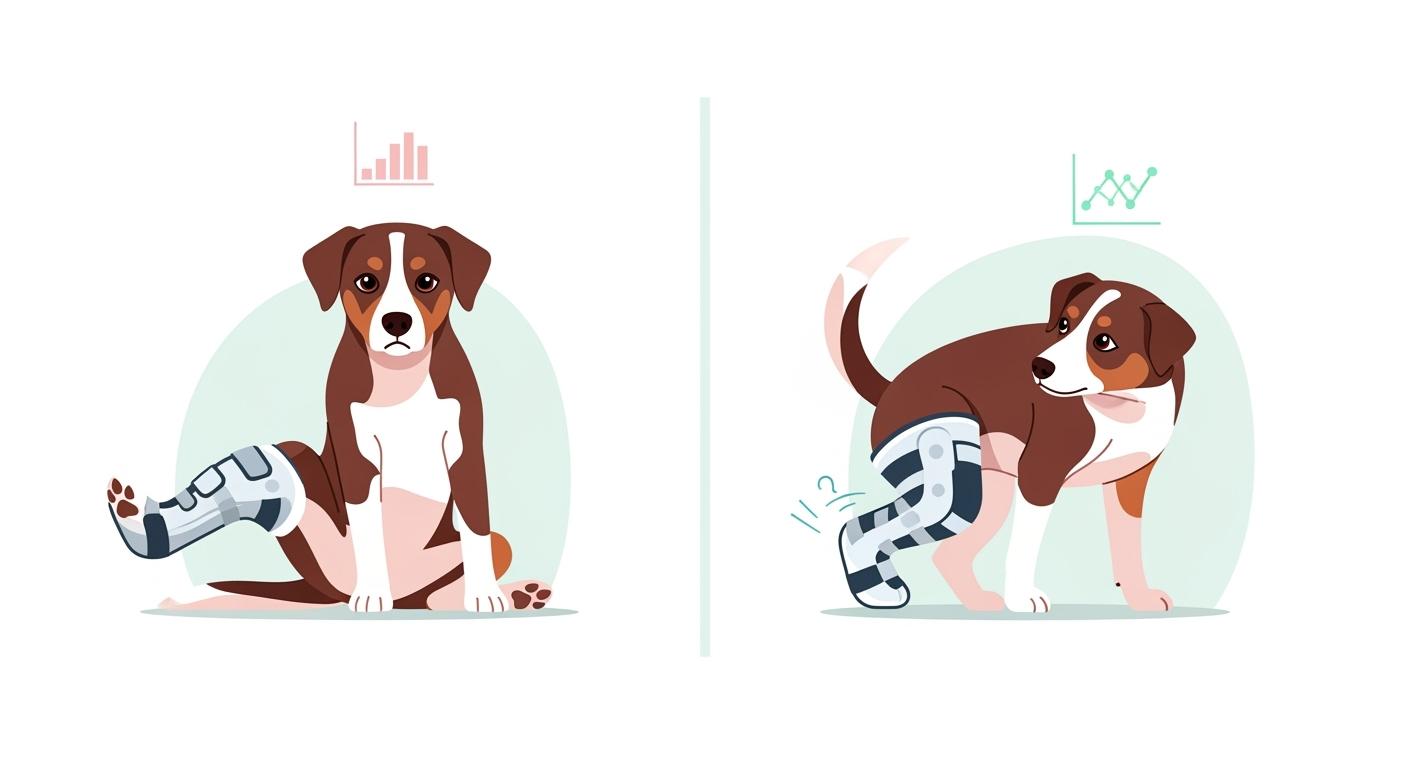
A brace can look perfectly centered when the dog stands on the exam table. Then the dog sits. The top strap shifts upward, the hinge drifts backward off the stifle, and the edge digs into the thigh. The standing fit meant nothing.
That gap — between how a brace fits at rest and how it performs through sitting, rising, and turning — is where most CCL braces fail. A search for the best brace for dog CCL tear usually starts with features and sizing charts. But the question that actually matters is narrower: which structural choices keep the brace aligned and comfortable when the dog changes position, and which ones create new problems the moment the dog moves?
Where a CCL brace fails during sitting, rising, and turning
Every posture change pulls, pushes, or twists the brace in a different direction. A brace that handles one of these forces may fail the next. Understanding where each movement concentrates load explains why some structures fail predictably — and what to check for.
Sitting pushes the thigh strap and brace edge
When a dog sits, the thigh muscles spread laterally and the stifle angle closes sharply. The upper strap — especially a single narrow strap — rides upward along the changing muscle profile. The top edge of the brace shell tilts forward and presses into the soft tissue at the front of the thigh.
This is not a minor comfort issue. That concentrated edge pressure can stop a dog from sitting normally. Some dogs hover above a sit position. Others sit crooked, shifting weight to the opposite hip. A few refuse to sit at all while the brace is on. In each case, the brace has altered a resting behavior the dog needs for recovery.
Standing up pulls the brace downward
Rising from a sit generates tibial thrust — the rear leg pushes hard against the ground, and the force vector runs downward along the limb. If the upper anchor cannot resist that downward shear, the entire brace slides toward the paw.
A narrow strap acts as a single point of resistance. Under load, the strap itself may hold, but the brace shell rotates around it. The lower portion of the brace drops. The hinge — now sitting below the stifle — loses mechanical control of the joint. The dog compensates by shortening the stride on that leg, which shifts weight to the sound side and can trigger secondary strain patterns over weeks of use.
Turning rotates the brace around the leg
This is the hardest movement for most CCL braces to handle. When a dog turns, side loads hit the brace shell from an angle the standing fit never accounts for. If the contact surface between the brace and the leg is narrow — as it is with single-strap anchoring — that side load finds a pivot point.
Here the mechanical chain is worth following: side load concentrates on the narrow strap bed → the strap bed acts as a fulcrum → the shell rotates around that fulcrum → the hinge drifts laterally off the stifle axis → joint loading becomes asymmetric → pressure concentrates at the misaligned hinge edge → the dog feels pain and shortens or avoids the turn. A brace that looked centered during straight-line standing is now rotated far enough that it provides no meaningful joint control through the turn — and it may be pressing hard enough into one side of the leg that the dog refuses to turn at all.
You can verify rotation within a single walk: after 10 minutes of leash walking that includes two or three slow, deliberate turns, check whether the brace shell has rotated more than half an inch from its original centered position. A half-inch of rotation means the hinge has already left the stifle’s axis of rotation.
Resting positions trap heat and create pressure
Lying down or curling up reshapes the leg again. A rigid shell that fits the standing leg may bunch or press into the thigh when the dog curls. Padding compresses under sustained pressure. Heat and moisture build up under non-breathable linings. Over hours of rest, the skin softens, friction tolerance drops, and what was a comfortable brace becomes an irritant.
The signs are often visible before they become wounds: the dog licks at the brace edge repeatedly, shifts resting positions every few minutes, or avoids lying on the braced side entirely.
| Movement | What happens to the brace | Why it fails | Better structure to look for |
|---|---|---|---|
| Sitting | Top strap shifts, edge presses thigh | Leg profile changes, hinge pulls away from stifle | Flexible edge, wide thigh anchor, stable hinge track |
| Standing up | Brace slides downward | Downward shear from tibial thrust, weak upper anchor | Anti-slip lining, load-spreading upper anchor |
| Slow turning | Brace rotates around leg | Narrow contact surface creates a pivot point | Anti-rotation shell contour, wide contact area |
| Short leash walking | Brace drifts, hinge may twist | Strap path cannot resist multi-directional loading | Angled strap path, hinge positioned close to stifle |
| Lying down or curling | Shell bunches, traps heat | Rigid shell, padding compresses and loses breathability | Breathable padding, remove during extended rest |
What brace structure for a dog CCL tear handles movement better
Each failure mode described above traces back to a specific structural choice. Change the structure, and the failure pattern changes. Four design dimensions determine whether a brace stays functional through daily movement.
Wider upper anchoring resists pivot and slide
A single strap tightens hardest at the closure point. That creates uneven grip: tight where the strap cinches, loose everywhere else. Under side load, the loose sections offer no resistance — all rotational force transfers to the tight spot, which becomes a pivot.
A double-locking system spreads anchor force across a wider contact area. Instead of one pronounced pressure band, the load distributes across two overlapping grip zones. The shell resists rotation because there is no single point for side loads to pivot around. After a session of sitting and standing, the skin tells the story: two faint, diffuse marks instead of one deep red band.
| Feature | Single Strap | Double-Locking System |
|---|---|---|
| Grip distribution | Uneven, tightest at closure point | Even, spread across a wider contact zone |
| Stability during movement | Creates a pivot point, shell rotates under side load | Conforms to muscle profile, resists both slide and rotation |
| Pressure marks after wear | One pronounced red band | Two fainter, more diffuse marks |
Hinge alignment that stays near the stifle
The hinge is the mechanical heart of a CCL brace. It controls how much the stifle can flex and extend, and it limits abnormal anterior translation of the tibia — the movement that stresses a torn cranial cruciate ligament. But a hinge only controls the joint when it stays aligned with the stifle’s axis of rotation.
A polycentric hinge — one with multiple pivot points — follows the natural rolling-and-sliding motion of the canine stifle more closely than a single-pivot hinge. This matters most during transitions: sit-to-stand and stand-to-turn, where the stifle’s instantaneous center of rotation shifts. A hinge that tracks that shift maintains joint control through the movement. One that does not creates a tug-of-war between the brace and the leg.
When selecting a stifle brace for daily wear, hinge alignment is decided at the initial fitting — a hinge positioned even a quarter-inch off the stifle’s axis will drift further with every weight-bearing step.
Anti-rotation shell contour and angled strap path
The inside surface of the brace shell determines whether it grips or slips. A shell that follows the natural taper of the canine hind leg — wider at the thigh, narrowing toward the hock — resists downward migration because the leg itself acts as a wedge against the shell contour.
Strap angle amplifies or undermines that geometry. Straps set at roughly 30 to 45 degrees relative to the leg’s long axis create a force vector with both vertical and rotational components — they pull the brace upward while also resisting twist. Straps that run perpendicular to the leg only cinch; they provide no directional resistance. When the hinge and shell work together as a system, rather than as independent features, the brace becomes harder to displace through any single movement.
| Design feature | Function | Impact on brace stability |
|---|---|---|
| Anti-rotation shell contour | Follows natural leg taper | Resists downward slip and rotational drift |
| Strap angle (30–45 degrees) | Creates a directional force vector | Resists both slip and twist simultaneously |
| Wider strap beds | Distributes side load across more surface area | Reduces migration and the rolling effect that precedes rotation |
Breathable padding and softer edges
A brace shell transfers load to the leg through its inner lining. If that lining does not breathe, heat and moisture accumulate within minutes of wear. The skin under the brace becomes warm, damp, and more fragile — the same pressure that was tolerable at minute five can cause a friction injury at minute forty.
Soft neoprene with hypoallergenic properties addresses two problems at once: it reduces the mechanical irritation from edge contact during sitting and turning, and it cuts the allergic or contact-dermatitis reactions that some dogs develop against synthetic linings. But breathability is not just a material claim — it produces an observable result. After 20 minutes of wear during normal indoor activity, lift the top edge of the brace lining and feel the skin underneath. If the skin feels noticeably warmer and damper than the unbraced leg, the padding is not moving enough heat or moisture away from the surface. Over weeks of daily wear, that retained moisture is what turns minor friction into open wounds.
| Brace feature | What it helps control | Where it may still fail | Best-use note |
|---|---|---|---|
| Wide thigh strap | Reduces concentrated edge pressure | May slip if tension is insufficient | Check fit after sitting and standing |
| Hinged stifle support | Keeps hinge near knee joint axis | Hinge can drift during turning | Verify hinge position before and after movement |
| Anti-rotation shell | Stops brace from twisting around the leg | May press if inner padding is thin or compresses | Watch for rubbing after turns |
| Breathable padding | Lowers heat and moisture buildup | May bunch during curling positions | Remove during extended rest unless otherwise directed |
| Adjustable strap path | Improves fit as leg position changes | Can loosen gradually with activity | Recheck straps after each wear session |
| Rear-assist support paired with knee support | Helps with rising from rest and stair negotiation | May not fit all body types equally | Use if the dog struggles to stand independently |
When a CCL brace is the right tool — and when it is not
A brace provides external joint support — it can reduce abnormal tibial translation, improve proprioceptive feedback, and help a dog move with more confidence during rehabilitation. But it cannot repair a torn ligament. The ends of a fully ruptured CCL will not rejoin inside a brace. For partial tears in dogs with moderate activity levels, external support can be part of a conservative management approach that keeps the joint stable enough for scar tissue to organize around the injury site. For complete tears in young, active, or large-breed dogs, a brace alone is typically insufficient for long-term joint stability.
The distinction matters because the search for the best brace for dog CCL tear often starts from the assumption that a brace can replace surgical stabilization. It cannot. What a well-structured brace can do — when matched to the right dog and the right tear pattern — is reduce pain during weight-bearing, slow the progression of joint degeneration while a treatment plan is underway, and protect the contralateral leg from the overload that often causes a second CCL tear. Understanding which CCL brace solutions match specific stability needs starts with an honest assessment of the tear severity and the dog’s daily movement demands, not with a feature list.
Disclaimer: The fit checks and wear observations described here assume a dog with typical breed-conforming hind-limb structure. Dogs with angular limb deformities, unusually deep or narrow chests, or significant unilateral muscle atrophy may distribute brace pressure differently — visual inspection of strap marks alone may miss deeper tissue pressure in these dogs. If the dog’s leg conformation falls outside the breed norms the brace was patterned for, hand-check under all brace edges rather than relying on visible skin marks.
| Signal | What you see | Action |
|---|---|---|
| Green | Brace stays centered after sitting, standing, and turning; skin remains normal in color and temperature | Continue supervised use, maintain daily checks |
| Yellow | Light slipping, mild edge marks, warmth under the brace, or short stiff steps after wear | Adjust fit, increase check frequency, limit activity duration |
| Red | Worsening limp, swelling, unusual heat, open sores, cold toes, panic, pain response, or refusal to bear weight | Remove brace immediately, contact your veterinarian |
There is no single best brace for dog CCL tear that works across every dog, every tear pattern, and every activity level. The question narrows to: which structural features keep this specific dog’s joint stable through its real daily movements — sitting in the crate, rising from the bed, navigating a tight hallway turn — without creating new pain or skin problems? When evaluating whether a CCL brace is working, the answer shows up in gait, skin condition, and the dog’s willingness to move through full postural changes — not in a spec sheet.
Practical fit check before the brace becomes a problem
A brace that slips, rubs, or rotates will signal trouble before it causes serious injury — but only if someone is watching for the early signs. The fit check sequence below catches problems at the stage where an adjustment can fix them.
- Place the brace while the dog stands calmly on a non-slip surface.
- Verify the hinge sits directly over the stifle joint before any movement.
- Have the dog sit once, then stand once, under close observation.
- Check whether the upper strap shifted position, the top edge pressed into the thigh, or the hinge drifted forward or backward.
- Walk the dog slowly through a controlled turn.
- Remove the brace. Check the skin for strap marks, heat, moisture, and any sign of rubbing.
- If slipping, rotation, rubbing, or gait changes repeat within 7 days, reassess the fit or the brace structure.
| Check point | Pass signal at rest | Fail signal during movement | Why it matters |
|---|---|---|---|
| Brace alignment | Centered over the stifle, no visible gaps | Slides downward, twists, or rides up | Support is not staying where it can control the joint |
| Strap response | Secure without pinching or leaving deep marks | Leaves pronounced red bands, loosens, or triggers licking | Pressure or movement may damage skin within days |
| Gait quality | Dog rises and walks without hesitation | Increased limping, skipping, stopping, or stumbling | The brace may be mismatched to the dog’s movement pattern |
| Surface tolerance | Stable on flat, non-slip surfaces | Hesitates or slips on stairs, slick floors, or during turns | The environment may exceed what the brace-and-dog system can handle safely |
Stop-use signs should never be ignored: severe pain or panic, swelling or unusual heat around the joint, toes that feel cold or look discolored, open wounds or skin breakdown under the brace, discharge or foul odor, inability to bear weight, or gait that is worse than before the brace was applied. Remove the brace immediately and contact your veterinarian if any of these appear. A brace designed for a torn CCL knee should reduce pain during supported movement, not create new problems that force the dog off the leg entirely.
The fit checks that catch problems early — after sitting, after rising, after turning — are the same movements that reveal whether the brace structure is right for this dog in the first place. A CCL brace fit that incorporates traction and movement testing catches issues that a standing-still sizing session will miss every time.
FAQ
Why does a CCL brace that fits perfectly at rest shift when the dog sits?
Sitting changes the cross-sectional shape of the thigh — muscles spread and the stifle angle tightens. A strap anchored to the standing leg profile will ride upward as the muscle bulk redistributes underneath it. The wider and more flexible the upper anchor, the less it shifts during this transition.
How quickly can a poorly fitted brace cause skin damage?
Friction injuries can develop within a single extended wear session — particularly if the padding is non-breathable and moisture builds up underneath. Redness or warmth after 30 minutes of wear is an early signal that should trigger a fit adjustment, not be waited out.
Can a dog wear a CCL brace during sleep or extended rest?
Most dogs should not wear a rigid or hinged CCL brace during extended rest unless a veterinarian has specifically instructed otherwise. Curled resting positions compress padding unevenly, trap heat, and can create pressure points that go unnoticed while the dog is still. Removing the brace for crate rest or overnight sleep lets the skin recover.
What is the difference between a stifle brace and a hock brace?
A stifle brace controls the knee joint — it limits flexion, extension, and tibial translation. A hock brace controls the ankle. The two joints sit close together on a dog’s hind leg, and a brace designed for one will not support the other. Confusing the two means the brace is controlling the wrong joint entirely.
Does a hinged brace always provide better support than a soft wrap?
Not in every case. A hinge provides mechanical joint control only when it stays aligned with the stifle axis. If the hinge drifts — which happens more easily with a single-strap anchor — a soft wrap that stays centered can deliver more consistent proprioceptive feedback than a misaligned hinge that creates a false sense of stability.
