
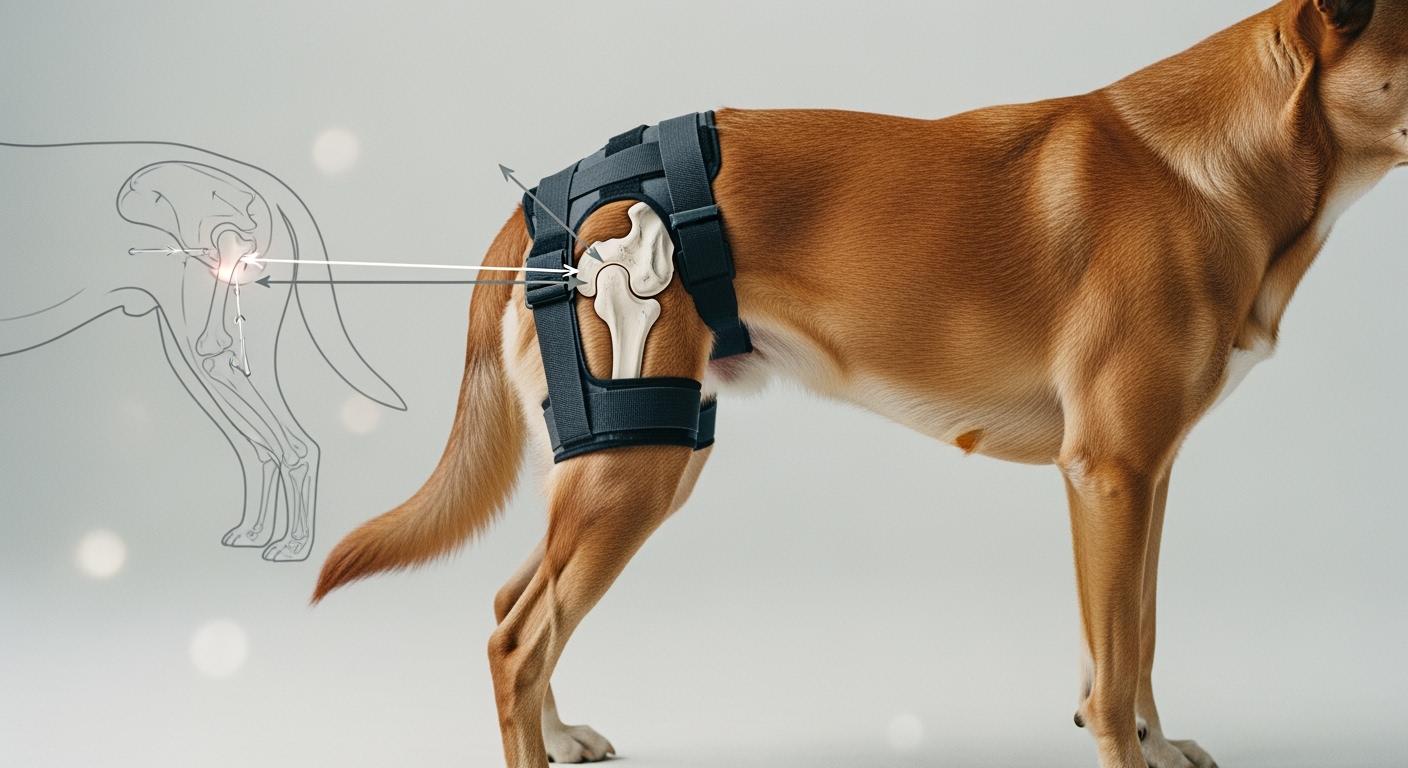
A senior dog walks for ten minutes. The thigh strap slips toward the groin. You reposition it. It slips again. The solution most people reach for — pulling the strap tighter — makes the problem worse. Now there is a red mark, the dog is slowing down, and the brace meant to support an arthritic hip has become the reason the walk ends early.
This is not a fit problem. It is a structure problem. A dog hip brace for arthritis that grips only the thigh cannot anchor the hip joint because the hip sits at the pelvic junction — not mid-thigh. When lateral leg motion pushes a thigh-only strap, the force has no counter-anchor. The strap rotates around the femur, the pressure concentrates at the leading edge, and the whole brace walks itself toward the narrowest point: the groin. Tightening the strap amplifies the edge pressure without adding any pelvic stability. The brace does not fail because it is loose. It fails because its structure ignores where the hip actually lives.
| Design feature | What fails in real use | Better structure |
|---|---|---|
| Thigh-only strap | Slides toward groin, misses hip joint | Pelvic wrap with thigh panels |
| Narrow belly strap | Rolls at edges, uneven pressure | Wide belly or chest anchor |
| No hip pad | Concentrated pressure over bony prominences | Shaped, removable hip pads |
| Rough edge binding | Groin friction, redness within days | Soft edge binding |
| Non-breathable lining | Heat and moisture buildup, reduced wear tolerance | Breathable lining |
| Loose rear anchor | Shift, escape, zero joint control | Stable rear anchor |
Tip: If you are evaluating a hip brace for the first time, check its position before and after every walk during the first two weeks. A brace that drifts more than half an inch from its starting position lacks adequate pelvic anchoring — tightening will not fix it, and continuing risks groin irritation that ends brace use entirely.
Where a Dog Hip Brace for Arthritis Fails First
The first failure point is almost always the same: the brace moves. Not because the dog is active. Not because the owner put it on wrong. It moves because a strap wrapped around a tapered cylinder — the thigh — is structurally destined to migrate toward the narrower end. The thigh tapers from hip to knee. Any downward force on the strap creates a wedge effect. The strap walks itself toward the groin. Every step advances the problem.
When the brace shifts, two things happen at once. The hip joint loses whatever support the brace was supposed to provide, and a new pressure point forms where the strap edge digs into groin skin. Groin skin is thinner, more vascular, and subjected to both friction and moisture. Within days, that narrow line of contact progresses from pink to red to raw. The dog slows down. The owner removes the brace. The arthritic joint gets less movement — the opposite of what controlled daily walks are meant to achieve.
Staying centered matters more than staying tight. A brace that holds position through the full gait cycle — walk, turn, sit, stand — protects the joint and preserves skin integrity at the same time. That kind of stability does not come from strap tension. It comes from the brace wrapping a structure that resists both vertical slide and rotational twist. The pelvis provides that structure. The thigh, on its own, cannot. For a deeper look at how fit interacts with daily wear outcomes, the observable slipping signals during a hip support brace walk follow a predictable pattern — shift first, rub second, refuse third.
In practice: Walk the dog for ten minutes on a flat surface. Stop. Without adjusting anything, note whether the top edge of the brace has moved relative to the hip bone you aligned it with. More than half an inch of drift = the anchoring strategy is not working.
| Signal | What you see | What it means for the brace |
|---|---|---|
| Stays centered | Brace position unchanged, dog walks normally, skin looks normal | Anchoring strategy matches this dog’s movement pattern |
| Mild shift | Brace has moved slightly, faint rub line, dog slows toward end of walk | Pelvic anchoring is present but insufficient — check wrap geometry, not strap tension |
| Major shift or pain | Brace has migrated to groin, red marks or sores, limping worse, dog resists wearing | Structure is fundamentally wrong for this dog — thigh-only anchoring has failed; a different support strategy is needed |
Pelvic Anchoring vs. Thigh Compression — What the Structure Decides
A pelvic wrap works differently from a thigh strap because it encircles a structurally different body region. The pelvis is a bony ring — the iliac crests flare outward and the sacroiliac joints sit at the connection between spine and hind limbs. When a brace wraps this ring and closes the loop, it has something to hold onto. Vertical slide is resisted because the iliac crests create a natural shelf above the wrap. Rotational twist is resisted because the closed loop engages both sides of the pelvis simultaneously — rotating the wrap would require deforming the entire ring or displacing both iliac crests, neither of which happens under normal gait forces.
A thigh-only strap, by contrast, wraps a single soft-tissue cylinder. The femur sits deep inside muscle bellies. There is no bony shelf above the strap, no closed-ring geometry, and the thigh itself tapers. Compression alone cannot solve the anchoring problem — it can only make the skin under the strap take more pressure before the strap still slides. The difference plays out in every step. The structural decisions behind hip brace anchoring — wrap geometry, strap width, closure point placement — determine whether a brace stays centered or walks itself into the groin.
Belly and chest anchors extend this logic forward. A wide anchor across the torso spreads load across a larger surface and resists edge rolling. When a dog sits, stands, or turns, the forward anchor keeps the rear wrap from pivoting. Without it, the rear wrap rotates around its own center — and rotation is the precursor to groin migration. Belly anchors with some width — not narrow straps — resist that rotation because they have an anti-roll surface. Narrow straps have almost none.
For a structured plan that connects the first wear week to longer-term tolerance, the fit progression for a dog hip support brace starts with short sessions where the owner watches for the shift-and-rub pattern described above — not with assumptions about what the brace should do based on how tight it looks.
When a Hip Brace Is Not the Right Answer
Dogs with neurological deficits affecting both hind legs — where the issue is not joint pain but the inability to place the foot or bear weight — often need a different support strategy. A lift harness distributes load differently than a hip brace does: the harness carries weight from above, while the brace works through circumferential compression around the joint. One is not better. They solve different mechanical problems. Using a brace when the dog needs a lift is not a tightness issue — it is a support-type mismatch.
Body conformation creates another boundary. Very deep-chested breeds — think a narrow, tucked-up sighthound — put the pelvic wrap at a different angle relative to the ribcage than a square-built breed. The wrap may not sit flush along its full circumference. Gaps mean inconsistent pressure. Inconsistent pressure means some areas take more load than intended, and the brace loses its ability to distribute force evenly. This is not a design defect. It is a geometry mismatch between a standardized wrap pattern and a non-standard body shape.
Dogs with angular limb deformities add another layer. If the femur angles outward or the hip socket is shallower than breed norms, the brace’s force path does not track the joint’s actual movement axis. What was designed to stabilize can instead push against an abnormal angle — creating pressure where there should be support.
Disclaimer: This fit-check approach assumes a dog with typical medium-to-large breed hip and torso conformation. Dogs with angular limb deformities, very deep or very round chests, or double coats may show subtler pressure signals that need hand-checking — run your fingers under every strap edge after each walk rather than relying on visual inspection alone. If the dog’s leg conformation falls outside the norms this brace pattern was built for, the checks described here may not catch every pressure point.
The question is not “brace or no brace.” It is: does the dog’s movement problem match what a circumferential hip brace is designed to address, and does the dog’s body shape allow the wrap to do its job? When the answer to either is no, a first-week wear evaluation for a hip brace will surface the mismatch quickly — the brace will shift, the dog will resist, and the wear log will show a pattern of early removal. That pattern is not a failure of effort. It is the structure telling you something.
Materials and Edge Details That Decide Whether the Dog Tolerates the Brace
Even a well-anchored brace fails if the dog will not keep it on. Tolerance is not about the dog’s temperament. It is about what happens at the skin interface after twenty minutes of movement. Two design details control that interface: what touches the skin at the edges, and what happens to heat and moisture under the lining.
Soft edge binding near the groin is not a comfort feature. It is the difference between a brace that can be worn daily and one that gets abandoned after the first red mark. Groin skin moves through a large range of motion with every step — flexion at the hip joint stretches and compresses the skin in the inguinal region. A stiff or rough edge concentrates that stretch-and-release cycle on a narrow line. Multiply by a thousand steps and the skin breaks down — not because the dog is sensitive, but because the mechanical load per unit area exceeds what skin can handle under repeated cycling.
Breathable lining controls the second variable. An arthritic senior dog wearing a brace for a thirty-minute walk generates heat and moisture under the wrap. If the lining traps both, the skin macerates. Macerated skin under compression is a fast track to sores. An observable check: after twenty minutes of wear, lift the brace lining and feel the skin with the back of your hand. Damp and clammy means ventilation is insufficient for sessions of that length. Dry and warm means the lining is managing moisture at a rate that matches this dog’s activity level and duration.
Removable hip pads serve a different function. Bony prominences over the hips — the greater trochanter and iliac crest — vary in prominence between breeds and individual dogs. A flat foam sheet inside the brace treats every hip as the same shape. Shaped pads that can be positioned independently let pressure be routed around the bony points and into the surrounding muscle. That routing is what turns a pad from a comfort accessory into a structural element: it changes where the brace’s compressive force lands. The pad placement inside a hind-leg hip brace matters more than the pad material — a well-shaped pad in the wrong spot concentrates force, while a basic pad positioned correctly distributes it.
Three details. Three failure modes. And none of them are solved by making the brace tighter.
FAQ
Why does tightening a thigh strap not fix hip brace slipping?
Tightening increases surface pressure but does not change the underlying geometry: a strap on a tapered cylinder will migrate toward the narrow end under load. The tighter the strap, the higher the edge pressure when it does slide — making groin irritation worse, not better. Pelvic anchoring solves the geometry problem; strap tension only masks it temporarily.
How long should a first session with a new hip brace last?
Start at ten minutes on flat ground. Check position, skin, and gait immediately after. If the brace stayed centered and skin is normal, add five minutes per session over the first week. If shifting or redness appears, do not increase duration — the anchoring strategy or pad placement needs adjustment before the dog builds tolerance.
What is the difference between a hip brace and a lift harness for an arthritic dog?
A hip brace applies circumferential compression around the pelvic region to stabilize the hip joints during independent walking. A lift harness supports weight from above — the owner carries part of the load through a handle. They address different deficits: joint instability vs. weight-bearing weakness. The choice depends on whether the dog can bear weight but needs joint control, or cannot bear weight reliably and needs load assistance.
Can a hip brace be worn all day?
Most dogs with arthritis build tolerance gradually. All-day wear is rarely the starting point and often not the goal — the brace supports controlled movement sessions, not continuous immobilization. Skin checks after every session, particularly during the first two weeks, determine whether the current wear duration is sustainable.
