
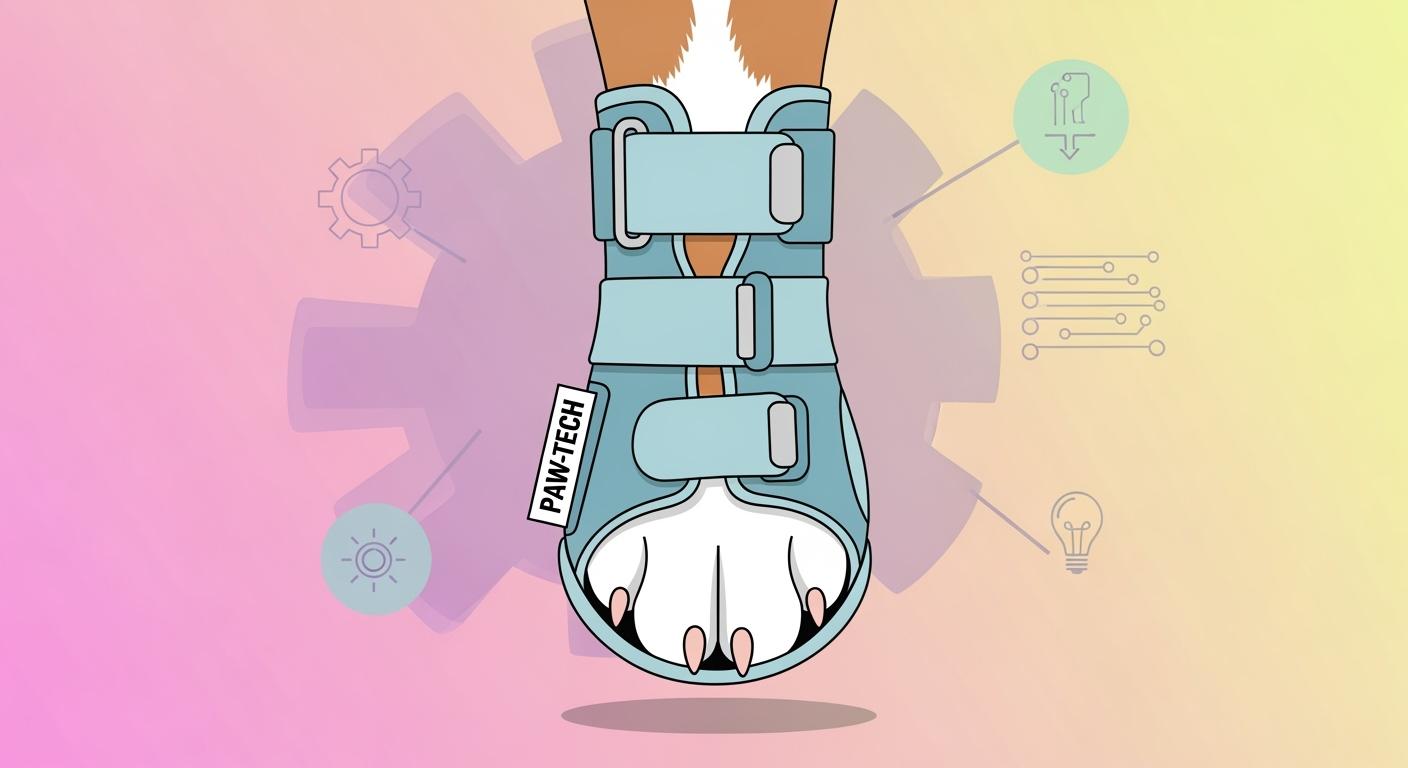
A dog anti knuckling brace slips off toes even when it looks snug. The strap sits where it should. The tension feels right. And then — three steps in — the loop slides off and the toes drag again.
The problem is almost never that the strap is too loose. It is that something upstream shifted. A cuff rotated. A strap path curved sideways instead of staying straight. The lift vector changed direction. Tightening only adds pressure to a misaligned system. It does not restore the lift path.
What fails first is usually the anchor — not the toe loop itself.
Why the Toe Loop Loses Its Grip Mid-Walk
A toe-loop brace works by pulling upward from a fixed anchor point — the hock for rear legs, the carpus for front legs. That anchor transmits walking forces into the strap, and the strap transfers them into the toes. When the anchor stays put, the lift path stays straight. When it rotates, the path tilts.
The most overlooked failure is not the strap tension. It is the anchor geometry. Narrow cuffs concentrate side loads into a thin band of contact. Under lateral force — a dog stepping slightly wide, turning, or pushing off — that band rolls. The cuff rotates a few degrees. The strap origin point moves. The pull angle shifts from upward to diagonal, and the toe loop migrates toward the nail or slips off the side of the paw entirely.
This is a chain failure:
Narrow cuff → no anti-rotation surface → side force concentrates at the strap edge → edge rolls under load → cuff rotates → strap path angles sideways → toe loop slides toward nails → lift lost.
Each link depends on the one before it. Tightening the toe strap addresses none of them.
The fix is not more tension. It is a cuff wide enough to resist rotation — one that brackets the joint above and below, spreading force across two contact bands instead of one. That two-point anchor geometry resists the moment arm that twists a narrow band. When the anchor holds, the strap stays on path.
Tip: After 10 slow steps on a flat surface, check whether the cuff has shifted from its original position by more than half an inch. Rotation you can measure means the lift path has already degraded — even if the loop has not slipped off yet.
Tightening the strap makes one problem into two
When the loop slides off, the instinct is to pull the strap tighter. That adds circumferential compression. Compression constricts the toe webbing. Constricted tissue reddens, swells, and grows tender within minutes. The dog chews at the paw, lifts the leg, or shortens stride to avoid loading the tender toes.
But the toes are still not lifting. The strap is tighter, the pain is worse, and the paw still drags. The original problem — anchor rotation — remains untouched.
You can verify this: remove the brace after a walk session. If redness across the toe webbing persists beyond 20 minutes, the strap is compressing tissue without producing functional lift. That is a structural mismatch, not a tension adjustment.
| What you see | Why it happens | Why tightening fails | What actually helps |
|---|---|---|---|
| Toe loop slides toward nails | Anchor rotated, strap path tilted sideways | Adds pressure to misaligned path | Check cuff position; re-center loop on two middle toes |
| Toes still scrape ground | Lift vector too weak or misdirected | Increases compression, not lift | Adjust elastic tension after confirming anchor stability |
| Cuff rotates before toes lift | Narrow anchor lacks anti-rotation surface | Does not resist rotation | Wider cuff with above-and-below-joint contact |
| Dog slips on tile or hardwood | No traction under lifted paw | No effect on grip | Add sole traction; check surface-specific performance |
| Red toe webbing after use | Strap compressing tissue without lifting | Worsens compression | Softer contact padding; reduce tension; re-center loop |
| Dog chews or lifts the paw | Pain from compression or misalignment | Increases avoidance behavior | Refit; consider boot-style support if pain persists |
Surface type changes the failure profile. A brace that holds on carpet can fail on tile — not because the strap slipped, but because the paw skids on contact and side-loads the cuff. That lateral impulse triggers the same rotation chain. If the brace works on one surface but not another, the problem is traction at the paw, not strap security.
Front and rear limbs compound this differently. Rear-leg braces anchor at the hock; front-leg braces anchor at the carpus. The joint angle, load path, and rotation axis differ. A brace sized or anchored for one limb will not transfer the same strap geometry to the other. Separate sizing for front and rear legs is not convenience — it is how the lift path stays straight when anchor and joint mechanics differ between forelimbs and hindlimbs.
What the First Walk Test Reveals About Fit
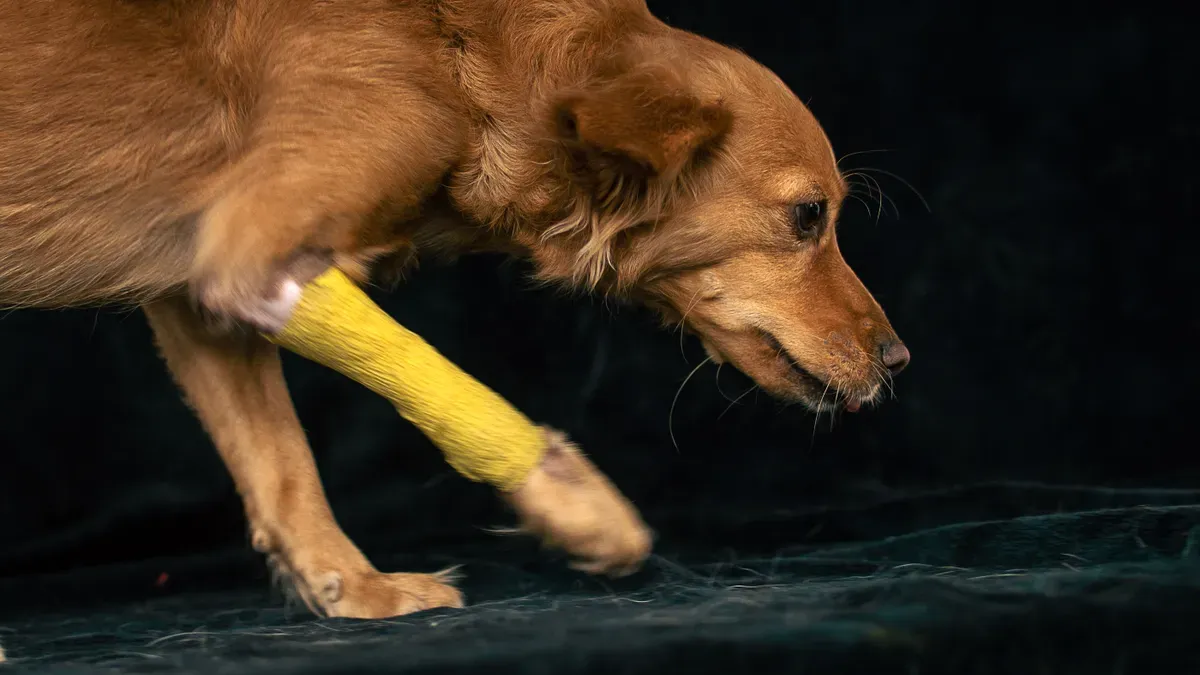
You can spot structural failure before the loop slides off. The signs appear early — sometimes within the first five steps.
Put the dog on a flat, non-slip surface. Center the toe loop around the two middle toes. Set light elastic tension — enough to support lift, not enough to pull toes sideways. Check that the hock or carpal anchor sits in its original position. Walk the dog 10 to 20 slow steps. Watch the cuff. Watch the strap angle. Watch the paw placement.
If the nails still scrape the ground, lift has already failed — regardless of whether the loop is still in place. Scraping with the loop on means the lift vector is too weak or pointed in the wrong direction.
If you can see the loop shift toward the nails by more than half an inch, the strap path has degraded. That half-inch migration will become a full slip-off within a few more steps.
If the cuff has visibly rotated — even a few degrees — the anchor has lost. Toe tension cannot work from a drifting origin point. The lift is already defeated, and the only question is how fast the loop follows.
Tip: Remove the brace immediately after the test. Redness across the toe webbing should fade within 20 to 30 minutes. Redness that persists or deepens signals compression injury — not a fit that needs more tension.
These checks are observable by anyone. You do not need to feel the tension or judge the fit by hand. You watch for three things: scrape, shift, rotation. None is subtle. All three point to the same root cause — an anchor that cannot hold its position under walking load.
Dogs that change gait to accommodate the brace — lifting the paw higher, crossing the legs, shortening stride — are compensating for the same failure. The brace is asking them to walk against a misaligned lift vector. Gait compensation is a pain-avoidance signal, not a training issue.
Elastic tension pulls the wrong way when the loop is off-center
The elastic strap produces lift along a single line. If the loop centers on the two middle toes, that line runs straight upward through the paw. If the loop shifts even slightly — toward the outer toes, toward the nail — the pull line tilts. A tilted pull line applies sideways force to the toe joint.
Sideways force does not lift. It torques. Torque on a toe joint that already drags creates pain without function. The dog feels the pull and fights it. The loop slides further. The cycle accelerates.
Toe shape and nail length influence this directly. Long nails push the loop forward. Wide or splayed toes let it slip sideways. A centered loop on one dog may not center the same way on another — even with the same brace model. The check is visual: is the strap pulling straight up, or is it pulling diagonally? Diagonal pull means the loop position or the anchor has shifted.
Toe-loop braces differ in how they manage this path. Some route the elastic through a guide channel that constrains the pull direction even if the anchor shifts slightly. Others rely entirely on anchor-cuff stability to maintain the vector. When the cuff design lacks that stability, even a centered loop drifts under load.
When a Toe-Loop Brace Is the Wrong Support Choice
If the dog cannot advance the limb — due to severe neurologic deficit, advanced degenerative myelopathy, or profound weakness — lifting the toes alone does not produce a functional step. The paw clears but the limb does not move forward. In that scenario, a toe-loop brace addresses the wrong part of the movement chain.
If the toes become cold, swollen, or develop open sores under the loop, tissue tolerance has been exceeded. Continued use risks skin breakdown and infection. Stop use immediately and consult a veterinarian.
Boot-style braces cover the paw and provide traction and toe protection without relying on elastic lift. They do not actively lift the toes — they shield them from abrasion and improve grip on smooth floors. A boot brace and a toe-loop brace solve different problems: one protects the paw on contact, the other pulls it up before contact. Using one when the other is needed produces failure that looks like a fit problem but is actually a type mismatch.
| Support type | What it does | Where it fails | Structural limitation |
|---|---|---|---|
| Toe-loop anti-knuckling brace | Lifts toes via upward elastic pull from leg anchor | Strap slips when anchor rotates; fails on dogs that cannot advance the limb | Lift depends entirely on anchor stability and centered loop path |
| Boot-style paw brace | Protects toes from abrasion; adds sole traction | Does not actively lift toes; relies on dog to place paw | No lift mechanism — paw still drags if neurologic deficit is severe |
| Traction aid or non-slip surface | Improves paw grip on smooth floors | No toe lift; no paw protection on rough surfaces | Does not address knuckling — only floor-induced slipping |
Disclaimer: This check assumes a short-coated dog where strap marks and cuff rotation are visible at a glance. Double-coated breeds may show subtler rub marks that need hand-checking rather than visual inspection — run your fingers under the cuff and along the toe webbing after each session. If the dog has angular limb deformities or a chest conformation far outside breed norms, the anchor positions described here may not land correctly on every dog. The fit checks still apply, but the reference points for cuff placement may differ.
Red marks that do not fade within 30 minutes, cold toes, swelling, or a worsening limp all signal the same thing: the brace in its current configuration is doing harm, not providing support. Remove it. Refitting may help if the problem is strap position or tension. If the problem is anchor stability or tissue intolerance, refitting will not be enough — the support type itself may need to change.
Knuckling itself has multiple possible causes, from disc disease to degenerative myelopathy to peripheral nerve injury. The underlying condition shapes which support mechanism can actually help. A brace that controls toe lift direction through a stable, wide anchor matters most when the dog still has some limb advancement — because then the lift is the missing piece. When limb advancement itself is lost, toe lift alone cannot produce a functional step.
FAQ
Why does the toe loop slide off even when the brace looks tight?
Because tightness and stability are separate properties. A strap can be tight circumferentially while the cuff that anchors it rotates freely. When the anchor rotates, the pull direction changes from upward to diagonal, and the loop slides toward the nails. The fix is anchor stability — a wider cuff with above-and-below-joint contact — not more strap tension.
How do I know whether the brace is actually lifting the toes?
Watch 10 to 20 slow steps on a flat surface. If the nails scrape, the lift is insufficient regardless of how the brace looks or feels. Also check the cuff position after walking: rotation of more than half an inch from its starting position means the anchor has shifted, and the lift vector has degraded. Nails not scraping plus cuff not rotating equals functioning lift.
Can I use the same brace on front and rear legs?
Front and rear legs have different joint angles, load paths, and rotation axes. A brace anchored at the carpus transfers force differently than one anchored at the hock. The strap geometry that works for a rear leg may not follow a straight lift path on a front leg. Separate sizing and independent fit checks for each limb are how you confirm the anchor stays stable on both.
What if my dog walks fine on carpet but drags on tile with the brace?
That pattern points to a traction problem, not a strap problem. On carpet, the paw grips and the cuff stays stable. On tile, the paw skids on contact, side-loading the cuff and triggering the rotation chain described above. A boot-style brace or traction aid addresses the surface interaction. Tightening the toe strap will not improve grip on smooth floors.
When should I stop using the brace and try something else?
Stop if redness across the toe webbing lasts beyond 30 minutes after removal, if the toes become cold or swollen, if open sores develop, or if the limp worsens despite adjustments. These are tissue-tolerance failures — not fit problems that more tension or repositioning can solve. A boot brace or lift support may be safer when the skin or circulation cannot tolerate sustained elastic contact.
