
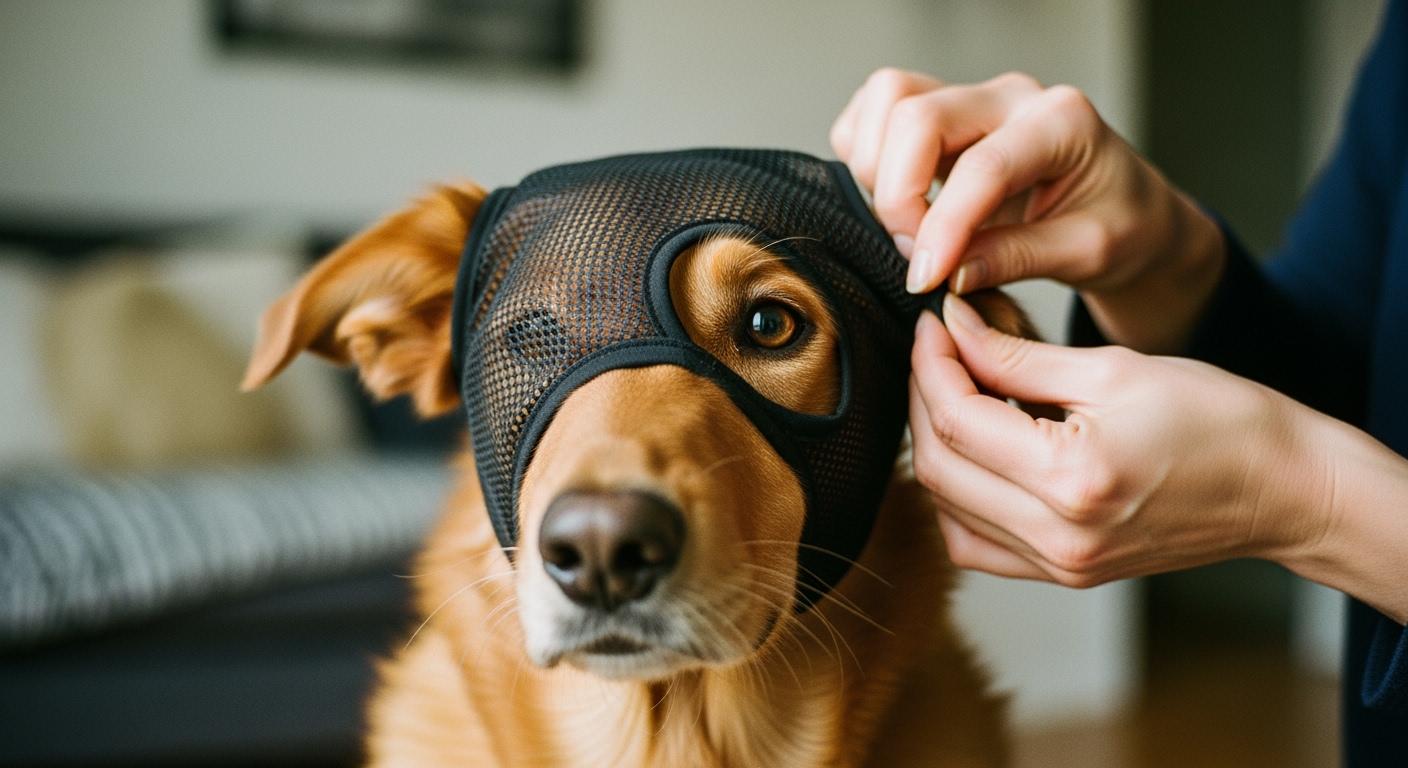
A dog freezes mid-stride on a familiar trail. No injury, no threat — just a mesh panel that drifted half an inch backward and erased the ground ahead. That is the moment a mesh head protector stops being protection and becomes the hazard. The mask covers eyes, ears, nose, and mouth against grass, insects, and debris. But coverage alone is not the measure that matters. What matters is whether the dog can see.
Most vision failures in mesh head protectors trace back to the same three structural gaps: the mesh-to-eye distance collapses, the front panel caves under sniffing pressure, or the neck fit cannot hold position through movement. Each of these is a design problem, not a sizing mistake.
Why a Mesh Head Protector Blocks Vision in the Field
A dog’s visual field spans roughly 240 to 270 degrees, with a narrow 30-to-60-degree binocular overlap directly ahead for depth perception. The mesh does not need to touch the cornea to disrupt this. It only needs to enter that forward overlap zone.
Here is the mechanical sequence. A flat mesh front sits millimeters from the eye. As the dog moves, the panel oscillates — head turns, sniffs, the neck band shifts. Each oscillation brings the mesh closer to the eye line. When the panel drifts into the binocular zone, the dog loses the visual reference that tells it where the ground is. Proprioception says forward is safe. Vision disagrees. The dog stops.
That stop is not stubbornness. It is a rational response to conflicting sensory input. The mask did not hurt. It did not press. It simply erased enough visual data to make forward movement unsafe.
| Field-use problem | Structural cause | What the dog does | Better design choice |
|---|---|---|---|
| Mesh blocks the eye line | Flat front lacks forward volume | Hesitates, bumps, freezes | Shaped front dome with eye clearance |
| Mask rotates to one side | Neck opening too wide, no grip structure | Paws at face, loses direction | Multi-point adjustable neck band |
| Front panel collapses during sniffing | Unreinforced mesh, no semi-rigid frame | Mesh folds into eye line mid-activity | Reinforced front edge or semi-structured dome |
| Mesh is too dark or dense | High thread-count mesh with low light transmission | Reduced visual comfort, hesitation in shade | Low-glare, open-weave mesh |
| Mask presses on the face | Front panel cut too shallow, no clearance volume | Blinking, pawing, stress signals | Volume-shaped front with eye and whisker clearance |
In practice: After 10 minutes of walking, lift the front edge of the mask and look at where the mesh sits relative to the eye. If the mesh is within one finger-width of the lashes at rest, it will enter the eye line during head-down sniffing — every time.
Structure and Material: What Causes Vision Failure
Three design choices determine whether a mesh head protector preserves vision or takes it away: the front panel geometry, the neck retention mechanism, and the mesh material itself. Each can fail independently. When two fail together — a flat front plus a loose neck, for instance — the dog is effectively blindfolded within minutes of active movement.
Front Panel Geometry and the Collapse Problem
Dogs lead with their faces. Sniffing means pushing the snout into grass, brush, and undergrowth. A fabric panel without structural reinforcement will deform under that pressure. The mesh folds inward. The eye clearance vanishes.
What prevents this is not thicker mesh. It is a shaped front volume — a dome or semi-rigid bridge that holds the mesh forward of the eyes under load. The difference is visible in how force transmits: in a flat panel, pressure at the nose tip translates directly into inward deflection at the eye zone. In a shaped front, the curvature redirects that force around the eye area, distributing it into the side panels and neck band instead.
The check is straightforward. Press gently on the nose area of the mask with two fingers while it is on the dog. Watch the eye zone. If the mesh moves inward toward the eye, the panel will collapse in the field. If the eye zone stays stable, the structure is doing its job. A closer look at how face protection designs handle this load path can be found in the structural breakdown of head cover fit and daily-use stability.
Neck Fit and Rotation
A loose neck opening does more than let the mask slide. It introduces rotation — the entire mask torques to one side when the dog shakes, turns, or moves through uneven terrain. Rotation is worse than sliding because it combines two failures: the mesh moves off-center and simultaneously pulls closer to one eye.
What stops rotation is not a tighter band — that creates pressure points — but a multi-point adjustment that distributes grip across the neck circumference. Size grading matters here because a single neck opening cannot fit a greyhound and a bulldog equally. The same fit principles that determine whether protective sleeves stay in place during movement apply here: coverage without migration depends on distributed tension, not constriction. Those mechanics are covered in the fit coverage analysis for protective dog sleeves.
Mesh Density and the Visibility Tradeoff
Dense mesh blocks more debris. It also blocks more light. A mesh with high thread count and dark pigmentation can reduce light transmission enough to impair vision in dappled shade — the exact condition found on most wooded trails. The dog hesitates not because it sees nothing, but because it cannot resolve contrast well enough to judge footing.
The observable check: put the mask on your own face in outdoor light. If you cannot read large print or distinguish a step edge through the mesh, the dog — whose visual acuity is lower than yours to begin with — is navigating by partial information. Low-glare, lighter-colored, open-weave mesh preserves more of the visual field without giving up meaningful debris protection for most trail conditions.
| Poor field-head-protector setup | Real failure in use | Better structure | Main limitation |
|---|---|---|---|
| Flat mesh front | Blocks eye line at rest and under load | Shaped forward dome with eye clearance | Adds slight bulk; may not suit flat-faced breeds |
| Loose neck opening | Mask rotates off-center during movement | Multi-point adjustable neck band with grip lining | Requires correct sizing per breed group |
| Dense dark mesh | Reduced vision in shade and low light | Low-glare open-weave mesh in neutral tones | Slightly larger aperture may pass fine seeds |
| Collapsing front panel | Mesh folds into eye line during sniffing | Semi-structured front with reinforced edge binding | Reinforcement adds cost; must not create pressure ridges |
| One-size fit | Poor adaptation across head shapes and muzzle lengths | Size-graded head, muzzle, and neck dimensions | Requires measurement; more SKU complexity |
Disclaimer: This inspection method assumes a short-coated dog. Double-coated breeds may show subtler rub marks under the mask that require hand-checking rather than visual inspection — run your fingers along the brow ridge, cheekbones, and behind the ears after each use. If the dog’s head conformation falls far outside typical breed proportions — particularly dogs with very short muzzles or extremely narrow skulls — the clearance checks described here may not catch every pressure point.
Post-walk inspection is not optional. After removing the mask, check the mesh for tears, trapped seeds, or moisture buildup. Run a hand over the dog’s brow, cheekbones, muzzle, and behind the ears. Redness or dampness under the mask is a fit failure signal — the mask is pressing, rubbing, or trapping heat. A quick post-use cleaning routine prevents debris accumulation that can scratch the cornea on the next wear. The same inspection and cleaning discipline used for recovery sleeves applies here.
When a Mesh Head Protector Is Not the Right Choice
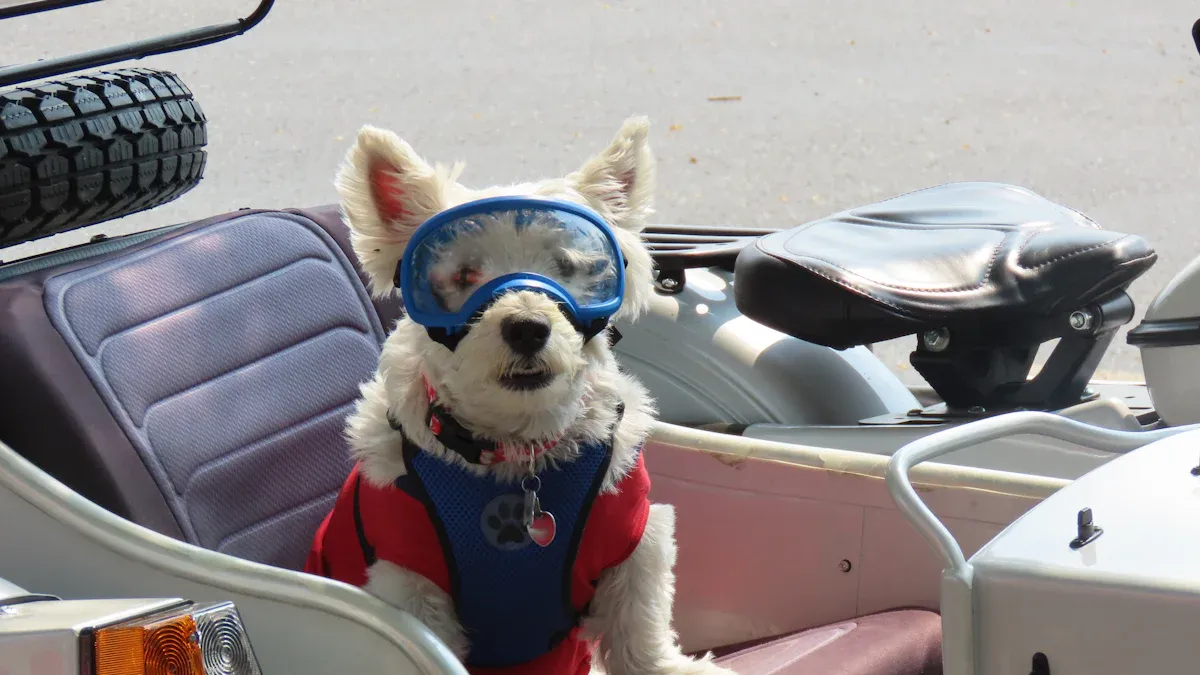
Some dogs cannot tolerate any facial obstruction, regardless of how well the mask is designed. The product’s boundary is real — pushing past it creates safety problems the mask was meant to prevent.
Dogs that panic, freeze, or thrash when the mask is introduced are not being difficult. They are signaling that the sensory disruption exceeds their tolerance threshold. Forcing continued wear risks self-trauma — the dog may claw at its own face, run into objects, or injure itself trying to remove the mask. Remove it. The decision to stop is not a failure of training. It is recognition that this product does not match this dog’s sensory profile.
Dogs with active eye irritation, nasal discharge, sneezing, or facial swelling after field exposure need assessment, not a mask. These symptoms can indicate foxtails, grass awns, or other embedded debris. Covering the face with mesh at that point traps the irritant and delays intervention. In these cases, alternative protective approaches — such as protective neck collars that block paw access without covering the face — may be worth considering. More detail on how protective solutions compare across wound and irritation scenarios is covered in the anti-lick and wound protection solutions overview.
Disclaimer: If the dog’s head shape or muzzle length falls far outside the breed standards this mask was patterned for — particularly in dogs with angular facial proportions, very flat faces, or extreme dolichocephalic profiles — standard fit checks may miss pressure points that only emerge after sustained wear. For these dogs, a protective collar or neck ring that blocks paw access without covering the face may be a more appropriate alternative in the protective product category.
Foxtails and grass awns can embed in the eyes, ears, nose, mouth, paws, and skin. If you notice persistent sneezing, eye squinting, head shaking, pawing at the face, or any swelling and discharge after field exposure, seek veterinary evaluation. A mesh head protector reduces debris exposure — it does not eliminate it. The mask is one layer of protection, not a guarantee. Understanding this boundary is what separates safe use from false confidence.
Choosing the right design means matching the mask’s structural features to the dog’s activity pattern and head shape. A closer look at how head cover designs differ across protection and recovery scenarios can help clarify which structural features matter for a given use case.
FAQ
How do you know if the mesh head protector fits your dog?
Check that the mesh sits at least one finger-width forward of the eyes at rest. The mask should not touch the lashes, eyelids, or whisker pads. Watch the dog move indoors for 10 minutes — hesitation, pawing, or freezing means the fit or structure is wrong.
Can a dog wear a mesh head protector for long walks?
Only if the structure holds position for the full duration. Test with a 15-minute walk, then inspect. If the mesh has shifted, the mask is not stable enough for longer sessions — the failure will compound with time.
What should you do if your dog keeps pawing at the mask?
Remove it immediately. Check for contact points on the face, especially around the eyes and muzzle. Pawing is almost always a fit or pressure signal — not a training issue.
Does the mesh block all foxtails and debris?
No. Mesh reduces the probability but cannot guarantee full blockage. Fine seeds and grass awns can still pass through or enter from gaps at the neck and sides. Post-walk face inspection is the only reliable check.
How often should you clean the mesh head protector?
After every outdoor session. Dried debris trapped in the mesh can scratch the cornea on re-wear. Mild soap and water, air-dried completely before the next use, prevents both irritation and material degradation.
