A rear lift harness does one thing mechanically: it shifts your lifting force to the back half of the dog. That works. Until it does not. The problem is not the harness. The problem is what happens at the front end when the rear goes up.
Lift the rear and the front legs inherit more body weight. They have to brake. They have to steer. If those front legs are already weak, the dog cannot manage the load transfer. The front end sinks. The harness starts to rotate. The belly panel sags. The dog freezes or takes short, choppy steps. You pull harder to compensate, and the harder you pull, the more unstable the dog becomes.
This is the support limit. Knowing where it sits and what design features push it further out is the difference between a harness that helps and one that creates new problems on every walk.
Where the Support Limit Actually Breaks Down
Rear-only lift seems straightforward. But the physics turn against the dog fast once the front legs are marginal.
A rear harness anchors lifting force behind the center of mass. When you pull upward, the dog’s body rotates around the lift point. The front half dips. The front legs — which should be doing maybe 60% of the weight-bearing work on level ground — suddenly get asked to do more. If they are not strong enough, the dog compensates. Stride shortens. The shoulders lock. The head tosses. And the handler, seeing the dog struggle, often pulls harder.
That makes it worse. More upward force at the rear means more downward force at the front. The harness straps, already under asymmetric tension, start to creep. A narrow belly panel, common on rear-only designs, has almost no surface area to resist lateral shift. The edge of the strap digs in, the panel rolls, and the harness drifts off-center. Once the harness rotates even a few degrees, the lift vector is no longer straight up — it pulls the dog sideways as well. Stability degrades quickly from there.
This is not a fitness problem. It is a load-path problem. The force goes where the harness sends it, and a rear-only harness sends it forward onto the legs least able to take it.
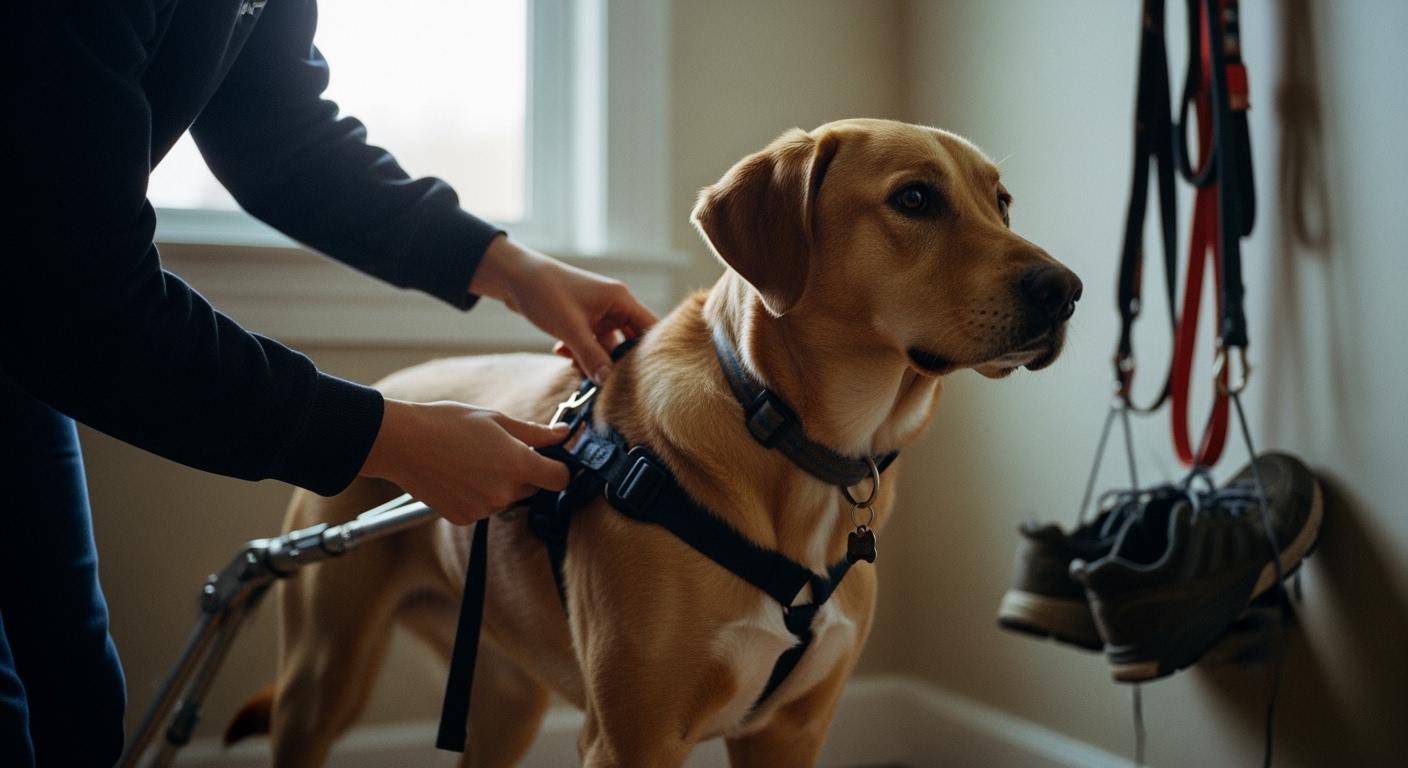
You can verify this in real time. Walk your dog 10 assisted steps on a level floor with the rear harness. Stop. Look at the harness from the side. If it has drifted more than half an inch forward from its starting position on the dog’s back, the load path is already compromised. Check the shoulders — if they are visibly lower than they were at step one, the front legs are losing the fight against the transferred weight.
The Design Details That Make Rear-Only Support Fail
Chest panel width. A narrow chest strap sits like a rope across the sternum. Under forward load shift, it concentrates pressure on a thin band of tissue. The dog tenses against it, which shortens stride and stiffens the shoulders. A wide chest panel spreads the same force across several square inches. The dog does not reflexively brace against it. This matters because bracing — the dog stiffening its front end in response to concentrated pressure — is often the first thing a handler misreads as “the dog just does not want to walk.” The dog wants to walk. The strap is hurting it.
Belly panel surface area. Narrow belly slings — maybe two or three inches wide — are designed for quick spot lifts. Put one under a dog that needs sustained support and the panel rolls. Under tension, the edges curl inward, the contact patch shrinks to maybe half its original width, and the harness rotates. A wide belly panel resists this because it has enough lateral surface area that the tension vector cannot easily flip the edge. The difference between rear-only and full-body support is visible right here: full-body designs include belly panels that are four to six inches wide with internal stiffening layers that prevent roll-up during sustained use.
Strap configuration. Rear-only harnesses typically have two or three adjustment points. That is not enough when both the chest and belly need to stay indexed to the dog’s body under dynamic load. A harness with adjustable chest, abdomen, and rear straps — often six to eight adjustment points in total — lets you tension each zone independently. The chest stays put while the belly panel is tightened separately. This stops the most common failure cascade: loose chest → harness slides forward → belly panel tilts → rotation starts → support fails.
After 10 assisted steps, slide two fingers under the chest strap at the sternum. If the gap is larger than it was at the start, the strap has loosened under load. That is the first domino.
| Support setup | Works when | Failure sign | Better structure | Main limitation |
|---|---|---|---|---|
| Rear-support harness | Rear legs weak, front legs strong | Shoulders sink, dog tips forward | Wider chest panel, stable belly support | Front-leg weakness defeats the lift |
| Full-body lift harness | Front and rear legs both need support | Wobbling, rotation if poorly fitted | Front and rear handles, full chest and belly panels | More straps to adjust and check daily |
| Narrow belly sling | Brief spot lift only | Belly panel sags, harness rotates under load | Wide belly panel with internal stiffening | No front-end control, rolls under sustained use |
| Wide belly panel with chest support | Stability needed at both ends | Less tipping, load spread evenly | Anti-slip lining, padded contact edges | Bulkier fit on very small breeds |
The harness type has to match where the dog’s strength actually is. A full-body lift harness with integrated chest and belly panels distributes the lifting force across a much wider contact area. That is not a minor detail — it is the structural difference between a harness that stays indexed to the dog’s body and one that gradually slips out of position over the course of a walk.
| Signal level | What the handler sees | Action |
|---|---|---|
| Green | Front paws place normally, dog stays level, harness does not shift, walk is controlled | Continue use, check fit each session |
| Yellow | Mild shoulder dip, slight wobble, handler slows down, straps need re-tightening | Recheck all adjustment points, monitor through the walk |
| Red | Front legs buckle, dog tips forward, paws scrape or cross, dog freezes, harness twists off-center, pain signals appear | Stop, remove harness, and consult a veterinarian |
Getting the fit right across all three support zones — chest, belly, and rear — is what determines whether the harness stays put session after session or starts drifting within the first few minutes.
Where Rear Support Still Works vs. Where You Need to Switch
Rear-only support has a real place. It is the right tool when the back legs are the problem and the front legs are still strong enough to carry, brake, and steer without assistance. If the dog passes the 10-step check — shoulders stay level, harness does not drift, stride stays normal — rear support is enough. Keep using it. Check before every walk, because front-leg strength can change.
But when the front end dips, even slightly, the support equation flips. At that point, a harness with front and rear handles becomes necessary. The reason is mechanical, not preferential: two lift points let you balance the force. You can lift the rear while supporting the front enough to keep the dog’s spine level. This changes how the dog moves through stairs, car transfers, and bathroom breaks.
Balancing lift between the front and rear handles keeps the dog level rather than tipped. During stairs, the front handle provides braking control that a rear-only harness simply does not have. During car transfers, a sling without chest support concentrates force at a single point under the belly, which can cause the dog to curl or twist mid-lift — exactly when you need the most control.
Disclaimer: The fit checks described here assume a dog with typical chest and shoulder proportions. Deep-chested breeds such as Greyhounds or Dobermans, and dogs with angular limb deformities or very narrow builds, may show subtler pressure patterns. On these dogs, a hand-check along the chest strap and belly panel edges after 10 steps is more reliable than visual inspection alone — pressure marks can develop under the fur where the eye cannot see them.
A full-body lift harness solution for dogs that need support at both ends is not about “upgrading” — it is about matching the hardware to where the dog’s weight-bearing capability actually sits. If the front legs cannot do their half of the work, no amount of rear lift force fixes that gap.
Design features that change real-world performance
- Wider chest panel — spreads load across the sternum instead of concentrating it on a narrow band
- Stable belly support — wide panel with internal stiffening that resists edge roll under tension
- Front and rear handles — independent lift control so the handler can balance force between both ends
- Adjustable chest, abdomen, and rear straps — each zone tensioned separately so loosening in one does not cascade
- Anti-slip lining — keeps the harness indexed to the dog’s body during sustained movement
- Padded armpit and belly edges — reduces friction at the highest-movement contact points
- Clear size chart with girth and length measurements — because breed labels alone do not predict fit
- Quick-release buckles — faster on/off reduces handling stress during multiple daily sessions
- Washable or wipe-clean outer material — dried saliva, dirt, and skin oil degrade strap grip over time
- Guidance on rear-only vs. full-body support limits — so the handler can recognize when the support type no longer matches the dog’s condition
FAQ
How do I know if my dog needs a full-body harness instead of rear-only support?
Run the 10-step observation. If the front shoulders drop, the dog takes shorter steps, or the harness drifts more than half an inch after 10 assisted steps on a level floor, the front legs are not managing the load transfer. A full-body harness with front and rear handles gives you independent lift control at both ends.
What is the first sign that a rear harness has reached its support limit?
Shoulder drop. Before the dog tips, before the harness rotates, the shoulders sink. The front end lowers relative to the rear within the first few steps of assisted movement. If you see this, the harness is sending more weight forward than the front legs can carry.
Can I use a rear-support harness for stairs and car transfers?
Only if the dog’s front legs are strong enough to brake and steer without help. Stairs demand more front-end control than level walking — the dog has to lower and raise the front end step by step. If you see any hesitation, paw scraping, or the dog trying to skip steps, the setup is not safe for that task.
Why does a narrow belly panel cause rotation?
A narrow panel has a small contact patch. Under tension, the edges curl inward and the effective width shrinks further. The panel becomes a rounded pressure line rather than a flat support surface. At that point, any lateral force — a slight wobble, a change in direction — rolls the panel to one side, and the harness follows.
What features actually keep a harness from sliding during daily use?
Three things working together: anti-slip lining on the inner contact surfaces, independent strap adjustment at the chest, belly, and rear zones, and a chest panel wide enough to resist lateral shift. If any one of these three is missing, the harness will tend to drift over the course of a walk — the question is how soon, not whether.