
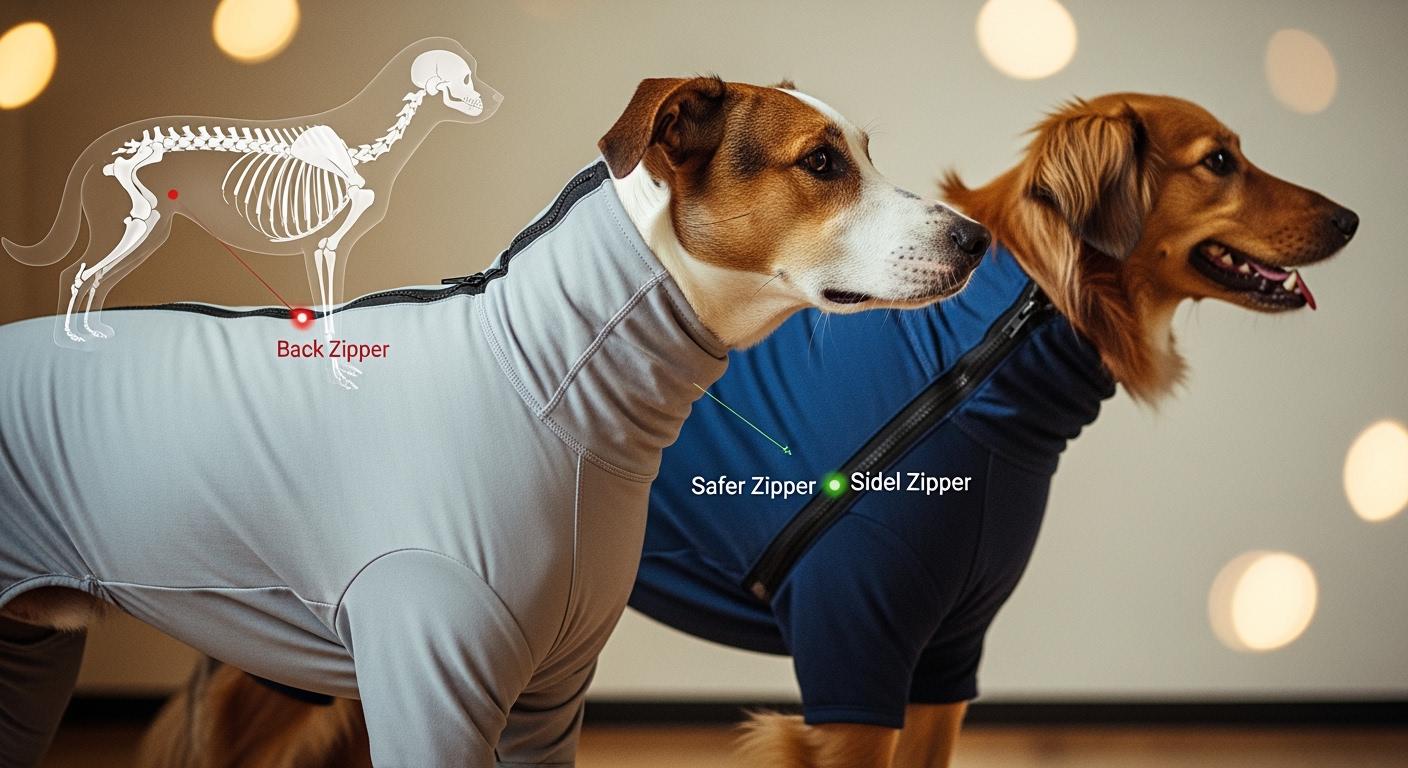
A dog stands calmly in a recovery suit after surgery. The suit covers the wound. It looks secure. Then the dog lies down, curls into a resting position, and the back zipper drives into the spine. This is not a comfort complaint. It is a structural failure that turns a wound-protection garment into a pressure injury risk.
The problem is straightforward. Fabric stretches. Zipper teeth do not. Run a hand along a center-back zipper path and you will feel raised teeth, a rigid pull tab, and thickened seam tape. Those elements form a non-compliant ridge directly over the vertebral column. When the dog stands upright, the suit hangs with light contact. When the dog curls, sits, or lies down, the dorsal contour shortens, the fabric tightens, and the zipper track becomes a linear pressure concentrator against bone.
This is the core failure worth understanding before a suit stays on for hours. The same mechanism plays out differently across recovery garment designs for small, short-coated, and fine-boned breeds, where there is simply less soft tissue between hardware and vertebra. Short-coated and hairless dogs lack the fur buffer that absorbs some of that contact in double-coated breeds. Slim-bodied dogs with prominent spinous processes feel each tooth.
Why a Back Zipper Concentrates Pressure Instead of Distributing It
The failure starts with material mismatch. A recovery suit body is typically knit or woven fabric with some degree of mechanical give—it elongates under tension and recovers when tension releases. A zipper chain, by design, does not. The interlocking teeth create a fixed-length column. When a dog transitions from standing to curled, the dorsal fabric panel lengthens by roughly 15–25% along the backline. The zipper cannot follow. Instead, the surrounding fabric stretches around it, and the zipper becomes the only non-yielding element in the load path.
That means every newton of tension in the suit body funnels into a narrow, hard line. On a standing dog, zipper contact pressure might be negligible. On a curled dog, it concentrates into a stripe roughly the width of the zipper chain—typically 6–10 mm. That is narrow enough to occlude capillary blood flow in superficial tissue under sustained load. The skin signals this within the first hour.
Run your hand flat along the inside of the suit after removing it at the 30-minute mark. The pass signal: the inner fabric feels uniformly warm but not hot, and the dog’s skin shows no linear indentation. The fail signal: a palpable temperature difference along the zipper track—hotter directly under the teeth line—and a visible ridge or line on the skin that takes more than two minutes to fade. That is sustained contact pressure, not momentary contact.
Metal zippers compound this. They are heavier, stiffer, and conduct ambient temperature. On a small or fine-boned dog, a metal zipper adds a thermal sink and a hard mass that swings with movement. Plastic coil zippers reduce weight but do not eliminate the pressure-concentration mechanism—they still form a non-stretch column inside a stretch garment. The variable that actually matters is closure placement, not tooth material.
Fit Variables That Turn Mild Contact Into Pain
A suit that passes a standing fit check can fail in motion. Four-leg recovery suits add a specific risk: if the torso panel length is too short for the dog’s back, every forward step pulls the rear leg openings backward. That backward traction tightens the dorsal fabric, pulls the zipper track taut, and increases contact pressure with each stride.
Dogs with long backs, deep chests, narrow waists, or senior dogs with reduced muscle padding over the spine amplify this effect. The geometry works like this: a deep chest pushes the suit forward ventrally. A short torso panel resists. The zipper—the stiffest element in the system—absorbs the resulting shear as compression against the dorsal midline. The dog feels this as a tightening band that bites hardest during sitting and curling, precisely when the garment should be most passive.
A 10-to-20-step walk test reveals what a static check misses. Let the dog move freely indoors. Watch the suit’s hindquarters. If the fabric creeps backward, if the zipper line shifts from midline to one side, or if the dog hesitates, freezes, or repeatedly turns to mouth at the back, the suit is generating enough discomfort to override normal behavior. That is a structural fail, not a training issue.
Check the skin after 30–60 minutes of supervised wear. Remove the suit and look along the zipper track under natural light. Pass: skin is even-toned, dry, and warm but not hot. Fail: a visible ridge line, localized redness, dampness from trapped sweat, or a heat differential you can feel with the back of your fingers. These signs appear before skin breakdown and are reversible if caught early. They also correlate with what a post-surgical wound check routine should flag—pressure irritation near an incision line is a compounding risk, not a separate concern.
| Failure sign | Likely cause | Coverage risk | Better design choice |
|---|---|---|---|
| Zipper line on the back | Rigid zipper over spine | Pressure injury, skin damage | Off-spine closure, soft inner flap |
| Dog arches or freezes | Zipper discomfort | Suit rejection, wound access | Stretch fabric, flat seams |
| Red skin under zipper | Rubbing, heat, moisture | Infection risk, pain | Covered zipper garage |
| Pull tab presses near shoulders | Thick hardware placement | Movement restriction | Low-profile zipper, soft tab |
| Suit rides backward when dog walks | Short torso length | Wound exposure, tightness | Adjustable torso length |
| Fabric tightens when dog curls | Poor fit, rigid closure | Increased pressure, escape | Four-leg coverage with stretch |
Closure and Coverage Designs That Reduce Spine Pressure

A center-back zipper is the default because it is the cheapest closure path to sew in production. It aligns with the garment center seam, requires no pattern offset, and minimizes fabric waste during cutting. Those are manufacturing advantages. They are not performance advantages for the dog wearing the suit.
Off-spine closure reroutes the zipper to one side of the dorsal midline—usually along the flank or lateral ribcage. This shifts the non-stretch column off the vertebral ridge and onto a surface with more soft-tissue coverage. The zipper still does not stretch, but the anatomy underneath it has more give. A side zipper also avoids the pull-tab landing zone near the shoulder blades, where a hard tab can restrict scapular movement during walking.
A zipper garage—a fabric pocket that houses the pull tab at the top of the closure—eliminates the single hardest point of contact. Without a garage, the pull tab sits exposed against the neck or upper back. Every time the dog lowers its head, that tab digs in. The garage tucks it away behind a soft fabric shield, removing the point load entirely.
A soft inner flap, sometimes called a zipper guard or placket, runs the full length of the closure on the inside of the suit. It is a strip of fabric—ideally the same face material as the suit body or a lighter liner knit—that sits between the zipper teeth and the skin. To check whether a flap does its job, unzip the suit halfway and fold the flap back. If the fabric is thin enough to see the zipper teeth through it, it is a cosmetic feature. A functional flap is thick enough that you cannot count the teeth by feel through it. This is what recovery suits built for post-surgical daily wear depend on—the barrier between hardware and healing skin determines whether the suit stays on or gets rejected.
Flat seams matter more on the inside than the outside. A conventional overlock seam leaves a raised ridge on the interior face. When that ridge aligns with the zipper path, it doubles the pressure concentration. Flatlock or flat-seam construction lays the seam allowance flat against the fabric body, eliminating the interior ridge. Run your fingers along the inside of a suit with flat seams and you should feel near-continuous surface, not a speed bump every few inches.
| Design feature | What can go wrong | Better structure | Performance difference |
|---|---|---|---|
| Center-back zipper | Direct spine pressure | Off-spine zipper | Moves closure away from vertebral ridge |
| Off-spine zipper | May still rub if unpadded | Covered zipper flap | Adds continuous soft barrier |
| Covered zipper flap | Can bunch if not flat-sewn | Flat seam construction | Eliminates interior ridge contact |
| Flat seam construction | May limit stretch recovery | Stretch recovery fabric | Allows dorsal elongation without binding |
| Stretch recovery fabric | Can lose shape if low-grade | Adjustable torso length | Prevents backward pull in motion |
| Adjustable torso length | May slip if unsecured | Four-leg sleeve coverage | Distributes tension across limbs |
| Four-leg sleeve coverage | Can tighten zipper if too short | Correct torso length + stretch | Prevents zipper-track tension buildup |
When a Recovery Suit Is the Wrong Choice
A recovery suit is a physical barrier. It stops the dog’s mouth from reaching a wound or incision. It does not stabilize a joint. It does not manage swelling. It does not prevent a determined dog from licking through the fabric. Recognizing the boundaries of what the product does prevents using it in scenarios where it will fail.
Scenarios where a recovery suit tends to underperform:
- The wound location sits directly under the zipper path. No amount of padding fixes this—the closure is applying pressure to the very tissue that needs to heal.
- The dog is a persistent chewer. Saliva-soaked fabric against an incision site creates a maceration risk that an anti-lick sleeve or rigid barrier collar may handle more safely.
- The dog’s body shape falls far outside standard size grading: extremely deep chest, very short back, or angular limb deformities that shift how the torso panel sits.
- The suit cannot be removed and inspected at least twice daily. Unchecked wear is the fastest path from minor irritation to wound complication.
When a suit fails the 30–60 minute skin check or triggers freezing, arching, or escape behavior, the correct response is to switch protection methods, not to modify the suit. Adding padding under a zipper that already presses into the spine increases contact pressure—it adds volume inside a fixed-volume garment, which tightens the fit further.
Disclaimer: The fit checks described here assume a dog with a short, smooth coat and a body conformation within typical breed standards. Double-coated breeds may show subtler skin marks that require hand-checking rather than visual inspection alone. Dogs with angular limb deformities, very deep chests, or pronounced spinal curvature may distribute suit tension differently, and the pass/fail signals described here may not catch every pressure point in those conformations.
In practice: If swelling, discharge, foul odor, bleeding, wound opening, worsening redness, or repeated chewing at the suit occurs, stop adjusting the suit at home and contact a veterinarian. These are not fit issues—they are wound complications that a garment cannot resolve.
A recovery garment guide focused on fit and daily wear can clarify when a sleeve, a suit, or a rigid collar is the appropriate tool for the specific wound location and dog behavior profile. The right choice is the one that protects the wound without creating a new problem at the closure line. If the closure itself becomes the injury source, the suit has reversed its purpose.
For product teams and retailers evaluating recovery suit inventory, the same principles apply at scale: off-spine zipper placement, functional inner flaps, flat interior seams, and adjustable torso length are the structural differentiators that determine whether a suit stays on a dog or gets returned. The cost difference between a center-back zipper and an off-spine closure is measurable in production. The cost of a suit that causes pressure injury is measured in returns, reviews, and lost trust. Recovery and anti-lick products succeed or fail on exactly this tension—protection that does not create a secondary problem.
FAQ
How do you check whether a recovery suit zipper is pressing into the spine?
Remove the suit after 30–60 minutes of supervised wear. Run the back of your fingers along the skin where the zipper sat. A hot stripe or a visible ridge that takes more than two minutes to fade is a fail. Dry, even-toned skin with no temperature differential is a pass. Do this check before the first extended wear session, not after problems appear.
Does an off-spine zipper eliminate all pressure risk?
It reduces the most dangerous failure mode—direct compression over the vertebral column—but does not eliminate pressure entirely. An off-spine zipper still forms a non-stretch column. The difference is that it sits over ribcage and flank tissue, which has more compliance than bone. The inner flap quality and seam flatness still determine whether the dog tolerates the suit for hours.
Can a suit that passes a standing fit check still fail in use?
Yes. Standing fit tells you almost nothing about dynamic fit. A suit looks correct on a stationary dog. The same suit can pull tight across the shoulders during sitting, bunch behind the elbows during lying down, or ride backward during walking. The 10–20 step movement test plus the curling and potty-posture checks are the minimum for evaluating whether a suit will work in real use.
When should a recovery suit be abandoned for a different method?
Abandon the suit if the dog consistently arches, freezes, or refuses to settle while wearing it; if skin lines, heat, or redness appear under the zipper after supervised wear; if the dog can reach the wound through or around the suit; or if the wound location sits directly under the closure path. In any of these cases, an e-collar, sleeve, or bandage approach may protect the wound without creating a pressure problem.
