
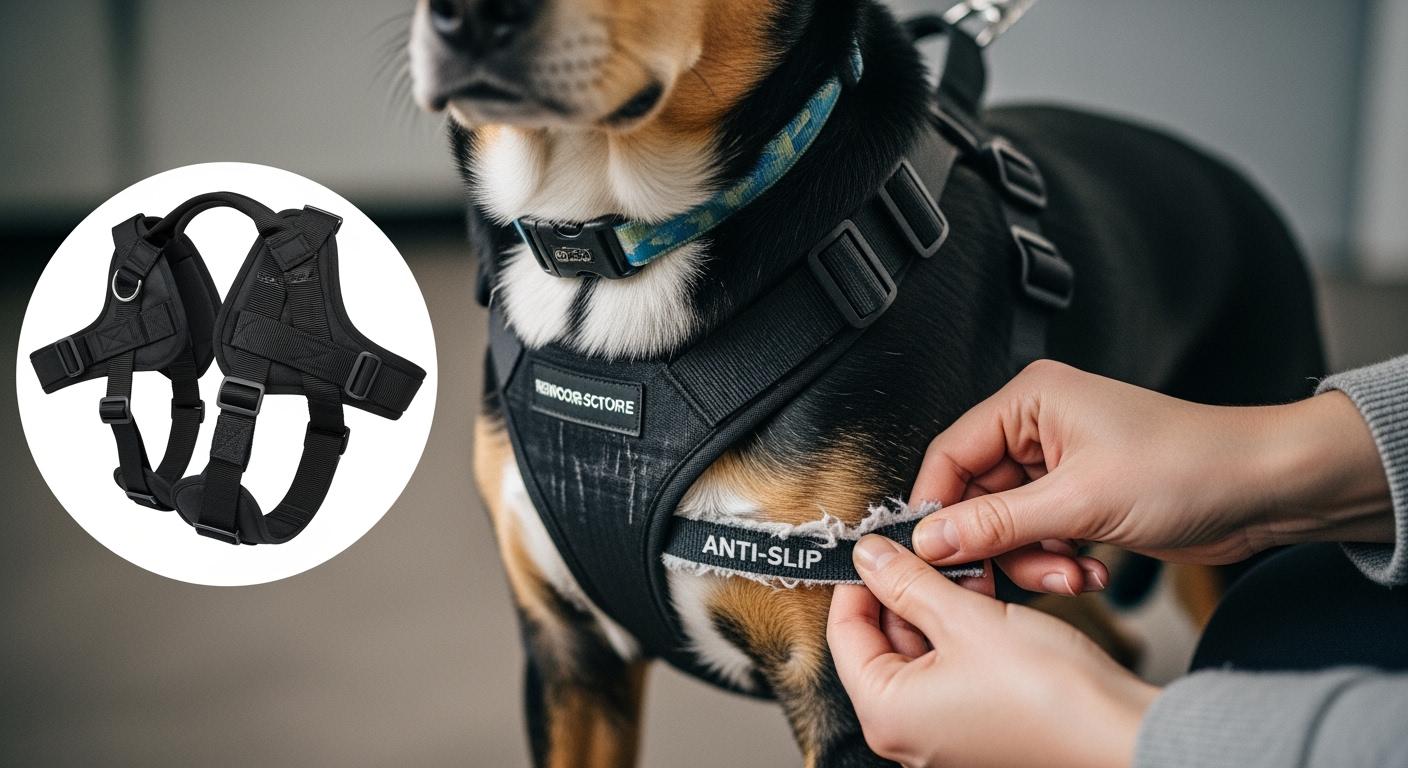
A dog lift harness that worked for weeks suddenly slides forward mid-lift. The rear drops. The dog twists. Red marks bloom under the belly. Same harness, same dog, same routine. The straps have not loosened. The problem is not sizing. The anti-slip lining has worn out, and grip is gone.
A six-point inspection catches the failure before it causes harm:
- Lay the harness flat. Check whether the inner lining is smooth, curled, pilled, greasy, torn, or detached.
- Press the padding for three seconds. Does it spring back or stay indented?
- Inspect load zones: belly, hips, groin, chest, armpits.
- Place the harness on the dog. Apply light support only.
- Watch the rear. Does it rise evenly or slide forward?
- Stop use if slipping, rubbing, or pressure marks repeat after strap adjustment.
Note: Tightening straps harder does not restore a worn lining. It redirects force onto fewer square inches and creates new pressure points. Repeated sliding after adjustment means the lining has structurally failed.
| What you see | What it means | Why support fails | Better design response |
|---|---|---|---|
| Slick inner surface | Grip loss | Dog slides, rotates | Controlled-grip lining |
| Flattened padding | Pressure spots | Red marks, discomfort | Resilient padding |
| Curled edge | Skin rubbing | Fur catches, skin irritation | Smooth, stable edges |
| Loose stitching | Uneven force | Load not spread evenly | Reinforced stitching |
| Odor or residue | Hygiene issue | Lining stays dirty | Easy-clean inner surface |
| One-side wear | Balance shift | Dog hangs unevenly | Wide, balanced panels |
Why Anti-Slip Lining Wear-Out Destroys Load Transfer
A lift harness works because the inner lining grips the coat and spreads force across wide panels. That grip is not decorative. It is the difference between a balanced lift and a harness that becomes a sling concentrating force on soft tissue.
When the lining is intact, friction between the inner surface and the coat keeps the harness centered. Lifting force enters through the handles, travels through the shell, and exits across a broad contact patch. The dog rises evenly. Load distributes across the chest, belly, and hip panels. Nothing shifts.
When the lining wears slick, that chain breaks. Friction drops. The harness no longer holds its position under tension. As the handler lifts, the rear panel slides forward toward the groin. The support angle changes. Force that was spread across six or eight inches of panel now concentrates on a two-inch strip of compressed fabric. The dog feels this as a pinch or a pull and compensates by twisting, leaning, or fighting the lift. That is not a behavioral problem. That is a load-transfer failure.
The failure sequence has a clear causal chain: lining compression reduces surface friction → the harness shifts under load → the contact patch narrows → pressure per square inch spikes → soft tissue bears concentrated force → the dog rotates or resists. Each step amplifies the next. By the time red marks appear, the lining passed the point of functional grip several lifting sessions earlier.
An observable check after a ten-minute supported walk tells you whether grip is still intact. Mark the harness edge against the coat with a finger. Walk the dog with light support. Check whether the harness edge has shifted more than half an inch forward. If it has, the lining is no longer holding position under load. Strap tightening will not reverse this. The surface itself has degraded.
What Makes the Lining Fail — Material Fatigue and Structural Causes
Four mechanisms drive lining wear-out. They operate at different speeds but converge on the same endpoint: a slick surface that cannot transfer load.
Repeated compression kills padding rebound
Every lift cycle applies direct pressure to the same contact zones. Over weeks, the open-cell or foam structure inside the padding collapses. The material stops springing back. A simple press test exposes this: push a thumb into the belly panel for three seconds. If the indentation lingers, the padding has lost its elastic recovery. A harness with permanently compressed padding cannot grip because the lining no longer presses evenly against the coat. Contact becomes patchy. Grip becomes unpredictable.
This failure accelerates with heavier dogs and frequent multi-lift days. The same rear harness that holds shape through two lifts a day for a thirty-pound dog may compress within weeks under a seventy-pound dog lifted six times daily. The math is simple: more cycles × higher load = faster padding collapse. A rear lift harness with concentrated hip-zone pressure tends to show this failure earlier than designs that distribute load across multiple panels.
Dirt, oil, and moisture coat the grip surface
Skin oils, road dust, and ambient moisture build a film on the lining over time. This film fills the micro-texture that creates friction against the coat. The surface becomes glazed. Washing removes the film, but each wash cycle also degrades the grip coating at a molecular level — the polymers that create tackiness break down under detergent and mechanical agitation. The lining emerges clean but incrementally slicker. After enough cycles, it is clean and useless.
An observable check: run a dry finger across the lining. It should drag, not glide. If the surface feels smooth like a rain shell rather than textured like athletic grip tape, the friction layer is gone. No amount of drying or airing out restores it.
Narrow panels concentrate wear into a small zone
A harness built with two-inch webbing strips instead of five-inch panels puts the entire lift force through a narrow contact band. The lining in that band wears faster because every pound of dog weight lands on fewer square inches of material. The wear pattern is visible: a single slick stripe running along the inner edge of each strap, while adjacent areas remain textured. That stripe is a hot spot. It is where the harness slid, rubbed, and lost grip first.
Wide panels distribute force and slow lining wear because the load spreads across more surface area. The same total force divided by more square inches means lower pressure at any single point. Lower pressure means slower compression, slower surface degradation, and more lifting cycles before grip fades. Choosing a dog lift harness with wide, multi-panel load distribution changes the wear timeline significantly.
Stitching failure lets the inner layer migrate
Even when the outer shell looks intact, failed stitching between the lining and padding lets the inner layer slide, bunch, or curl independently of the harness body. The lining no longer stays flat against the coat. It wrinkles under tension. The wrinkles become pressure ridges. The ridges create concentrated force lines that show up as linear red marks on the skin.
This failure is structural, not cosmetic. A stitch line that separates by even a quarter-inch creates a pocket where the lining can fold. Once folded, the effective contact surface halves. The dog feels the fold as an edge digging in. The handler feels the dog resisting. The harness looks fine from the outside. The failure is invisible until the harness is laid flat and inspected seam by seam.
| Harness type | Where lining wears first | What failure looks like | Better structure |
|---|---|---|---|
| Rear harness | Groin, hip zone | Slides forward, uneven hip lift | Wide panels, stable lining, multi-point |
| Full-body | Chest, belly, rear | Rotates, hangs to one side, imbalance | Balanced handles, resilient padding |
| Level | What you see | Action needed |
|---|---|---|
| Green | Lining grips, padding rebounds, dog rises level | Safe to use |
| Yellow | Minor sliding, light rubbing, lining feels slick | Monitor, check after each use |
| Red | Repeated sliding, pressure marks, loose stitching | Replace or reassess harness |
When a Lift Harness Is No Longer the Right Tool
A worn lining is one failure mode. A harness that was the wrong structural choice from the start is another. Distinguishing between them determines whether the fix is replacement or a different harness type entirely.
When strap adjustment does nothing
If the harness still slides after adjusting every available strap point, the issue is structural, not tension-related. The harness geometry does not match the dog’s proportions. Some designs adjust only around the chest, leaving the neck opening fixed. On a narrow-shouldered breed, that fixed neck gap lets the harness rotate. On a deep-chested breed, the chest strap sits too high and the belly panel drifts rearward under load.
Adjustment cannot fix a shape mismatch. It cannot fix a lining that has lost all surface friction. When sliding persists through multiple adjustment attempts, the harness has reached its functional limit for that dog’s build and that household’s lifting frequency. A lift harness fit evaluation across contact points reveals whether the issue is geometry, lining, or both.
When rear-only support is not enough
A rear harness works when the dog retains some front-leg strength and only needs hind-end assistance. It fails when the dog’s condition progresses and front-end compensation maxes out. Signs that rear support alone is insufficient: the dog’s front legs splay wider with each lift, the chest drops during stair climbs, the handler must pull harder on the rear handle to keep the dog level. These are not lining problems. They are support-coverage problems.
For dogs with bilateral hind-leg weakness or post-surgical restrictions on both rear limbs, a harness with only rear lift points asks the front end to carry more than it can. A full-body lift harness with front and rear balance distributes the dog’s weight across four contact zones instead of two. The lining still matters. But the structural question — rear-only versus full-body — determines whether the harness can support the dog at all, regardless of lining condition.
When pressure marks are not a lining problem
Not every red mark means the lining failed. Marks that appear in the exact same pattern every session, even with a harness that passes the press test and drag test, suggest a design issue: the panel shape does not match the dog’s anatomy at that contact point. The harness might have the right lining and the right padding but the wrong cut for a dog with a pronounced tuck-up, a barrel chest, or angular hind-limb confirmation.
Disclaimer: The pass/fail checks described here assume a short-coated dog where skin marks are visible. Double-coated breeds may develop pressure points under the fur that require hand-checking rather than visual inspection — run fingers slowly under the harness contact zones after each session and feel for warmth, swelling, or sensitivity. If the dog’s leg confirmation falls outside breed norms — particularly dogs with angular limb deformities or very deep chests — the fit checks may not catch every pressure point.
In these cases, the issue is not lining wear-out. The issue is that the panel geometry does not match the dog. A different harness design — one with longer belly coverage, a deeper chest cut, or adjustable panel angles — may resolve what a lining replacement cannot. The decision path matters: fix the lining when the lining failed, switch between rear lift and full-body harness types when the support coverage is wrong, and reassess fit when pressure marks persist through both.
When a full-body harness is the safer path
Several conditions push the decision toward full-body support regardless of lining quality. Post-surgical recovery after hip, knee, or spinal procedures requires weight distribution across both ends to avoid loading the surgical site. Senior dogs with generalized weakness need multi-point support because their compensation reserves are thin — when one limb fatigues, the harness must catch the shift instantly. Large breeds put more absolute force through any given panel, making wide distribution a structural requirement, not a preference.
The lining still determines how well that full-body harness actually performs. A full-body harness with worn lining on the chest panel but intact lining on the rear panel creates an asymmetry: the rear grips, the front slides, the dog tilts forward, and the handler fights to keep the dog level. Full-body coverage is not a substitute for lining integrity. It is a complement. Both must hold for the lift to stay balanced.
Before every session, run the press test and drag test on each panel independently. A harness that passes on three panels and fails on the fourth is not safe to use. The failure will pull the dog toward the slick zone, and the handler will unconsciously compensate by pulling harder on the opposite handle. That compensation creates the very twisting and pressure concentration the full-body design is meant to prevent. A structured approach to hind-leg weakness support starts with confirming the equipment itself can deliver what the design promises.
FAQ
How fast does anti-slip lining wear out in a dog lift harness?
No fixed lifespan applies across all harnesses. Wear speed depends on four variables: the dog’s weight (more pounds = more pressure per cycle), daily lift frequency, whether the lining is washed and air-dried between sessions, and the panel width of the harness design. Narrow-panel harnesses tend to show slick spots within weeks of daily use on dogs over fifty pounds. Wide-panel designs with dense, closed-surface lining materials typically last months longer under the same conditions.
Can a worn harness lining be restored or repaired?
Surface treatments like grip sprays or adhesive strips create temporary friction but introduce new failure modes: the coating may transfer residue to the coat, peel under shear force mid-lift, or create uneven grip zones that twist the harness. Stitching repairs on separated inner layers can restore flat contact if the lining material itself is still intact. But a lining that has gone slick from polymer degradation cannot be restored. The material has changed at the surface level. Replacement is the only reliable fix.
What is the fastest way to check lining condition before a lift session?
Two five-second checks cover most failures. Press the belly panel with a thumb — if the indentation stays visible after three seconds, the padding has lost rebound. Drag a dry finger across the inner surface — if it glides without resistance, the grip layer is gone. A harness that fails either check should not be used for that session.
Does lining wear out faster on rear harnesses or full-body harnesses?
Rear harnesses tend to show concentrated wear at the groin and hip zones because those panels carry nearly all the lift force. Full-body harnesses spread the load but introduce more panels that each need inspection. A full-body harness may take longer to reach the failure threshold on any single panel, but once one panel fails, the asymmetry affects the entire lift. Neither type is inherently more durable — the wear pattern simply differs.
