A recovery sleeve looks simple. Pull it on, cover the wound, let the leg heal. But on a Dachshund, a Corgi, or a French Bulldog, that sleeve often slides toward the paw within ten minutes of walking. It bunches behind the elbow. The wound edge peeks out after the dog curls up to rest. The sleeve looked right when the dog stood still. It was never right.
Short front legs break the assumptions that standard sleeve designs are built on. The limb is too short to give the fabric enough anchor surface. The elbow bends through a sharper angle than most sizing charts account for. And the chest is wide enough to push the top of the sleeve out of position the moment the dog lowers its head. What follows is not a sizing problem. It is a geometry problem.
Why Short-Leg Geometry Defeats Standard Sleeve Designs
The elbow ratchet: how each step pulls the sleeve lower
Put a sleeve on a short-leg dog and watch it walk. The elbow does not just bend. On a compact limb, the elbow flexes through a steep angle with each stride. Because the sleeve material cannot stretch and recover fast enough to track that motion, the fabric catches at the top of the flex and releases at the bottom slightly further down the leg. Each step ratchets the sleeve a fraction of an inch toward the paw. Ten minutes of walking adds up. The sleeve that started above the wound is now sitting below it.
Mark the sleeve’s top edge with a small piece of tape before a walk. After ten minutes of normal movement, measure how far the tape has shifted. A shift of more than half an inch means the ratchet is active and the sleeve will keep migrating.
This is not a defect in one particular sleeve. It is a mechanical consequence of putting a straight tube of fabric onto a short limb with a high-flex elbow. The shorter the leg, the fewer inches of fabric there are to distribute the force of each stride. All the displacement concentrates into a smaller zone, so movement that would be minor on a longer leg becomes coverage-losing on a short one.
Why standing fit lies
A sleeve that looks perfect when the dog stands still has not been tested. Standing fit checks only one geometry: the leg at rest. But a short-leg dog spends its day walking, sitting, curling, and shifting weight from one side to the other. Each of those positions changes the shape the sleeve has to wrap around. Fabric that lies flat at standing bunches when the elbow closes. Coverage that looks complete at rest gaps open when the dog tucks its paw under its chest. The sleeve passes the easiest test and fails every real one.
The core mismatch: standard recovery sleeves are built as straight or slightly tapered tubes, which works when the leg itself provides a long, relatively uniform cylinder to grip. Short legs do not offer that. The limb profile changes sharply from the thick upper segment to the paw, and the elbow creates a pivot point that a straight tube cannot conform to without bunching. When the dog sits, the fabric that was spanning the elbow now has nowhere to go. It folds. That fold becomes a pressure point. The wound that was centered under the sleeve is now half an inch off target.
If the dog is recovering from a wound or incision, this matters. A fold pressing into healing tissue does more than annoy the dog. It concentrates pressure on a narrow line of skin beneath the fabric, restricting local blood flow. Over hours of wear, that line can become red, damp, and irritated. The sleeve that was supposed to protect the wound is now creating a new problem adjacent to it. Front leg sleeve coverage checks that only look at standing position miss this entirely.
Small-dog sizing is not short-leg sizing
Breed makes the difference. A Miniature Dachshund and a French Bulldog may both wear a “small” on the label, but the Dachshund has a long body and very short, bowed legs. The Bulldog has a wide chest, thick upper limbs, and elbows that angle outward. The same sleeve cannot work the same way on both. The Dachshund’s leg offers less anchor length, so the sleeve slips. The Bulldog’s chest pushes the top of the sleeve laterally, so the sleeve twists. Neither failure is random. Both are structural.
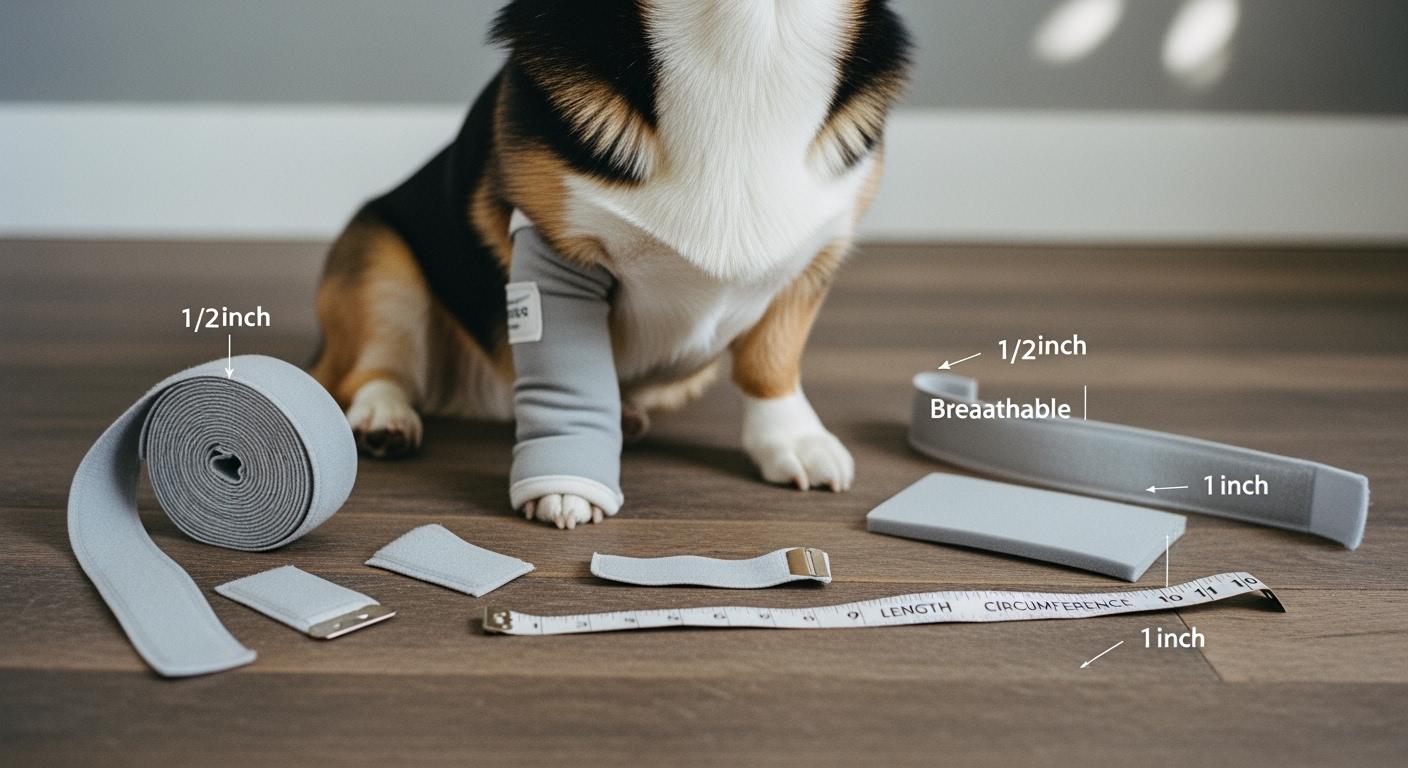
Product dimensions that matter for short-leg fit are not always printed on the package: the sleeve’s length relative to the dog’s elbow-to-paw distance, the cuff diameter compared to the lower leg circumference, and the amount of stretch built into the elbow zone. A sleeve that matches on circumference but is too long will bunch. One that matches on length but has a loose cuff will slide. And one that lacks an intentional flex zone at the elbow will fold and rub against the skin. Recovery sleeve fit across different leg lengths depends on these three dimensions far more than on a small/medium/large label.
Failure Signs That Show the Sleeve Is the Wrong Match
A sleeve that does not fit does not fail silently. The dog tells you. The fabric tells you. The wound tells you. Recognizing the signals early keeps a small fit problem from turning into a setback.
| Failure sign | What you see | Why it happens | Better sleeve feature |
|---|---|---|---|
| Sliding toward the paw | Sleeve migrates down, paw emerges, wound loses cover | Sleeve too long for limb or cuff too loose to anchor | Tapered lower sleeve, stable cuff diameter matched to lower leg |
| Bunching at the elbow | Fabric gathers in folds behind or in front of the elbow joint | Straight-tube design cannot track elbow flex; fabric has nowhere to go | Flexible elbow zone with stretch that recovers between strides |
| Armpit crowding | Fabric presses into the armpit, the dog resists or freezes | Sleeve extends too far up a limb that is already short | Shorter limb-friendly pattern that stops below the chest line |
| Wound edge exposed | Wound or incision becomes visible after walking or sitting | Sleeve shifts during movement, breaking the coverage zone | Stable coverage zone, adjustable upper anchor |
| Dog chews or licks through fabric | Dog mouths the sleeve at the wound site, fabric gets wet | Sleeve rotates, slides, or leaves a gap the dog can access | Secure non-bulky fit, seams placed away from wound zone |
| Red marks or damp skin | Skin under sleeve looks pink, feels moist, or shows crease lines | Fabric traps heat and moisture, or seams press into skin | Breathable material, low-profile seams, moisture-wicking inner layer |
The dog’s behavior is the most honest fit signal
When a sleeve hurts or annoys, short-leg dogs do not tolerate it quietly. They chew at the fabric. They rub the leg against furniture. They freeze mid-stride and refuse to take the next step. They hold the leg up. They work the sleeve off with their teeth and shake it across the floor. None of this is random behavior. The dog is reporting that something is wrong with the fit.
Pressure marks appear fast on short legs because there is less surface area to distribute the sleeve’s grip. A sleeve that feels snug-but-fine to your hand can concentrate enough pressure on a Dachshund’s thin-skinned foreleg to leave red crease lines within thirty minutes. Flip the sleeve inside out and inspect the skin. If you see defined lines where the fabric edges or seams sat, the sleeve is gripping too hard in that zone, and the pressure will only increase with continued movement.
When a dog that normally tolerates handling suddenly resists the sleeve, or when a wound that was healing cleanly starts looking moist or inflamed, the sleeve is the likely variable. Licking that persists through a front-leg sleeve often means the coverage has shifted and the dog has regained access to the wound. Adjusting or changing the sleeve design matters more than simply tightening it.
What Better Sleeve Structure Looks Like for Short-Leg Coverage
Shorter limb-friendly pattern
A sleeve that is too long for the leg cannot anchor. The extra fabric has to go somewhere, so it bunches at the elbow or pushes up into the armpit. On a Dachshund or Corgi, the usable limb length from just below the elbow to just above the paw may be only three to four inches. A sleeve built for a longer leg will extend past the elbow and into the chest zone, where the wider body profile pushes it off-axis. The result is a sleeve that twists as the dog walks, rotating the coverage zone away from the wound.
A shorter pattern stops below the armpit, stays within the limb’s natural cylinder, and does not interact with the chest wall. That isolation matters. When the sleeve does not touch the chest, chest movement cannot displace it. The sleeve’s stability comes entirely from its grip on the leg, which is a simpler and more predictable anchoring surface.
Tapered lower fit and stable cuff
The lower cuff is where most sleeves lose their hold. A cuff that is cut straight or only gently tapered cannot resist the downward pull of the elbow ratchet. With each stride, the cuff edge catches less and less of the lower leg, until it slips past the narrowest point and the whole sleeve follows. A cuff that is measurably narrower than the mid-sleeve body creates a mechanical stop. The fabric cannot slide past the taper without stretching, and if the cuff material resists stretch in that direction, it stays put.
The practical check: after walking the dog, look at where the cuff sits relative to the paw. If the cuff has moved closer to the paw than where it started, the taper is not aggressive enough or the cuff material has too much give. Recovery sleeve wound protection solutions that rely on a stable lower anchor point tend to maintain coverage longer than those that depend on top-down tension alone.
Flexible elbow zone and breathable fabric
The elbow zone is where the sleeve bends and where it fails. A sleeve built from a single uniform material responds to elbow flex by folding, because the outer curve of the elbow demands more fabric length than the inner curve, and uniform material cannot give more on one side than the other. A flexible elbow zone solves this by incorporating a panel or section with directional stretch. The outer side extends, the inner side stays short, and the sleeve bends without bunching.
Material choice interacts with this. A dense, low-porosity fabric holds heat and moisture against the skin, and on a short leg where airflow is already limited by the compact limb and body proximity, dampness builds fast. Flip the sleeve’s inner surface and feel it with your fingers after twenty minutes of wear. If it feels humid or tacky, the fabric is trapping moisture. Breathable material with micro-perforations or a wicking inner face keeps the skin dry, which reduces the risk of irritation under a sleeve that is being worn for extended daily periods. Anti-lick sleeve designs that combine a breathable body with a tapered cuff tend to address both the moisture problem and the sliding problem simultaneously.
Structure comparison
| Poor match | Why it fails on short legs | Better structure | Main limitation |
|---|---|---|---|
| Long straight tube | Bunches at elbow, crowds armpit, twists from chest contact | Shorter limb-friendly pattern | Must match elbow-to-paw length closely; too short loses coverage |
| Loose lower cuff | Slides toward paw with each stride, exposes wound | Tapered lower sleeve, stable cuff | Taper angle must not constrict; overly tight cuff creates pressure ring |
| Stiff uniform fabric | Folds at elbow bend, rubs skin, creates pressure point | Flexible elbow zone with directional stretch | Stretch panel must recover between strides; stretched-out fabric loses anchor |
| Bulky internal seam | Presses a line into skin, causes redness within 30 minutes | Low-profile soft seam, placed away from wound | Flat seams still create a texture boundary; wound should not sit directly under any seam |
| Heavy low-porosity fabric | Traps heat and moisture, skin stays damp and macerates | Breathable or perforated material, moisture-wicking inner face | Perforations reduce insulation; may not suit cold-weather outdoor wear |
When a Front Leg Recovery Sleeve Is Not the Right Option
A sleeve works when three conditions hold: the wound sits within a zone the sleeve can keep covered through full movement, the dog does not persistently defeat the sleeve to reach the wound, and the skin under the sleeve stays dry and unirritated. When any of these breaks down, the sleeve is the wrong tool for the job.
Disclaimer: The fit checks described here assume a short-coated dog where skin visibility is straightforward. Double-coated breeds such as Corgis and some terrier mixes may show subtler rub marks beneath the undercoat. On these dogs, rely on hand-checking — run your fingertips along the skin under the sleeve edge and feel for warmth, moisture, or raised crease lines rather than depending on visual inspection alone.
When the wound sits outside the real coverage zone
Some wound placements defeat a sleeve regardless of design. A wound that sits right at the elbow crease moves through too much range for any fabric to track reliably. One that sits on the paw or just above it leaves too little lower-leg surface for a cuff to anchor below the wound. A wound high on the limb near the armpit gets pushed by chest movement no matter how the sleeve is constructed. In each case, the geometry works against coverage, and the sleeve cannot deliver protection that holds through the dog’s full daily movement. Recovery sleeves on small short-leg dogs face this boundary more often because the usable limb surface is compressed into a smaller total area.
When licking continues despite the sleeve
A sleeve that the dog can lick through has lost its barrier function. The fabric may be thin enough that the tongue reaches the wound through it. The sleeve may have rotated so the wound sits at an unguarded edge. Or the dog may have worked the fabric up or down enough to expose the target area. Continued licking with the sleeve in place signals that the barrier has been breached. Continuing to use the same sleeve without addressing how the breach happened risks the wound staying wet from saliva, which slows closure.
When the skin shows warning signs
Remove the sleeve and inspect. Swelling around the wound or under the sleeve edge, a hot sensation when you touch the skin, an odor that was not present before the sleeve was put on, or any discharge — clear, yellow, or otherwise — means the sleeve environment has become unsafe for that wound. These signs can indicate that moisture built up and skin integrity degraded, or that the sleeve itself introduced enough friction to create a secondary irritation. Stop using the sleeve. The skin needs to dry and recover before any covering goes back on.
Disclaimer: If the dog’s leg conformation falls outside the breed norms this sleeve was patterned for — particularly dogs with angular limb deformities, very deep chests, or disproportionate upper-to-lower leg ratios — the fit checks described here may not catch every pressure point. On these dogs, a sleeve that passes all the movement tests can still create focal pressure where the limb shape deviates from the expected contour.
FAQ
How do I check whether the sleeve slips during movement?
Mark the top and bottom edges of the sleeve with tape before the dog walks. After ten minutes of normal movement, measure the distance each mark has shifted. A shift of more than half an inch at either edge means the sleeve is migrating during use. Check both standing and after sitting, since sitting compresses the fabric at the elbow and can push the sleeve in ways walking does not.
Can a short-leg dog wear a recovery sleeve overnight?
Overnight wear removes your ability to check the skin and the sleeve position for eight or more hours. During that time, a sleeve that shifts can create a pressure point, trap moisture, or expose the wound without anyone noticing. Removing the sleeve at night and inspecting the skin before reapplying it in the morning is the safer approach, particularly for dogs with thin skin on the lower leg.
What is the difference between a recovery sleeve and an anti-lick sleeve on a short front leg?
A recovery sleeve is built primarily to cover and protect a wound or incision site, with coverage stability as the main requirement. An anti-lick sleeve is built primarily to block the dog’s tongue from reaching the skin, which often means a tighter weave or thicker material. On a short front leg, a recovery sleeve that lacks anti-lick density may let saliva soak through, while an anti-lick sleeve that lacks a tapered limb pattern will slide just like any other straight tube. The structural requirements overlap but are not identical.
When should I stop using the sleeve and switch to a different option?
Stop if the skin under the sleeve shows swelling, heat, odor, or discharge. Stop if the dog limps, chews at the sleeve persistently, or manages to expose the wound despite adjustments. Stop if the wound itself looks worse than it did before the sleeve went on — more moisture, more redness, larger area. In any of these cases, the sleeve is no longer providing net benefit, and continuing to use it risks making the wound environment worse.
| Situation | Why the sleeve may not be enough | Alternative to discuss with a veterinarian |
|---|---|---|
| Wound at the elbow crease | No fabric can track the full flex range without bunching or gapping | Bandage or splint that immobilizes the joint |
| Deep or surgical wound | Sleeve fabric contact may introduce moisture or friction at the suture line | Vet-applied sterile bandage with scheduled changes |
| Persistent licking despite secure fit | The dog’s drive to lick exceeds the sleeve’s barrier function | Recovery cone combined with or replacing the sleeve |
| Skin breakdown under sleeve | Moisture, heat, and friction have created a secondary irritation site | Remove sleeve, let skin dry and recover, reassess coverage approach |