
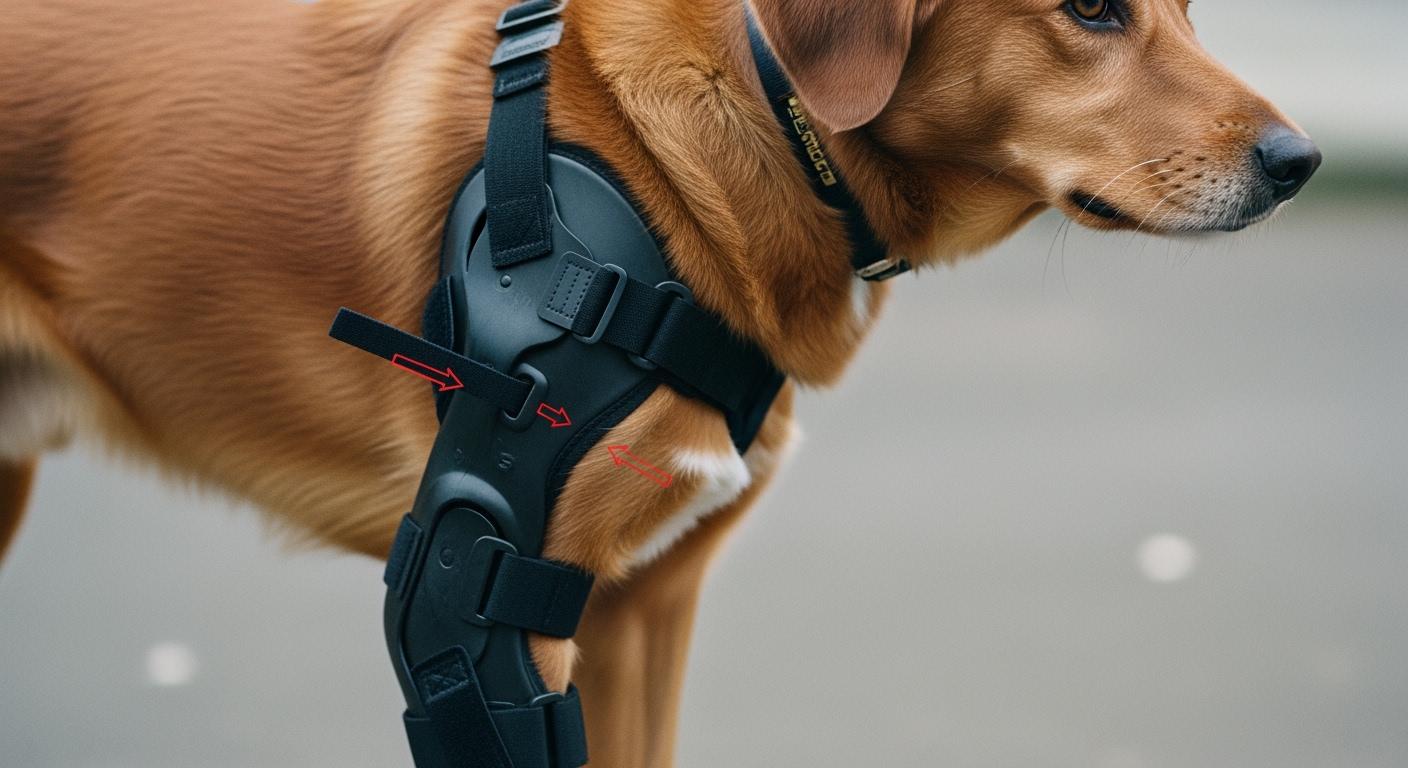
A narrow strap on a dog knee brace looks harmless when the dog stands still. Then the dog walks. Tension that felt evenly distributed tightens into a thin line of concentrated pressure. The strap is not just tight — it is digging.
The physics is straightforward: the same anchoring force spread across a half-inch strap lands on far less skin than the same force across a wider padded zone. Under a narrow strap, edge pressure can spike enough to leave sharp red lines within minutes. Every step concentrates load at the strap boundary. The dog tenses. The strap rolls. The edge digs harder.
This is not a comfort complaint. It is a product failure mode — one that a standing fit check will never catch. The design features that prevent it are specific, testable, and rooted in how force distributes across skin under motion.
What Narrow Strap Pressure Looks Like in Real Use
After a 10- to 15-minute walk — not a standing fit check — remove the brace and look at the skin under each strap.
A strap that is too narrow leaves a sharp, well-defined red line. Not a diffuse pink flush. A crisp line tracing the exact strap path. That line is the strap edge pressing into tissue with enough sustained force to displace blood flow at the surface. If it does not fade within 20 to 30 minutes after removal, the pressure is high enough that the skin is not recovering between wear sessions.
Other failure signals are equally visible. Heat directly under the strap path means friction is elevated. Swelling signals a fluid response to sustained compression. Hair loss at the strap line means repeated edge shear is damaging follicles. And a dog that chews or licks the strap site is not bored — it is signaling pain.
In practice: After a 10-minute walk, remove the brace and press a finger along the strap line. Dry and cool is acceptable. Damp and warm means the padding is not breathing and the strap is trapping heat against the skin. A sharp red line still visible after 30 minutes means the pressure under that strap exceeds what tissue tolerates in repeated wear sessions.
Why the Strap Fails — Width, Edge Finish, Padding, and Anchor Design
Strap width and why it determines everything
Pressure equals force divided by area. A narrow strap concentrates the entire anchoring load onto a thin band of skin. The same tension spread across a wider zone drops the per-square-inch load dramatically — not because the brace is looser, but because more skin shares the force.
Width also provides rotational stability. A wide strap resists twisting because its breadth creates a stable contact plane. A narrow strap has almost no anti-rotation surface. When the dog turns, sits, or lies down, side loads hit the strap edge. The edge rolls. The contact zone collapses to a line. Pressure at the leading edge spikes. The dog feels a sharp pinch, tenses the surrounding muscle, and the brace shifts off-center. That shift misaligns the hinge, and joint loading becomes asymmetric — one side of the joint bears excess force while the other side loses contact entirely.
That causal chain — narrow strap, edge roll under side load, contact collapse, pain signal, muscle tension, brace shift, hinge misalignment, asymmetric joint loading — is not theoretical. It plays out within minutes of a dog walking on anything other than a straight, flat surface.
Edge finish and seam construction
Raw-cut strap edges cycle across the skin with every step. A bound edge — folded and stitched with soft Spandex or Lycra binding — distributes that cycling force across a rounded surface rather than a sharp corner. The difference in skin tolerance can mean a dog that tolerates the brace for two hours versus one that starts chewing within twenty minutes. Flat-lock or overlock stitching keeps the binding smooth. A stiff seam standing proud of the strap surface creates a focused pressure ridge — the same physics as the narrow-strap problem, compressed to the millimeter scale.
Padding that breathes versus padding that traps
Padding is a skin-contact surface worn for hours, not a comfort add-on. Non-breathable padding traps moisture and heat. Warm, damp skin softens and becomes more vulnerable to friction damage — a condition that escalates silently under the brace where it cannot be seen. Breathable padding allows air circulation and moisture wicking. After 20 minutes of wear, flip back the inner lining and touch the skin. Damp and warm means the padding is failing as a skin-contact surface regardless of how plush it felt to the hand at room temperature.
Anchor zones that force the strap to do too much
A strap anchored to a narrow or poorly contoured zone slips during movement. The natural response — pull it tighter. But tightening a narrow strap increases edge pressure without fixing the root cause. The anchor itself needs more surface area, a shape that cups muscle contour rather than wrapping like a belt, and placement on muscle bellies rather than bony prominences. A stable anchor lets the strap work at moderate tension. An unstable anchor asks the strap to do two jobs — anchor and support — and it fails at both when tension is asked to substitute for design.
| Strap design | What can fail | What the dog owner sees | Better design direction |
|---|---|---|---|
| Narrow single strap | Edge digging, rotation | Sharp red line, chewing, slipping | Wider padded anchor zone |
| Elastic-only strap | Overstretch, instability | Brace drifts, dog limps | Low-stretch, stable support |
| Raw or stiff strap edge | Skin rubbing, hair loss | Swelling, heat, fur loss | Bound-edge, soft padding |
| Strap over a bending crease | Shear, movement irritation | Mark at joint, discomfort | Adjustable path, avoids creases |
| Wider padded anchor zone | Less edge pressure | No marks, dog moves comfortably | Load-spreading, soft contact |
| Bound-edge low-stretch strap | Stable, gentle support | No skin change, brace stays in place | Rounded edges, keeper loops |
| Signal level | What appears after brace removal | What to do next |
|---|---|---|
| Green | No skin change, strap stays flat, dog moves normally | Continue use, monitor twice daily |
| Yellow | Mild pink mark fades within 20-30 minutes, slight shifting, light chewing interest | Shorten wear, adjust fit, recheck |
| Red | Sharp strap line, swelling, heat, cold toes, hair loss, open sore, new limp, repeated chewing, brace rotated off target | Stop use, reassess fit, seek veterinary guidance |
Strap Design That Works in Daily Wear
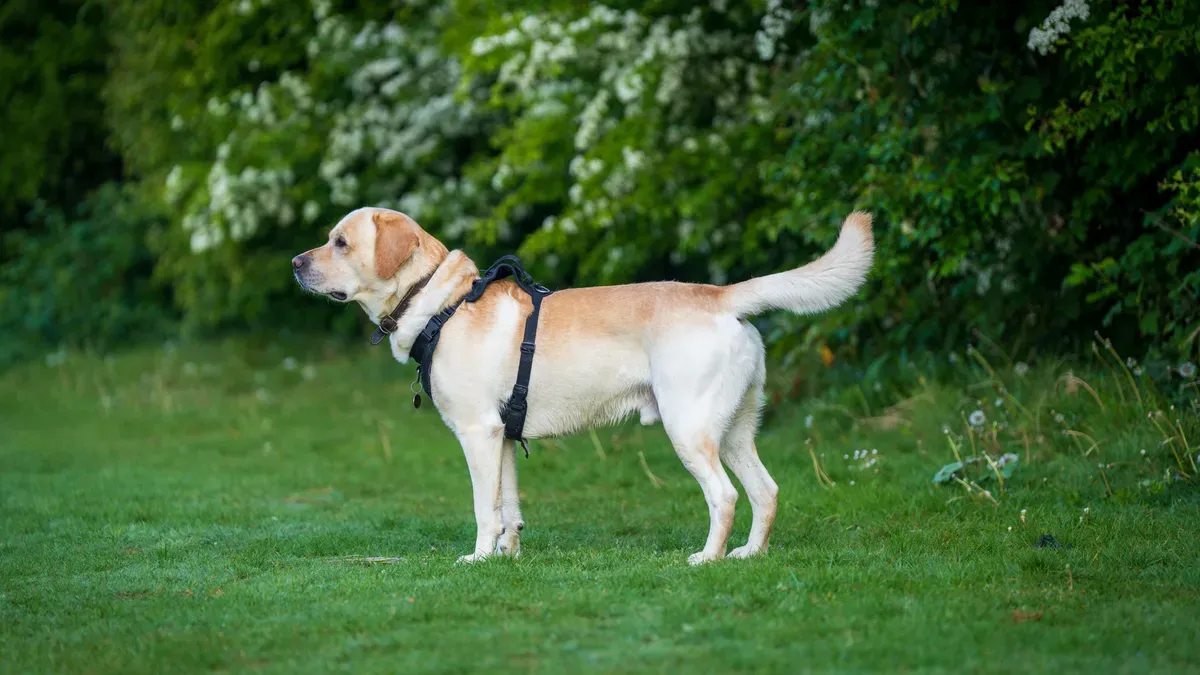
Wider load-spreading contact zones
A strap with a wider contact zone distributes anchoring force across square inches of skin rather than a thin line. Width alone is not enough — the strap material must resist rolling and bunching during movement, or the effective width collapses to the leading edge under side load. The same material width that measures adequately at a standstill can halve its functional contact area the moment the dog turns.
Rounded and bound strap edges
Bound edges eliminate the raw-cut corner that cycles across skin with every step. The binding folds a soft material — typically Lycra or Spandex — over a flat-lock stitch, turning what would be a focused pressure line into a distributed contact surface. Knee brace strap designs that use bound edges consistently produce fewer skin reactions because the edge cannot dig regardless of how much tension the strap carries.
Stable anchor zones that reduce rotation
An anchor zone shaped to cup the muscle contour above or below the joint resists rotation without requiring high strap tension. When the anchor stays put, the strap only needs to hold — not grip. That difference in mechanical role is why a well-anchored strap runs at moderate tension without slipping, while a poorly anchored strap slips even when overtightened.
Low-stretch straps and keeper loops
Elastic straps overstretch during movement, then rebound in a slightly different position — a drift cycle that repeats with every step and accumulates millimeter by millimeter until the brace is off-target. Low-stretch material paired with keeper loops that lock the strap path in place eliminates that drift cycle. The strap stays where it is placed, walk after walk.
In practice: After a 10-minute walk, check whether any strap has shifted more than half an inch from its original position. A stable strap stays. A strap that drifts means the anchor zone, the strap material, or both are not doing their job — regardless of how secure the standing fit looked.
When a Knee Brace Strap Design Is Not Enough
Strap design solves pressure problems caused by the strap itself. It does not fix a brace that is the wrong type for the dog’s condition, a brace sized for a different leg shape, or a dog whose anatomy falls outside the pattern the brace was built for.
A strap that passes every fit check — no marks, no shifting, no chewing — can still be the wrong tool if the dog needs hip stabilization but is wearing a knee brace, or if hock support is required and the brace concentrates all its structure around the stifle. A knee brace with well-designed straps supports the knee joint specifically — it does not substitute for hip or hock support. Strap comfort is necessary but not sufficient. The brace type must match the joint it is intended to stabilize.
Disclaimer: The fit checks and pressure observations described here assume a short-coated dog where skin is directly visible after brace removal. Double-coated breeds may show subtler rub marks that require hand-checking — run fingers along the strap path rather than relying on visual inspection alone. If the dog’s leg conformation falls outside typical breed norms — particularly dogs with angular limb deformities or very deep chests — the strap pressure patterns described here may not catch every pressure point. Stop use and reassess if the dog shows any sign of discomfort regardless of what the skin surface looks like.
FAQ
Can a strap that fits perfectly at a standstill still cause pressure during movement?
A standing fit check only verifies strap placement against static anatomy. Movement adds shear forces, muscle flexion, and joint rotation that change the strap’s contact geometry. A strap lying flat on a standing dog can roll, bunch, or shift within the first minute of walking. Fit must be checked dynamically, especially for small dogs where strap positioning tolerances are inherently tighter.
Why does tightening a slipping strap usually make everything worse?
Slipping is an anchor stability problem, not a tension problem. Pulling a narrow strap tighter increases edge pressure without improving stability. The root cause is the anchor zone — its shape, surface area, and placement. Fix the anchor, and the strap works at moderate tension. Tighten a bad anchor, and both the anchor and the strap fail.
What is the quickest way to tell if a strap is too narrow during use?
Remove the brace after a 10-minute walk and run a finger along the strap line on the skin. A temperature difference — warmer directly under the strap path — signals elevated friction and trapped heat. A sharp red line that remains visible 20 minutes after removal means the pressure exceeds what tissue tolerates for repeated wear sessions. Either signal means the strap width, edge finish, or padding design needs reassessment.
