
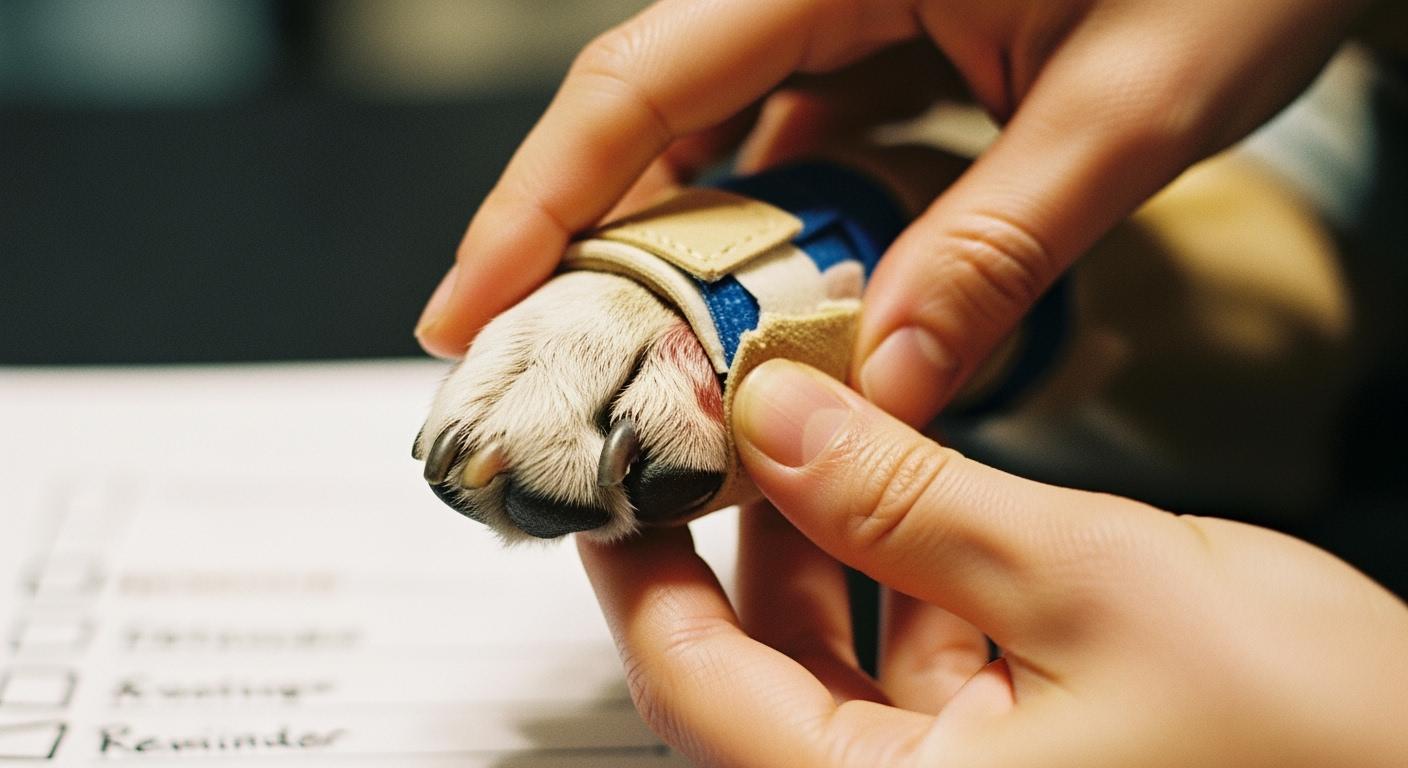
A dog comes back from a short walk. The paw brace is still on. But the dog is licking between the toes. You lift the paw, spread the webbing, and see a red line pressed right where the cord sat. The brace was supposed to help the paw land pad-first, not leave a mark.
This happens because the interdigital webbing is thin, soft, and has almost no ability to spread concentrated force. When a narrow lift cord presses into that space under tension, it does not distribute load the way a wider padded surface would. Instead, it creates a focused pressure line. The skin compresses. Capillary flow slows. With each step the cord drags microscopically across the same compressed tissue. After a few minutes, the surface layer breaks down. That red line is not a cosmetic mark. It is the first visible stage of pressure-induced skin damage.
A dog paw brace can fail in two primary ways: cord geometry that concentrates force instead of spreading it, and anchoring that lets the brace rotate so the lift line drags sideways across the webbing. Both failures trace back to the same root: the contact surface was designed as a tension transfer point, not as a load-distributing interface. Understanding the difference changes how you evaluate fit.
Why a Dog Paw Brace Rubs Between Toes
The mechanics are straightforward once you look at the cross-section. Between a dog’s toes sits a thin web of skin, no fat pad, no muscle belly underneath to absorb compression. A narrow cord under even modest tension applies force to a contact patch that might be three or four millimeters wide. That is a pressure concentration problem — the same force that would be harmless spread across a centimeter-wide padded strap becomes damaging when focused onto a line.
But the cord does not sit still. As the dog walks, the paw flexes and extends. Each cycle changes the angle of the cord relative to the webbing. What starts as a static pressure point becomes a dynamic friction point. The cord saws back and forth across the same strip of skin. This is the causal chain: narrow cord → high pressure per unit area → cyclic micro-movement → friction superimposed on compression → epidermal shear → redness → surface breakdown. A knuckling brace that cannot spread that load across a wider contact patch will produce this result on most dogs, given enough steps.
The cord acts like a wire, not a strap
Think of the difference between carrying a heavy bag with a thin drawstring versus a wide canvas strap. Same weight, completely different tissue response. The thin cord between toes works the same way. It presses into the soft webbing like a wire. The skin underneath cannot dissipate the force laterally because there is no firm backing tissue — just more soft tissue on the other side.
You can verify this yourself. After a 10-minute supervised walk, remove the brace and press a dry white tissue between the toes. Hold it there for five seconds. Pull it out. If the tissue comes away damp, moisture is trapped in the webbing. Wet skin macerates faster under pressure — the surface layer loses integrity and the friction damage accelerates. Dry webbing after a walk is a pass signal. Damp webbing is an early warning.
Rotation turns the lift line into a cross-cut saw
Even a well-padded cord fails if the brace rotates. Rotation shifts the entire lift path off-center. Instead of pulling straight up through the natural plane of the paw, the cord pulls at an angle. The contact point drifts toward the edge of the webbing. Now the cord is sawing sideways — not just forward and back, but laterally across the toe web with each stride.
The mechanism is simple: the brace’s anchor point cannot resist the torsional force generated when the paw strikes the ground at a slight angle. Without an anti-rotation feature, the brace twists. The cord follows. The rub pattern changes from a centered pressure line to an off-center friction burn. This is why foot brace fit checks that only look at tension miss the most common failure point. A brace can feel snug at the strap and still rotate enough to cause damage between the toes.
The main mechanical reasons a dog paw brace rubs between the toes include inadequate contact-patch width, improper cord placement depth, and rotation under load. A brace with a thin cord over the toe knuckles creates sustained pressure on tissue the dog cannot offload voluntarily. As the leg moves inside the brace, even a well-fitted one allows micro-movement, the compressed contact surface rubs across the skin over those knuckles. Moisture from sweat or a wet walk accelerates the process. The skin macerates. The surface layer breaks. A wound opens.
Fit Details That Make Rubbing Worse
Cord depth matters more than tension
A cord placed deep in the toe webbing presses into softer, thinner tissue. The skin at the base of the interdigital space has the poorest pressure tolerance anywhere on the paw. Even low tension at that depth creates a damaging pressure gradient. The cord should contact the webbing surface, not wedge into the cleft.
Mark the cord position with a small piece of surgical tape on the metatarsal area before a walk. After five minutes of supervised walking, check whether the tape has shifted more than half an inch from its original spot. If it has moved, the cord is migrating deeper into the webbing with each step — a fit failure that tension adjustment alone will not fix.
More tension does not mean more lift
There is a point where adding tension stops improving paw lift and starts compressing the interdigital space. Beyond that point, the toes spread apart, the webbing stretches taut, and the cord presses harder into tissue that is now under dual stress — tension from the strap above and compression from the cord below. The paw may still drag because tension does not correct the underlying gait pattern. It only pulls harder on the same lever point.
A rear paw drag brace that relies on tension alone rather than lift-path alignment will tend to mask the problem while creating a new one between the toes. That fails fast.
Wet hair, grit, and long toe hair amplify friction
Moisture softens the stratum corneum and doubles the friction coefficient against most brace materials. Grit trapped between the cord and the skin acts as an abrasive slurry with each step cycle. Long toe hair wicks moisture into the contact zone and can wrap around the cord, pulling it deeper into the webbing as the dog walks. All three conditions accelerate the timeline from first use to visible skin damage.
Dry the paw thoroughly before fitting. Trim long toe hair if it extends past the pad surface. Run a finger through the webbing to check for hidden debris. These are not grooming preferences. They are pre-wear contact surface preparation.
What a Better Dog Paw Brace Design Looks Like
Padded contact patch instead of a narrow cord
A soft padded toe loop spreads the lift force across a wider contact area. The physics is simple: doubling the contact width halves the pressure per unit area for the same tension. But padding also changes the friction behavior. A padded surface has more contact area and a lower peak pressure — which means less micro-movement shear at the skin surface. The padding conforms to the webbing contour instead of cutting across it.
In manufacturing terms, a padded loop requires a multi-layer construction: a soft inner face fabric for skin contact, a compressible middle layer to absorb micro-movement, and a durable outer layer that holds its shape under tension. Stitching through all three layers must lie flat — raised seam lines become secondary pressure points in their own right. This is why toe-up paw support designs that prioritize contact-surface engineering over raw tension capacity tend to produce fewer between-toe problems in daily use.
Anti-rotation anchoring that keeps the lift path centered
An anti-rotation anchor resists the torsional moment that tries to twist the brace during paw strike. The anchor typically uses a secondary strap or a wider proximal contact zone that creates a longer moment arm against rotation. A longer moment arm means the same rotational force produces less angular displacement. Less displacement means the lift cord stays centered in the sagittal plane of the paw, where it pulls straight up through the webbing rather than dragging sideways.
The difference in daily use is measurable: mark the brace position before a walk. After 10 minutes, if the anchor point has rotated more than a quarter-inch off-center, the anti-rotation design is undersized for that dog’s gait forces.
Washable, quick-drying contact materials
Materials that hold moisture against the skin accelerate maceration. A contact surface that dries within an hour of washing reduces the risk of prolonged dampness during the next wear session. Rounded edges on all contact surfaces eliminate sharp transition points where pressure can spike at the material boundary. These are not cosmetic details. They are structural decisions that change how the brace interacts with thin, sensitive skin over repeated wear cycles.
| Problem seen during use | Likely design or fit cause | Why it fails | Better structure or next step |
|---|---|---|---|
| Red line between toes | Narrow cord, high tension | Pressure concentrated on small contact patch | Use padded loop, reduce tension |
| Toes spread apart | Excessive cord tension | Webbing stretches, toes splay | Lower tension, check pad-first landing |
| Brace rotates during walking | Inadequate anchoring, loose proximal fit | Lift line shifts off sagittal plane, cord rubs sideways | Use anti-rotation anchor, center the lift path |
| Paw still drags after tightening | Tension applied without correcting alignment | Cord pulls harder on same lever, does not change paw trajectory | Refit for alignment, use gentle lift |
| Dog chews the toe loop | Discomfort from rubbing or pinching | Dog targets source of localized pain | Inspect skin, stop use if redness or swelling present |
| Skin is damp or debris-filled after use | Non-breathable materials, wet conditions | Moisture increases friction coefficient, accelerates maceration | Use washable quick-drying materials, dry paw before fitting |
When to Stop Using the Brace
A brace that is causing tissue damage needs to come off. The question is not whether it can be adjusted — it is whether the current contact surface and fit configuration are creating conditions the skin cannot recover from between wear sessions.
| Signal level | What the caregiver sees | Action |
|---|---|---|
| Green | No redness, stable centered lift, dog walks normally, dry webbing after removal | Continue supervised use, regular checks |
| Yellow | Light temporary redness, slight cord shifting, mild licking, damp webbing | Adjust fit, reduce tension, dry paw thoroughly, monitor next session |
| Red | Swelling, raw or broken skin, bleeding, odor, discharge, limping, cold toes, repeated chewing, refusal to bear weight | Stop use immediately, consult veterinarian |
Redness that does not fade within 20 to 30 minutes
Skin that blanches under pressure and returns to normal color within seconds of removing the brace is reacting to temporary compression. Skin that stays red 20 to 30 minutes after removal is signaling a deeper problem: the pressure exceeded the tissue’s ability to reperfuse. Capillary refill is delayed. Inflammatory mediators are already active. Put the brace back on at this stage and you are compounding damage onto tissue that has not yet recovered.
A dog knuckling brace worn over damaged skin can also mask worsening neurological signs by altering proprioceptive feedback. If the paw position changes while the skin is breaking down, two problems are evolving simultaneously — and the brace is hiding one of them.
Swelling, odor, discharge, or limping
These are not fit problems. They are injury signals. Swelling between the toes after brace use means fluid has accumulated in tissue that was compressed past its tolerance. Odor or discharge means the skin barrier has been breached and microorganisms have colonized the site. Limping means the dog is redistributing weight to avoid pressure on the damaged area. All three mean the same thing: stop the brace, document what you see, and have the paw examined.
Disclaimer: This check assumes a short-coated dog where between-toe skin is visible without parting dense fur. Double-coated or heavily feathered breeds may show subtler rub marks that require hand-checking — run a fingertip along each interdigital space and note any warmth, tackiness, or tissue that feels firmer than the surrounding webbing. If the dog’s paw conformation falls outside typical breed norms — particularly dogs with fused digits, webbing that extends unusually far toward the pad, or angular limb deformities that alter paw strike angle — the fit checks described here may not catch every pressure point. In those cases, a shorter supervised walk-test with more frequent skin checks is a safer starting point.
FAQ
How often should the skin between the toes be checked when using a paw brace?
Before and after every wear session during the first week. After that, at least once daily. Early detection of redness or dampness prevents a fit problem from becoming a skin injury.
What does it mean if redness does not fade after removing the brace?
Sustained redness 20 to 30 minutes after removal means tissue perfusion has not returned to normal. The pressure exceeded what the capillaries could tolerate during wear. Do not reapply the brace until the skin looks and feels identical to the opposite paw.
Can the brace and padding be washed?
Most padded toe loops and contact surfaces can be washed with mild soap and water. Air-dry completely before the next use. Residual dampness trapped in padding accelerates skin maceration on the next wear cycle.
Why does a dog chew at the toe loop?
Chewing at the toe loop is a targeted pain response. The dog is trying to remove the source of localized discomfort. Check the webbing for redness, swelling, or a pressure line. Stop use until the skin clears.
How much tension should the toe loop have?
Enough to lift the toes gently without spreading them apart or pulling the cord deep into the webbing. The paw should land pad-first. If the toes splay or the skin bulges around the cord on visual inspection, back the tension off.
