
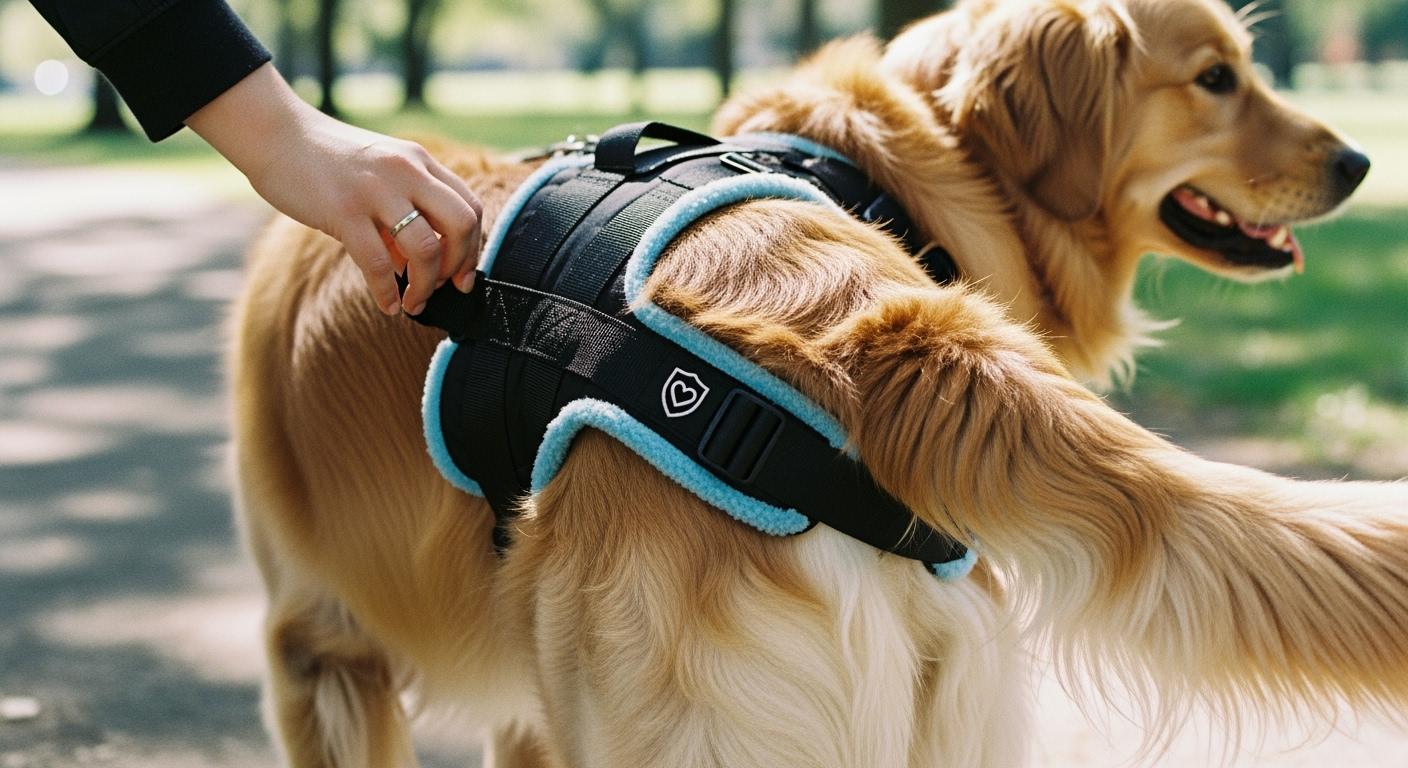
A rear support harness worn all day rubbing often starts from a fit that passes every standing check. The dog stands still. The straps look centered. The panel sits flat. Then movement begins. Each step the dog takes shifts the rear panel forward by a fraction of an inch. Ten steps later the edge sits in the groin crease. Twenty steps later moisture has built up underneath. By the end of a full wear session, the skin under that panel has been fighting friction for hours. The dog licks the area. The owner finds pink skin. The harness did not fail because it was too tight. It failed because the panel migrated under load.
This is the core problem with a dog rear support harness worn all day: a static fit check cannot predict what happens during movement. The rear panel drifts. Straps twist. Contact zones shift. And the skin trapped underneath pays the price.
When a Rear Harness Worn All Day Starts to Rub
A rear support harness may look correctly positioned when first fitted, but problems surface after repeated standing assists, short walks, stair climbs, or car transfers. The rear panel or straps shift fractionally with every sit, stand, turn, and squat. Edges press into the groin, the inner thigh, the belly, or over the hips. Moisture and heat accumulate under the contact surface. Skin tolerance drops. The dog begins to resist, chew at the harness, limp, or avoid movement altogether.
Tightening the straps does not solve this. The failure is not about clamping force — it is about where the load lands and whether the contact surface stays put under real movement. A rear lift harness guide for back legs explains how fit changes across different movement patterns, but the short version is this: if the rear panel can drift forward at all, it will.
Panel Migration — The Failure Most Standing Fit Checks Miss
Groin crease rubbing almost always traces back to forward panel migration. The dog sits. The rear panel slides forward into the groin fold. The dog stands — the panel does not slide all the way back. Ten repetitions of sit-to-stand. The panel has now walked half an inch forward from where it started. The edge contacts the groin crease with every movement cycle.
Here is the mechanical chain that makes this destructive: when the hip pad has a thick, blunt front profile, it acts like a wedge. Each hip-flexion cycle pushes the pad forward rather than letting it settle into the natural crease. The forward edge now bears the dog’s weight not as distributed support but as a focused line of pressure. That line of pressure quickly becomes a line of friction. Add the moisture that builds up inside any non-breathable lining, and you have a perfect setup for skin breakdown — not because the dog has sensitive skin, but because engineering a contoured, tapered pad profile changes where and how force enters the groin fold.
An observable check: after a ten-minute supported walk, lift the rear panel edge and press a dry paper towel against the groin crease skin for three seconds. If the towel comes away damp and the skin shows a pink line tracing the panel edge, forward migration is happening. The panel is not staying where it was placed. That moisture trapped under the contact surface is a pass/fail signal — dry skin means the panel stayed put, damp skin with a line means it drifted.
Narrow Straps and Pressure Concentration
Narrow lifting straps create a different but related class of failure. When the entire rear lift force passes through a one-inch-wide strap running under the belly or across the inner thigh, the pressure at the strap-to-skin interface is high — physics dictates that a narrower contact area under constant load generates higher pounds per square inch. Under a wide pelvic cradle, the same lifting force spreads across a contact zone three to four times larger. The peak pressure drops proportionally.
But the damage from narrow straps is not just about peak pressure. It is also about rotational instability. A narrow strap has almost no resistance to twisting. When the dog shifts weight laterally — stepping onto an uneven surface, turning to look back, squatting at an angle — the strap can roll. A rolled strap edge concentrates all the load onto a line perhaps one-eighth of an inch wide. That is no longer a support surface. It is a cutting edge. Inner thigh skin, which tends to be thinner and less protected by fur in many breeds, has almost no defense against it.
Check this by running a finger along the strap edge after a walk. If the strap has twisted even fifteen degrees, the edge that was flat against the dog at the start is now angled into the skin. That twist is visible. It is also a fail signal.
Design Features That Turn Daily Movement Into Friction

A rear support harness may seem comfortable at first, but rubbing often appears after repeated daily use. The gap between a design that works in a catalog photo and one that works across a full day of standing, walking, turning, and squatting comes down to specific structural choices. Seven features separate a harness that rubs from one that does not — and each one maps to an observable pass/fail signal.
| Design feature | Common failure | What the dog shows | Better product direction |
|---|---|---|---|
| Narrow rear strap | Rubbing and pressure on groin/hips | Redness, hair loss, limping | Wider pelvic cradle, padded contact |
| Thin pelvic panel | Panel migration, poor load spread | Panel shifts, dog resists movement | Contoured, anti-slip, broad panel |
| Stiff edge binding | Chafing at high-motion zones | Licking, biting, red lines | Rounded, soft edge finish |
| Smooth low-friction lining | Panel slides forward | Groin rubbing, panel drift | Anti-slip lining, stable rear anchor |
| Non-breathable fabric | Moisture buildup, skin irritation | Wet coat, odor, skin changes | Breathable, washable, quick-dry fabric |
| Fixed short handle | Poor lift angle, panel twist | Topline dips, panel off-center | Adjustable, ergonomic handle |
| Poor belly or potty clearance | Rubbing or soiling at belly/genitals | Wet fur, dog resists harness | Better clearance, easy potty access |
Each row in this table represents a design decision made at the manufacturing level — and each has a consequence that shows up on the dog within minutes to hours of wear. A rear lift harness built for hind leg weakness support needs these features built into the product, not retrofitted with padding or wraps after the fact.
A practical movement test catches most of these failures before the dog’s skin does. Fit the harness while the dog stands. Check contact points around the groin, inner thigh, belly, and hips. Assist the dog through a ten-step walk. Pause and check whether the rear panel moved forward or twisted. Hold the dog standing for thirty seconds and watch the topline for dips or shifts. Remove the harness and inspect the skin. If the panel has drifted or the skin shows any pink tracing along a strap edge, the design is not holding under real movement — no matter how good it looked at the start.
When Rear-Only Support Creates More Problems Than It Solves
A rear support harness worn all day does more than risk rubbing at contact points. It can also redistribute load in a way that hurts the dog elsewhere. When a rear-only harness lifts the hindquarters, the front legs absorb more weight to compensate. The dog leans forward. The front limbs take on a braking and balancing role they were not built for during extended wear. Over hours of use, this can produce front-leg soreness, fatigue, or altered gait patterns that the dog shows as new limping or reluctance to move.
This is not a failure of any individual harness — it is a mismatch between the support tool and the dog’s full-body condition. For a dog with healthy, strong front legs, rear-only lift during short supervised sessions may work well. For a dog with compromised front limbs — arthritis in the elbows, shoulder weakness, carpal instability — rear-only support can amplify the very problems the owner is trying to manage.
Disclaimer: This rear-only support assessment assumes a dog with structurally sound front limbs. If the dog already shows front-leg stiffness, paw knuckling, or uneven weight distribution at a standstill, rear-only lift may overload the forelimbs rather than help. For dogs with angular limb deformities or breeds with naturally deep chests and narrow fronts, the fit checks described here may not catch every pressure point — hand-check all contact zones rather than relying on visual inspection alone.
The warning signs that a harness needs to come off now are consistent across designs. Red lines tracing the strap path. Hair loss or wet coat under the panel. Raw or broken skin. Swelling or unusual heat at any contact area. A foul odor or discharge from the skin surface. Cold toes or a new limp that was not present before wear. The dog biting at or refusing the harness outright. Any one of these means the session needs to end. Multiple signs together mean the harness design may be wrong for this dog’s anatomy, not just for this session length.
| Warning sign | What it may mean | Safer next step |
|---|---|---|
| Red line under the strap | Early rubbing or pressure | Remove harness, rest, check skin |
| Hair loss or wet coat under panel | Friction or moisture buildup | Clean area, switch to short sessions |
| Raw skin or broken skin | Severe rubbing or chafing | Stop use, consult veterinarian |
| Swelling or heat | Inflammation or pressure injury | Remove harness, rest, monitor closely |
| Bad odor or discharge | Infection or wound | Seek veterinary care |
| Cold toes or new limping | Circulation or nerve issue | Remove harness, check fit, rest |
| Dog biting or refusing harness | Discomfort or pain | Stop use, inspect harness and skin |
When front-leg overload becomes visible, switching from a rear-only harness to full-body support distributes weight across a broader contact area. A full-body harness that addresses slipping and rubbing can reduce the concentrated load on any single limb pair. The same principle applies to dogs recovering from surgery, managing degenerative conditions, or showing signs of forelimb weakness alongside the rear weakness the harness was originally bought for.
Sometimes the right tool is not a harness at all — a sling for brief transfers, a ramp to eliminate stair climbing, or a structured rest period may serve the dog better than any wearable support. If the dog shows new or worsening signs across multiple sessions, a veterinary evaluation helps rule out conditions that no harness design can address.
Materials That Change the Rubbing Equation
A rear support harness may seem comfortable at first, but problems often appear after repeated use. When a dog stands, walks, or climbs stairs with assistance, the harness shifts. Each movement cycle rubs the contact surface against the dog’s skin. The choice of contact material determines whether that friction stays low or escalates into irritation.
Traditional cotton and standard polyester linings trap heat and moisture. They create a warm, damp microclimate between the harness and the skin. Heat softens the outer skin layer. Moisture increases the friction coefficient. The skin becomes both mechanically weaker and more likely to grip the harness surface instead of letting it glide. This is the cascade: trapped moisture raises friction, friction breaks down the skin barrier, broken skin invites bacterial colonization, and the cycle accelerates with each additional hour of wear. Sandwich mesh reverses the first step of that cascade — it allows airflow through the contact layer, keeps the skin surface drier, and lowers the friction coefficient from the start. A material that dries fast also spends less time in a damp state between sessions, which matters for dogs that need support multiple times per day.
| Performance difference | Why it matters | Main limitation |
|---|---|---|
| Sandwich mesh vs. solid polyester lining | Airflow through the contact layer keeps skin drier and lowers friction under movement | Open-weave mesh may catch debris on outdoor surfaces; shorter-coated dogs benefit more than heavily furred breeds |
| Anti-slip lining vs. smooth nylon interior | Reduces forward panel migration by resisting coat-to-surface slip during sit-to-stand cycles | Anti-slip coatings can wear down over repeated machine washing; inspect grip texture every few washes |
| Rounded edge binding vs. cut-and-stitched flat edge | Eliminates the concentrated pressure line at the strap perimeter; distributes edge contact across a curve | Slightly more complex to manufacture consistently at scale; edge profile should feel smooth under a finger run along the entire strap length |
| Quick-dry treatment vs. untreated absorbent fabric | Reduces time a harness spends damp between sessions; lowers bacterial colonization window | Chemical treatments have a finite wash-cycle lifespan; persistent odor after washing signals treatment degradation |
An observable check: after removing the harness at the end of a session, place the back of your hand against the inner lining. If it feels warmer than ambient room temperature and noticeably damp, the material is trapping heat and moisture. If it feels close to room temperature and dry to the touch, the material is managing airflow and moisture. This is a pass/fail check any owner can run at home — no instruments needed, just a hand and a few seconds.
The right combination is a wider pelvic cradle distributing load across the hip structure, rounded edges eliminating pressure lines at high-motion zones, an anti-slip lining resisting forward drift during sit-to-stand cycles, and breathable fabric keeping the skin surface dry. When evaluating rear lift harness fit and pressure points, these material-level factors matter as much as strap length. A harness that fits in dimension but traps moisture will still rub. A harness that breathes but drifts forward will still irritate the groin.
The right harness for all-day wear is also the right harness for choosing lift support for stairs and hind leg weakness — the same design features that prevent rubbing during long sessions also make stair assists and car transfers safer and more stable. A panel that stays put during a full day of intermittent movement is a panel that stays put during a single transfer. The failure modes are the same. The product features that prevent them are the same. The full range of rear lift harness options for daily canine support reflects this convergence — not more features, but the right ones built into the contact surface, the load path, and the edge profile.
FAQ
How can an owner tell if a rear harness is rubbing — beyond just looking for red skin?
Run a dry paper towel over the groin crease and inner thigh after removing the harness. Dampness on the towel combined with a pink line tracing the strap or panel edge is the earliest signal — it appears before visible hair loss or broken skin. Check the inner lining warmth with the back of a hand. A lining that feels hot and humid to the touch has been trapping heat and moisture for long enough to begin degrading skin tolerance, even if the skin still looks normal.
Why does a harness that fits perfectly while standing still cause rubbing during movement?
Standing fit checks the harness against a static silhouette. Movement introduces panel migration, strap rotation, and changing load angles that the static check cannot predict. Each sit-to-stand cycle can push the rear panel forward. Each lateral weight shift can twist a narrow strap. The fit that passes in the kitchen fails on the third stair climb because the harness was never tested against the forces that matter — dynamic load transfer across a moving joint.
What structural features actually reduce rubbing risk during repeated daily use?
A wide pelvic cradle spreads lifting force across a broad contact zone instead of concentrating it under a narrow strap. Rounded edge binding eliminates the high-pressure line at the strap perimeter. Anti-slip lining resists forward panel migration during sit-to-stand cycles. Breathable, quick-dry contact fabric keeps the skin surface drier and lowers the friction coefficient. Each of these features addresses a specific step in the rubbing cascade — pressure concentration, edge cutting, panel drift, and moisture accumulation — rather than masking symptoms with more padding.
When should rear-only support be switched to full-body support?
Switch when the dog shows new front-leg stiffness, limping that appears during or after harness sessions, or visible weight shifting toward the front at a standstill. Full-body support distributes load across a broader contact area and reduces the concentration of force on either limb pair. For dogs with existing forelimb conditions or angular conformation outside typical breed norms, starting with full-body support often prevents the overload pattern rather than waiting for it to appear.
