
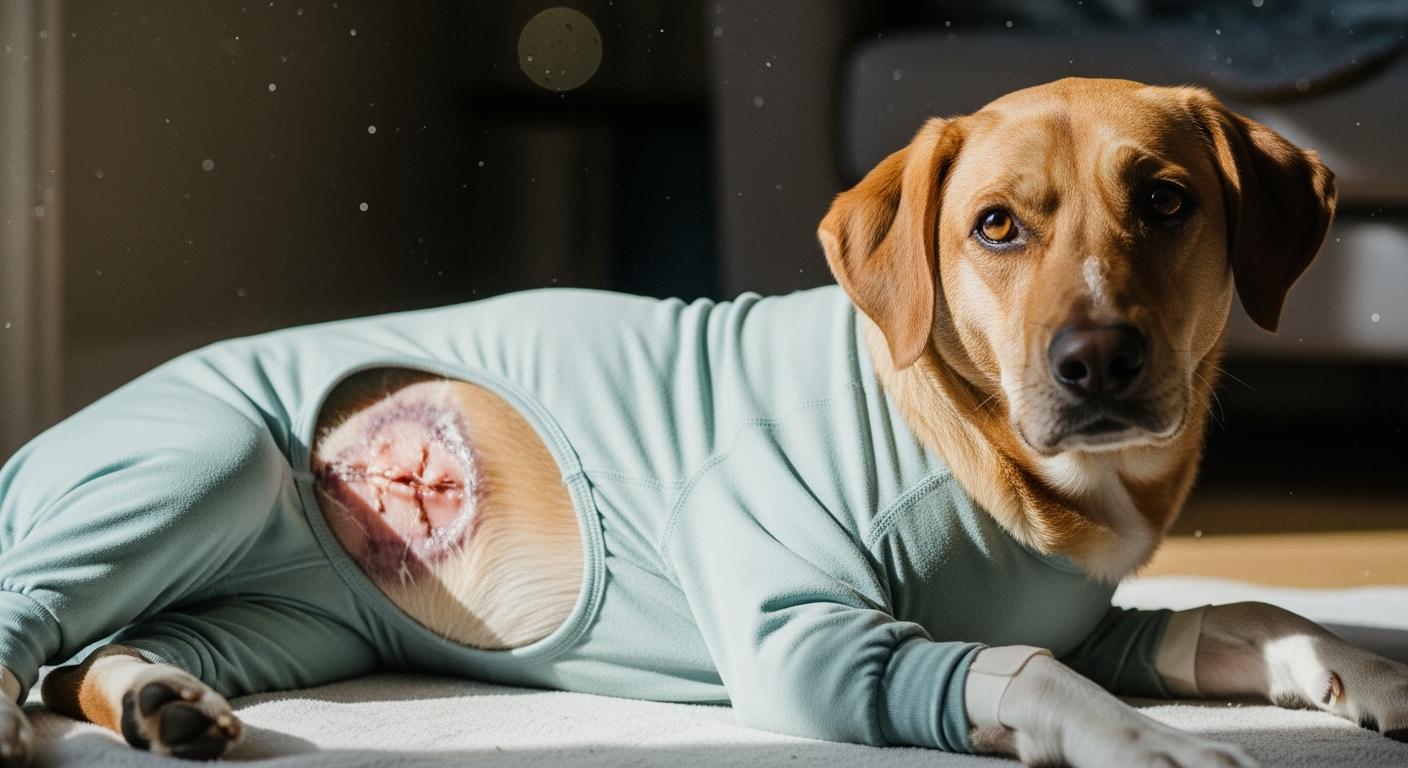
A dog recovery suit for belly wound potty opening covers the incision while the dog stands still. That is the easy part. The problem starts when the dog squats to urinate, sits down, curls up to sleep, or walks across the room. The rear cutout pulls forward. The belly panel rolls or bunches. Gaps open along the wound edge. What looked secure thirty seconds ago is now letting dirt, moisture, and a determined tongue reach the incision.
The failure is not random. It follows the same pattern in suit after suit: an oversized fixed cutout that stretches too far forward, paired with a belly panel too short to hold position once the spine flexes. Understanding that pattern is what lets you pick a suit that actually protects the wound instead of just looking like it does.
Where the Potty Opening Fails During Real Movement
A static fit check is a snapshot of the one position your dog occupies least during the day. The suit and the wound zone need to survive squatting, sitting, curling, and walking — each of which deforms the fabric in a different direction.
Squatting Pulls the Rear Cutout Forward
When a dog squats, the spine rounds and the pelvis tucks. Fabric anchored at the shoulders and tail base has to span a longer path. If the rear cutout is a large fixed opening, that extra path length translates directly into forward shift — the opening edge migrates toward the belly. A wound on the lower abdomen or groin-side that was covered during standing can become fully exposed in under two seconds.
This is the core mechanical failure: the cutout is sized for a neutral spine but the suit is worn through a flexed spine. The mismatch between static cutout dimensions and dynamic torso extension is what creates the exposure window.
Tip: After putting on a suit for the first time, watch your dog through a full squat during the first potty break. If the opening edge moves within half an inch of the wound, coverage will fail during normal daily movement.
| Movement | What goes wrong | Why it happens | Design that holds |
|---|---|---|---|
| Squatting | Opening shifts forward, wound exposed | Spine flexion lengthens torso path; fixed cutout cannot absorb the extension | Mapped rear opening with adjustable flap |
| Sitting | Belly panel rolls upward, gap forms at wound edge | Compression at the hip fold pushes fabric into a ridge; short panels have no reserve length to stay anchored | Longer abdominal panel extending past the wound zone |
| Curling | Fabric bunches into the incision line | No leg anchoring lets the suit rotate; loose torso fabric gathers at the tightest point | Four-leg sleeve anchoring with stable torso length |
| Walking | Suit rides backward, coverage shifts | Shoulder stride pulls fabric rearward; without front-leg anchoring the whole garment migrates | Four-leg coverage distributing tension evenly |
Sitting and Curling Create Belly Panel Gaps
Sitting compresses the abdomen. The hip fold pushes fabric upward. A belly panel that barely reaches the wound edge in a standing position has no reserve — it rides up and the wound margin appears. Curling adds a rotational force: the dog tucks into a ball and the suit twists. Without leg anchoring, the panel follows the path of least resistance, which is directly into the incision zone.
You can verify this without waiting for a problem to surface. After your dog has been lying down for ten minutes, run two fingers along the belly panel edge closest to the wound. If the edge has crept more than half an inch, the panel length is insufficient for the dog’s resting posture. A suit that passes a standing check but fails this lying-down check will expose the wound every time the dog settles in for the night.
Moisture After Potty Breaks Compounds the Problem
Exposure is not the only risk. Even when the wound stays covered, a potty opening that sits close to the incision line can wick moisture into the fabric. Urine contacts the cutout edge. The fabric absorbs it. Capillary action draws it inward toward the wound zone — especially in materials with high absorbency and no moisture barrier layer. Within minutes, the inner surface pressing against the incision is damp.
Damp fabric against a healing wound creates the conditions for bacterial growth and skin maceration. The suit that looked clean after the potty break may have already transferred moisture to the wound margin.
In practice: Flip the inner belly panel inside out after every potty break and press a dry paper towel against it for five seconds. Any moisture transfer to the towel means the suit needs to be swapped for a dry backup.
| Risk | How it reaches the wound | What stops it |
|---|---|---|
| Urine moisture | Contacts cutout edge, wicks inward through absorbent fabric | Moisture-barrier inner layer; small mapped opening placed behind wound zone |
| Fecal bacteria | Transfers if opening is too large and positioned near wound | Adjustable flap that closes the opening when not in use |
| Ambient dampness | Non-breathable fabric traps sweat and humidity against skin | Breathable knit that allows vapor to escape while blocking liquid |
Design Features That Determine Whether the Wound Stays Covered
Potty Opening: Mapped Placement vs. Oversized Fixed Cutout
The single largest variable is whether the opening was placed relative to the dog’s anatomy or simply cut large to fit every shape. An oversized fixed cutout follows a universal pattern — one size of opening for all dogs in a given torso length. But wound location varies. A lower-abdomen incision sits closer to the rear legs than a mid-belly incision. An opening that reaches too far forward clears the way for urination but also clears the way for wound exposure.
A mapped opening, by contrast, is positioned behind the typical wound zones for abdominal procedures. It stays rearward of the incision field. Combined with an adjustable flap, it lets a dog urinate without pulling the opening edge into the wound zone. The flap adds a second line of defense: closed when the dog is resting, opened only during potty breaks.
Belly Panel Length and Anchoring
Belly panel length is not just about coverage distance — it is about reserve length under deformation. When the spine flexes during squatting, the distance from ribcage to pelvis increases. A panel that exactly reaches the wound edge when standing has zero reserve. The moment the torso extends, the panel pulls short. Adding even an extra inch of length — positioned so the panel extends past the wound zone rather than ending at it — creates a buffer that absorbs the extension without exposing the incision.
Four-leg anchoring converts the suit from a torso tube into a full-body garment. When each leg passes through its own sleeve, rotational forces from walking and curling are distributed across four anchor points instead of concentrating at the shoulders and tail base. The panel stays oriented. A recovery suit designed for post-surgery protection that anchors at all four legs resists the twisting that shifts coverage during sleep.
| Design feature | Weak version | Better version | Why it matters for belly wounds |
|---|---|---|---|
| Potty opening | Oversized, one-size fixed cutout | Mapped placement behind wound zone, adjustable flap | Prevents forward shift into incision field during squatting |
| Belly panel | Ends at wound edge, no reserve | Extends past wound zone with deformation buffer | Maintains coverage when torso extends during movement |
| Anchoring | Shoulder and tail only; suit rotates freely | Four-leg sleeves distributing tension evenly | Prevents panel bunching and rotation during curling |
| Inner seams | Raised, ridge-contact on wound margin | Flat-seam construction, no interior ridge | Eliminates friction point at the most sensitive skin |
| Closure path | Centered spine zipper, hard to avoid wound | Off-spine zipper with covered flap | Moves hardware away from incision and vertebral ridge |
| Fabric | Absorbent knit, no moisture barrier | Breathable with wicking inner face and liquid-barrier layer | Keeps wound zone dry even if opening edge gets wet |
Seams, Fabric, and What Happens After Day Three
A recovery suit worn continuously accumulates pressure hours that a standing fit check never simulates. Raised interior seams press the same ridge of skin for hours. On a short-coated dog, that ridge line turns pink within a day. On any dog, the combination of pressure, moisture, and friction against a healing incision can degrade the wound edge. Flat-seam construction eliminates that ridge — the seam sits flush against the body and distributes pressure across its full width instead of concentrating it along a single line.
Fabric choice determines whether the suit stays breathable after multiple wear-wash cycles. A knit that feels airy on day one can lose its vapor permeability after three washes if the fiber structure collapses under agitation. Machine-washable fabric that holds its loft keeps airflow moving across the wound zone. Washing and drying routines matter for maintaining that breathability — a suit that gets pulled from the dryer while still damp or washed with fabric softener can coat the fibers and reduce vapor transfer.
After three days of continuous wear, lift the suit edge and press the back of your hand against your dog’s belly skin for ten seconds. If the skin feels warmer than the surrounding uncovered area, or if it is visibly damp, the fabric is not venting enough moisture. That is your signal to rotate suits more frequently or switch to a more breathable material. This check works regardless of the suit brand or fabric label — skin temperature and moisture are the only metrics that matter.
When a Recovery Suit Is the Wrong Tool for a Belly Wound
A suit that fails the movement checks above is not protecting the wound. But there are also cases where even a well-designed suit should not be the primary barrier.
The Dog Can Still Reach the Wound
Some dogs can lick through a potty opening regardless of how well it is mapped — particularly dogs with long snouts, flexible necks, or determined licking behavior driven by itching or discomfort. If the dog’s tongue reaches the wound edge, the suit is a partial barrier at best. The licking introduces bacteria, disrupts healing tissue, and can open sutures. A lick sleeve compared against a cone addresses a different mechanism — targeted limb protection — but for belly wounds, the question is whether any fabric opening within tongue range creates a path. If it does, the suit needs to be paired with a cone or replaced by one.
Moisture and Contamination Cannot Be Controlled
If every potty break leaves the inner panel damp, and you are changing suits three or four times a day, the suit is not the right solution for that dog’s anatomy or that wound location. A recovery sleeve designed with mapped coverage can provide localized protection on limbs, but for abdominal wounds, persistent moisture means the opening placement does not match the dog’s urination posture. Continuing to use the suit under those conditions trades one risk — licking — for another — maceration and infection.
When a Cone, Bandage, or Veterinary Barrier Is Safer
Wounds positioned directly on the midline of the lower abdomen, within an inch of the prepuce or vulva, sit in a zone that no potty opening can fully avoid. For those wounds, a cone collar paired with a protective anti-lick solution often provides more reliable coverage than a suit alone. The same applies to wounds that are actively draining — drainage saturates fabric, and once saturated, the suit becomes a bacterial reservoir pressed against the incision.
Disclaimer: This fit guidance assumes a dog with standard body proportions and a surgical wound on the abdomen. Dogs with very deep chests, pronounced tuck-ups, or angular limb deformities may show pressure points and coverage gaps that the checks described here do not catch. Short-coated breeds may show rub marks visibly, but double-coated breeds need hand-checking — run your fingers under the suit edges daily, because fur can hide early irritation. If the wound is on the ventral midline within an inch of the prepuce or vulva, no potty opening design is likely to keep the wound fully covered during urination, and an alternative barrier method should be used.
A recovery sleeve sized and fitted for the individual dog works for limb wounds, but the belly presents a different geometry entirely — the surface curves in two directions, flexes with every breath and step, and sits directly in the path of urine. When the design cannot match those conditions, the right call is to step up to a cone, a bandage protocol from a veterinarian, or both.
FAQ
Why does the potty opening expose the wound only when my dog squats?
Squatting rounds the spine and lengthens the torso path between shoulder and tail anchors. A fixed cutout cannot stretch to absorb that extension, so the opening edge migrates forward. The effect is mechanical — it is not a sizing error but a design limitation of oversized fixed openings applied to a flexing body.
How many recovery suits should I keep during healing?
Two at minimum. One worn, one clean and dry. After a potty break where the inner panel shows any moisture, swap immediately. Damp fabric against a wound margin can cause maceration within hours.
Can a recovery suit replace a cone for a belly wound?
Only if the dog cannot reach the wound through the potty opening. If the tongue makes contact with the incision edge — test by observing the dog for ten minutes after putting the suit on — the suit needs a cone paired with it. A determined dog will find the path through any fabric opening within tongue range.
What is the first sign that a suit is causing skin problems?
Redness or dampness at the seam line after removing the suit. For short-coated dogs, this is visible. For double-coated breeds, run your fingers under every suit edge and check for warmth, moisture, or a change in skin texture. Any of these means the suit needs to come off and the skin needs to dry completely before reapplying.
