
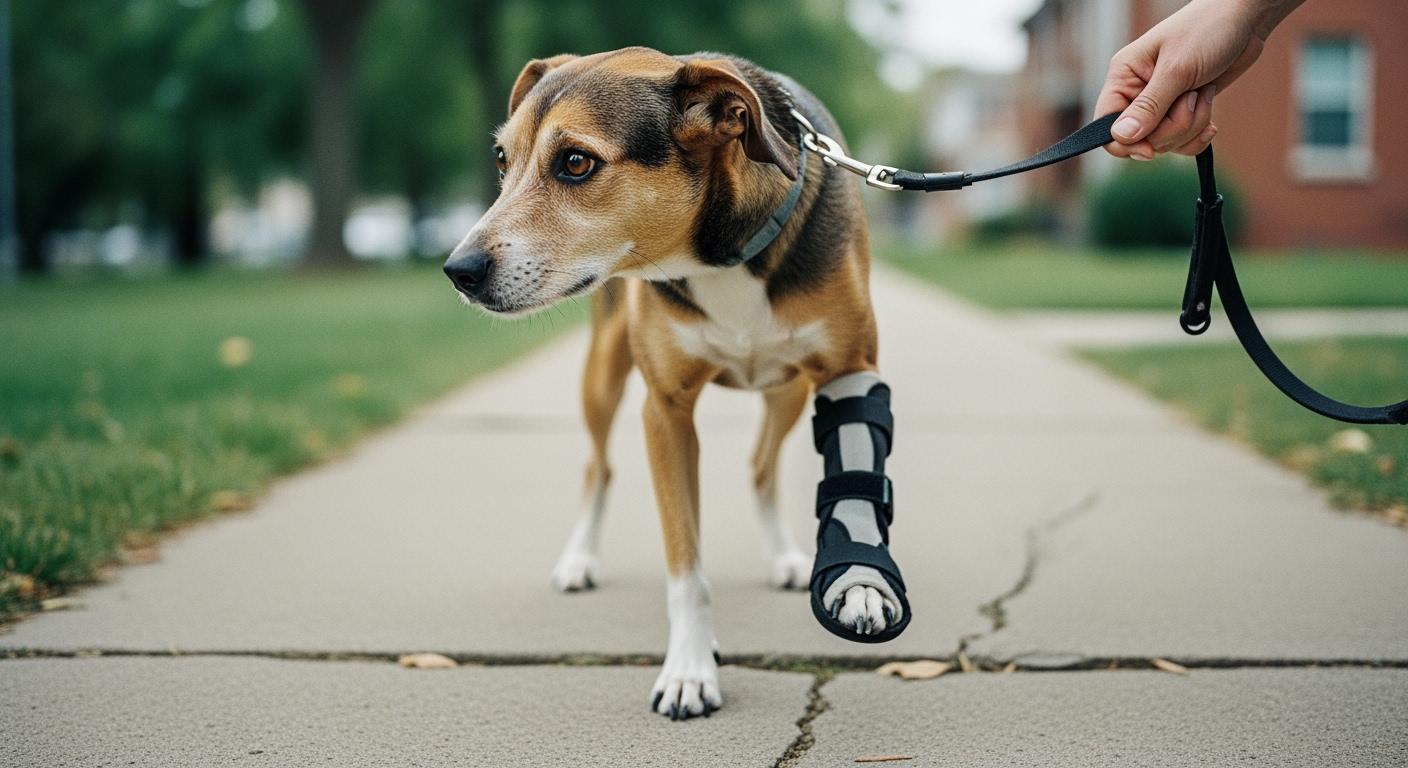
The brace goes on. The toes lift. The paw lands flat. Two minutes later, nails scrape the ground again.
Tension was not the problem. Fit was not the problem — at least not in the way most people check for it. What failed was a cascade that starts where the strap meets the leg and ends where the paw hits the floor. This scene repeats across thousands of short walks because the real failure points are invisible during a static fitting. They only reveal themselves in motion.
A knuckling brace for paw support lives or dies by what happens between the first step and the fifth minute. If the anchor rotates even a few degrees, the lift line goes diagonal. The paw rolls. The nails drag. And tightening the strap — the instinctive response — accelerates every one of these failures.
First Steps Hide the Real Fit Problem
A narrow anchor strap concentrates all side-load force onto a single thin edge. Under lateral load during a turn or weight shift, that edge has no anti-rotation surface to spread the force. The strap edge rolls, taking the brace body with it. As the anchor rotates, the lift cord pulls off-axis — what was a vertical toe-up path becomes a diagonal pull.
That shift matters.
The diagonal force vector introduces shear across the skin surface instead of pure lift through the cord. Shear triggers friction. Friction triggers discomfort. The dog compensates by shortening stride on the braced side or shifting weight to the opposite leg. The brace did not lose tension. It lost alignment. And the first sign — clean paw placement for ten or twenty steps — hides the rotation already building underneath.
This is why static fit checks are not enough. A brace that sits perfectly on a standing dog can rotate fifteen degrees inside two minutes of walking. The wider the anchor zone, the more surface area resists that torque. A toe-up brace fit guide that only checks standing position misses the only check that matters: whether the anchor stays put through a full short-walk cycle.
In practice: Mark the anchor strap’s edge on the fur with a small dot of water-soluble marker before the walk. After ten minutes on flat ground, check whether the dot and strap edge still align. A shift of more than half an inch means rotation has begun — even if the paw has not yet started dragging. This check catches anchor failure before skin damage appears.
What Structure Actually Holds Up During Short Walks
Four structural choices determine whether a toe-lifting brace survives a short walk or fails before the dog reaches the end of the block.
Anchor width. A narrow strap acts like a single-point tether. Side force has nowhere to go except into rotation. A wide anti-rotation cuff distributes the same force across a larger contact patch, keeping the lift cord aligned with the toe axis. Dogs that pivot or turn frequently — common in early knuckling presentations where neurologic control is inconsistent — expose this difference within the first minute.
Tension type. Fixed high tension overpulls at rest. The toes lift, but the constant pull compresses capillaries in the paw. Swelling begins. As tissue expands, effective pressure under the strap increases further. Adjustable tension breaks this loop: set the lift only as high as needed for clearance, and the paw stays perfused. More pull is not safer. It is the fastest route to a dog that refuses the brace entirely.
Sole profile. A bulky sole changes paw placement geometry. The dog’s proprioceptive feedback — the sense of where the paw is relative to the ground — relies on consistent contact through the pads. Add a thick, rigid sole and that signal distorts. The dog lifts the leg higher, lands harder, or drags through the stride. A low-bulk, flexible sole preserves ground feel and reduces compensatory gait changes. After a five-minute walk, paw protection designs that prioritize ground contact feedback show less nail scuffing than rigid-soled alternatives.
Contact padding. Bare cord against skin creates a concentrated pressure line. Under the repeated micro-movements of walking, that line becomes a friction burn. Padded toe contacts — fleece liners, foam-wrapped cord channels, sheepskin under-strap pads — convert a linear cutting surface into a distributed load. The difference is measurable without instruments: lift the brace after ten minutes and press a fingertip along the contact line. Warmth is expected. A defined red groove or skin that stays depressed for more than two seconds is not.
| Weak structure | Why it fails during short walks | Better structure |
|---|---|---|
| Narrow anchor | Rotates under side load, shifts lift line off-axis | Wide anti-rotation cuff |
| Fixed high tension | Overpulls at rest, causes swelling that worsens fit | Adjustable toe-up tension |
| Bare cord contact | Concentrated pressure line creates friction burn | Padded toe contact |
| Bulky sole | Disrupts proprioceptive feedback, causes tripping | Low-bulk grippy sole |
| Low strap path | Shallow lift angle, toes still drag | Lifted strap path |
| One-size fit | Generic contour mismatches paw shape, promotes rotation | Size-specific paw and limb fit |
Pass/Yellow/Fail: The Short-Walk Test
Run this test on flat, dry, non-slip ground for two to five minutes. Do not skip the middle and end checks — they catch what the first steps conceal.
| Test result | What you see | Likely failure point | Response |
|---|---|---|---|
| Toes lift and paw lands flatter | Paw lands cleanly, no scuffing | None | Continue use, monitor skin after each walk |
| Toe lift fades after a few minutes | Paw starts dragging, scuffing returns | Tension loss, rotation | Recheck anchor position; adjust tension, not tighter — reposition |
| Paw rotates outward or inward | Brace twists, paw turns | Narrow anchor, poor contour match | Switch to wide anti-rotation cuff |
| Toes swell or show strap creases | Swelling, deep marks, skin stays depressed | Excess pressure, insufficient padding | Reduce tension, add padding layer under straps |
| Nails still scrape the ground | Nails drag, toe lift fails | Low strap path, insufficient lift angle | Raise strap path on the limb, increase lift cord tension incrementally |
| Dog refuses to walk or limps harder | Limping, freezing, avoidance | Pain, poor fit, gait limit exceeded | Stop use immediately, seek veterinary evaluation |
When a Toe-Lifting Brace Is the Wrong Tool
A brace lifts the toes. It does not create forward movement. If the dog cannot advance the limb on its own — if the leg drags passively without any active swing phase — the brace has no gait to support. This is the hard boundary between a product that helps and a product that cannot reach the problem.
Before putting the brace on, watch the dog take three steps without it. If the paw stays planted and the leg drags behind the body without forward swing, the limitation is not toe clearance. It is limb propulsion. No no-knuckling brace design bridges that gap. That is a lift-harness or assisted-mobility scenario.
Other hard stops: sudden knuckling that was not present yesterday. Collapse during the walk. Vocalization when the brace is touched or adjusted. Loss of bladder or bowel control. These are not fit problems. They are neurologic red flags that need veterinary assessment, not a different strap configuration.
Swelling that persists after removing the brace, cold toes, or skin that turns dusky at the contact line also mean stop. These signs indicate the skin safety risks that rear paw drag braces must account for have been exceeded. A brace that compromises circulation to maintain lift has crossed from support into harm.
Disclaimer: This check assumes a short-coated dog where strap marks and skin color changes are visible without parting fur. Double-coated breeds may show subtler rub marks that need hand-checking — run your fingertips along the strap path rather than relying on visual inspection alone. Dogs with angular limb deformities or very deep chests may fall outside the conformation norms these braces are patterned for, and the fit checks described here may not catch every pressure point in those cases.
FAQ
Why does the toe lift work for the first minute and then stop?
Because the anchor rotates. The strap holds at the starting position, but side forces during walking shift it incrementally. Once the lift cord is even slightly off-axis, the vertical pull becomes diagonal. The effective lift force drops without any change in tension. You are still pulling — just in the wrong direction.
Can I just tighten the strap more when the paw starts dragging?
That is the instinct, and it usually makes things worse. More tension increases pressure under the strap, which restricts circulation, which causes swelling, which increases effective pressure further. The paw drags because the anchor rotated, not because the cord is too loose. Re-center the anchor first. Adjust tension only after the lift path is straight again.
What surface should I test the brace on?
Flat, dry, non-slip ground. Hardwood, short-nap carpet, or smooth concrete. Avoid grass, gravel, or stairs during the first short-walk test — uneven surfaces mask early rotation and make it harder to spot small changes in paw placement and nail contact.
How do I know if the brace is causing skin damage I cannot see?
After removing the brace, press a fingertip along the strap path and cord contact line. Any area that stays indented for more than two seconds, feels hotter than surrounding skin, or produces a pain response when pressed lightly has sustained contact stress. For double-coated breeds, part the fur and check the skin directly. Redness or a defined groove means the padding layer or tension setting needs adjustment before the next use.
When should I skip the brace entirely and go to a veterinarian?
Sudden-onset knuckling — the dog was walking normally yesterday and cannot place the paw today — is a neurologic event until proven otherwise. Collapse during walking, vocalization when the leg is touched, cold toes after brace removal, and any loss of bladder or bowel control all mean stop the test and seek urgent veterinary care. The brace supports gait; it does not diagnose why gait failed.
