
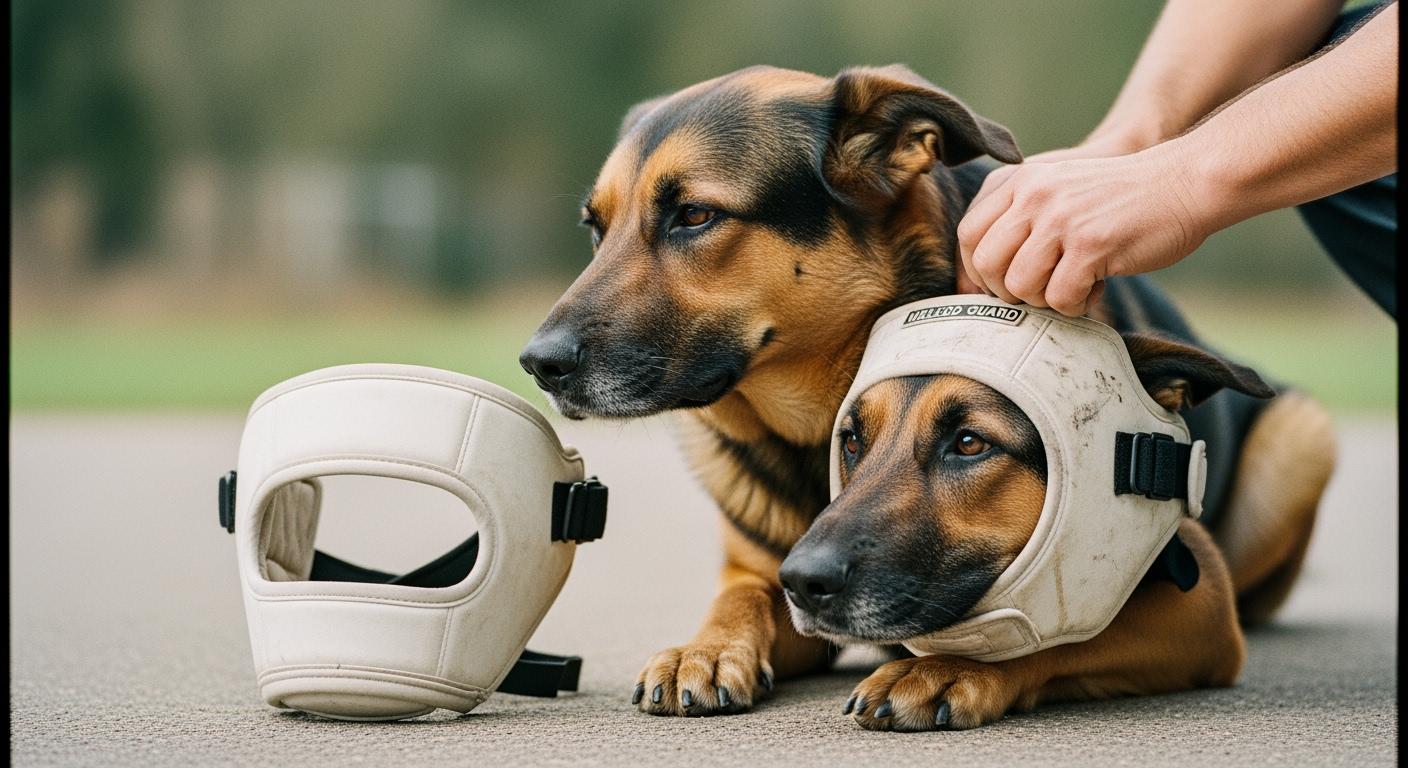
A dog steps into dry grass, lowers its head to sniff, and immediately paws at the field guard head protector. Rubs it on the ground. Freezes. Refuses to move.
That is not stubbornness. It is feedback.
Most refusal comes down to three product failures: flat mesh that collapses against the nose during sniffing, rear straps that shift when the head drops, and cheek edges that rub during side-to-side movement. Each one traces back to a structural or material choice made long before the protector ever touched the dog. How the front panel is shaped, how the rear straps anchor, and what sits against the cheeks matter more than any size chart or acclimation routine.
Where the Protector Fails First: Mesh Collapse Against the Nose
A dog lowers its head to sniff. The mesh panel, if flat and unsupported, folds inward. It touches the nose. Airflow drops. The dog cannot pant freely, cannot catch scent, cannot do the one thing that brought it into the grass in the first place.
Pawing starts within seconds.
The mechanics are straightforward. A flat mesh sheet has no inherent resistance to bending perpendicular to its plane. When a dog drops its head, gravity and the forward pull of sniffing apply a small torque to the lower edge of the mesh. Without a shaped curvature or a rigid front spine to distribute that torque into the frame, the entire panel bows inward. The contact point is the nose tip — the most innervated, scent-driven structure on the dog. Even light pressure there triggers removal behavior.
What changes the outcome: a shaped front standoff. A domed or curved mesh structure creates a gap between the fabric and the nose that holds its shape under the low torque of a dropped head. The standoff works not because the material is stiffer, but because curvature converts bending force into in-plane compression — a direction most mesh materials resist far more effectively. The result is a nose clearance that stays consistent whether the dog is walking at head height or rooting through grass.
Check this yourself. After 10 minutes of walking, lift the protector and look at the dog’s nose. Dry and cool to the touch? The standoff is working. Damp, warm, or visibly indented? The mesh is making contact.
Raw-cut mesh edges compound the problem. A flat mesh that also lacks a finished edge binding concentrates pressure along a narrow line instead of distributing it across a soft hem. That line lands directly on highly sensitive facial skin. Soft edge binding — a folded, stitched hem or a silicone-beaded rim — spreads the same contact force over a wider area and eliminates the cutting sensation that triggers pawing at the face.
Beyond the front panel, the fit of any face gear depends on structures that let a dog open its mouth, pant, and sniff without the fabric restricting those movements. A design that shapes the mesh away from the nostrils while leaving the mouth freely mobile tends to produce far less rejection than one that treats the face as a static surface. For dogs recovering from wounds or managing skin conditions where licking is the primary concern, similar principles show up in how well face and body protection stays in place during movement — a topic covered in more detail when looking at the structural features that keep a head cover seated during active sniffing and turning.
Where the trade-off lives: a deeper dome adds nose clearance but increases the overall profile, which can catch on brush. A shallower dome stays closer to the face but risks contact during aggressive sniffing. Neither design is categorically better — the right choice depends on the terrain and the dog’s sniffing style.
| Refusal sign | Likely reason | Better structure or adjustment | When to stop |
|---|---|---|---|
| Pawing at the face | Mesh touches nose or blocks airflow | Shaped front standoff, deeper dome | Repeated pawing with stress signals |
| Rubbing protector on ground | Nose or cheek edge contact | Soft edge binding, smooth inner seams | Strong rubbing, refusal to walk forward |
| Refusing to move | Blocked panting or vision | More nose clearance, breathable mesh | Refusal persists after fit adjustment |
| Heavy panting or drooling | Poor airflow, heat buildup | Open-weave mesh, larger standoff gap | Panting with closed mouth, stress drool |
| Mask rotating during sniffing | Loose or shifting straps | Stable rear and neck anchoring | Mask slides over eyes or nose |
| Nose still pushes into grass | Insufficient coverage or depth | Deeper dome, extended lower panel | Protector cannot maintain position |
Strap Shift and Edge Pressure: Why the Rear Anchoring Decides Stability
That fails fast.
The force pathway matters here. A single rear strap resists forward pull only through friction against the fur and skin. When the dog drops its head, the downward vector of the head adds to the forward pull of sniffing, and the combined force exceeds the static friction that was holding the strap in place. A dual-point rear anchor — one strap behind the ears, one under the chin or across the crown — creates a triangulated hold. The two anchor points convert sliding force into tension between fixed positions, which the strap material can resist structurally rather than relying on friction alone.
Walk the dog for 10 minutes, then check whether the rear strap has shifted more than half an inch from where you fastened it. If it has, the anchoring configuration is not holding — and no amount of tightening will fix it, because tightening only increases the downward vector that causes the shift in the first place.
Cheek rubbing is a separate but related failure. When a dog sniffs side to side, the cheek panels flex. If the edge binding is stiff, narrow, or positioned high on the cheekbone, each head turn drags that edge across the skin. The dog responds by rubbing the whole protector on the ground — not because the fit is wrong in the abstract, but because the edge geometry concentrates lateral force onto a line instead of a surface.
Tip: After the first field walk, run a finger along the inside of each cheek panel. If you feel a ridge, seam, or texture change at the edge, that is where the pressure concentrates. A rolled or padded edge spreads the same contact force and tends to reduce rubbing in most dogs.
Ear base pressure triggers a different signal: head shaking. Most head protectors sit near the base of the ears, and if the fabric bunches or the strap anchor point presses into that junction, the dog shakes its head repeatedly. Smooth inner seams and softer materials near the ear openings reduce this trigger. The same fit principles that determine whether a head cover stays stable during active movement without creating ear pressure apply directly to field guard head protectors — the strap configuration and seam placement are what matter, not the overall size label.
None of these failures are about the dog being difficult. They are about straps that slide because the anchoring geometry cannot resist the forces of natural head movement, and edges that rub because the contact surface is a line rather than a pad. Protective gear across the body shares this pattern — whether it is a leg sleeve or a full-coverage design, how well the piece stays in position under motion is rarely about the size and almost always about how the anchoring points and edge finishes manage movement forces.
When a Field Guard Head Protector Is the Wrong Choice
A shaped standoff cannot fix a protector that is fundamentally too small for the dog’s skull. Adjustable straps cannot compensate for a face shape that falls outside the design template. Some dogs, some breeds, some conformations simply do not match what a given head protector was patterned for.
Stop the session immediately if the dog cannot open its mouth to pant. If the protector presses on the eyes. If the dog freezes, drops to the ground, or shows panic — rapid panting with a tight mouth, whites of the eyes visible, trembling. These are not acclimation issues. They are structural incompatibility.
Breeds with very short muzzles, very deep brow ridges, or heavily domed skulls can present fit challenges that no amount of strap adjustment resolves. The protector’s internal cavity shape either matches the dog’s head geometry or it does not. When it does not, the mismatch shows up as concentrated pressure at the points of contact — typically the brow, the cheekbones, or the bridge of the nose.
Disclaimer: This fit assessment assumes a mesocephalic or moderately dolichocephalic skull shape with standard-set eyes and ears. Dogs with brachycephalic conformation, angular limb deformities, or very deep chests relative to head size may show pressure points that visual inspection alone does not catch. For these dogs, run a hand under every edge after 5 minutes of wear — if you feel heat, dampness, or indentation at any single point, the cavity shape is not matching and forcing acclimation will not solve it.
Warning signs after grass exposure demand a different response. Sudden sneezing, repeated head shaking, eye squinting, discharge, or bleeding are not fit failures — they may signal that a grass awn or foxtail has already embedded. The protector is not a retrieval tool. If these symptoms appear, stop using the protector and seek veterinary attention. The same caution applies to any protective gear worn on the face or head — the design can deflect debris but cannot address material already lodged in tissue.
There is a broader principle here that also appears when protective gear must stay in contact with healing or sensitive skin for extended periods. A design that works in a brief trial often fails during sustained wear because heat and moisture accumulate, the dog’s movement patterns change, and pressure points emerge that were not visible in the first 5 minutes. The same dynamic plays out with a range of field and recovery products across different body zones, including protective sleeves and covers designed to resist shifting during daily movement.
For dogs that cannot tolerate any face gear after multiple fit attempts, a different protective strategy is the better path. The slow, pressure-free introduction steps that help some dogs accept body-worn protection — letting the dog inspect the item, rewarding calm proximity, building from seconds to minutes without fastening — also serve as a useful framework when introducing any unfamiliar protective equipment, as discussed in the context of step-by-step habituation for gear that must sit against sensitive skin.
FAQ
Why does my dog paw at the protector only when sniffing the ground?
Ground sniffing drops the head and applies forward pull. A flat mesh panel bows inward under this combined force and touches the nose. The dog paws to remove the contact. A shaped front standoff that holds curvature during head drop tends to eliminate this trigger.
The protector stays on at first, then shifts after a few minutes. What is failing?
The rear anchoring is likely losing position. A single horizontal strap around the back of the skull slides down the natural taper of the head as the dog moves. Each step adds a small shift. After several minutes, the accumulated shift rotates the protector forward. A dual-point anchor — behind the ears plus across the crown — resists this by converting sliding force into tension between fixed positions.
Can I tighten the straps to stop the shifting?
Tightening a single rear strap often makes the problem worse. It increases the downward force vector that causes the strap to ride down the slope of the skull in the first place. If the strap has shifted more than half an inch after 10 minutes of walking, the anchoring geometry needs to change — not the strap tension.
How do I know if the cheek edges are the problem?
After a walk, look at the inside of each cheek panel. If the dog has been rubbing the protector on the ground, run a finger along the inside edge. A ridge, seam, or abrupt texture change at the edge concentrates lateral rubbing force. A rolled or padded edge tends to distribute it. Redness or dampness on the dog’s cheek at the edge line confirms the rubbing point.
What if my dog simply will not accept any face gear at all?
Some dogs, particularly those with very short muzzles or prominent brow ridges, may not fit the internal cavity shape the protector was patterned for. If three separate fit attempts with different strap configurations all produce panic, freezing, or refusal to move within 5 minutes, the protector is likely incompatible with that dog’s head geometry. A different protective strategy — such as environmental management during grass walks — is the safer path.
When does refusal become a veterinary concern?
If the dog shows sudden sneezing, repeated head shaking, eye squinting, nasal discharge, or bleeding after grass exposure, stop using the protector and seek veterinary care immediately. These symptoms can signal an embedded grass awn that the protector cannot address. The protector deflects debris during wear. It does not retrieve material already lodged in tissue.
