
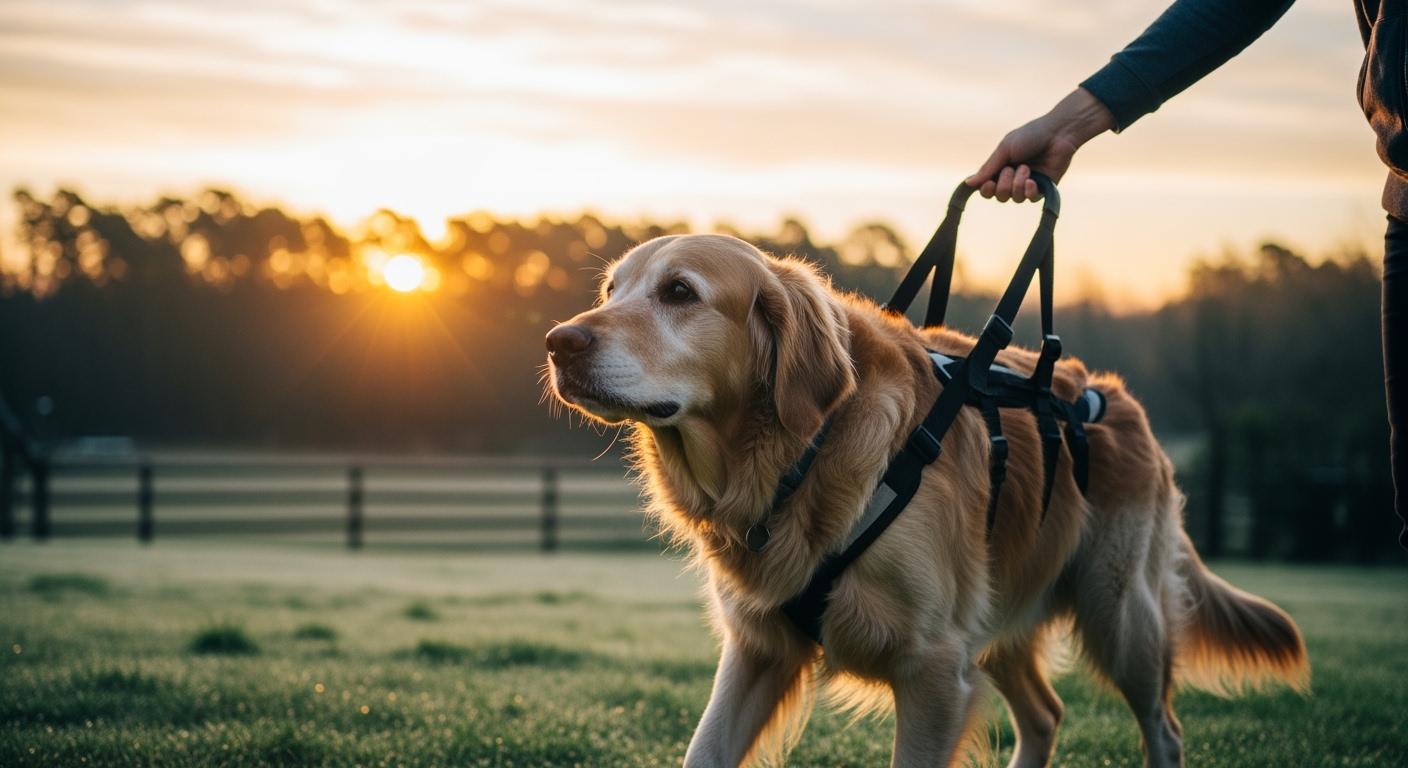
A narrow strap under the belly looks like enough. It is not. Morning stiffness changes the equation — joints cooled overnight resist load differently than they do mid-day. A towel or a thin sling concentrates body weight onto a band no wider than two fingers. That band pinches. It slips. The dog tenses against the discomfort, and the tool meant to help becomes another thing the dog braces against.
This article picks apart where lift support fails during the first minutes after waking, which design choices cause those failures, and what separates a harness that stabilizes an arthritic dog from one that makes the morning harder.
Where Morning Lift Support Fails for Arthritic Dogs
Narrow support surfaces concentrate pressure instead of spreading it
A hand under the belly. A rolled bath towel. A basic sling with a single strap. Each applies force through a contact patch roughly an inch and a half wide. On a 60-pound dog, that means roughly 40 pounds per linear inch pressing into soft tissue.
The physics is straightforward. Pressure equals force divided by area. Halve the area, double the pressure. When the contact surface is a thin band, the load does not distribute across the hips and ribcage. It drills into one narrow line. Subcutaneous tissue gets pinched between the strap edge and the underlying muscle. Blood flow drops in that compressed zone. Within a minute or two, the dog starts to squirm — not from the arthritis, but from the strap itself.
You can verify this without special equipment. Run your fingers under the lift point immediately after setting the dog down from a towel assist. If you feel a warm, indented line across the belly that stays visible for more than 30 seconds, the pressure concentration is too high. A properly distributed load leaves no lasting impression because pressure never exceeded capillary refill pressure in the first place.
A harness with a wide padded panel — typically 4 to 6 inches across the belly section — spreads that same load over roughly five to seven times the surface area. The edges are bound with a soft finish that does not dig. The panel stays flat under tension instead of rolling into a cord. That is the structural difference between a support surface and a pinch point. The dog lift harness category spans designs with broad belly bands and others that cut corners with narrower straps that roll under load.
Short handles create jerky lifts that stiff joints cannot absorb
Handle length seems minor. It is not. When the handle is too short, the person lifting must bend forward. That bent posture shifts the pull angle from vertical to diagonal. A diagonal pull introduces a horizontal force component that drags the dog sideways while lifting upward. Stiff hips and knees, already reluctant to flex, get pulled at an angle they cannot follow.
The result is a jerk — a sudden acceleration when the handler’s arms reach full extension and slack snaps tight. An arthritic joint loaded abruptly triggers protective muscle contraction. The dog stiffens further. The handler pulls harder. The cycle escalates.
Adjustable handles change the geometry. The handler stands upright. The pull stays vertical. Force rises gradually as the handler straightens their knees, not in a single snap. After a short assisted walk, check whether the harness handles let you maintain an upright posture throughout. If you find yourself bending forward by the end, the handle length is not matched to your height and the dog’s torso depth.
| Morning stiffness problem | Why the support fails | Better harness feature |
|---|---|---|
| Narrow towel lift | Pressure concentrates on a thin band; skin pinches; dog squirms | Wide padded belly/hip support panel with soft edge binding |
| Short fixed handles | Diagonal pull angle drags dog sideways; slack snaps tight into a jerk | Adjustable handle length matched to handler height and dog depth |
Wrong sling shape blocks potty posture
A sling that wraps fully under the belly and between the hind legs blocks the dog from spreading the rear limbs wide enough to squat. A male dog cannot lift a leg. A female dog cannot lower her hips into position. The dog circles, hesitates, or holds urine — which increases the risk of a urinary tract issue over repeated mornings.
The structural fix is a rear cut-out or open-perineum design. The support panel runs under the belly and stops before the groin. The rear edge sits behind the last rib but forward of the genital area, leaving the potty zone unobstructed while still supporting the hip and lower-spine load path. Watch your dog during the first potty attempt with a new harness. If the dog sniffs the ground and straightens back up without going, the sling edge is likely interfering. Reposition it forward by half an inch and try again.
| Problem with wrong sling shape | What you see | Better solution |
|---|---|---|
| Sling blocks hips or thighs | Dog cannot squat or lift leg | Use a harness with open potty zone |
| Sling pinches or rubs | Dog resists or whines during placement | Choose soft, padded edges with flat-lock stitching |
| Sling too wide under belly | Dog holds urine or stool | Select a sling with rear cut-out that stops before the groin |
When Rear-Only Support Is Not Enough

Why arthritis rarely stays in one joint
A dog with arthritic hips compensates by shifting weight forward. The front legs take more load. Over months, the carpal joints and elbows accumulate wear they were not designed for. What started as hind-end stiffness becomes a multi-joint problem. The owner sees a rear-leg issue and buys a rear-support harness. The harness lifts the hips. But the front end — carrying extra load from months of compensation — has no support.
The dog takes two assisted steps and the front legs buckle. Or the dog leans hard to one side, twisting the rear harness panel out of position. The handler tightens their grip to correct the lean, which pulls the harness further off-center. A full-body harness with front and rear control points distributes stabilization across both ends, so a front-end wobble does not cascade into a full-body off-balance event.
What a full-body lift harness changes structurally
A rear-only harness has one load path: handler hands to handle to strap to belly panel to the dog’s hindquarters. A full-body harness adds a second load path through the chest and shoulder girdle. When the dog shifts weight forward, the chest strap catches the shift before it becomes a stumble. The rear panel stays centered because the front attachment prevents the assembly from rotating around the dog’s torso.
The design difference that matters most is independent adjustability. Each support point tightens separately. A dog with a deep chest and narrow waist needs different tension front and rear. If both sections pull from the same strap, one zone is always too loose or too tight. Check this after the first five minutes of wear: run a finger under each strap edge. If one edge leaves a deeper impression than the others, that zone is carrying disproportionate load. Rear-lift and full-body designs diverge most at this adjustment granularity — the number of independent tension points directly controls how evenly the load spreads.
| Harness type | Best for | When to avoid |
|---|---|---|
| Lift sling | Short transfers, potty breaks | Long walks, dogs with front-end weakness |
| Rear support harness | Hind-end stiffness, dog can control front legs | Dogs that lean, twist, or stumble forward |
| Full body lift harness | Multi-joint weakness, balance loss, stairs and ramps | Dogs with open wounds, severe skin conditions, or harness intolerance |
Which Harness Design Fits the Morning Routine
Not every stiff dog needs a full-body harness. Not every dog does fine with a simple sling. The match depends on where the stiffness concentrates and what the dog does in the first ten minutes after waking.
Rear support harness: hind-end stiffness with stable front legs
When the dog’s front legs plant firmly and the problem is purely rear-end, a rear support harness with a wide belly panel and adjustable handles is the right match. The panel spans from hip to hip. The key fit check: after the dog stands, the panel should sit centered under the belly without riding forward toward the ribcage. If it migrates forward within the first minute, the rear edge is not anchored firmly enough against the hind legs. Harness selection for hind-leg weakness often comes down to this migration pattern — a panel that drifts forward under load shifts support away from the hips and onto the abdomen, where it does little for joint stability.
Lift sling: short transfers and potty support
A sling is not a walking harness. It is a transfer tool — bed to door, door to grass, grass back to bed. Under two minutes of continuous use. The sling works when the dog can bear weight on at least three legs and needs only a small upward assist to clear a threshold or maintain balance during elimination.
The sling fails when asked to do more. On a five-minute walk, the narrow support band that was tolerable for 60 seconds becomes uncomfortable. The handler’s grip fatigues. The sling fabric bunches. The dog, sensing the instability, slows down or stops. For anything beyond a short transfer, the support surface needs to be wider. A properly fitted lift harness with daily-use ergonomics distributes load across a broader contact area and keeps handle strain off the handler’s wrists during longer assist sessions.
Full body lift harness: when balance is not single-joint
The decision point is observable. If the dog’s front paws slide outward during a rear-only assist, the front end is not stable enough for single-point support. If the dog leans into the handler’s legs for balance rather than using them purely for lift, the dog is compensating for multi-point weakness. Both signals point toward a full-body harness.
A full-body design adds chest and shoulder stabilization through a separate front panel connected to the rear section by adjustable side straps. The load distributes across four to six contact zones instead of one or two. For dogs that twist, drift sideways, or panic when one end loses footing, this multi-point control prevents the spiral where instability triggers fear triggers muscle tension triggers more instability. Mobility support solutions for dogs with hind-leg weakness cover the full spectrum from single-point slings to multi-point harness systems, matched to where the weakness pattern falls on the rear-only to full-body continuum.
| Morning problem | Best harness type | Why it fits | When to avoid it |
|---|---|---|---|
| Rear legs shaky, slow to rise | Rear support harness | Wide padded panel supports hips without pinching; handles allow upright posture | Dog leans, twists, or stumbles in front |
| Needs help standing for potty or short transfer | Lift sling | Quick to position, open design for potty, soft edges for brief contact | Dog needs to walk more than two minutes or has front-end weakness |
| Leans, twists, or stumbles in front and back | Full body lift harness | Independent front and rear control points stabilize both ends simultaneously | Dog resists harness or has wounds under contact zones |
| Potty posture blocked by sling | Harness with rear cut-out | Open-perineum design allows natural squat or leg lift | Sling edge still sits too far back for the dog’s specific anatomy |
| Handler must bend or pull at awkward angle | Harness with adjustable handles | Handle length matches handler height; vertical pull reduces sideways drag | Handles not independently adjustable for length |
| Dog slips or loses balance on smooth floor | Full body lift harness | Multi-point control plus non-slip inner surface keeps dog stable on slick surfaces | Dog only needs rear support and has reliable balance |
When a Lift Harness Is Not the Right Tool
A harness supports controlled movement. It does not create movement where none exists. If a dog cannot rise at all — even with verbal encouragement and a stable floor — a harness will not solve that. The inability to generate any upward force from the limbs signals a problem beyond what support alone addresses.
Other boundary conditions: a dog that cries out when the harness panel touches the belly or hips may have pain at the contact site, not just joint stiffness. A dog that collapses completely when the harness takes weight — rather than using the support to steady itself — may have neurologic involvement where proprioception is impaired. One leg that consistently fails to bear weight while the other three function normally points toward a single-joint injury, not generalized arthritis stiffness.
Fit failure shows up in specific patterns. Redness or hair loss along a strap line after 5 to 10 minutes of use means the pressure under that strap exceeds what the skin can tolerate. A harness that rotates around the dog’s torso during walking means the panel shapes do not match the dog’s cross-section — typically because the chest is deeper or narrower than the harness pattern was cut for. If adjusting one strap to fix a gap loosens another strap elsewhere, the harness lacks independent tension zones.
| Sign | What it may mean | Safer next step |
|---|---|---|
| Dog cannot rise at all | Severe pain or loss of limb function | Contact your veterinarian before attempting harness use |
| One leg not weight-bearing | Possible single-joint injury, not generalized stiffness | Stop harness use, seek veterinary evaluation |
| Dog cries out or collapses when lifted | Pain at contact site or neurologic instability | Stop immediately, reassess with veterinary guidance |
Disclaimer: The fit checks and pressure-distribution observations described here assume a short-coated dog where skin and strap lines are visible. Double-coated breeds may hide rub marks under the outer coat — hand-check by running fingers flat under each strap edge after removal rather than relying on visual inspection alone. If the dog’s leg conformation falls well outside typical breed proportions — particularly dogs with angular limb deformities or very deep chests — the panel and strap positions described may not catch every pressure point. In those cases, a custom-fitted harness pattern is more reliable than adjusting an off-the-shelf design.
FAQ
How do I know if the harness panel is wide enough?
After a short assisted walk, remove the harness and check the skin. A panel that is too narrow leaves a distinct indented line. A properly wide panel leaves either no mark or a broad, faint impression that fades within 30 seconds. The indentation tells you whether load spread across the panel or concentrated at its edges.
Can a lift harness make morning stiffness worse?
It can, if the support pulls at an angle that forces joints into positions they resist. A harness with fixed short handles that forces the handler to bend and pull diagonally can torque stiff hips outward. A harness that concentrates pressure on a narrow band can cause the dog to tense against the discomfort, which increases overall muscle stiffness rather than reducing it. The harness itself is not the problem — the mismatch between the design and the dog’s stiffness pattern is.
Should I leave the harness on between morning assist sessions?
No. Even a well-fitted harness creates sustained pressure on the skin and underlying tissue. Over hours, that pressure can restrict circulation and cause irritation even when no single strap feels tight. Remove the harness after each use session. Check the skin underneath before reapplying.
