
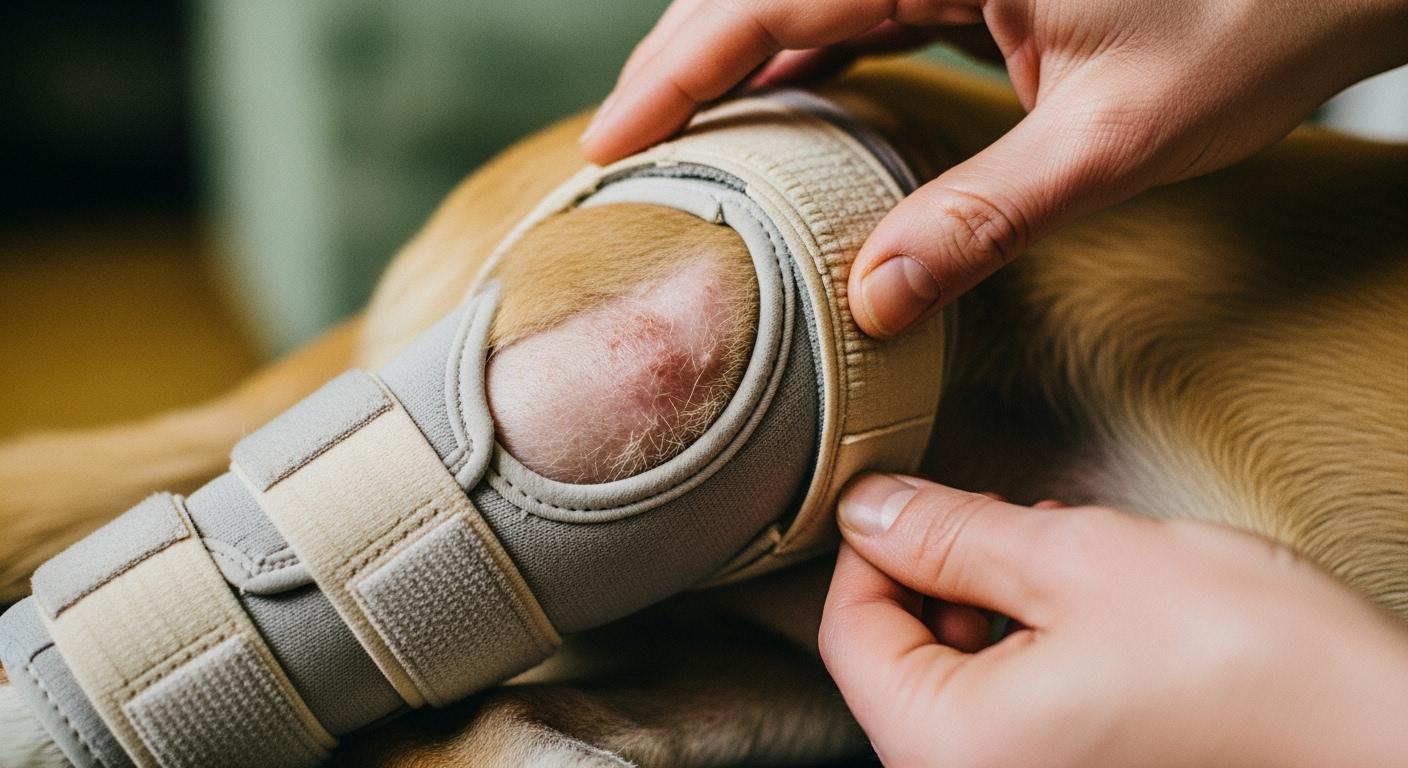
A brace goes on. The dog stands still. Ten minutes later there is a red line pressed into shaved skin. The skin is bare because the surgical prep clipped every hair from knee to ankle, and what remains has no buffer against strap edges, liner seams, or shell rims. The problem is not that the brace is tight. The problem is that the brace interfaces with unprotected skin through design features that were never meant for a zero-hair surface. Two failure paths dominate: strap edges concentrating force into a narrow pressure band, and brace rotation turning light contact into repeated abrasion while damp liner material multiplies the friction coefficient against that same patch of skin.
Why a Dog Leg Brace Rubs a Surgical Shave Area During TPLO Recovery
Hair is not decoration. It is a shear plane. When a strap or shell rim presses into a furred leg, hair fibers slide against each other and dissipate lateral force before it reaches the skin. Shave that leg, and the same strap now presses directly into epidermis with no intermediate layer to absorb displacement. This is why a brace that feels comfortable on an unshaved leg leaves a welt on a post-surgical one.
Strap edges and the force-concentration problem
A narrow strap is a force concentrator. When you tension a half-inch strap over hairless skin, the contact patch is small and the pounds-per-square-inch are high. What a wider strap does is not just “spread pressure” in the abstract. It increases the contact area, which drops the psi for the same strap tension. The skin under a wide strap may experience one-third to one-quarter the localized pressure of a narrow strap at the same overall tightness. That difference determines whether capillaries under the skin stay open or collapse under load.
The edge matters as much as the width. A strap with a sharp, unbound edge creates a pressure spike right at the rim — a line of peak compression that the tissue beneath cannot redistribute. Rolled-edge binding or a padded hem diffuses that rim force across a curved surface instead of a cut edge. Watch for the 15-minute signal: remove the brace, note any red lines, and check again 15 minutes later. A line that fades within that window reflects temporary compression. A line that stays red beyond 15 minutes means the tissue took more pressure than it could recover from quickly. That is the threshold where strap design has failed the skin.
Rotation: how light contact becomes repeated abrasion
A brace that stays put and a brace that shifts half an inch with every step are fundamentally different tools. The shift turns a contact point into an abrasion cycle. Each time the dog plants the leg, the brace rotates slightly, the liner or strap edge drags across the same strip of shaved skin, and the abrasion count accumulates stride by stride.
The mechanical root is usually a shape mismatch. A dog’s thigh tapers from proximal to distal. If the brace shell is a straight cylinder, the wider thigh section creates a wedge that pushes the brace downward with each weight-bearing phase. An anti-rotation contour — a shell shaped to match the taper, or an upper anchor that sits above a muscular curve — resists that migration. Without it, tightening the straps harder only increases the contact pressure while the brace still rotates. Now the skin faces both high pressure and high shear. That fails fast.
Check rotation by marking the top edge of the brace with a piece of tape aligned to a reference point on the dog’s leg. Walk the dog for five minutes on a flat surface. If the tape has shifted more than half an inch relative to that reference point, the anti-rotation shape is not working for this dog’s leg geometry.
Damp liner: the friction multiplier
Most liner materials have a higher coefficient of friction when wet. A dry neoprene or polyester liner slides against skin with relatively low drag. The same liner, saturated with sweat or water from outdoor walks, grips the skin. Each micro-movement of the brace now tugs at the surface layer of the epidermis instead of gliding over it. Over hours of wear, that tugging accumulates into erythema, then superficial erosion, then an open wound.
The observable check is straightforward. After a wear session, open the brace and press the back of your hand against the liner. If it feels damp against your skin, it was damp against the dog’s skin the entire time. Breathable liner materials with moisture-wicking construction reduce the time the skin spends in a wet-friction state. But no liner breathes well enough to skip removal and drying between sessions.
| Failure Sign | Why it Happens | Better Structure or Action |
|---|---|---|
| Red strap line on shaved skin | Narrow strap concentrates force on small contact patch; unbound edge creates rim pressure spike | Wider straps with rolled or padded edge binding spread load across larger area |
| Edge mark near the joint | Hard shell or hinge rim contacts bare skin without cushioning layer | Padded edge guard; verify hinge aligns with joint axis not above or below it |
| Brace rotates during walking | Cylindrical shell shape does not match natural leg taper; no anti-rotation contour | Contoured shell or upper anchor point above muscular curve; check with tape-mark test |
| Damp liner over shaved skin | Sweat or external moisture trapped in non-wicking liner; wet material has higher friction coefficient | Breathable, moisture-wicking liner; remove and dry between sessions |
| Dog chews or refuses the brace | Pain or persistent discomfort from pressure, friction, or heat buildup | Pause use; check for all failure signs above; consult veterinarian before resuming |
| Safety Level | What You See |
|---|---|
| Green | Skin normal, no lasting redness, dog moves without guarding or limping |
| Yellow | Mild pinkness that fades within 15 minutes, slight brace shifting, occasional licking interest |
| Red | Swelling, heat, discharge, bleeding, pain response, cold toes, open skin, worsening limp |
Fit Checks Before You Tighten the Brace for TPLO Recovery
Most fitting problems start before the first strap is tightened. The sequence is: position, align, check contact points, then tension. Reversing that order — tightening first and checking alignment second — is how pressure points get locked in.
Alignment before tension
Place the brace on the leg without tightening anything. Look at where the hinge or side stabilizer sits relative to the knee joint. The hinge axis should line up with the joint axis, not above it on the femur or below it on the tibia. A hinge offset by half an inch creates a lever arm: every step the dog takes, the brace applies a bending moment to the joint instead of tracking with it. That moment transmits through the shell into the strap contact points, and the shaved skin under those straps absorbs the extra force.
Check that no strap path crosses directly over the incision line unless a protective barrier is in place and the veterinarian has confirmed it is safe. The incision itself should not bear strap pressure during the early healing phase. A brace positioned with clearance around the surgical site reduces the risk of wound-edge tension that can delay closure.
The 15-minute redness rule
Redness immediately after brace removal is expected — compression temporarily restricts blood flow and the rebound produces visible erythema. The diagnostic window is what happens next. Remove the brace, note the location and intensity of any red marks, and set a timer for 15 minutes. At the 15-minute mark, recheck. If the marks have faded to barely visible or gone, the tissue perfusion recovered normally and the fit is within the skin’s tolerance range. If the redness persists, deepens, or has distinct edges matching strap or shell borders, the tissue sustained more than it can recover from in that window. Stop use and adjust the fit before the next session.
This same check appears across TPLO recovery protocols because sustained tissue compression under a brace follows the same mechanism regardless of which leg or which surgery: pressure above capillary closing pressure, applied for longer than the tissue can tolerate, produces ischemia, then inflammation, then breakdown.
Compare standing, sitting, and walking contact points
A brace that fits perfectly in a standing position may shift noticeably when the dog sits or walks. The stifle angle changes, muscle bellies shorten or lengthen, and the skin surface moves relative to the brace shell. Check contact zones in all three positions. Mark the skin lightly with a washable marker at the brace edges, then walk the dog and recheck. If the brace rim has moved relative to the marks, the fit is not stable across the full range of motion. This is particularly relevant for dogs whose leg conformation falls outside breed-typical proportions, where off-the-shelf shell shapes may mismatch the individual taper angle.
Better Structure for Shaved-Skin Contact
Edge binding
The rim of a brace shell or strap is where pressure peaks. A raw-cut edge, whether neoprene or molded plastic, presents a narrow linear contact surface. All the force distributed through the strap or shell body funnels into that thin line where it meets skin. Rolled binding, padded hemming, or a folded-over liner that wraps the edge changes that line contact into a radiused surface contact. The peak pressure drops because the same force now acts on a wider strip of tissue.
For a knee brace worn after CCL surgery, the edges closest to the shaved patch matter most. If the proximal or distal rim crosses the clipped zone, those edges need binding as soft as the liner itself. A hard shell edge with no buffer can produce a visible indentation after a single wear session.
Strap width and pressure distribution
Wider is not just more comfortable. It is a different mechanical system. A one-inch strap distributes the same tension force across roughly twice the skin area of a half-inch strap. But there is a limit: beyond about one and a half inches on a medium-sized dog, a strap becomes difficult to tension evenly across its full width, and the center may carry more load than the edges. The effective width is the width that can be tensioned uniformly. Straps should lie flat. A twisted or bunched strap concentrates its entire load into whatever ridge of material touches the skin, functionally behaving like a much narrower strap.
Liner material and moisture management
A liner serves two functions that can conflict: it cushions, and it must pass moisture. Dense foam cushions well but holds water. Open-cell foam passes moisture better but compresses permanently under repeated loading and loses its cushioning. A multi-layer liner — a thin, dense cushion layer bonded to a moisture-wicking face fabric — separates those functions. The wicking layer moves sweat away from the skin surface, and the cushion layer provides mechanical protection.
The daily check: after each wear session, remove the brace and feel the liner surface. Dry and smooth means the moisture-management system is keeping up with the dog’s output for that session duration. Damp or sticky means the session length exceeded what the liner can handle, and the skin spent the final portion of wear time in a wet-friction state. Shorten sessions or add a liner change mid-day.
Anti-rotation shape
Rotation resistance comes from geometry, not strap tension. A brace that relies on strap friction alone to stay in place will always migrate under dynamic loading. The shell itself must create mechanical interference with the leg’s natural contours. A well-designed brace uses an upper anchor — a flare above the thigh muscle, a cupped heel seat, or a shaped calf pocket — that gives the brace something to push against when gravity and motion pull it downward. Strap tension then becomes a secondary stabilizer rather than the only thing keeping the brace from sliding off. That distinction matters because any brace tight enough to resist rotation by strap friction alone is almost certainly tight enough to compromise circulation under the straps.
For a closer look at how hinge type and shell contour affect daily-use stability, the design differences between hinged and soft-shell knee braces illustrate why anti-rotation geometry, not just padding thickness, determines whether a brace stays put through a full walk.
When the Brace Is Not the Right Tool
A knee brace or immobilizer is a mechanical support device. It is not wound care, not a bandage, and not a substitute for controlled rest. There are conditions under which continuing to use a brace despite rubbing or irritation turns a manageable fit issue into a wound that delays recovery by weeks.
Red flags that mean stop immediately
Some signals are not fit-adjustment problems. They are stop-and-call-the-vet signals. Swelling that increases over the course of a day. Heat radiating from the shaved area compared to the opposite leg. Discharge of any color from the incision or from a rubbed spot. Bleeding, even pinprick-sized. A toe that feels cooler than the same toe on the other foot. Any of these means tissue is in distress and continued brace use will accelerate the damage. Remove the brace. Contact the veterinarian. Do not trial a different strap arrangement until the leg has been evaluated.
When rubbing means the brace is not suitable yet
A brace that produces persistent redness despite correct alignment, appropriate strap tension, and dry liner conditions is simply not the right shape for that dog’s leg at that stage of recovery. Post-surgical swelling changes leg circumference daily. The brace that fit on day five may not match the leg on day ten. A dog with an angular limb deformity, a very deep chest that shifts weight distribution, or disproportionately heavy muscling above the stifle may need a knee support approach that accounts for individual leg geometry rather than breed averages.
Disclaimer: The fit checks and pressure-point assessments described here assume a short-coated dog where shaved skin is visible and redness is easily detected. Double-coated breeds, even after surgical clipping, may retain enough undercoat to obscure early-stage rub marks. In those cases, rely on hand-checking — run fingers along strap paths and shell rims feeling for warmth, moisture, or texture changes — rather than visual inspection alone. If the dog’s leg conformation falls well outside breed norms, particularly with angular limb deformities or extreme taper from hip to hock, the standard fit checks may miss pressure concentrations near bony prominences.
When a sleeve, cone, bandage, or different recovery plan is safer
There are recovery phases where mechanical joint support takes a back seat to wound protection. If the primary threat to recovery is the dog licking the incision, an anti-lick sleeve or recovery collar addresses that threat more directly than a knee brace. If the primary need is keeping a bandage clean and dry, a protective sleeve does that without introducing joint-level pressure points. The right tool matches the dominant risk at that stage of healing. Mechanical support becomes the priority after the incision has closed, the swelling has stabilized, and the skin has regained enough resilience to tolerate brace contact.
Shaved skin under a brace is a predictable problem with predictable causes. Narrow straps that concentrate force. Shell edges that lack radiused binding. Liners that hold moisture and multiply friction. Braces that rotate because the shell shape does not match leg geometry. Each of these has a structural countermeasure, and each countermeasure can be checked with a specific observation: the 15-minute redness window, the tape-mark rotation test, the dry-liner check. When those checks pass consistently, the brace is supporting the leg. When they fail, the brace is working against the skin and the fit needs structural adjustment — not just more padding under the same strap.
FAQ
How often should the skin under the brace be checked?
Every time the brace comes off. During the first two weeks after TPLO surgery, that means at least twice daily. A check takes under a minute: remove the brace, look at the skin, note any marks, wait 15 minutes, recheck. Consistency matters more than duration — a missed check is a missed early signal.
What is the difference between normal compression redness and a problem?
Normal compression redness fades within 15 minutes of removing the brace. It looks like a diffuse pink flush, not a sharp-edged line matching a strap or shell border. Problem redness persists past 15 minutes, may deepen in color, and often has distinct borders that mirror the shape of whatever pressed into the skin.
Can a brace be placed directly over the TPLO incision?
Not unless the veterinarian has specifically cleared it. The incision line should not bear direct strap or shell pressure during the early healing phase. If the brace design unavoidably covers the incision area, a protective barrier layer between skin and brace is the minimum precaution, and even that requires veterinary approval.
What features matter most for protecting shaved skin?
Edge binding that turns a cut rim into a radiused surface. Strap width sufficient to drop contact pressure below the capillary closing threshold for that dog’s size. A liner that wicks moisture away from the skin rather than holding it. And an anti-rotation shell shape that keeps the brace from shifting with every step — because no liner, no matter how soft, survives repeated shear against bare skin.
