
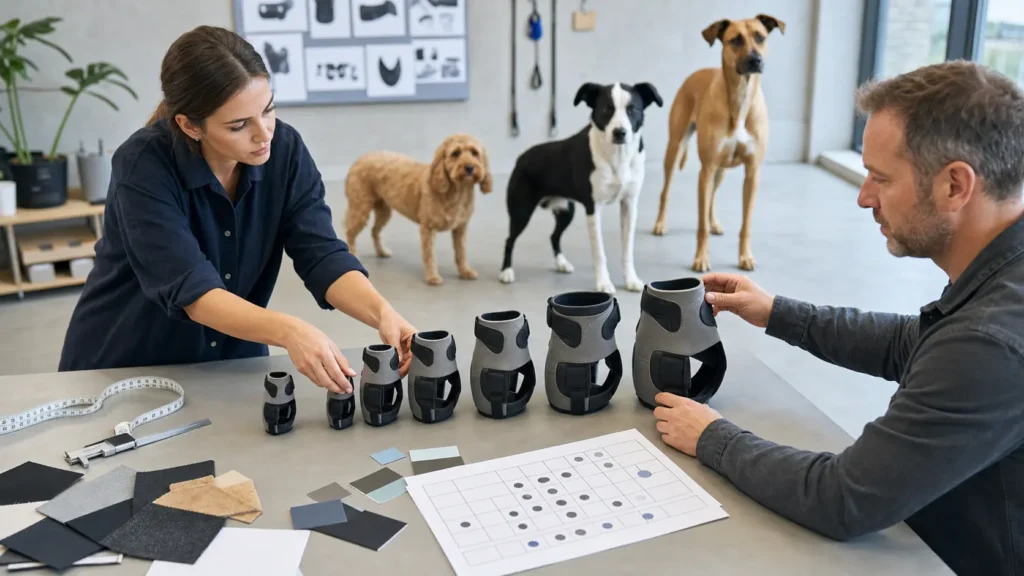
A dog brace size range should cover meaningful anatomical variation, not every possible measurement. If the range is too narrow, fit failures rise. If it is too granular, demand is divided across slow-moving SKUs, purchase quantities fragment, and replenishment becomes harder. The product team’s job is to find the smallest number of sizes that can still be fitted, explained, produced, and stocked reliably.
This is not a universal S–XL chart. Knee, hock, carpal, elbow, back, and hip braces use different anchor points and fail in different ways. Instead, this guide provides a repeatable B2B method for building and validating a compact dog brace size range.
The size-range decision framework
| Decision | Use one SKU when… | Split the SKU when… |
|---|---|---|
| Circumference | Adjustment maintains overlap and anchor stability | Extreme settings reduce contact or closure security |
| Length | The support zone and joint clearance remain correct | Edges, straps, or hinges move into the wrong zone |
| Limb taper | Strap geometry controls downward slip and rotation | The same pattern cannot anchor narrow and conical limbs |
| Left/right | The construction is genuinely symmetrical | Hinge, panel, strap, or label orientation is side-specific |
| Body type | Adjustment absorbs the variation without bunching | Long, deep, short, or broad proportions change coverage |
| Support level | The structure and intended use are unchanged | A hinge, splint, panel, or reinforcement changes function |
1. Define the fit job before collecting data
Begin with the support zone, not a generic dog-size label. Identify where the brace must anchor, what area it must cover, which joint or body region must remain clear, and which dimensions control placement. A knee brace may depend on upper and lower limb circumference, brace length, and joint alignment. A back brace may depend on torso circumference, panel length, and strap position. If a measurement does not change product selection or fit, it should not drive a size boundary.
Create a short list of critical dimensions and define how they are taken. GaitGuard’s guide to measuring a dog for a leg brace covers the collection side; the next step is turning those measurements into commercial size decisions.
2. Build a measurement dataset, not a breed list
Breed and body weight can help with merchandising, but they are weak primary grading variables. Dogs of similar weight can have different limb length, joint circumference, taper, chest depth, or back proportion. Collect measurements using the same landmarks, posture, tape tension, and units. Record product category, side, relevant body-shape notes, and whether the sample represents the target channel.
Clean the data before grading. Remove duplicate records, flag obvious measurement errors, and separate animals whose anatomy or use case requires a different product architecture. A single extreme observation should not automatically create an XXL SKU; first determine whether it represents meaningful demand and whether the current design can serve it safely.
3. Find natural clusters across multiple dimensions
Do not create sizes from circumference alone when length or taper also affects fit. Plot the critical dimensions together and look for groups that can share the same pattern and adjustment system. A practical first pass is to propose three to five core sizes, then test where each sample would fall. The objective is not equal numerical intervals. It is a set of ranges within which the brace maintains the intended anchor, coverage, closure overlap, and clearance.
Pay special attention to dogs near boundaries. If many records sit between M and L, the boundary or pattern grading may be wrong. If only a few records fall outside the range, an extension strap, alternate strap position, or different product route may cover them without creating a full new SKU.
4. Use adjustability to absorb variation—within limits
Adjustability reduces SKU count only when it preserves product geometry. Longer straps can expand circumference coverage, but they cannot correct a brace body that is too long, a hinge that misses the joint, or a panel that wraps into a flexion zone. Define the functional adjustment window for every size: minimum and maximum circumference, acceptable closure overlap, strap angle, and anchor contact.
Avoid advertising one size as covering an extremely wide range merely because the straps close. At the small end, excess material may bunch or straps may wrap into the wrong area. At the large end, insufficient overlap and reduced contact can weaken retention. The usable range ends where fit performance changes—not where the hook-and-loop stops.
5. Decide which variations deserve separate SKUs
Create a separate SKU when the customer, warehouse, or product must distinguish the item. Common triggers include size, side-specific construction, different support structure, different package language, or a materially different product. Keep cosmetic options limited unless demand justifies them. Each color multiplied by each size creates another forecasting and replenishment decision.
This has identification consequences as well as inventory consequences. GS1 states that the brand owner is normally responsible for allocating the GTIN, regardless of where the item is manufactured. Plan the size and variant architecture before finalizing barcodes, cartons, marketplace listings, and inventory records.
6. Model SKU economics before freezing the range
Translate the proposed chart into an opening-order matrix. For every size, estimate demand share, purchase quantity, unit cost, packaging requirement, safety stock, and reorder point. Then test the tail. A size that represents very little expected demand may consume cash, packaging setup, inspection effort, storage locations, and customer-service complexity disproportionate to its sales.
Ask the manufacturer how MOQ applies: total product, each size, each color, or each packaging version. GaitGuard currently states a standard MOQ of 500 units; its MOQ and cost framework explains why size range and order configuration affect quotation. Do not divide 500 evenly across five sizes by default. Allocate according to expected demand and supplier constraints, then confirm whether the proposed mix is producible.
7. Validate a size set, not only the middle sample
A medium approval sample does not validate the grading rule. Review at least the smallest, largest, and relevant boundary sizes. Confirm critical finished dimensions, strap lengths, closure overlap, label accuracy, and packaging fit. Conduct fit reviews across the intended measurement window and document where each size stops working.
For production inspection, size-specific dimensions should be part of the approved specification. If acceptance sampling is used, identify the plan and edition rather than writing only “AQL.” ISO 2859-1:2026 is the current ISO standard for AQL-indexed lot-by-lot inspection by attributes. GaitGuard’s quality review process outlines current production checkpoints; the buyer still needs to define critical dimensions and defect examples by size.
8. Launch with a size ladder and a review rule
Publish measurement instructions that mirror the product-development method. Show landmarks, units, posture, boundary guidance, and what to do when measurements point to different sizes. Train customer service to record the actual measurements, recommended size, purchased size, and return reason. “Too small” is not enough to improve the chart.
Set a review point after the first meaningful sales sample or reorder cycle. Compare sell-through, stockouts, returns, exchanges, and fit comments by size. Merge or discontinue a size when adjacent coverage is proven and demand remains weak. Add a size only when repeated evidence shows a real coverage gap that adjustment or clearer instructions cannot solve.
A compact example of SKU reduction
Suppose a proposed soft leg-brace line starts with six sizes, left and right versions, and three colors: 36 SKUs before packaging-language variants. The team tests the construction and finds it is symmetrical, two colors have no channel requirement, and the two smallest ranges can share one pattern with a validated strap window. The revised line has five sizes, one neutral color, and no side split: five SKUs.
The reduction is valid only because product geometry, fit testing, and channel needs support it. Removing variants by spreadsheet alone would be cost cutting. Removing variants after proving equivalent coverage is assortment design.
Questions buyers should ask before approving the range
- Which measurements actually control fit for this brace type?
- What is the functional adjustment window of each size?
- Where do the smallest, largest, and boundary samples fail?
- Can the product be symmetrical, or is left/right construction necessary?
- How is MOQ allocated across sizes, colors, and packaging versions?
- Which finished dimensions will be inspected for every size?
- What sales and return data will trigger a boundary change?
Build for coverage, then earn every extra SKU
The right dog brace size range is not the range with the most labels. It is the smallest validated ladder that maintains anchor position, coverage, adjustability, customer clarity, and supply continuity across the target population. Begin with anatomy, validate the edges of every size, model the inventory consequences, and require evidence before adding another variant.
If you are developing a bulk or private-label size system, review GaitGuard’s OEM/ODM scope and share your product category, target market, size requirements, and expected quantity for an initial feasibility discussion.
