
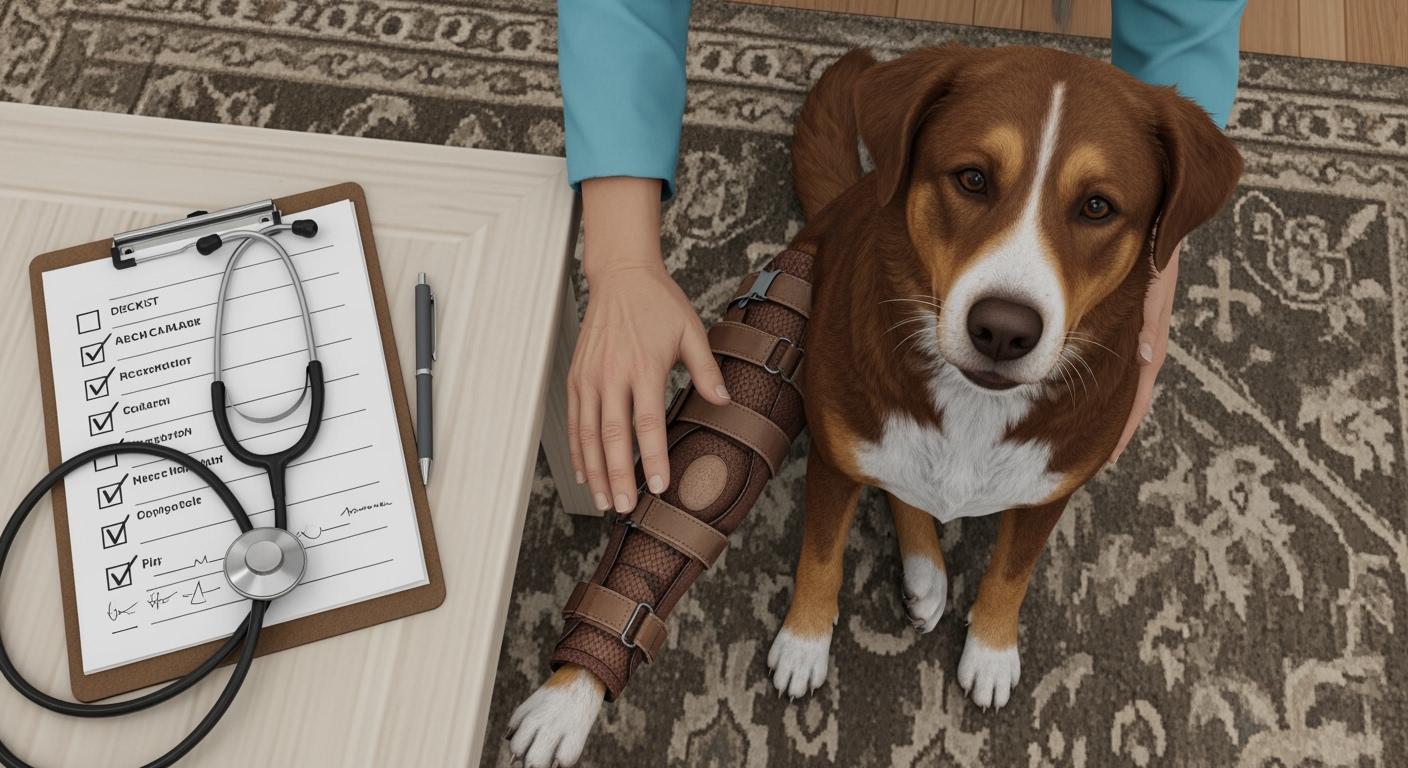
A luxating patella knee brace may provide external support for some dogs with mild kneecap instability, especially during short, controlled activity or as part of a vet-approved support plan. It should not be used as a cure, a way to force movement, or a substitute for veterinary advice when pain, swelling, constant limping or severe instability is present. This guide explains when a brace may help, when to wait, and how fit stability, slippage, skin checks and break-in time affect safe use.
If you are comparing several recovery problems at once—stairs, potty breaks, lifting support, incision protection, brace fit, and pressure checks—start with the Dog Recovery Support Guide before choosing a specific brace, lift harness, sleeve, or anti-lick product.
Key Takeaways
A luxating patella knee brace can help dogs with mild problems or after surgery. You should always talk to your vet before using a brace.
Not every case needs a brace. Bad cases of luxating patella often need surgery. Your vet will help you find the best treatment.
Watch your dog when it wears the brace. Look for redness or sore spots. Change the fit if needed to keep your dog safe.
What Is Luxating Patella in Dogs?
How the Kneecap Functions Normally
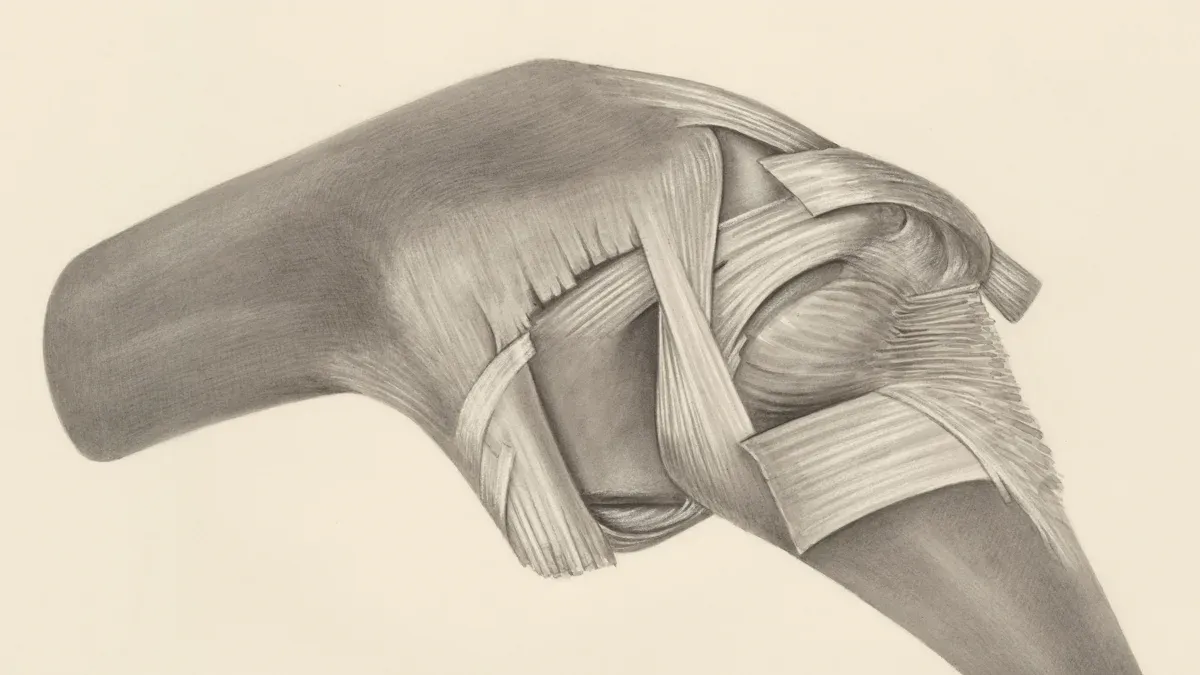
Your dog’s kneecap, or patella, sits in a groove at the knee joint. When your dog walks or runs, the patella glides smoothly up and down. This movement helps your dog bend and straighten the leg. A healthy kneecap stays in place and supports normal movement.
Why Small Breeds Are at Risk
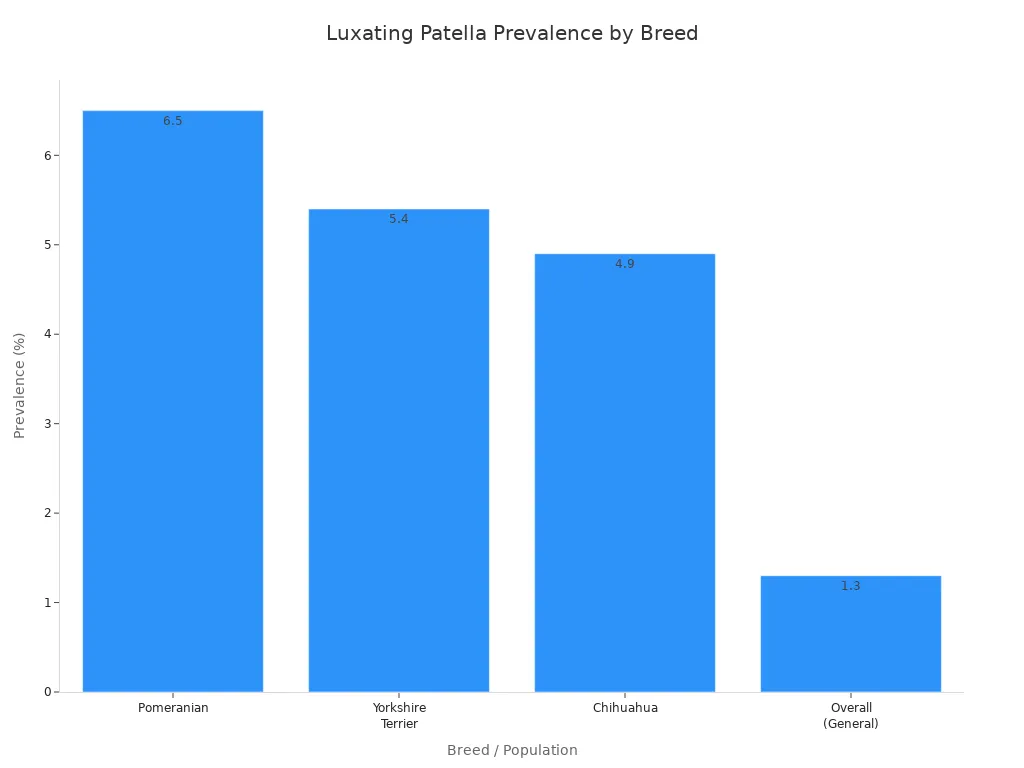
Small breeds face a higher risk for luxating patella. In these dogs, the kneecap can slip out of its groove. This problem happens more often in breeds like Pomeranians, Yorkshire Terriers, and Chihuahuas. You can see the difference in prevalence in the table below:
Breed | Prevalence (%) |
|---|---|
Pomeranian | 6.5 |
Yorkshire Terrier | 5.4 |
Chihuahua | 4.9 |
Overall (General) | 1.3 |
You may notice your dog skipping, limping, or stretching the leg backward. Some dogs show a crouched gait or stiffness. The table below lists common symptoms:
Symptom Description |
|---|
Attempt to stretch the leg backward |
Skipping or stiff gait |
Lameness |
Pain or sudden crying out |
Stiffness of the hind limb |
Abnormal posture or crouched gait |
Why Severity Grade Matters More Than the “Skip”
Not every dog with a skipping step needs the same care. Veterinarians use a grading system to decide the best treatment. Mild cases of luxating patella (Grade 1 or 2) often do well with conservative care, such as rest, rehab, or a knee brace. Severe cases (Grade 3 or 4) usually need surgery, especially if your dog has pain or trouble walking. Always ask your veterinarian to grade your dog’s condition before starting any treatment. The right plan depends on your dog’s needs and your vet’s advice.
Tip: A knee brace can help support your dog’s comfort and stability, but only your veterinarian can decide if it is the right choice.
Do Luxating Patella Dog Braces Help?
A luxating patella knee brace should be understood as external support, not a way to change the dog’s joint structure or severity grade. It may help some mild cases feel more stable during controlled activity, but pain, swelling, frequent limping or worsening instability should be checked by a vet.
What a Dog Knee Brace Can Do: Support and Comfort
You want your dog to feel good and stay active. A dog knee brace helps keep the knee steady if your dog has mild luxating patella. The brace holds the kneecap in place so it does not slip. Many pet owners use a knee brace for dogs with mild signs. The brace gives gentle pressure and keeps the joint from moving too much. This support helps the soft tissues around the knee get stronger again. You might see your dog limp less and walk better.
Dog knee braces come in two main types: rigid and flexible. Flexible braces let your dog move more but still give support. Rigid braces give more support but can make movement harder. Studies show that dogs with these braces often have less pain and move better. You might see your dog play, walk, or go up stairs with less trouble. The brace does not cure the problem, but it can help your dog feel better each day.
Note: Always ask your veterinarian to check your dog’s luxating patella before using any brace. Your vet will help you pick the right type and size.
What Bracing Cannot Fix: Bone Alignment and Severe Cases
A dog knee brace cannot fix bone shape or severe luxating patella. The brace does not change the bones or fix the groove for the kneecap. If your dog has a bad case, you may see limping, pain, or trouble walking all the time. In these cases, a brace is not enough.
Here are some important things to remember:
The brace does not fix deep bone problems.
Symptoms can come back if your dog does not wear the brace often.
Using a brace for a long time can make muscles weak if your dog only uses the brace.
Rigid braces can make it hard for your dog to move.
Some dogs do not like wearing a brace.
If your dog has a lot of pain, swelling, or cannot stand on the leg, call your veterinarian right away. Surgery is often needed for Grade III or IV luxating patella. Your vet will say if a brace is safe or if surgery is best.
Choosing the Right Tool for the Right Situation
You want to make the best choice for your dog’s health. The right tool depends on your dog’s grade and signs. Mild cases (Grade I or II) often do well with a brace and simple care. Bad cases (Grade III or IV) usually need surgery.
The table below shows when a dog knee brace is a good idea and when surgery is needed:
Indicator | Description |
|---|---|
Sudden or severe limping | Your dog cannot stand on the leg |
Persistent or worsening lameness | Limping does not get better or gets worse |
Visible swelling or redness | The knee looks big, feels hot, or looks red |
Audible clicking or popping | You hear clicking or popping from the knee |
Reluctance to move or play | Your dog does not want to run, jump, or climb stairs |
Grade III Medial Patellar Luxation | Frequent limping, strange walk, and discomfort |
Grade IV Medial Patellar Luxation | Limping all the time and a lot of pain |
For Grades I and II, a brace is good for mild cases. For Grades III and IV, surgery is needed for worse cases. Always ask your veterinarian to check your dog’s grade before you decide.
Tip: A dog knee brace works best when used with other care. You can use it with gentle exercise and weight control. Your veterinarian will help you and watch your dog’s progress.
Severity Grades and Treatment Decisions
Knowing how bad patellar dislocation is helps you pick the right care for your dog. Vets use a grading system to show how far the kneecap moves out of place. Each grade tells you how serious the problem is and what to do next.
Luxating Patella Grades Explained
You and your vet can use the tables below to see the differences between grades. These grades help you both decide how to treat patellar dislocation.
Grade | Definition |
|---|---|
1 | The patella moves out easily when the leg is straight but goes back in place when let go. No grinding is felt. |
2 | The patella slips out often, sometimes stays out. The leg may be held up, but your dog can put weight on it with a little bend. |
3 | The patella is always out, and the tibia is twisted. The leg is used with the knee partly bent. |
4 | The tibia is twisted, and the patella is always out. The leg is held up or moves in a crouched way. |
Grade | Description |
|---|---|
1 | Mild, with some skipping or short limping. Your dog walks fine most of the time. |
2 | More skipping or limping. Some dogs stop playing or have stiff legs after moving. |
3 | Limping all the time or walking differently. Dogs may hop on both legs or hurt when touched or moved. |
4 | Very bad movement. Dogs often drag a leg or walk with bent knees. The leg may look twisted or smaller. |
Patellar dislocation looks different in every dog. Some dogs only limp or skip sometimes. Others have trouble walking every day. You need to know your dog’s grade before picking a treatment.
Clinic Script Box
Grade meanings: Grades 1–4 show how much the kneecap slips and how it changes walking.
Break-in schedule for braces: Start with 3 hours on the first day, add 1 hour each day, and work up to 8–14 hours a day.
Post-op milestones: Keep activity low for 10–14 days, check again at 6–8 weeks, bones heal by 8 weeks, and slowly return to normal by 12 weeks.
Skin check rule: If straps cause mild redness, it should fade in 20–30 minutes. If redness stays longer, fix the brace and use it less.
Grade-to-Action Decision Table
The table below shows what to do for each grade of patellar dislocation. It helps you know when to watch, use a brace, or think about surgery.
Grade | Typical Pattern | Common Plan | Where the Brace Fits |
|---|---|---|---|
1 | Slips sometimes | Watch and simple care | Use a brace during activity if needed |
2 | Slips or limps off and on | Simple care or surgery based on signs | Use a brace and check again; use until surgery if needed |
3 | Out most of the time | Usually surgery | Use a brace for a short time while waiting for a plan |
4 | Always out | Usually surgery | Only use a brace if the surgeon says so |
As the grade gets higher, treatment changes. Mild patellar dislocation often needs simple care. Bad cases usually need surgery.
When to Monitor, Use Bracing, or Consider Surgery
Look at your dog’s grade, age, health, and how active they are before choosing a plan. Mild patellar dislocation (Grade 1) often gets better with weight control, joint supplements, and physical therapy. You can use a knee brace for extra help during walks or rehab. Grade 2 may need more help if your dog limps a lot or stops playing. Your vet might suggest a brace, rehab, or surgery if things get worse.
For Grades 3 and 4, patellar dislocation causes limping or pain all the time. Surgery is usually the best way to fix the kneecap and stop joint damage. If your dog cannot have surgery right away, use a brace until the operation. Always ask your vet to grade your dog’s patellar dislocation before starting any treatment.
Step Block A: Decide if a brace is appropriate today
Watch your dog walk and play.
See if your dog skips, limps, or stops playing.
Ask your vet to grade the patellar dislocation.
For Grade 1 or mild Grade 2, think about a brace for support.
For Grade 2 with lots of limping, talk about surgery or rehab.
For Grade 3 or 4, ask about surgery and only use a brace if your vet says it is safe.
Check your dog’s skin after using the brace.
Follow the break-in and activity plan from your clinic.
Here is a table to compare your choices for patellar dislocation care:
Option | Best For | What It Does | When to Use |
|---|---|---|---|
Brace Only | Mild Grade 1–2 | Supports the knee, controls movement | During walks, rehab, or while waiting for surgery |
Rehab | Mild–Moderate Grade 1–2 | Makes muscles stronger, helps stability | With or without a brace, as part of home care |
Surgery | Grade 2–4 with pain or deformity | Fixes the kneecap, repairs bone and soft tissue | When simple care does not work or signs are bad |
Bridge Plan | Waiting for surgery, or can’t have surgery | Gives support for now, controls pain and movement | Until surgery or for long-term care if surgery is not possible |
Patellar dislocation can get worse if not treated. Even mild cases need regular checks. Your vet will help you know when to watch, use a brace, or think about surgery. Always follow your clinic’s advice for safe care.
🐾 Reminder: Only your vet can grade patellar dislocation and say if surgery is needed. Bracing is just one tool in rehab, not a cure. Watch your dog’s progress and ask your clinic if you see new problems or changes.
How to Choose a Luxating Patella Knee Brace
Selecting the most suitable brace for your dog with patellar luxation can feel overwhelming. You want a luxating patella knee brace that supports your dog’s knee, fits well, and keeps your pet comfortable during daily activities. The right choice helps your dog move with less pain and more confidence.
Brace Feature Checklist for Owners and Clinics
Use this checklist to compare options and find the most suitable brace for your dog’s needs:
Feature | Description |
|---|---|
Supportive Alignment | Keeps the kneecap in the right place, reducing pain and helping movement. |
Promoting Healing | Creates a safe space for healing, making recovery smoother. |
Stability and Support | Holds the knee steady, stopping more slips and supporting the patella. |
Enhanced Comfort | Reduces discomfort, letting your dog move without pain. |
Improved Mobility | Helps your dog walk, play, and enjoy daily life with fewer problems. |
Step Block B: Choose the brace features that matter most for luxating patella
Check your dog’s size and measure carefully.
Ask your veterinarian to grade the patellar luxation.
Decide if your dog needs a rigid or flexible brace.
Look for a brace with stable straps and soft, breathable liners.
Make sure the brace comes with clear fitting instructions.
Try the brace and watch your dog walk, sit, and turn.
Adjust as needed for comfort and stability.
Fit Stability Tests: Walk, Sit, Lie Down, Turn
A luxating patella knee brace must stay in place during all your dog’s movements. After putting on the brace, have your dog walk, sit, lie down, and turn. Watch for slipping or twisting. A good fit means the brace does not move out of place. If you see rubbing or sliding, adjust the straps or ask your vet for help. Proper fit helps prevent discomfort and keeps the brace working as intended.
Comfort and Design to Prevent Rubbing
Comfort is key when choosing a luxating patella knee brace. Soft, smooth edges and breathable liners help prevent rubbing and skin problems. A well-designed brace reduces the risk of sores and lets your dog wear it for longer periods. Always check your dog’s skin after use. If you see redness that lasts more than 20–30 minutes, remove the brace and talk to your clinic. Regular checks and adjustments keep your dog safe and comfortable.
B2B sourcing note: For pet brands or distributors comparing canine knee brace products for bulk supply, review GaitGuard’s custom dog brace manufacturing support.
Remember: Only your veterinarian can decide if a brace is right for your dog’s patellar luxation. Always follow their advice for the most suitable brace and treatment plan.
Fitting and Break-In Schedule for Dog Knee Braces
During break-in, check whether the brace slips, twists, rubs behind the knee, traps heat, or leaves redness after removal. Redness that does not fade within about 20–30 minutes, or any change in walking comfort, means the fit or use scenario should be reconsidered.
Measuring and First Fit: Avoid Twist and Slippage
You want your dog’s knee brace to fit well from the start. Begin with a veterinary check to confirm the diagnosis and grade. Measure your dog’s leg carefully or use a casting kit for custom options. Align the brace hinge with your dog’s knee joint during the first fitting. Make sure the brace fits snugly without pinching or twisting. Watch your dog walk, sit, lie down, and turn. The brace should stay in place and not slip or rotate. Create a calm environment and use treats to help your dog feel comfortable.
Tip: Always check the fit after the first walk. If you see rubbing or sliding, adjust the straps or ask your clinic for help.
Break-In Schedule: 3 Hours Day 1, +1 Hour/Day
Start with short sessions to help your dog get used to the brace. On Day 1, let your dog wear the brace for a total of 3 hours, split into several short periods. Each day, add about 1 hour of total wear time as your dog tolerates it. Build up to 8–14 hours per day for daytime use. Remove the brace at night or during crating unless your veterinarian says otherwise. Use the brace during walks or playtime, and combine it with rehab exercises and weight management.
Step Block C: Fit, break-in, and monitor
Measure and fit the brace with your vet’s help.
Start with 3 hours on Day 1, split into short sessions.
Add 1 hour per day as tolerated.
Use the brace during activity and rehab.
Remove the brace at night.
Check your dog’s skin after each session.
Skin Checks: 20–30 Minute Redness Rule
Check your dog’s skin every time you remove the brace. Look for redness, rubbing, or irritation. Mild strap marks should fade within 20–30 minutes. If redness lasts longer or you see swelling, reduce wear time and adjust the fit. Contact your veterinarian if you notice wounds, swelling, or heat. Regular skin checks help prevent problems and keep your dog comfortable.
Reminder: Only your veterinarian can decide if a brace is right for your dog’s luxating patella. Always follow their advice for fitting, break-in, and monitoring.
Rehab and Home Care with Bracing
Bracing helps your dog’s knee, but it works best with good home care. Dog knee braces let your dog move safely. You also need to help your dog exercise and stay at a healthy weight. Always ask your veterinarian for advice and checkups.
Controlled Leash Walks and Traction
Begin with short, slow walks on a leash while your dog wears bracing. These walks help your dog get stronger and keep the kneecap in place. Use a harness so you can control your dog better. Walk on grass or rubber mats so your dog does not slip. Bracing keeps the knee steady and makes walking safer. Watch your dog for signs of being tired or sore. If your dog limps or wants to stop, take a break and check the fit of the dog knee braces.
Strength and Stability Exercises
You can use bracing when doing easy rehab exercises at home. These activities help your dog build muscle and balance. Try the exercises in the table below:
Exercise Type | Description |
|---|---|
Short, slow leash walks | Helps build leg strength and supports the kneecap’s position. |
Sit-to-stand | Encourages muscle engagement by having the dog sit and stand multiple times slowly. |
Cavaletti poles | Promotes step-over motion to improve coordination and strength. |
Ramp or hill walking | Builds thigh strength through incline walking. |
Army crawls | Gentle crawling to engage muscles without causing pain. |
Hydrotherapy (Underwater treadmill) | Provides low-impact strength building while reducing joint pressure. |
Hydrotherapy (Swimming) | Allows for muscle movement in water, which supports the dog’s body and improves strength. |
Bracing helps your dog stay safe and active during these exercises. Dog knee braces support your dog as you practice these movements.
Weight Management for Knee Health
Keeping your dog at a healthy weight helps bracing work better. Too much weight puts more stress on the knee. You can help your dog by:
Feeding the right amount for your dog’s size and how much they move.
Using bracing and therapy to make muscles stronger and the knee more stable.
Giving your dog love and support during rehab to help them feel good.
Dog knee braces work best when you use them with these healthy habits. Bracing is only one part of your dog’s care. Always talk to your veterinarian before starting new exercises or changing your dog’s routine.
Reminder: Only your veterinarian can say if bracing is right for your dog. Regular checkups help keep your dog safe and comfortable.
Post-Op Use of Luxating Patella Knee Braces
Post-Op Timeline Milestones: 10–14 Days, 6 Weeks, 8 Weeks, 12 Weeks
After surgery, your dog needs a special recovery plan. For the first 10–14 days, your dog must rest a lot. Your vet might suggest using luxating patella dog braces to keep the knee steady. At 6 weeks, your dog goes back to the vet for a checkup. By 8 weeks, your dog’s bones are healing well. Most dogs can play and walk like normal by 12 weeks. You use luxating patella dog braces during these weeks to help your dog move safely and feel better.
Milestone | What to Expect |
|---|---|
10–14 Days | Highest restriction, possible lift-assist support |
6 Weeks | Recheck, gradual increase in activity |
8 Weeks | Bone healing milestone |
12 Weeks | Return toward full activity |
Lift-Assist Support in Early Recovery
During the first two weeks, you might use luxating patella dog braces with lift-assist support. This helps your dog stand and walk without hurting the knee. Lift-assist support gives gentle help when your dog moves. Your vet will tell you if this is a good idea. Always follow your vet’s instructions for using luxating patella dog braces after surgery.
Tip: Always ask your clinic before trying new support tools. Only your vet can say when luxating patella dog braces are safe after surgery.
When to Pause and Contact the Surgeon
Watch your dog closely while they heal. If you see swelling, heat, or redness that stays longer than 20–30 minutes after taking off luxating patella dog braces, stop using them and call your surgeon. Call your clinic if your dog limps more, will not walk, or seems to be in pain. Do not ignore these signs. Luxating patella dog braces help your dog feel better, but only your vet can guide post-op care.
Reminder: Only a vet can grade the problem and decide on surgery. Luxating patella dog braces help with recovery, but do not replace your vet’s advice.
Red Flags and Common Mistakes in Bracing
Red-Flag Triage Table: Green, Yellow, Red
You must look for warning signs when your dog wears a knee brace. The table below helps you know what to do if you see problems:
Status | What You See | What to Do |
|---|---|---|
🟢 Green | Mild redness goes away in 20–30 minutes | Keep using the brace as planned |
🟡 Yellow | Redness stays longer, swelling, or brace slips | Fix the fit, use less, call your clinic if unsure |
🔴 Red | Open sores, swelling, heat, or sudden pain | Stop using the brace, call your vet right away |
Check your dog’s skin after every session. Acting fast keeps your dog safe and comfortable.
Common Mistakes: Fit, Scenario, Ignoring Grade
Dog owners often make the same mistakes with knee braces. You can avoid these problems if you know what to watch for:
Mistake | Solution |
|---|---|
Bad fit of the brace | |
Wrong way to use the brace |
If you rush the break-in time, your dog’s skin may get sore.
Some dogs do not like the brace if it feels big or strange.
Skipping slow training makes it harder for your dog to wear the brace.
Using a brace for severe cases or ignoring the grade can delay surgery your dog needs.
Weekly Re-Evaluation and Tracking
Check how your dog is doing every week. Watch for changes in walking, skin, and comfort. Write down how long your dog wears the brace and any problems you see. Share this with your vet at each visit. Only your vet can say if you need to change the plan or think about surgery. Bracing works best with regular checkups and other rehab care.
Reminder: Always ask your vet to grade your dog’s problem and help you choose the right treatment.
Luxating Patella Knee Brace FAQs
Can a Brace Replace Surgery for Severe Luxating Patella?
You might wonder if a knee brace can take the place of surgery for severe luxating patella. Surgery is usually the best way to treat bad cases. A brace can help your dog feel better and keep the knee steady. But it does not fix the bones or stop joint damage in serious grades. Most vets say bracing is only a short-term help, not a real fix. Always ask your vet to check how bad your dog’s luxating patella is before you decide.
Surgery is best for severe luxating patella.
Braces help but do not replace surgery.
Bracing might not stop more joint damage.
How Many Hours Per Day Should My Dog Wear a Knee Brace?
Start with short times when you use a luxating patella knee brace. Try 30 to 60 minutes, two to five times each day. Slowly let your dog wear the brace longer as they get used to it. Take the brace off at night unless your vet says to keep it on. This plan helps your dog get used to the brace and keeps the skin healthy.
What If Redness or Slipping Occurs?
Check your dog’s skin every time you take off the luxating patella knee brace. Look for redness, swelling, or signs your dog feels bad. If you see any problems, call your vet to adjust the brace. Stop using the brace if your dog licks, chews, or does not want to walk. These signs mean the brace might not fit right or is not comfortable.
How Long Is Recovery After Surgery?
Recovery after luxating patella surgery takes about 8 to 12 weeks. Your dog will start to put weight on the leg in a few days. After surgery, your dog needs crate rest, leash walks, pain medicine, and checkups. Bracing can help mild or early luxating patella and is part of a full recovery plan.
Aspect | Details |
|---|---|
Typical Recovery Time | 8–12 weeks |
Initial Weight-Bearing | Starts within days |
Post-Op Care | Rest, walks, medicine, exams |
Role of Bracing | Good for mild or early luxating patella |
What Features Should I Look for in a Dog Knee Brace?
Pick a luxating patella knee brace with strong straps, smooth edges, and a liner that lets air in. Look for straps you can adjust and clear instructions for fitting. The brace should stay in place when your dog walks, sits, or turns. Comfort and support are the most important things for luxating patella.
Is Bracing Safe for Puppies or Older Dogs?
Bracing can be safe for puppies and older dogs with mild luxating patella. Always ask your vet to check the luxating grade and your dog’s health. Puppies need extra checks as they grow. Older dogs may need bracing if they cannot have surgery.
When Should I Avoid Using a Knee Brace?
Do not use a luxating patella knee brace if your dog has severe luxating patella, open wounds, or skin problems. Do not use the brace if your vet says not to. Dogs that limp all the time or get worse quickly need a vet check before using any luxating support.
What Are Signs My Dog Needs to See a Vet?
Watch for these signs that mean your dog should see a vet:
Limping or pain that does not go away
Swelling, heat, or redness after you take off the luxating brace
Not wanting to walk or play
Open wounds or sores under the luxating brace
Reminder: Only your vet can grade luxating patella and say if surgery is needed. Always follow your vet’s advice to keep your dog safe.
You can use a luxating patella knee brace for mild cases or during recovery. Make sure a veterinarian checks your dog first. Talk with your vet about what you want to achieve. Measure your dog’s leg carefully before using the brace. Give your dog time to get used to wearing it. The brace helps your dog move and keeps the knee safe from more injury. Watch how your dog does and ask your vet if you have questions.
