
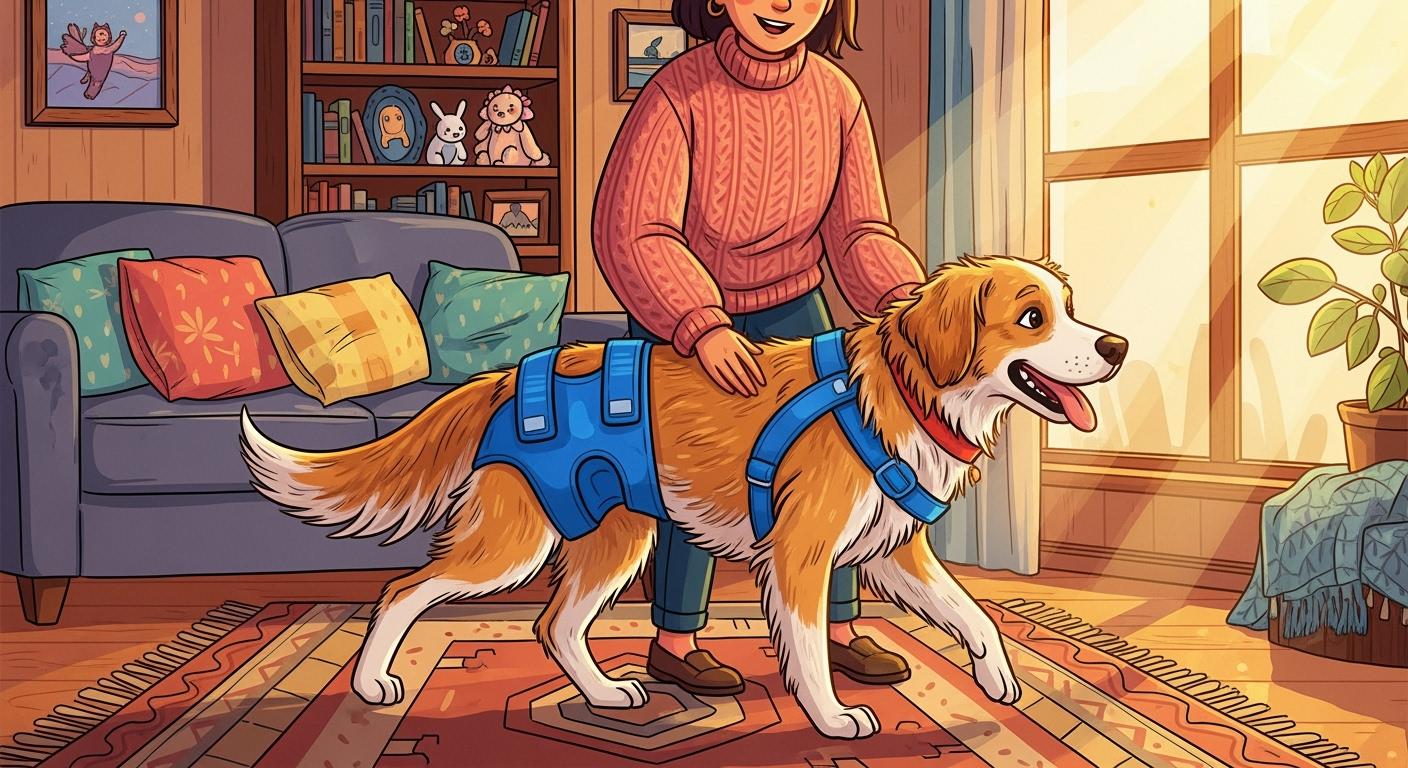
A dog hip dysplasia support brace is designed to add external support around the pelvis, hips, or lower trunk during selected activities. It may help limit unwanted side-to-side movement or provide a more stable contact area, depending on the brace structure. It does not correct the shape of the hip joint, rebuild cartilage, cure arthritis, or replace veterinary pain management.
The useful question is not simply, “Does a hip brace work?” It is whether a particular design provides the right coverage, suspension, adjustment, and movement control for a diagnosed condition without slipping, rubbing, restricting normal motion, or encouraging more activity than the dog can safely tolerate.
| Question | Practical answer |
|---|---|
| What can a hip brace do? | Provide external support and, in some designs, limit selected pelvic or hip movement. |
| What can it not do? | Correct joint laxity, cure hip dysplasia, guarantee pain relief, or prevent every fall or further injury. |
| Who should assess suitability? | A veterinarian should confirm the diagnosis; the brace must then be matched to the dog’s anatomy, gait, skin condition, and activity plan. |
| What should owners monitor? | Brace position, skin, breathing, gait, circulation, movement tolerance, and any increase in discomfort. |
Key takeaways
- A hip brace is an external support device, not a treatment for the underlying joint deformity.
- Limping, stiffness, difficulty rising, bunny hopping, or reluctance to jump should be assessed before a brace is selected.
- Brace suitability depends more on diagnosis, anatomy, coverage, suspension, and fit than on labels such as “mild” or “moderate.”
- There is no universal daily wear schedule for every dog or every hip-brace design.
- Stop use and seek veterinary advice if the brace causes pressure, skin damage, gait changes, increased weakness, or worsening discomfort.
How hip dysplasia affects movement
Canine hip dysplasia is a developmental condition in which the ball-and-socket joint does not fit or function normally. Joint laxity and abnormal loading can contribute to degenerative changes over time. The visible signs vary: one dog may appear stiff after rest, while another may show hind-limb lameness, difficulty rising, shortened steps, reduced willingness to jump, or a “bunny-hopping” gait.
These signs are not specific to hip dysplasia. Knee injuries, spinal conditions, muscle strains, neurological disease, and other orthopedic problems can produce similar movement changes. A brace should therefore be selected after diagnosis—not from the symptom alone.
Why a hip brace cannot cure hip dysplasia
A brace sits outside the body. It cannot deepen the hip socket, tighten the joint capsule, restore damaged cartilage, or reverse osteoarthritis. Its possible role is narrower: to provide contact and external support around the pelvis or upper hindquarters and, depending on the design, to guide or limit selected movement during controlled activity.
- External support: adds contact around the hips, pelvis, or lower trunk.
- Movement guidance: may reduce selected side-to-side or rotational movement.
- Handling support: some systems can be paired with a handle or harness for controlled assistance.
- Clinical limits: does not independently treat pain, inflammation, arthritis, muscle loss, or neurological weakness.
For a broader explanation of how brace structure should be matched to the affected area, see the dog support brace selection guide.
When a dog hip dysplasia support brace may be considered
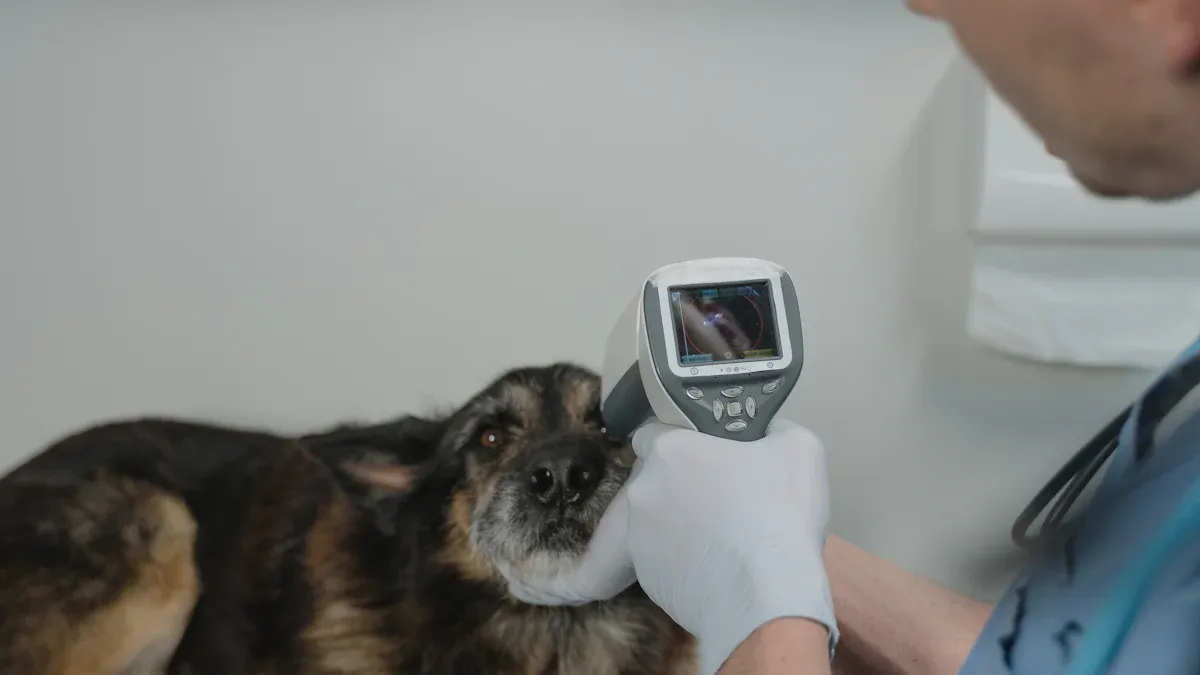
A brace may be discussed when a dog has a confirmed hip condition and the care plan includes a specific need for external support, controlled activity, or handling assistance. The diagnosis alone does not determine whether a brace is suitable. The dog must also be able to tolerate the structure and move without new pressure or compensation.
| Situation | What must be checked |
|---|---|
| Dog remains able to stand and walk | Whether the brace stays centered without changing stride or restricting normal hip extension. |
| Support is needed during short controlled activities | Whether the structure matches the activity and can be removed between supervised sessions. |
| Dog has difficulty on slippery surfaces | Whether traction changes, rugs, a lift harness, or handling support are more directly useful than a hip brace. |
| Dog has an existing rehabilitation plan | Whether the brace is compatible with prescribed exercise and does not interfere with movement assessment. |
| Postoperative use is being considered | Whether the surgical team has approved the timing, coverage, pressure distribution, and movement limits. |
A severity label is not enough
Statements such as “hip braces work best for mild or moderate cases” are too broad. Two dogs with the same diagnosis can have different anatomy, muscle condition, gait, skin tolerance, and support needs. One may tolerate a wrap-style brace; another may need a different support method or may not be a brace candidate at all.
A veterinarian or rehabilitation professional should help define the functional goal. The product decision then becomes more precise: where must the brace apply support, which movement should remain free, how will it stay in position, and how will pressure be distributed?
When a hip brace is not enough
Do not use a brace to cover up severe pain or rapidly worsening movement. A dog that cannot rise, suddenly stops using a hind limb, cries out, loses coordination, develops bladder or bowel changes, or declines quickly needs prompt veterinary assessment.
- Severe or rapidly increasing pain
- Sudden inability to stand or walk
- New dragging, knuckling, crossing, or loss of coordination
- Marked swelling, heat, or a suspected acute injury
- Open wounds, active skin infection, or pressure damage under the brace area
- Postoperative use without approval from the surgical team
- A new gait change or increased weakness after the brace is applied
A brace may be one part of a management plan. It should not delay diagnosis, medication decisions, rehabilitation, or a surgical consultation when those are needed.
Choosing the right hip-brace structure
The phrase “hip brace” covers several different constructions. Some are soft wraps around the pelvis and upper thighs. Others combine a waist section, leg straps, reinforced panels, or attachment points for handling support. Product photos alone do not show whether the design will remain stable on a moving dog.
1. Coverage
Coverage should match the intended support area. A design that sits mainly around the waist may offer different control from one that extends around the upper thighs. More coverage is not automatically better: excessive coverage can restrict movement, trap heat, or create additional pressure points.
2. Suspension and anti-slip design
The brace must resist rotation and downward migration. Waist contours, leg loops, strap direction, panel shape, and surface friction all affect suspension. A brace that repeatedly slips cannot deliver consistent support and may concentrate pressure along the edge of a panel or strap.
3. Adjustment range
Adjustment should allow the brace to remain secure without being overtightened. Look for independent adjustment around the waist and thighs rather than one strap controlling the entire fit. Dogs with deep chests, narrow waists, heavy coats, or uneven hind-limb muscle mass may need more adjustment range.
4. Liner and contact surfaces
Materials should be assessed by how they function in the complete product. Relevant factors include surface softness, seam placement, ventilation, moisture retention, cleaning requirements, edge binding, and durability. No material name alone guarantees comfort or skin safety.
5. Movement-control level
A soft wrap, reinforced panel, or more structured system will not affect movement in the same way. The required level of control depends on the diagnosed problem and intended activity. A more rigid design is not automatically more appropriate for a more serious condition.
How to measure and check fit

Do not assume that every manufacturer uses the same measuring points. Follow the sizing diagram for the specific product. Common measurements may include waist circumference, hip or pelvic circumference, upper-thigh circumference, body length, and the distance between key anatomical landmarks.
- Measure while the dog is standing naturally. A sitting or leaning posture can change circumference and length measurements.
- Keep the tape flat. Do not pull through the coat or leave the tape hanging loose.
- Record both sides when requested. Muscle loss or asymmetry can affect fit.
- Use the product-specific chart. Do not automatically choose the larger size when a dog falls between sizes; contact the supplier for the intended decision rule.
- Recheck after fitting. Correct measurements do not guarantee correct placement once the dog begins to move.
For additional fitting checks that apply across brace types, use the brace fit and wear-safety guide.
Fit checklist before walking
| Check | Acceptable | Stop and adjust |
|---|---|---|
| Position | Brace remains centered over the intended area. | Brace rotates, drops, or pulls to one side. |
| Straps | Secure without digging into the groin, waist, or abdomen. | Edges curl, straps twist, or pressure concentrates under one point. |
| Skin | No persistent redness, heat, moisture, or rubbing. | Red marks remain, hair is pulled, or skin becomes sore. |
| Movement | Dog can take controlled steps without a new compensation pattern. | Stride shortens, paws cross, the back arches, or the dog resists moving. |
| Breathing and toileting | No restriction around the abdomen and no interference with elimination. | Brace limits breathing, urination, or defecation. |
Break-in and daily wear time
There is no universal schedule such as “30 minutes on day one” or “two to three hours twice daily” that applies to every dog hip brace. Wear time depends on the product design, diagnosis, skin response, activity, fit, and veterinary plan.
Begin with a short, supervised introduction according to the product instructions. The first goal is not to reach a target number of hours. It is to confirm that the brace stays in position and that the dog can stand, turn, and take controlled steps without new pressure or movement problems.
- Check the skin and coat after each early session.
- Remove the brace for inspection if it shifts or becomes damp.
- Do not increase activity simply because the dog is wearing support.
- Do not leave the brace on unsupervised unless the veterinarian and product instructions specifically allow it.
- Reassess sizing if body weight, coat thickness, swelling, or muscle mass changes.
Hip brace, lift harness, rehabilitation, or surgery?
A hip brace is not a substitute for every other support option. The correct choice depends on the problem that needs to be solved.
| Option | Primary role | Main limitation |
|---|---|---|
| Hip support brace | External support or selected movement guidance around the pelvis and upper hindquarters. | Does not correct joint anatomy or independently treat pain and arthritis. |
| Lift or support harness | Assists handling, standing, stairs, toileting, or short transfers. | Does not stabilize the hip joint or treat the underlying condition. |
| Rehabilitation | Uses an individualized exercise and movement plan to address strength, mobility, and function. | Requires professional assessment and consistent follow-through. |
| Medication | Addresses pain or inflammation under veterinary direction. | Requires appropriate prescribing and monitoring. |
| Surgery | Addresses the joint through a procedure selected for the individual dog. | Suitability, recovery, and expected outcome vary by procedure and patient. |
Dogs that mainly need help rising, using stairs, or going outside may benefit more directly from a rehabilitation or lift-support product than from a hip wrap. A clinician may also combine different tools for different tasks rather than relying on one device throughout the day.
Home changes that reduce avoidable strain
Home management should match the veterinary plan. Common changes include improving floor traction, reducing uncontrolled jumping, using ramps where appropriate, maintaining a suitable body condition, and choosing controlled exercise rather than sudden high-impact activity.
- Place nonslip rugs or runners on frequently used routes.
- Keep food, water, and resting areas easy to reach.
- Use a stable ramp or controlled assistance when stairs are difficult.
- Follow the prescribed exercise and rehabilitation plan.
- Use a support harness when lifting assistance is the actual need.
- Reassess the plan if mobility changes rather than increasing brace tightness or wear time.
For dogs with arthritis-related weakness or changing mobility, compare the function of a brace with other options in the hip support and senior-dog mobility guide.
Common hip-brace mistakes
- Choosing from the diagnosis name alone. Hip dysplasia does not define the exact support structure a dog needs.
- Assuming tighter means more support. Overtightening can create pressure, restrict motion, and worsen tolerance.
- Ignoring rotation or downward slip. A brace that does not stay in position cannot provide consistent support.
- Following a generic wear-time formula. Use the product-specific protocol and the dog’s response.
- Increasing exercise because the brace is on. Activity limits still come from the treatment plan.
- Using the brace over irritated skin. Address wounds, infection, moisture, or pressure damage first.
- Expecting pain relief to prove fit. Fit should be judged by placement, skin, gait, and tolerance—not an assumed medical result.
- Using a hip brace when lifting help is needed. A lift harness may be better for transfers and toileting.
- Skipping follow-up checks. Weight, coat, muscle condition, and gait can change the fit.
- Delaying veterinary reassessment. Worsening movement or neurological signs require diagnosis, not a stronger brace.
FAQ
How do I know if my dog needs a hip support brace?
Signs such as stiffness, hind-limb limping, difficulty rising, bunny hopping, or reluctance to jump indicate that veterinary assessment is needed. They do not by themselves prove that a hip brace is appropriate. The decision should be based on the diagnosis, support goal, anatomy, gait, skin condition, and fit.
Can a dog hip dysplasia support brace reduce pain?
A brace should not be presented as a pain-control device. It may provide external support, but pain assessment and treatment remain veterinary decisions. A dog moving differently in the brace does not automatically mean that pain has decreased.
How long should a dog wear a hip brace each day?
There is no universal daily wear time. Follow the product-specific fitting instructions and veterinary plan. Begin with supervised use and check the skin, brace position, gait, circulation, and tolerance after each session.
Should a hip brace be worn during sleep?
Do not assume that overnight wear is appropriate. Sleep and unsupervised-use rules depend on the brace design, skin risk, diagnosis, and veterinary instructions. Remove the brace if the product protocol does not specifically support overnight use.
Can a hip brace replace medication or surgery?
No. A hip brace does not replace prescribed medication, weight management, rehabilitation, activity modification, or surgery. Those decisions depend on the individual dog and should remain under veterinary direction.
Is a custom hip brace always better than an adjustable brace?
No. A custom device does not guarantee perfect fit or better results. The better option is the one that provides the required coverage and movement control, remains stable, distributes pressure appropriately, and can be fitted and monitored correctly.
For additional help comparing brace types and sizing systems, see how to choose the right dog brace and the broader Dog Recovery Support Guide.
For pet brands and rehabilitation-product buyers
For a commercial hip-support range, the main sourcing questions are not limited to fabric choice. Buyers should review anatomical coverage, anti-slip suspension, size grading, adjustment range, seam and edge placement, liner contact areas, cleaning instructions, labeling boundaries, and sample fit across different body shapes.
GaitGuard works with pet brands, distributors, and sourcing teams on canine support products. Review the custom dog brace manufacturing process when evaluating private-label or OEM development requirements.
