
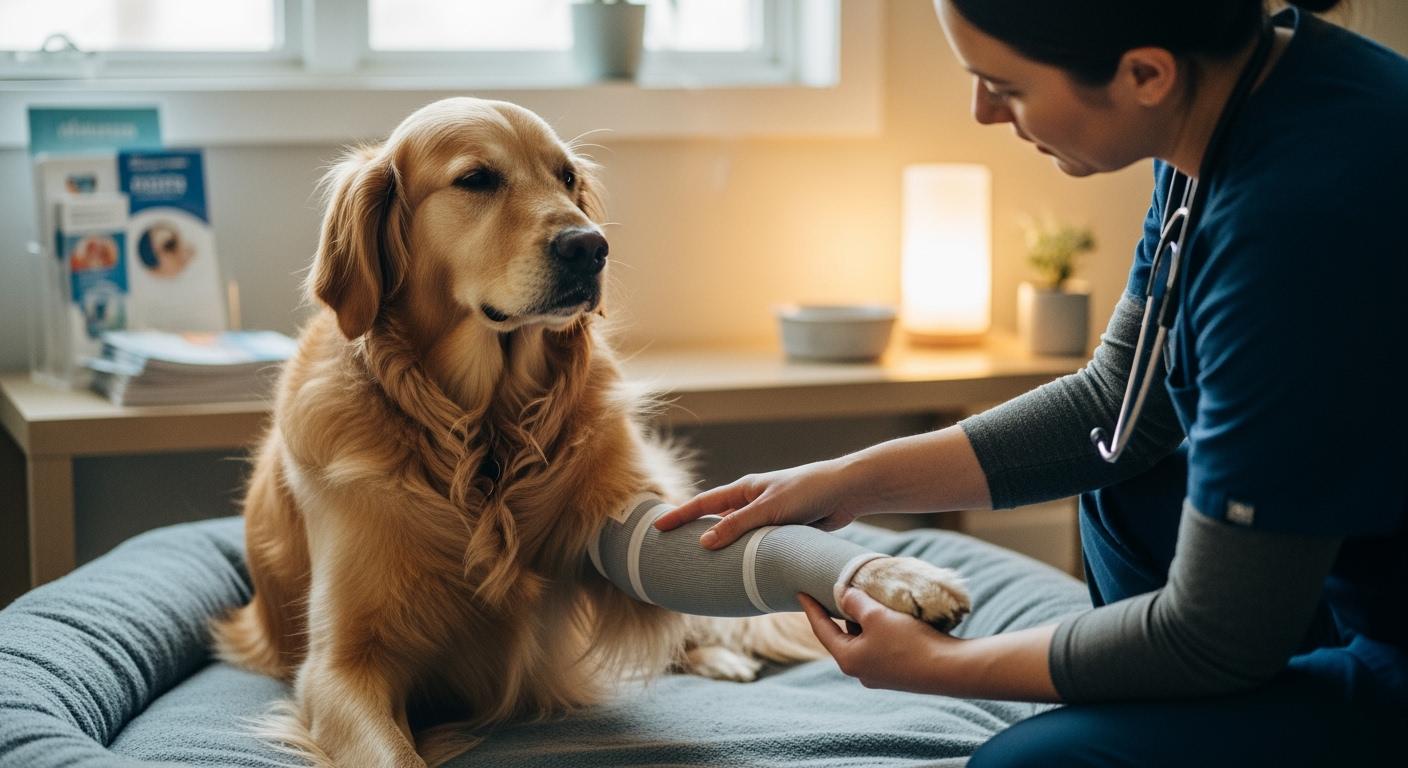
A brand evaluating whether to add an anti lick sleeve for dogs to its product line is making a series of design, sizing, and supplier-validation decisions that determine whether the product performs reliably in the field.
Anti-lick sleeves look straightforward from the outside, but the differences between a sleeve that protects a wound and one that shifts, gaps, or irritates the skin are built into the pattern, the anchoring method, the closure system, and the size grade. Missing any of these during product development shows up later as coverage failures, customer confusion, and product returns.
This article walks through the design decisions brands should evaluate before finalizing an anti-lick sleeve specification, from front-leg and hind-leg pattern differences to sizing logic to supplier sample validation.
An anti-lick sleeve is a physical access barrier, not a wound treatment; brands should keep protection claims separate from healing or medical claims.
Pattern and Coverage: Front-Leg vs. Hind-Leg Sleeves
The first product decision is not about material or color. It is about which limb the sleeve is built for. A front-leg anti-lick sleeve and a hind-leg sleeve require different patterns. A single universal pattern will not fit both correctly.
A front-leg pattern is shaped for the straighter profile of the forelimb. The sleeve needs to cover from below the elbow to above the paw, with enough length to prevent the dog from reaching the wound around the top opening. The shoulder area provides a natural anchor point.
A hind-leg pattern must account for the angled hock and stifle joints, the wider thigh profile, and the clearance needed for toileting. A hind-leg sleeve built on a front-leg pattern will pull, rotate, or leave gaps at the hock — each creating a reach path. Brands that use one pattern for both front and hind legs may face more fit complaints when the pattern does not match the target limb anatomy. on the leg the pattern was not designed for.
Beyond front vs. hind, brands should also define which wound locations each SKU is designed to cover. Anti-lick sleeves are most effective for forearm and lower hind-limb wounds. Upper-leg wounds near the shoulder or hip demand extended anchoring and longer sleeve bodies. Torso, abdominal, paw, and multi-site wounds fall outside sleeve coverage entirely and require alternative protection such as a recovery suit or cone.
When evaluating sample coverage, brands should not rely on a single dog or a single size. A pattern that fits a medium-sized dog with average proportions may fail on a dog with a deeper chest or shorter limb length. For more on coverage and fit checks for front-leg sleeves, see coverage and return patterns in dog front-leg sleeves.
| Wound Location | Sleeve Suitability | Required Design Feature | Alternative When Sleeve Fails |
|---|---|---|---|
| Front forearm | High | Full-length sleeve, shoulder anchor | Recovery suit or cone |
| Upper front leg | Medium | Extended sleeve, reinforced anchor | Recovery suit |
| Lower hind leg | High | Hind-leg pattern, hock clearance | Recovery suit or cone |
| Upper hind leg | Medium | Longer sleeve, thigh anchor | Recovery suit |
| Torso or abdomen | Low | N/A | Recovery suit or cone |
| Multiple wound sites | Low | N/A | Multi-site protection product |
| Wet or draining wound | Low | N/A | Veterinary-directed bandage |
If a brand plans to launch with a narrow range, the product development team should document which wound locations are within scope and which are explicitly out of scope. This boundary definition shapes the size chart, the fitting guide, and the customer-facing product description — and it prevents the kind of misaligned expectations that drive returns in this category. For guidance on choosing between front and hind-leg sleeve SKUs, see choosing front vs. hind-leg recovery sleeve patterns.
Anchoring, Closures, and Material Trade-Offs
Anchoring and Sleeve Migration
A sleeve that slides during activity may indicate an anchoring, pattern, material, or sizing problem rather than a failure that should automatically be attributed to the user. Anchoring depends on where the top of the sleeve lands and whether that anchor point remains stable during movement.
For front-leg sleeves, anchoring at the shoulder area redirects the downward pull that occurs with each stride. For hind-leg sleeves, anchoring above the thigh or near the hip prevents the sleeve from rotating around the leg. The anchor must hold without excessive tension — overtightened closures create pressure points, while undertightened closures allow migration.
Sourcing note: When evaluating supplier samples, check whether the anchoring method maintains position after repeated movement cycles. A sleeve that remains stable during a static fit check but migrates during a defined supervised movement assessment may have an anchoring, pattern, material, or sizing issue that requires further evaluation.
Closure Placement and Reach Paths
Hook-and-loop closures are the most common choice for anti-lick sleeves because they allow adjustment and easy removal for wound inspection. But closure placement is what determines whether a dog can find a way around the sleeve.
Closures should be positioned away from the wound area and away from high-movement zones. A closure placed directly over a joint can create pressure points and irritation during repeated flexion. Hook-and-loop edges that are not finished with edge guards or protective flaps create both a reach path and a skin irritation risk in a single design detail.
Brands should also confirm whether closure materials are specified for repeated use. Hook-and-loop that loses grip after several wear-and-wash cycles will produce sleeves that no longer stay closed — a failure that may not appear in initial samples but emerges in the field.
Material Selection: Breathability, Stretch, and Seams
The core fabric in an anti-lick sleeve needs to balance breathability with enough structure to maintain edge stability. Fabrics that are too rigid restrict movement; fabrics that are too elastic lose shape at the hem and creep during activity, gradually exposing the wound.
Material performance when wet also matters. Dogs walk on damp ground, and wound sites may have drainage. A fabric that stretches out when exposed to moisture will fit differently after the first wear cycle than it did during the dry sample check. Brands should ask suppliers whether the specified material has been tested for wet-state dimensional stability.
Interior seam construction is equally consequential. Flat seams or covered seams reduce friction against the skin, especially in areas of repeated movement like the elbow or hock. Raised or unfinished interior seams can create pressure points that lead to skin irritation — a product failure that may not appear in a quick sample check but emerges after extended wear. For common failure patterns in hind-leg sleeves that trace back to seam and coverage issues, see fit and coverage problems in dog hind-leg sleeves.
| Product Route | Protection Method | Best-Fit Location | Key Development Requirement | Main Limitation |
|---|---|---|---|---|
| Front-leg anti-lick sleeve | Physical barrier | Forearm, lower front leg | Pattern fit, shoulder anchoring | Not for torso or paw wounds |
| Hind-leg anti-lick sleeve | Physical barrier | Lower hind leg | Hind-leg pattern, hock clearance | Not for front leg or upper thigh |
| Bilateral sleeve | Dual-limb coverage | Both front or hind legs | Symmetrical pattern, dual closure | Not for single-site wounds |
| Recovery suit | Full-body garment | Torso, abdomen, multi-site | Size range, stretch, closures | May restrict movement, heat buildup |
| Cone or E-collar | Head barrier | Any location | Adjustable fit, lightweight | Stress, limited eating/drinking |
Sizing Logic and Sample Validation
Building a Functional Size Grade
Anti-lick sleeve sizing typically relies on limb circumference and sleeve length. But circumference alone is insufficient. Two dogs with the same leg circumference can have different leg lengths, joint positions, and body proportions — and a sizing system that only uses girth will place dogs with mismatched proportions into the same SKU.
The result is predictable: the sleeve fits the circumference but is too short or too long, creating coverage gaps or bunching that opens reach paths. Brands should ask suppliers how their size grades account for length as a separate dimension, and whether front-leg and hind-leg sleeves use independent sizing tables. A single size chart applied to both front and hind sleeves is a signal that pattern differentiation may be insufficient for consistent fit across the range.
Size grade decisions also affect SKU count and inventory complexity. A brand that offers only two or three circumference-based sizes may capture a broad weight range but will see higher rates of fit-related returns at the edges of each size band. Adding intermediate sizes reduces this risk but increases minimum order complexity and warehousing requirements. The trade-off should be evaluated before locking the size chart, not after the first production run.
Four Validation Checks Before Production Approval
Before approving a sample for production, brands should complete four checks across the full size range:
- Coverage: The sleeve covers the entire wound area with margin beyond the wound edges. Check on the smallest and largest sizes in the range, not just the medium.
- Reach: The dog cannot access the wound by licking around the sleeve opening, through closure gaps, or by pushing the sleeve edge up.
- Movement: The sleeve maintains position during walking, sitting, lying down, and transitions between positions. Anchoring should hold without readjustment.
- Condition: After a wear cycle, the wound area remains clean, dry, and free of pressure marks. The sleeve fabric and seams show no evidence of stretching, fraying, or edge curling.
Sample check: Validate samples across the smallest and largest sizes in the range. Edge sizes expose different fit issues — the smallest may have excess material that bunches, the largest may have insufficient length for full coverage. A sample that passes in medium does not guarantee that small or large will perform the same way.
These checks are not one-time. Each new size, each material substitution, and each pattern revision should go through the same four validations. Brands should also confirm which validation the supplier has already completed internally and which they expect the brand to perform. This distinction affects sample turnaround, development timeline, and where responsibility falls if a fit issue emerges after production begins.
Once a brand has validated its size chart and samples, the fitting guide and packaging should clearly communicate which wound locations the sleeve is designed for and which are outside its coverage boundary. An accurate sizing guide that includes stop-use conditions reduces the volume of fit-related customer service inquiries and helps channel partners support end users correctly. For a detailed breakdown of anti-lick sleeve sizing and fit documentation, see the dog recovery sleeve fit and protection guide.
The anti-lick sleeve category rewards brands that treat it as a product development exercise, not a simple resale item. Pattern differentiation between front and hind legs, anchoring that resists migration, closure placement that eliminates reach paths, and a sizing system that accounts for length as well as circumference — these are the decisions that separate a sleeve that works consistently from one that generates returns and channel partner complaints.
Brands evaluating this category should prioritize suppliers who can explain their pattern logic, demonstrate size-grade reasoning, and walk through the four validation checks for each SKU. That conversation reveals whether a supplier understands the product well enough to deliver it across production runs. For brands ready to explore anti-lick sleeve development, the dog anti-lick solutions overview and the anti-lick product category provide a starting point for specification and sample discussions.
