
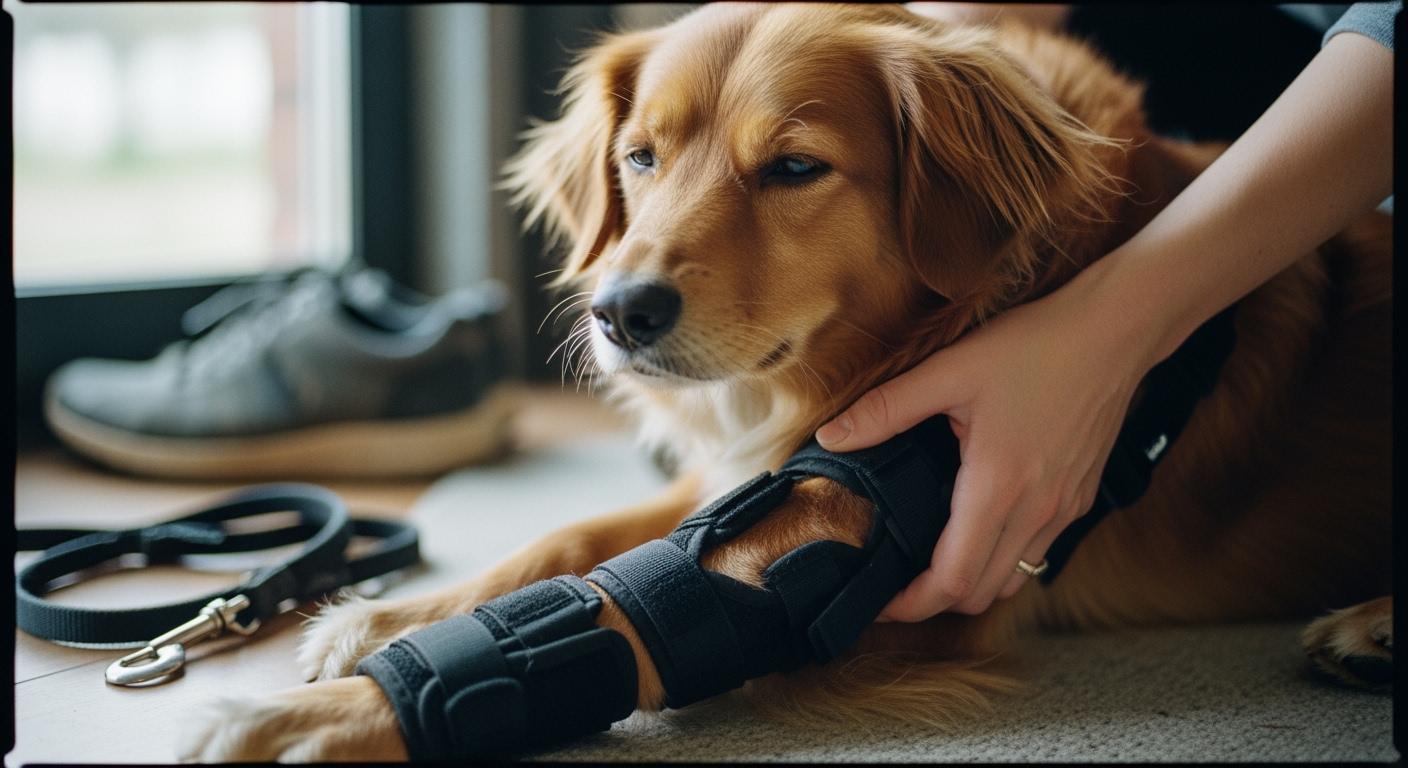
A CCL brace that holds perfectly during a straight-line walk can fail silently the moment your dog sits down. Straps shift. Padding bunches. The stifle hinge that tracked the joint at a standstill now presses half an inch above the knee axis — and every step loads the wrong structure.
That is the gap between how braces are tested and how they are used. The search for the best CCL dog brace is not about finding the strongest product. It is about finding one whose design holds up across the postures and conditions of real daily use — walking, sitting, lying down, getting up, repeating — without creating new problems under the brace.
Where a CCL Brace Fails First
Two failure modes show up faster than any others. They are not rare. They are predictable — built into how most braces interact with canine anatomy outside of standing.
Strap migration when the dog is not walking
A stifle brace is patterned for extension. The strap paths, hinge placement, and shell contour all assume the leg is straight or near-straight — the position of a standing or walking dog. When the dog sits, the stifle flexes past 90 degrees. The upper strap, anchored around the thigh, stays roughly in place. The lower strap, sitting below the knee, gets pulled proximally as the gastrocnemius shortens and the skin over the tibial crest shifts.
This differential movement — upper strap static, lower strap migrating upward — creates a shear plane across the brace shell. The hinge axis tilts. Instead of the medial and lateral condyles taking equal pressure, one side loads harder. Within minutes, the dog feels a focused pressure point on one side of the joint, not distributed support. That is when the dog starts licking the brace edge, shifting weight off the leg, or refusing to move.
You can verify this yourself. After a 15-minute walk that includes at least two sit breaks, remove the brace and check the strap positions against the marks they left on the fur. If the lower strap indentation has moved more than half an inch relative to where you set it, the brace is migrating under load. That offset will grow with each sit-stand cycle.
Heat, moisture, and what happens to skin inside a closed wrap
The second failure mode is quieter but faster. A closed-cell foam liner or dense neoprene wrap traps body heat against the skin. The stifle has almost no natural airflow even without a brace — thick fur, folded skin, and minimal surface-area-to-volume ratio mean heat dissipates slowly. Add a non-breathable wrap and the microclimate under the brace changes in under ten minutes of walking.
Sweat and ambient moisture get absorbed into the liner but have nowhere to evaporate. The stratum corneum — the outermost skin layer — begins to hydrate beyond its normal range. Hydrated skin is softer and more fragile. Friction from even a well-fitted brace now causes micro-tears that dry skin would have tolerated. Left unchecked across multiple wear sessions, those micro-tears become visible erythema, then superficial erosions, then open sores that require stopping brace use entirely.
The check is straightforward: twenty minutes after removing the brace, press the back of your hand against the skin where the liner sat. If the skin still feels warmer than the opposite leg or feels tacky to the touch, moisture is not clearing between sessions and the liner material is not breathing fast enough for your dog’s activity level and coat type.
Design Details That Decide Whether Support Holds
Three structural choices determine whether a CCL brace prevents these failures or accelerates them. None of them show up on a spec sheet, but all of them are visible if you know what to check.
How hinge placement interacts with joint loading
A stifle hinge that sits even a quarter-inch off the joint axis does not just feel wrong. It changes the moment arm through which ground reaction forces travel up the leg. When the hinge is aligned, vertical force from the paw passes through the mechanical axis of the brace, and the shell distributes load across the intended contact area — typically the proximal tibia and distal femur.
When the hinge drifts high or low, the force vector shifts off-axis. The brace no longer transmits load through the shell. It transmits it through the hinge pin itself — a small metal or polymer pivot never designed to carry body weight. The pin deforms microscopically with every step. Over weeks, that deformation accumulates into visible play in the hinge. A loose hinge cannot stabilize the joint. It becomes a pivot point for uncontrolled rotation.
This is why single-axis hinges on off-the-shelf braces fail more often on dogs with non-standard leg conformation — deep-chested breeds whose femur angle differs from the pattern the brace was molded to, or dogs with angular limb deformities. The hinge cannot self-correct. It either matches the joint or it fights it.
Strap width, edge finishing, and why narrow straps cut more than wide ones
A narrow strap concentrates force onto a thin line of contact. When the dog flexes the stifle, that strap edge becomes a fulcrum. Skin and underlying tissue get compressed between the strap and the bone below. Wide straps — at least 1.5 inches for medium-to-large dogs — spread the same retention force over a larger surface area, dropping the peak pressure under any single point of contact.
Edge finishing matters equally. A raw-cut neoprene edge has a square profile. Under tension, that square edge digs into the skin at exactly the pressure point a smooth rolled edge would have distributed. Braces with bound edges — fabric-wrapped or heat-sealed — reduce the shear concentration at the strap border.
After a walk, run a finger along the inside of each strap. If you feel a ridge or hard corner, that is exactly what your dog’s skin felt for the duration of the session.
| Performance difference | Why it matters | Main limitation |
|---|---|---|
| Hinge axis matches joint center vs. drifts proximal under load | Off-axis loading concentrates force through the hinge pin, not the shell — wear accelerates, stabilization fails | Single-axis hinges cannot self-correct for dogs outside the conformation range the brace was patterned for |
| Wide bound straps vs. narrow raw-cut straps | Wider straps lower peak contact pressure; bound edges eliminate the shear line that raw cuts create under tension | Wide straps add bulk in the popliteal region behind the knee, which can limit flexion range on small dogs |
| Breathable spacer-mesh liner vs. closed-cell foam | Moisture evaporation through the liner prevents skin hydration creep across sessions; closed foam traps it | Open-mesh liners offer less impact cushioning — the tradeoff is ventilation for shock absorption |
When a CCL Brace Is the Wrong Tool
A CCL brace works within a narrow band of use: short, controlled leash walks on even terrain where the dog’s weight is fully on the leg and the stifle stays near extension. Outside that band, the brace can create problems faster than it solves them.
Unsupervised or all-day wear. No stifle brace is designed for continuous wear. Every hour the brace stays on beyond a supervised session adds cumulative risk of skin maceration, strap-induced pressure sores, and hinge-axis drift from repeated posture changes.
Off-leash activity. A brace cannot protect the cranial cruciate ligament against the rotational and shear forces of sprinting, jumping, or sharp turns. If the dog breaks into a run, the brace becomes dead weight that may actually increase the twisting moment on the joint.
Full-thickness tears with significant instability. When the tibia translates forward freely (positive cranial drawer), a soft or semi-rigid brace lacks the structural authority to restore joint congruence. At that level of laxity, the brace functions as a proprioceptive cue — reminding the dog to load the leg carefully — rather than mechanical stabilization.
Dogs with extreme leg conformation. Breeds with very short femurs relative to tibia length, or dogs with significant angular limb deformities, fall outside the fit range that standardized brace patterns can accommodate. In these cases the hinge cannot be positioned correctly, and an off-axis brace is worse than no brace.
Disclaimer: The fit checks described here assume a short-coated dog where strap marks and skin changes are visible on inspection. Double-coated breeds may show subtler rub marks that require hand-palpation rather than visual inspection — run your fingertips along the skin under the brace line after each session, feeling for warmth differences, texture changes, or the dog’s flinch response to light pressure. If the dog’s leg conformation falls outside breed norms — particularly angular limb deformities or very deep chests that change the standing angle of the femur — the hinge-axis checks described above may not be sufficient to catch every pressure point.
Reading the Signals Before the Brace Does Damage
Most brace failures announce themselves before they become injuries. The signals are there. The question is whether you know which ones to track.
| Signal level | What you see | Pass or fail | What to do |
|---|---|---|---|
| Green | Brace stays aligned through sit-stand cycles, skin looks identical to the unbraced leg, dog loads the leg evenly | Pass | Continue supervised sessions at current duration |
| Yellow | Strap indentation has shifted, pinkness that fades within 10 minutes of removal, dog shortens stride slightly but still weight-bears | Borderline — recheck fit | Shorten session by half, verify strap tension and hinge position, monitor for one more session |
| Red | Swelling or heat under the brace, strap-line abrasions that do not blanch, cold paw, worsening limp, dog refuses to stand or repeatedly tries to remove the brace | Fail | Remove the brace, discontinue use, contact your veterinarian before resuming |
This table works because it ties each signal to a specific pass-or-fail action. Green means the current fit and wear duration match your dog’s anatomy and the brace’s design limits. Yellow means the margin is eroding — either the fit drifted, the session was too long for conditions, or the brace’s materials are not keeping up with your dog’s heat output. Red means the design has already failed for this dog in this condition and continuing use creates a wound, not support.
A CCL brace that fits your dog’s stifle anatomy, uses breathable liner materials, holds hinge alignment through posture changes, and stays on only for supervised leash walks can provide meaningful joint support during conservative management or post-surgical rehabilitation. For a deeper look at how hinge type affects daily stability, the difference between hinged and soft-shell CCL brace designs comes down to whether the joint needs rotational constraint or primarily proprioceptive feedback. If you are still evaluating whether a brace is appropriate for your dog’s specific injury, the signs that indicate a CCL brace is providing effective support include consistent stifle alignment through full walk sessions and unchanged skin condition between uses. Getting the fit right from the first session matters — a step-by-step approach to fitting a CCL knee brace walks through the strap tension, hinge placement, and traction checks that catch most fit problems before the first walk.
For dogs with partial CCL tears or post-surgical recovery needs, the product design that matters most is not the one with the highest listed support rating. It is the one whose stifle brace fit and daily use checks match how the brace actually performs through sit-stand cycles, on the surfaces your dog walks on, in the climate you live in. A CCL knee brace built for torn ligament support must hold alignment through the full wear session — not just at the start. Across the range of CCL brace solutions for knee stability and recovery, the common failure thread is not weak materials. It is design details that work on the test bench but do not survive posture changes, moisture, and repeated use cycles.
FAQ
How long should a CCL brace be worn per session?
Start with 15 to 30 minutes of supervised leash walking. Increase only if the brace holds alignment and skin checks are clean. Remove the brace for all rest, sleep, and indoor time unless a veterinarian has given specific contrary instructions for a documented reason.
What is the first sign that a brace is failing?
Strap migration. Before skin breaks down, before the dog limps, the brace shifts. Check strap positions against the fur marks after every session. Movement over half an inch means the fit is not holding and the session should have been shorter or the strap configuration needs adjustment.
Can a dog sleep in a CCL brace?
No. During sleep the dog cycles through postures — curled, sprawled, side-lying — that apply unpredictable shear and compression to the brace. Overnight wear multiplies the risk of pressure sores and skin maceration without providing meaningful stabilization, since the dog is not weight-bearing.
Does a CCL brace work for a full tear?
A brace can provide proprioceptive feedback and mild mechanical support for a full tear, but it cannot restore joint congruence when significant cranial drawer is present. Its role shifts from stabilization to movement cueing — reminding the dog to load the leg conservatively. This distinction matters for setting realistic expectations about what the brace can and cannot do for a given injury severity.
