
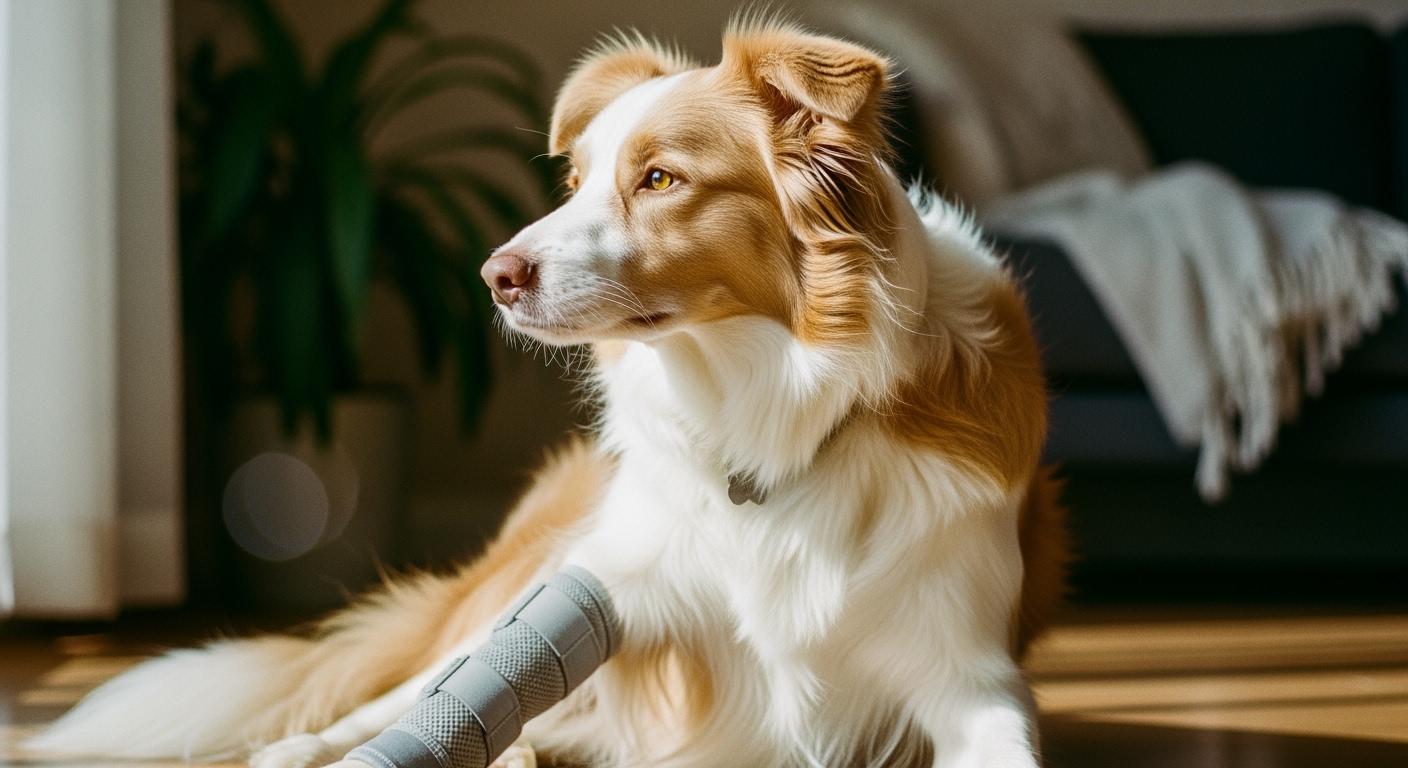
A sleeve sits clean over the hock wound while the dog stands. Ten minutes later the dog curls up, the leg bends, and the wound edge appears right beside the cuff. The sleeve did not fail. It was never designed to hold position through that angle change — and most owners miss this because the fit check happens at rest.
A dog anti lick sleeve for hock wound coverage faces a geometry problem no straight-leg sleeve encounters. The hock bends sharply. The limb tapers fast above and below the joint. Every sit or curl reshapes the surface the sleeve grips. Coverage that holds standing can vanish sitting. Understanding which structural details reduce this — and when no sleeve can — is the difference between a sleeve that protects and one that covers but does not stop licking.
Why Coverage Fails When the Sleeve Looks Correct
The hock bends — it is not a straight limb
Above the hock, the thigh flares. Below it, the cannon bone narrows. Between them sits a joint that flexes roughly 45 degrees during a normal sit. Every degree reshapes the surface a cuff must grip.
A sleeve cuff holds position through circumferential tension. On a straight cylinder, that tension distributes evenly. On a tapering limb that bends, tension concentrates at the narrowest grip point. As the joint flexes, limb diameter at that point changes. The cuff either loosens — letting the sleeve slide — or tightens unevenly into a pressure ring. Either way, it migrates. Within a few sit-stand cycles, the wound creeps toward the opening. That fails fast.
This is not a sizing error. It is a geometry mismatch — one that a longer coverage zone and a flexible bend panel address by spreading grip load across surface that deforms less during flexion.
Rest coverage is not motion coverage
Checking sleeve position while the dog stands checks the one position where the hock does not challenge fit. Run this sequence instead:
- Locate the wound and measure its distance from the nearest sleeve edge.
- Put the sleeve on without overtightening straps.
- Watch the dog stand, walk for two minutes, then sit or lie down.
- Remove the sleeve. Check the same edge-to-wound distance and inspect skin for red marks, dampness, or bunching creases.
If the wound has moved closer to the edge after this cycle, the sleeve is shifting during movement. Tightening straps will not fix this. It adds pressure on bony points without stopping migration driven by hock angle change.
In practice: After a five-minute walk, run a finger along the inside of the cuff. If the cuff has moved more than half an inch from its original position, anchoring is failing. A photo taken at initial fit gives you the baseline.
Why edge gaps give dogs a starting point
Dogs do not chew through sleeve fabric. They find the edge and work inward. If the cuff sits within an inch of the wound, a tongue bridges that gap when fabric shifts during movement. The wound does not need to be fully exposed — just reachable.
Coverage-zone length matters more than tightness. A cuff extending two inches past the wound in all directions buys margin against migration. A cuff flush with the wound edge works at rest and only until the dog moves.
| Real failure | Why it happens | What the dog does next | Better structure choice |
|---|---|---|---|
| Edge too close to wound | Cuff sits near wound; joint flexion shifts it closer | Licks or chews at exposed margin | Longer coverage zone, smooth low-bulk cuff |
| Fabric bunches behind hock | Joint bends, fabric folds into crease, creates pressure lump | Finds gap at fold, starts licking | Flexible bend panel, stable anchoring above hock |
| Sleeve slides during walking | Taper plus repeated flexion pulls sleeve toward paw | Reaches wound as cuff migrates down | Anchoring that grips without overtightening |
| Strap pressure on bony points | Overtightening to fight sliding concentrates force | Discomfort, altered gait, possible limping | Distributed grip design, skip the overtightening impulse |
| Wound below sleeve opening | Sleeve cannot extend to paw-level wounds | Licks or chews at exposed area | Cone, boot, or vet-applied wrap |
| Dog still reaches wound | Sleeve shifts, edge gap forms, wound becomes reachable | Persistent licking or chewing | Full-coverage anti-lick product or combination approach |
| Signal level | What you see | Action |
|---|---|---|
| Green | Wound stays covered in all positions, skin dry, dog walks normally | Continue use, monitor twice daily |
| Yellow | Sleeve shifts slightly, light rubbing marks, minor bunching at bend | Adjust fit, check more often, photo-compare at next check |
| Red | Wound exposed, chewing, wet fabric, swelling, heat, discharge, odor, bleeding, new limping | Stop use immediately, try safer option, call vet |
A systematic fit-check routine catches these failures before licking starts. Following a structured approach to recovery sleeve fit assessment surfaces the motion-coverage gap early — the difference between catching a shift at yellow versus discovering the wound wet and exposed.
Fit and Material Problems That Defeat Coverage
Bunching behind the hock
The hock crease is where fabric goes to fold. When the joint bends, excess material behind the hock cannot stretch — it bunches. That lump pushes the cuff up or down, opening a gap on the opposite side. It also presses directly on the hock point, which is bone-close-to-skin on most dogs.
A flexible bend panel — thinner material or a gusset behind the joint — gives fabric a place to fold without stacking into a lump. Without it, bunching is nearly guaranteed on any dog that sits repeatedly.
- Signs of bunching failure:
- Fabric folds behind hock after sitting
- Wound migrates closer to edge after movement
- Red marks or crease impressions at the hock crease
Sliding toward the paw
A sleeve that migrates down the leg during walking enters a runaway failure mode: the grip surface shrinks as the limb tapers, so the cuff slides faster the further it moves. Anchoring above the hock — where the thigh provides a broader, more consistent grip surface — stops this before it starts. Sleeves relying entirely on below-hock grip are vulnerable, especially on slender-legged or slick-coated dogs. The issue appears across hind leg sleeve designs where slipping and poor coverage trace back to a single narrow grip band on a tapering surface.
- Signs of sliding:
- Sleeve rides visibly lower after walking than at initial fit
- Wound edge appears near the top cuff
- Sleeve rotates so seams no longer align with leg anatomy
Over-tight straps and pressure on bony points
Overtightening to stop sliding creates a tourniquet effect at the narrowest point while the rest of the cuff stays loose. The hock point, tibial crest, and Achilles insertion all sit close to skin with minimal padding.
Remove the sleeve after two hours. Run your thumb along the skin where each strap sat. A faint pink line that fades within minutes is acceptable. A deep red groove that persists, or any swelling, means strap pressure exceeded tissue tolerance. Stop using that configuration.
- Pressure warning signs:
- Deep red grooves persisting after sleeve removal
- Swelling or warmth at strap contact points
- Dog licks at the strap area rather than the wound
Soft fabric that traps moisture
Fabric that feels soft often has high yarn-surface-area construction — brushed fibers, terry loops — that wick moisture in and hold it. Under a sleeve, with body heat and zero airflow, trapped moisture macerates skin within hours. Macerated skin loses barrier function. Bacteria that were harmless on dry skin find a wet entry point.
Breathable, low-pile fabric that dries quickly breaks this cycle. Rotating two sleeves — one worn, one washed and air-dried — keeps fabric moisture low. For wounds in positions where coverage is harder to hold, understanding how wound location changes sleeve effectiveness avoids expecting one design to solve every placement challenge.
| Skin Sign | What It Means | What To Do |
|---|---|---|
| Redness | Pressure, friction, or early moisture damage | Adjust fit or switch sleeve; dry skin thoroughly |
| Swelling | Sustained pressure exceeding tissue tolerance | Remove sleeve, contact vet if swelling persists |
| Dampness, pale or wrinkled skin | Moisture trapped under non-breathable fabric | Dry skin completely, wash and dry sleeve, rotate to spare |
| Deep marks or grooves | Strap pressure too high at contact point | Loosen straps, redistribute grip, recheck after one hour |
When a Dog Anti Lick Sleeve Is Not the Right Tool
Wounds below the hock or near the paw
A hind-leg sleeve ends above the paw. If the wound sits on the paw, between toes, or within an inch of the paw on the lower cannon bone, the sleeve cannot cover it with margin. The bottom opening is structurally necessary — the paw must pass through — but it means wounds near that opening have zero margin against exposure. For paw-level wounds, a boot or vet-applied wrap closes that gap. A cone adds a second barrier.
Dogs that can still reach the wound
Deep-chested breeds with long necks and small flexible dogs can curl far enough to reach a hock wound despite a sleeve. The tongue finds the edge, works underneath — the sleeve becomes irrelevant. If the dog reaches the wound even once while wearing the sleeve, the sleeve alone is insufficient. Comparing lick sleeve and cone protection is about which geometry matches the dog’s reach and wound placement — not which product is better in the abstract.
Wet, infected, or worsening wounds
A sleeve covers. It does not debride, deliver medication, or reverse infection. If the wound is producing discharge, smells foul, or has grown since sleeve use began, the problem has moved beyond what a physical barrier addresses. Continuing to use a sleeve on an actively infected wound traps bacteria and moisture, accelerating tissue breakdown.
Disclaimer: These fit checks assume a short-coated dog where skin changes are visible on inspection. Double-coated breeds — Huskies, Malamutes, Shepherds — may show subtler rub marks hidden under dense undercoat. On these dogs, rely on hand-checking: run fingers slowly over the skin after each wear period, feeling for warmth, bumps, or dampness the coat conceals. If the dog’s leg conformation falls well outside breed norms — particularly angular limb deformities or unusually deep chests — the standard coverage zones described here may not catch every pressure point.
| When Not to Use a Sleeve | Why It Fails | What to Try Instead |
|---|---|---|
| Paw or toe wounds | Sleeve opening leaves paw exposed; no margin below wound | Boot, cone, or vet-applied wrap |
| Dog still reaches wound despite sleeve | Neck flexibility or spine length beats sleeve edge margin | Cone alone, or sleeve-plus-cone combination |
| Wet, draining, or infected wounds | Barrier traps moisture and bacteria; wound needs treatment | Veterinary wound care plan |
When to switch to a different approach
Stop using the sleeve when any of these appear:
- The wound sits below the hock or on the paw.
- The sleeve keeps sliding or bunching after adjustment.
- The dog licks at the wound through or around the sleeve.
- The wound shows swelling, discharge, odor, or has grown.
- The dog limps, vocalizes, or shows pain when the leg is touched.
These alternatives are not universally better — they are different geometries for different wound placements. Anti-lick solutions that match wound position to barrier geometry outperform forcing one product type across every scenario.
| Alternative | When to Use It | What It Does |
|---|---|---|
| Cone (E-collar) | Dog reaches wound with tongue despite sleeve | Blocks tongue access regardless of leg position |
| Boot | Wound on paw, toes, or lower cannon near paw | Covers below-hock areas a sleeve cannot reach |
| Vet-applied wrap | Wound needs dressing contact or medication | Combines coverage with treatment access |
| Veterinary wound plan | Infection, non-healing, or worsening wound | Addresses underlying healing failure, not just licking |
A dog anti lick sleeve for hock wound coverage is a geometry-dependent tool. It works when the wound sits within a zone the sleeve can cover with margin, on a dog whose flexibility does not outreach that margin, with fabric that breathes and anchoring that holds without tourniquet pressure. When those conditions are not met, the sleeve is the wrong choice. For most hock wounds, selecting the right anti-lick product starts with measuring wound-to-edge margin in all three positions — stand, walk, sit — not with comparing feature lists on a product page.
FAQ
How often should the sleeve and skin be checked?
Remove the sleeve at least twice daily. Inspect skin for redness, swelling, dampness, or deep marks. Check wound-edge position relative to the cuff before and after a short walk. Early detection of migration or moisture damage prevents a failing sleeve from becoming a worsening wound.
Can a dog wear the sleeve overnight?
Overnight wear amplifies every fit risk: the dog lies on the sleeve, body heat and weight trap moisture, and hours pass without inspection. If overnight coverage is unavoidable, rotate two sleeves and check skin first thing in the morning. A cone is often the safer overnight option — it adds no moisture or pressure to the wound site.
What if the sleeve gets wet?
Remove it immediately. Wet fabric against skin accelerates maceration. Dry the leg completely, wash the sleeve, and do not reapply until the sleeve is fully dry. A spare sleeve matters here — wound protection should not pause while fabric dries.
