
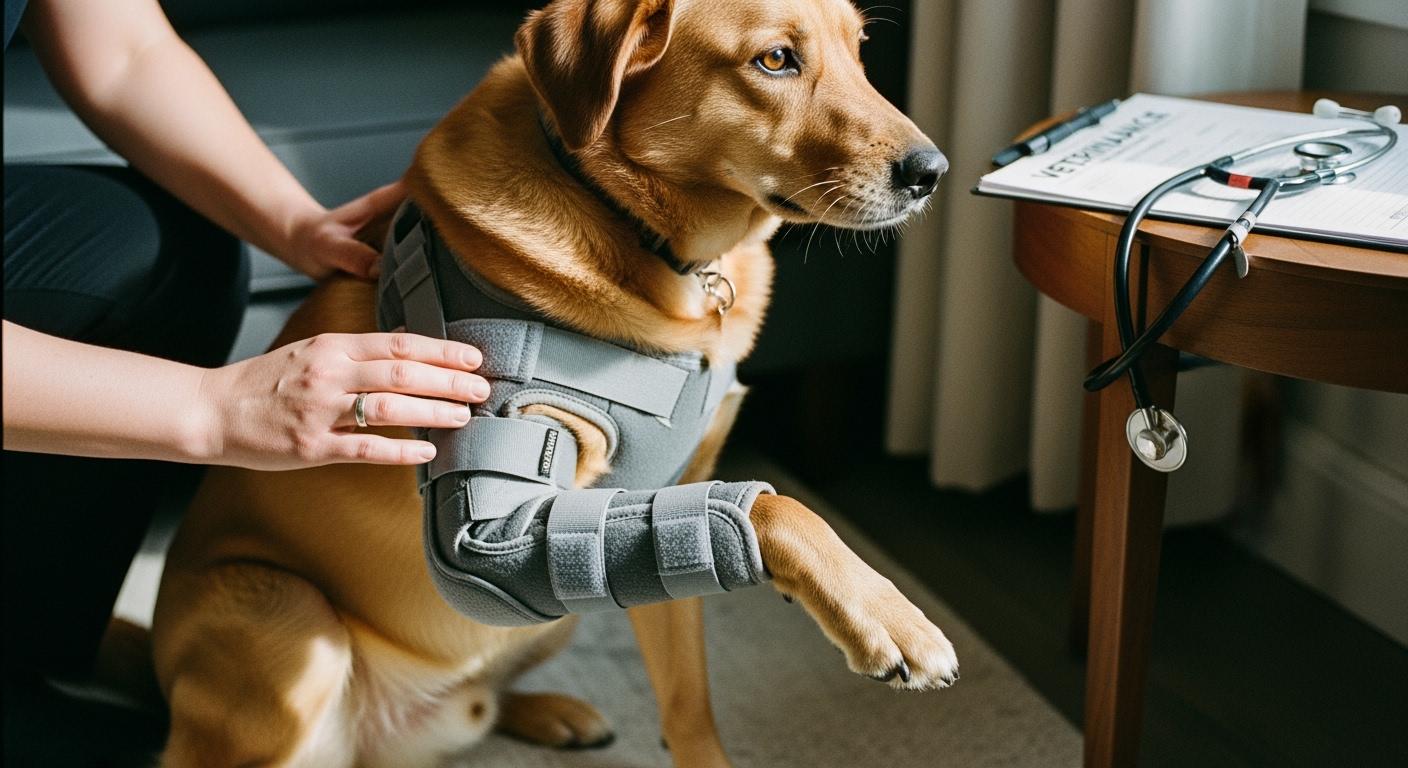
A guard that presses into the same spot it is supposed to protect does not fail quietly. It leaves a ring. A red, circular pressure mark that says the padding never actually shifted force away from the swelling — it just wrapped the problem in fabric.
That is the central tension in a dog elbow knee guard for hygroma pressure balance. The hygroma itself is a fluid-filled pocket the body builds in response to repeated trauma over a bony point. Give it pressure relief and it can reabsorb. Push into it with a pad that sits dead center on the swelling, and the guard becomes another source of impact.
Most failures trace back to two structural choices: where the padding lands relative to the hygroma, and how the straps translate force into the skin. Everything else — breathability, edge binding, panel segmentation — determines whether those two core issues get caught early or compound silently.
Why Hygroma Pressure Balance Fails in Most Dog Elbow Knee Guards
A hygroma is not a callus. It is a pocket of fluid the body lays down over a bony prominence — usually the olecranon at the elbow — after repeated impact against hard surfaces. Large-breed dogs and dogs with thin coats see this most often. The body can reabsorb that fluid if the pressure stops. But the guard itself can become the next source of trauma if the padding geometry is wrong.
When direct padding creates a pressure ring instead of relieving it
Here is the causal chain that turns a soft-looking guard into a pressure concentrator.
The olecranon is a small, pointed contact zone. When a dog lies down, body weight drives that point into the floor through whatever sits between them. If the guard places its thickest padding directly over that bony point, the pad acts as a piston: body weight above, hard floor below, soft tissue compressed in between. The force does not spread — it transmits straight through the padding into the hygroma.
Over hours of lying down, that repeated piston effect keeps the fluid pocket pressurized. The body never gets the signal to reabsorb. The swelling stays, or grows. The dog starts shifting weight off the guarded leg. That is the observable failure: after 20 minutes of rest on a hard floor, flip back the lining and look for a defined circular red mark directly over the bony point. A diffuse pink is normal tissue response. A sharp ring that matches the pad contour is a pressure concentrator in action.
This is why offset cushioning — padding that surrounds the hygroma rather than sitting on top of it — changes the mechanics entirely. The contact force transfers to the tissue ring around the swelling, where blood flow and lymphatic drainage are intact. The hygroma itself floats in a pressure shadow. This structural difference between center-pad and offset-pad designs is the divide between a guard that helps and one that adds to the problem. The same logic applies to elbow braces built for daily wear on hard surfaces, where pad placement relative to the olecranon determines whether the brace protects or creates a new pressure source.
Tip: A red mark that fades within 5 minutes of removing the guard is a circulation return, not a failure. A mark still visible after 10 minutes means the pad geometry needs changing.
Why narrow straps fail before the padding does
A strap that is 8 mm wide and a strap that is 25 mm wide are not just different sizes. They create fundamentally different force distributions under side load.
When a dog shifts position — rolling from sternal to lateral recumbency, or pushing up to stand — the guard experiences lateral force. A narrow strap has almost no anti-rotation face. The force concentrates at the strap edge. That edge rolls. Once the edge rolls, the entire strap migrates a few millimeters. Then the pad shifts with it, and what was offset cushioning is now partially on top of the hygroma.
The observable check: after 10 minutes of the dog moving between lying, sitting, and standing, mark the strap position with a small piece of tape on the fur. Check whether the strap has drifted more than half an inch. Drift means the force-distribution system is losing its geometry during normal movement — and the pad is no longer where the design intended it to be.
Wide straps resist this because their broader contact face creates more friction area and distributes the lateral force across more skin surface, reducing the per-millimeter shear that triggers edge roll. Soft edge binding on those wide straps removes the sharp transition that would otherwise dig in under tension. This strap-to-pad relationship is central to how elbow support guards maintain fit across different coat types and activity levels, since a strap that works on a short-coated dog may behave differently under a double coat.
Bedding and guard design: why one without the other still fails
A guard spreads contact force. Soft bedding spreads it further. Use the guard on a concrete kennel floor and the floor still wins — the padding compresses, the effective contact area shrinks, and the olecranon loads up again.
The guard-and-bedding combination works as a two-stage pressure diffuser. The guard handles the first stage — lifting the bony point away from direct floor contact. The bedding handles the second stage — increasing the contact area under the guarded limb so the force per square inch drops low enough for tissue tolerance. Remove either stage and the system reverts to point loading.
The choice between an elbow sleeve and a structured elbow brace often turns on whether the dog has access to soft resting surfaces. A sleeve alone on hard flooring may not provide enough pressure redistribution for an existing hygroma, while a structured brace with offset cushioning paired with soft bedding can maintain the pressure shadow through longer rest periods.
Guard Design Features and Failure Points
| Design feature | What can fail | Why it fails | Better structure |
|---|---|---|---|
| Direct center pad | Pressure on swelling | Piston effect drives force into hygroma | Offset cushioning, avoids center pressure |
| Narrow strap | Edge roll, rub lines | No anti-rotation face under lateral load | Wide straps with soft edge binding |
| Non-breathable padding | Damp heat, maceration | Moisture trapped against skin softens tissue | Breathable lining, moisture-wicking inner face |
| Hard seam or sharp edge | Friction line, skin breakdown | Concentrated edge pressure at seam | Low-profile seams, soft bound edges |
| Loose guard body | Migration, new pressure points | Guard shifts during movement, pad leaves target zone | Adjustable multi-point fit system |
| Padding crosses joint crease | Restricted flexion, skin rub | Material bunches in crease during bending | Segmented panels with joint crease relief |
Skin and Guard Check: Red-Yellow-Green Signals
| Signal level | What the caregiver sees | Action |
|---|---|---|
| Green | Guard stays in place, skin dry, no mark lasting over 5 minutes, dog tolerates wear | Continue use, monitor twice daily |
| Yellow | Light rub line, minor strap shift, mild dampness, mark fading within 10 minutes | Adjust fit, recheck after 10 minutes of wear |
| Red | Red ring lasting over 10 minutes, circular pressure mark, heat, swelling, discharge, bleeding, limping, or chewing at guard | Stop use, consult a veterinarian |
Note: Prevention is twice-daily skin checks. A guard that passed fit testing last week can fail this week if the dog’s weight changes, coat thickens or thins, or the padding compresses with use.
Better Guard Structure for Pressure Distribution
Offset cushioning: lifting pressure away from the swelling
Offset cushioning works on a simple geometric principle. Instead of placing the thickest padding at the center of the guard — directly over the hygroma — the padding forms a ring or horseshoe around the swelling. The bony point and the fluid pocket sit in a recessed zone where the guard body does not make firm contact.
This is not about more padding. It is about where the padding is not. The pressure shadow over the hygroma is what lets the body reabsorb the fluid. A guard with offset geometry can be thinner overall than a center-padded design and still perform better, because the total force is the same but the distribution is radically different. Distinguishing elbow-level support from carpal-level support matters here — the olecranon needs a recess, while carpal support demands a different contact profile entirely. Using a guard designed for the wrong joint means the offset geometry does not line up with the right bony landmark.
Wide contact zones instead of narrow bands
Surface area is the single largest lever in pressure reduction. Double the contact area and you halve the pressure per square inch, assuming the same body weight and lying position. Narrow bands throw away surface area in exchange for nothing — they do not hold the guard in place better, they just concentrate the holding force into a smaller skin footprint.
Wide straps and broad pad faces spread the same load across more skin. More skin sharing the load means lower pressure at any single point. It also means more friction area holding the guard in place, so it is less likely to migrate during movement. A guard with wide contact zones needs less strap tension to stay put, which further reduces the risk of constriction.
Breathable lining and soft edge binding
Moisture changes everything. Dry skin tolerates pressure reasonably well. Damp, macerated skin loses structural integrity — the outer layer softens, friction coefficient changes, and the tissue becomes more vulnerable to shear and abrasion. A non-breathable lining traps body heat and moisture against the skin, creating exactly the conditions that accelerate skin breakdown under a pressure load.
Breathable lining lets vapor escape. Soft edge binding removes the hard transition at the guard perimeter that would otherwise dig into the skin when the dog lies on that edge. Together, they keep the skin environment closer to its normal, dry state — where it can handle the remaining pressure that offset cushioning and wide contact zones have not eliminated.
Flexible panels for elbow and knee movement
A joint crease is a problem for any guard. When the dog bends the elbow or knee, the skin over the joint stretches and folds. If the guard has a continuous panel crossing that crease, the material bunches. That bunch becomes a hard ridge. That ridge becomes a new pressure point — exactly in the fold of a moving joint, where the skin is already under mechanical stress.
Segmented panels solve this by placing a relief gap or a highly flexible bridge at the joint crease line. The guard bends with the joint instead of fighting it. The observable check: after the 15-minute fit test, run a finger along the inside of the guard at the joint crease line while the dog’s leg is fully flexed. If you feel the material bunching into a ridge, the panel segmentation is wrong for that dog’s joint range of motion. Knee support braces face this crease problem acutely because the stifle joint has a wider range of motion than the elbow, making panel segmentation more critical for knee guards than elbow guards.
Fit Checks That Catch Pressure Failures Before Skin Breaks Down
A guard that looks right on the dog is not necessarily distributing pressure correctly. The only way to confirm function is to check what the skin says after wear. These three checks turn invisible pressure problems into visible signals.
The 10-15 minute supervised test
Before the guard goes into daily use, run a short, supervised wear test that includes the positions the dog actually spends time in — not just standing.
- Identify the bony point and where it contacts the floor when the dog lies down.
- Confirm the pad surrounds the hygroma rather than sitting on it.
- Fit the guard. Let the dog lie down, stand up, shift sides, and walk a few steps over 10-15 minutes.
- Remove the guard. Check for a defined red ring, dampness, heat, strap track marks, or new swelling around the hygroma.
A diffuse pink that fades within 5 minutes is normal. A sharp ring, wet skin, or a hot spot is a failed test. Adjust or stop.
Twice-daily skin checks
Pressure damage accumulates. A guard that passes the morning test can fail by evening if the dog spent the afternoon lying on the guarded side without repositioning.
- Redness: a defined line or circular patch means the pad or strap is concentrating force in that area.
- Moisture: damp or slick skin under the guard means the lining is not ventilating adequately.
- Heat: skin that feels noticeably warmer than the unguarded side means tissue is under stress.
- Swelling: any increase in hygroma size means pressure is still reaching the fluid pocket.
Red marks, damp heat, and strap migration
These three signals often appear together. A damp, hot skin surface under a guard that has shifted position means the entire pressure-distribution plan has broken down. The pad is no longer where it was placed. The skin is softened by moisture. The remaining pressure concentrates into a smaller area because the guard geometry is off. That is how a guard that passed the morning check produces a red-ring failure by afternoon.
Knee support solutions that incorporate consistent fit-check protocols reduce this cumulative failure risk because the same pressure-management principles — confirm pad position, check skin state, verify strap location — apply regardless of whether the guard covers the elbow or the knee.
When a Dog Elbow Knee Guard Is Not the Right Tool
A guard manages pressure. It does not treat infection, close wounds, or replace medical management. Knowing when to stop using a guard is as important as knowing how to fit one.
Open, infected, or draining hygromas
If the skin over the hygroma is broken — bleeding, weeping fluid, or showing signs of infection — a guard should not go on that leg. The moisture and warmth under the guard create an environment where bacteria multiply. Pressure on infected tissue can drive bacteria deeper. These cases need veterinary care first. A guard can return to the management plan only after the skin is intact and the infection is cleared.
When chewing or repeated slipping means stop use
A dog that chews at the guard or shakes it off repeatedly is not being difficult. The dog is signaling that something about the guard — edge pressure, pad position, strap tension, heat buildup — is intolerable. Continued use under those conditions risks the dog injuring itself trying to remove the guard, or developing a learned aversion that makes any future guard use harder.
Repeated slipping is a structural mismatch. The guard’s fit system cannot maintain position on that dog’s leg conformation. No amount of tightening fixes this — tightening only increases constriction pressure while the guard still migrates. A different guard geometry or size is the only path forward.
Disclaimer: This check assumes a short-coated dog where skin and strap position are visible. Double-coated breeds — huskies, shepherds, malamutes — may show subtler rub marks buried under dense undercoat. For these dogs, hand-check by parting the coat and feeling for heat, dampness, or a raised ridge along the strap path. Visual inspection alone is not reliable. Dogs with angular limb deformities or unusually deep chests may have leg conformation that falls outside the patterning norms for standard guard sizes — the fit checks described here may not catch every pressure point in those cases.
When a different support approach may be safer
For dogs with open wounds, surgical incisions that are still healing, or skin that cannot tolerate any contact pressure, a guard is the wrong tool regardless of design quality. Medical bandaging, wound dressings, or custom-fitted supports applied under veterinary supervision may bridge the gap until the skin can tolerate a guard.
Pressure balance in a dog elbow knee guard is not about how soft the padding feels to the hand. It is about whether the pad geometry keeps force off the hygroma, whether the straps stay in place under movement, and whether the skin stays dry enough to tolerate the pressure that remains. Check the pad position. Check the strap location. Check the skin. These three checks — done twice daily — catch pressure failures before the dog pays for them.
FAQ
How do you know if the guard fits correctly?
A correct fit leaves no defined red ring after 15 minutes of wear across lying, sitting, and walking. The guard should not shift more than half an inch from its starting position. The dog should move naturally — no limping, no repeated attempts to shake or chew the guard.
Can a dog wear an elbow knee guard all day?
No. Extended wear without skin checks risks cumulative pressure damage that develops without visible warning. Remove the guard at least twice daily to inspect the skin. If the dog is unsupervised for long periods, remove the guard during those windows.
Is soft bedding still necessary when using a guard?
Yes. The guard and bedding form a two-stage pressure-diffusion system. The guard handles the first stage; the bedding handles the second. Without soft bedding under the guarded limb, the floor compresses the guard padding and reduces its effective contact area, bringing pressure back up to levels that can sustain hygroma formation.
What does strap migration actually look like?
Place a small mark — a piece of tape on the fur, or note the strap edge position relative to a visible skin feature. After 10-15 minutes of the dog moving through lying, sitting, and standing, check whether the strap edge has moved. More than half an inch of drift means the fit system is not holding geometry under real-world movement.
