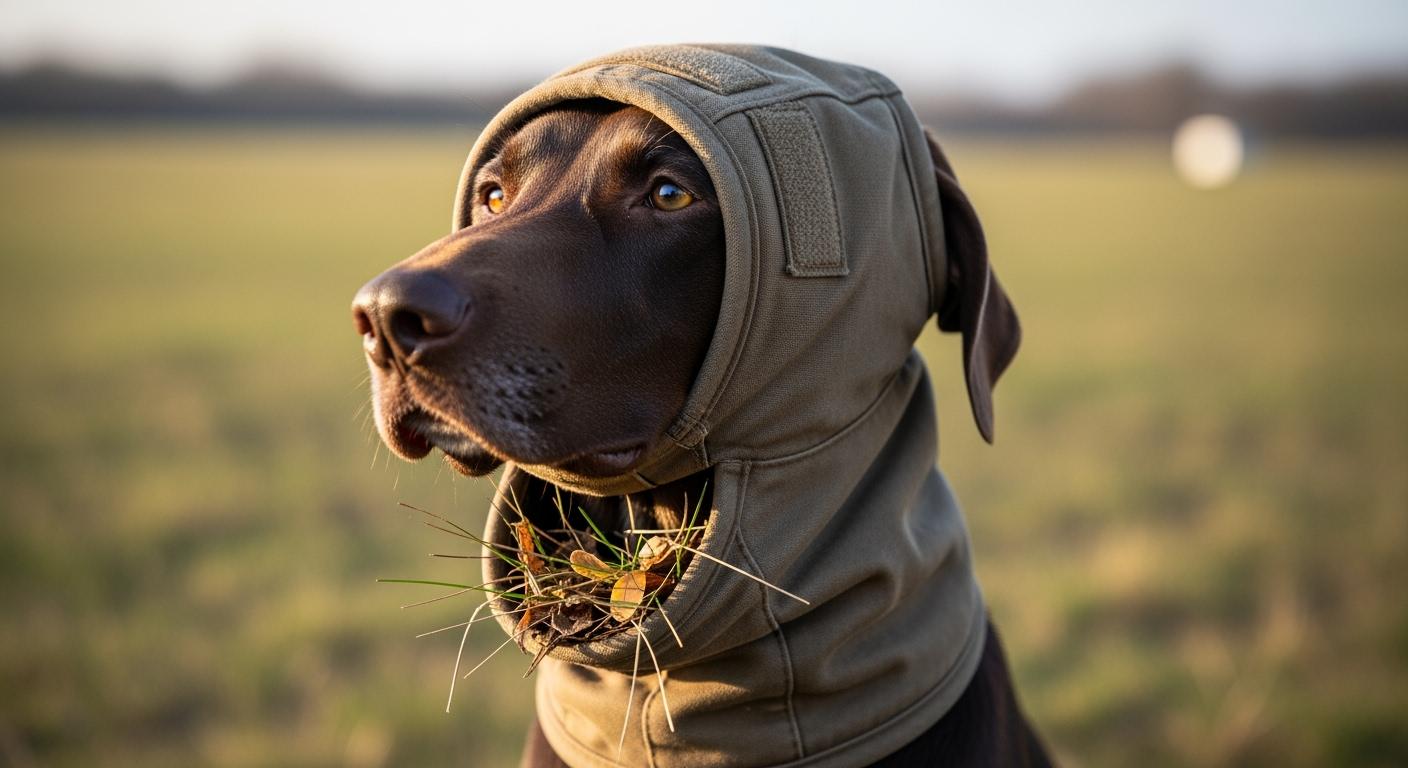
A field guard that sits flush against the throat while the dog stands still can open a half-inch gap the moment the head drops toward the ground. That is not a sizing mistake. It is a geometry problem. The lower edge lifts, debris finds the opening, and the guard that looked secure indoors becomes a channel for everything it was supposed to block.
A dog field guard head protector loose around neck fails in three predictable ways: the throat edge peels back during sniffing, the sides flare out when the dog pushes through grass, and the entire mask rotates when the dog shakes its head. Each failure has a specific mechanical cause. Each has a specific check that catches it before debris gets through.
Why the Neck Opening Fails as Soon as the Dog Lowers Its Head
Standing fit is not sniffing fit. The two postures create completely different neck-opening geometries.
When a dog stands upright, the neck opening sits at a roughly horizontal angle against the throat. The mesh edge rests against the skin with even tension around the circumference. The guard looks right. It feels right. But lower the head to sniffing position and the angle changes — the throat side of the opening tilts downward, the tension on the lower edge releases, and if the closure is a fixed-diameter opening or a single strip of elastic with no adjustment range, that edge lifts away.
Neck circumference does not change between standing and sniffing. What changes is the shape the opening must hold against gravity. A closure that relies on a static diameter cannot track that angle shift. The lower edge peels back. Grass stems, foxtail awns, and seed heads that contact the lifted edge slide upward into the space between mesh and skin. From there they migrate toward the nose, mouth, or eyes.
This is the core failure chain: fixed opening → angle change during sniffing → lower edge lift → debris channel. A head cover fit sequence that only checks the standing posture misses the only posture that matters outdoors.
In practice: Fit the guard, guide the dog’s head into a full sniffing position, and hold it there. Run a fingertip along the lower throat edge. If the fingertip slides under without resistance, the gap is large enough for foxtail entry. Recheck this after 10 minutes of outdoor movement — fur compression and movement settle the guard differently than a static indoor fitting.
Three Zones Where Gaps Let Debris Through
Gaps do not form randomly. They concentrate in three zones, each opened by a different movement pattern. Knowing which movement opens which zone turns fit-checking from guesswork into a repeatable inspection.
Lower throat opening — triggered by sniffing. When the head drops, the lower edge at the front of the throat lifts. This is the primary entry point because the angle change is largest here. The check: lower the dog’s head and look for daylight between the mesh edge and the throat skin. If you can see skin through a gap, debris can find that same opening.
Rear edge near the collar line — triggered by head shaking. A field guard with a single stabilization point acts like a lever. When the dog shakes, the mask rotates around that point. The rear edge shifts backward, opening a crescent-shaped gap. Debris enters from behind — grass that brushes the back of the neck during movement slips into the opening before the mask settles back. A structured neck support brace uses different stabilization principles, but for a mesh guard, the rear edge seal depends entirely on the closure maintaining consistent tension around the full circumference during rotation.
Side-to-neck transition — triggered by lateral push through vegetation. When a dog shoulders through tall grass, stems press against the side of the mask. The structural response of the edge determines whether that pressure opens a gap or stays sealed.
The mechanics here are worth tracing in detail. A stem presses against the side mesh. If the edge is contoured and structured, the pressure distributes along the binding and the edge stays sealed — the load path runs through the binding, not into the gap zone. If the edge is a raw-cut fabric or thin elastic, the pressure concentrates at a single point, the fabric folds inward, and the stem slides along the fold crease like a rail. That crease guides debris deeper, past the guard and toward the ear or eye. This is not about tightness. It is about whether the edge has enough structural integrity to redirect lateral load instead of collapsing under it.
The same slipping-and-gapping failure pattern appears in other protective gear. A hind leg sleeve can lift at the top opening when the thigh angle changes during walking — a debris path that mirrors what happens at the neck when the edge binding cannot hold its profile under load.
| Gap zone | Trigger | Pass signal | Fail signal |
|---|---|---|---|
| Lower throat | Head drops to sniff | Edge stays flush against skin; fingertip cannot enter without resistance | Daylight visible between edge and throat; fingertip slides under freely |
| Rear collar line | Head shake or quick turn | Mask returns to center; rear edge stays within half an inch of original position | Mask stays rotated; one ear partially exposed; gap at rear visible |
| Side-to-neck | Lateral push through grass | Edge holds profile; no flare at side opening | Edge lifts away; vertical slit forms; stems visible inside mesh |
When a Head Protector Creates More Problems Than It Solves
Dogs with very short muzzles and broad skulls often have a head-to-neck ratio that falls outside the adjustment range of most mesh guards. The head circumference may match one size while the neck circumference lands two sizes smaller. Tighten the closure enough to seal the neck and the mask pulls forward, blocking the eyes. Leave the mask correctly positioned on the head and the neck opening gaps during any movement. This is not a design defect — it is a geometric mismatch between the guard’s adjustment architecture and the dog’s proportions.
Dogs that cannot tolerate anything enclosing the face should not be forced into a mesh guard regardless of how gradually the guard is introduced. Pawing at the face, freezing in place, or repeated attempts to rub the guard off are not training problems. They are tolerance boundaries. A guard that triggers persistent pawing creates a secondary risk: a paw caught in mesh during a struggle can tear the fabric, loosen the closure, or injure the dog.
For dogs needing cervical stabilization rather than debris protection, the design requirements are fundamentally different. Choosing a head cover for face protection means matching the product type to the actual need — a mesh debris guard and a structured neck brace serve non-overlapping mechanical functions. Using a debris guard where stabilization is needed leaves the neck unsupported. Using a neck brace where only debris shielding is needed adds weight and restricts movement without benefit.
Disclaimer: The gap-check methods described here assume a dog with a typical mesocephalic head shape and a short-to-medium coat. Dogs with heavy facial folds, extremely narrow skulls, or double coats dense enough to create a compressible layer between the mesh edge and the skin may need hand-checking rather than visual inspection — run a fingertip along the inside of the edge after each posture change instead of relying on sighting daylight through the gap. If the dog’s head conformation falls well outside breed norms — particularly dogs with angular limb deformities or very deep chests that alter head carriage — the fit checks described may not catch every pressure point.
What Changes Neck-Fit Performance — and What Does Not
Three design decisions determine whether the neck opening stays sealed across postures or opens under movement. None of them involve making the closure tighter. Tighter often makes the problem worse.
Separate head and neck adjustment. When one drawcord or strap controls both the head circumference and the neck opening, tightening one pulls the other out of position. The adjustment points fight each other. A design that adjusts the head band independently from the neck closure lets each zone match its actual circumference. The result is not a tighter guard. It is one where tension in the head zone does not pull the neck edge out of alignment.
The difference is easy to observe. Put the guard on, adjust the head band first, then set the neck closure. Lower the dog’s head to sniffing position. If the neck edge lifts, the adjustment points are linked — tightening the neck further pulls the head band forward and distorts the mask. If the neck edge stays flush while the head band remains stable, the adjustments are independent. This test takes under 30 seconds and reveals more about fit quality than any standing inspection.
Contoured edge binding vs. raw-cut edge. A contoured binding is cut on a curve that approximates the oval profile of a dog’s neck. When the dog moves, the binding flexes with the neck but does not fold. A straight-cut edge on lightweight mesh has no curve memory — it folds at the first point of pressure contact. That fold becomes a channel.
Adjustable closure with sizing granularity. A fixed-diameter neck opening matched to a single measurement — neck circumference at rest — has no way to compensate for fur compression, posture changes, or small measurement errors. An adjustable closure with several inches of range within each size band absorbs these variables. The adjustment is not about making the fit tighter. It is about matching the actual circumference the guard encounters on this specific dog during movement, not the circumference measured while the dog stands still on a measuring table.
Protective coverage solutions for active dogs span a wide range of product types, but within mesh head guards specifically, these three design features separate closures that hold their seal from closures that fail the first time the dog drops its head.
| Design feature | Performance difference | Main limitation |
|---|---|---|
| Fixed neck opening | Seals in one posture; gaps in all others | Cannot adapt to angle changes during movement |
| Independent head/neck adjustment | Each zone maintains seal without pulling the other out of position | Adds a second adjustment step; sequence order matters for results |
| Contoured edge binding | Flexes with neck profile; resists folding under lateral pressure | Stiffer feel than raw-cut mesh; may need a short break-in period for dogs with sensitive skin |
| Adjustable closure with size bands | Absorbs fur compression and measurement variance; seals across postures | Range within each band is finite; dogs at extreme ends of breed proportions may still fall between sizes |
After any walk through grass or brush, cleaning the guard matters as much as checking the fit. Dried debris trapped in mesh pores reduces airflow and stiffens the fabric, which changes how the edge sits against the neck on the next use. Post-walk cleaning and air-drying of protective gear keeps the guard’s fit behavior predictable from one outing to the next — debris-encrusted mesh bends differently than clean mesh, and that difference is enough to turn a passing fit into a failing one.
FAQ
Why does the guard look fine at home but gap outside?
Indoor fit checks typically happen with the dog standing or sitting — postures where the neck opening stays at a neutral angle. Outdoors, sniffing, turning, and pushing through vegetation create the angle changes and lateral pressure that expose gaps. A fit that passes a standing-only check has not been tested in the postures that matter.
Can a mesh field guard replace a neck brace?
No. A mesh field guard blocks debris. A neck brace provides cervical stabilization through structured panels. The two products serve non-overlapping mechanical functions. Using one where the other is indicated leaves the dog unprotected in the dimension that actually matters.
What is the quickest way to confirm the neck fit is holding during a walk?
After 10 minutes of outdoor movement, guide the dog’s head into a sniffing position and check whether the lower throat edge has shifted more than half an inch from its original position. If it has, the closure needs adjustment or the size is wrong. Do not wait until the end of the walk — debris that enters in the first 10 minutes stays against the skin for the rest of the outing.
Does a tighter closure always mean a better seal?
No. Over-tightening a closure that lacks independent head and neck adjustment pulls the entire mask forward, distorting the head fit and creating new gaps elsewhere. The goal is matched tension — the neck edge stays close without the head band shifting. Verify by adjusting until the edge makes continuous contact without compressing the skin, then lowering the head to confirm the contact holds.