
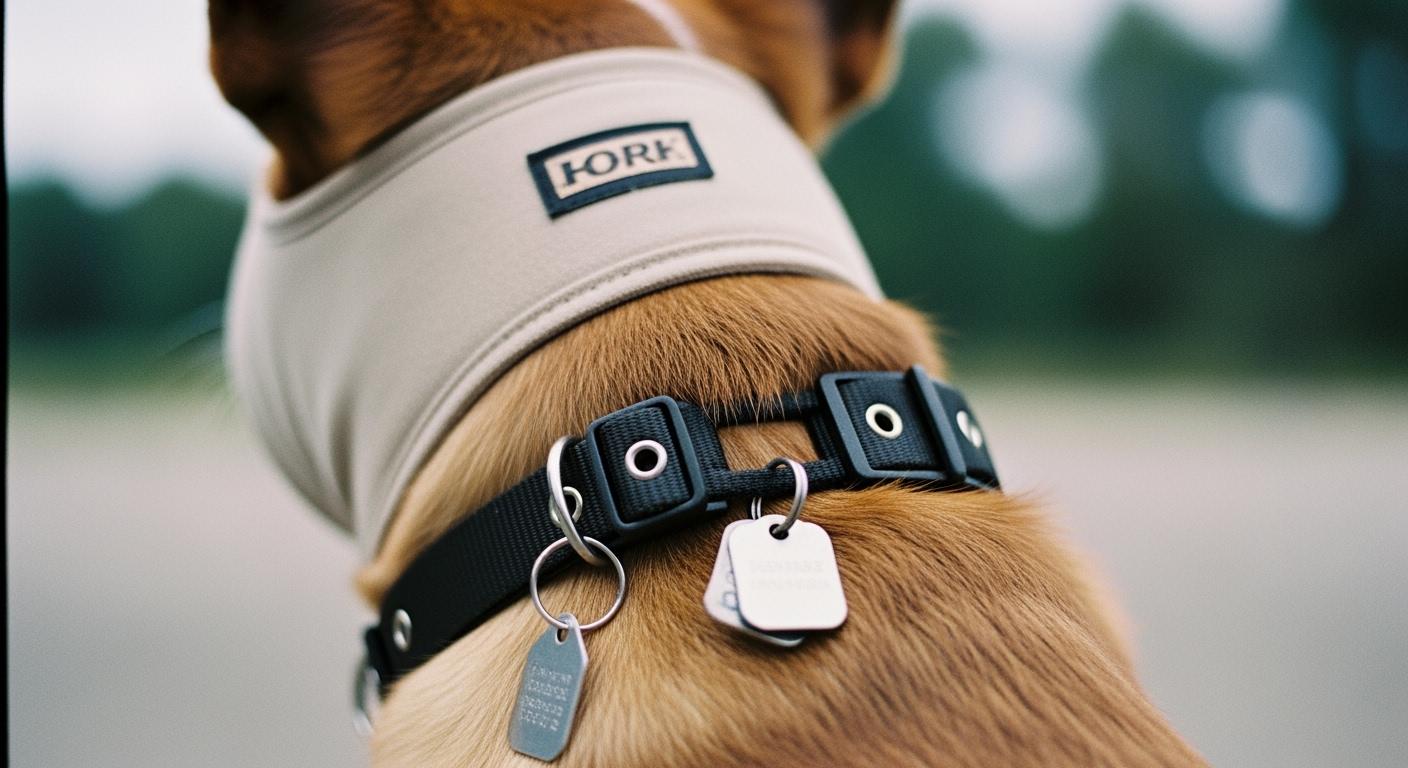
A foxtail head protector passes the living-room check. The mesh sits flat behind the ears. The collar feels snug. Everything looks right.
Then the dog steps into dry grass and lowers its head to sniff.
The rear edge lifts. A buckle or tag sat under the closure the whole time — invisible during the static fit, gap-opening once the dog moves. The opening may look small. A foxtail awn is smaller. And it only takes one.
This is the whole problem with a dog foxtail head protector under collar fit: the mask and the collar share the same real estate on the dog’s neck. Two separate systems. One narrow band of contact. When they conflict, the protector loses. The mask does not fail because the mesh is weak. It fails because collar hardware creates a pressure point under the rear closure, and that point becomes a gap under movement. Understanding why this happens — at the mechanical level — is what separates coverage that holds from a dog walking through dry grass with its ears and cheeks exposed. The same fit logic applies across protective gear categories, whether you are working through fit challenges with canine protective equipment or dialing in a single head cover.
Why the Rear Closure Gap Opens During Movement
The static fit check is not the real test
You fit the protector at home. The dog stands still. The mesh lies flat behind the ears. The collar passes a two-finger slide. Visually, nothing looks wrong.
But a foxtail head protector worn under a collar faces its real test when the dog lowers its head. At that moment, the front mesh flattens against the nose. The geometry of the mask changes. The lower edge can lift. The rear closure — the critical seal behind the ears — shifts forward if anything pushes against it from underneath.
The collar does not stay in the same position during head-down movement. It rides forward slightly. The skin and fur under it compress and slide. If a buckle, D-ring, or tag occupies the space directly under the rear closure, that hardware becomes a fulcrum. The closure tilts. One edge lifts. A gap opens.
That gap may be a quarter inch. A foxtail awn needs less.
The mechanical chain: pressure point to gap to awn entry
Here is the causal chain that turns a small hardware placement error into a protection failure.
When a buckle sits directly under the rear closure, it creates a single point load. The mesh cannot distribute pressure evenly across that point — the contact area is too small, and the mesh has no rigid backing plate to spread the force. The closure edge tilts: one side lifts while the opposite side digs in. As the dog lowers its head, the collar shifts forward by even a few millimeters, and the buckle rotates with it. The closure edge, now unseated, cannot re-seat itself because the buckle occupies the space it needs to return to.
The gap that was a fraction of an inch becomes large enough. And unlike a visual inspection that checks for obvious openings, foxtail awns are barbed and directional — they do not need a wide opening. They need a directional entry point, and a lifted rear edge aimed forward gives them exactly that.
That fails fast. And it fails silently, because the dog does not yelp when an awn slips past the rear seal.
For a deeper look at how protective head covers interact with daily collar wear, the daily-use fit behavior of dog head covers follows the same mechanical principles — collar interference is the most common failure point across head protection designs.
How Collar Hardware Changes the Rear Closure
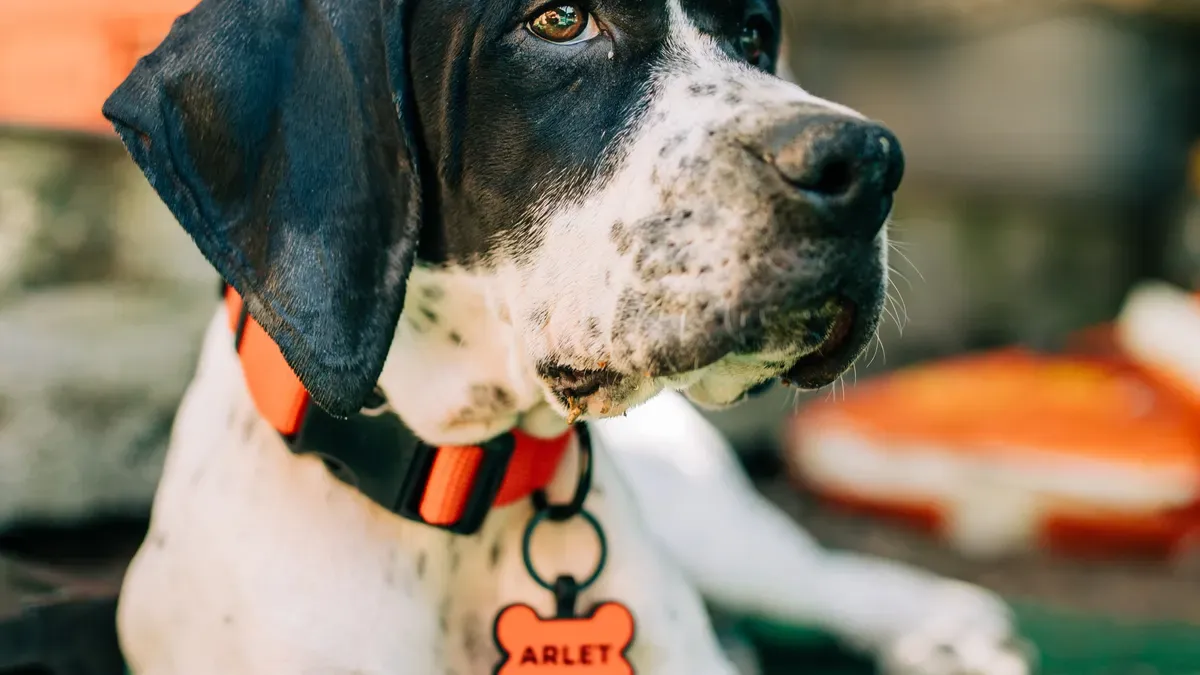
Not all collar hardware creates the same kind of problem. Each piece interacts with the rear closure differently, and the failure mode changes with the hardware type.
Buckles under the rear edge
A buckle under the rear closure is the most common failure point. The buckle body is rigid, raised, and wider than the surrounding collar material. When the rear edge of the mask sits over it, the mesh cannot achieve flat contact. The closure rides on a bump. That bump tilts the entire rear panel.
Move the buckle. Rotate the collar so the hardware sits to the side or under the chin — anywhere but directly under the closure line. Then run the head-down test: ask the dog to lower its nose toward the ground as if sniffing. Watch the rear edge. If it stays flat and does not ride forward, the buckle is no longer fighting the mask.
D-rings, ID tags, and GPS trackers
A D-ring under the closure creates an uneven pressure distribution that worsens when the leash clips on. Leash tension pulls the ring forward; the ring pulls the collar; the collar pulls the mask. The protector distorts along the line of tension. A centered mask becomes a rotated mask in a single leash tug.
Hanging tags introduce a different failure: snag. The mesh on most foxtail masks is a fine-gauge knit or woven material. A dangling tag with a split ring has edges that can catch individual mesh fibers. When the dog turns its head, the tag pulls the mesh sideways. The rear closure shifts off-center. The ear base on one side becomes exposed.
Observable check: After 10 minutes of walking with the leash attached, run your finger along the rear edge from ear to ear. If one side sits higher than the other by more than the width of your index finger, the hardware configuration is pulling the mask off-axis.
| Fit problem | What the owner sees | Why it happens | Better setup |
|---|---|---|---|
| Buckle under rear closure | Mask tilts or lifts at the back | Rigid buckle body creates a point load the mesh cannot distribute | Rotate collar hardware away from the closure line |
| Loose rotating collar | Mask shifts off-center with movement | Collar rotates freely and drags the protector with it | Tighten to two-finger fit; collar should not spin independently |
| Hanging ID tag | Mesh catches or pulls sideways during head turns | Tag split ring snags fine mesh fibers and pulls laterally | Remove dangling tags; use flat slide-on ID if identification is required |
| Thick collar edge | Rear opening bunches; cannot achieve flat contact | Bulky collar crowds the rear closure zone, preventing the mesh from seating | Use a thinner collar in foxtail-prone environments |
| Leash pressure from D-ring | Mask distorts on leash pull; pulls off-center | Leash tension transfers through D-ring to collar to mask along a single force line | Test fit with gentle leash movement before entering dry grass |
| Rear opening too shallow | Ear base exposed even when mask is centered | Insufficient rear panel length leaves the ear base uncovered | Select a mask with enough rear clearance for the dog’s ear position |
Loose collars that rotate during movement
A loose collar does not stay put. As the dog trots or turns, the collar rotates around the neck. The mask — attached to or sitting over that collar — rotates with it. The rear closure drifts off-center. One ear base becomes exposed.
The two-finger fit check is the floor, not the ceiling. Slide two fingers flat under the collar. If three fit easily, the collar is too loose for a head protector to stay stable on top of it. If the collar can be rotated by hand without moving the dog’s skin, it will rotate during movement — and drag the mask with it.
Observable check: Mark the center point of the rear closure with a small piece of tape (on the mask, not the dog). Walk the dog for five minutes with normal head movement. If the tape has drifted more than half an inch off-center, the collar rotation is defeating the mask. Choosing between different protective gear types often comes down to this same rotation problem — what stays centered under movement versus what looks centered at a standstill.
Thick collars that crowd the throat and ear base
A thick collar eats up the space the rear closure needs. The mask cannot seat against the dog’s neck because the collar occupies too much vertical room. The rear edge bunches. It cannot lie flat. When the dog lowers its head, the thick collar presses upward into the mask, forcing the rear opening to ride higher — closer to the ear base, closer to exposed skin.
A thinner collar frees up that zone. The mask gains a flat landing area behind the ears. The closure seals. The same principle shows up when evaluating head cover designs for different face and neck shapes — collar bulk is often the hidden variable that makes an otherwise well-designed mask fail on a specific dog.
Fit Checks Before Field Use — And When the Setup Is Not Safe Enough
The movement-test sequence
Start with the collar alone. Two-finger fit. Remove dangling tags, charms, GPS trackers. Then place the head protector and check the rear edge. It should sit flat behind the ears without pressing into the throat.
Now the movement tests:
- Head-down sniff. Ask the dog to lower its nose to the ground. Watch the rear edge. If it rides forward, twists, or exposes the ear base, the collar is interfering with the closure.
- Turn and trot. Walk the dog at a light trot with a few direction changes. Watch whether the mask stays centered or drifts. A mask that rotates more than half an inch off the centerline during two minutes of movement will only drift further over a full walk.
- Leash-pull test. Clip the leash and apply gentle tension — the kind that happens when the dog pauses to sniff and you maintain light contact. If the mask distorts or the rear edge shifts, the D-ring placement is pulling the system apart.
Only use the protector outdoors if it passes all three. A mask that holds during a living-room static check but fails the head-down test is not ready for dry grass.
| Signal | What it means | Action |
|---|---|---|
| Green: Collar stable, rear edge flat, dog can pant freely, mesh stays centered through movement | Hardware is clear of the closure line; collar tension is balanced | Safe to use in foxtail areas |
| Yellow: Slight tilt after movement, occasional tag catching, minor rear bunching that self-corrects | A hardware element is making intermittent contact with the closure | Recheck buckle and tag position; adjust before next use |
| Red: Throat pressure, repeated pawing at the face, mesh twisting, ear base exposed, dog cannot pant comfortably | The collar is actively fighting the mask; protection is compromised | Stop use immediately; refit with different collar or mask configuration |
When the setup is not safe enough
Some signs mean the fit has already failed — not on a technicality, but in a way that leaves the dog exposed. Pawing at the face is the clearest. A dog that repeatedly paws at the mask is telling you something is pressing, pinching, or twisting in a way that demands attention. Do not override this signal. Stop and refit.
A rear edge that presses into the throat or rides up over the ear base is a structural failure of the collar-mask interface. The mask may be the right size for the dog but the wrong match for the collar it is sitting over. A mask that shifts every time the leash moves has a D-ring conflict — the force path from leash to collar to mask is not neutral.
Stable coverage comes from balanced geometry and collar compatibility, not from tightening everything down harder. The rear closure should stay flat without pressing into the throat. The dog should be able to pant, drink, and move its head freely. If any of these is compromised, the setup is not safe — regardless of how secure the mask looks at a standstill.
Disclaimer: This fit assessment assumes a mesaticephalic or dolichocephalic skull shape. Brachycephalic breeds with shortened muzzles may show different gap patterns at the rear closure because the mask must bridge a steeper facial angle with less snout length to anchor the front. For dogs with dense neck fur or double coats, visual gap checks can miss small openings — hand-check the rear edge by feel after movement rather than relying on sight alone. If the dog’s head or neck conformation falls well outside typical breed proportions, the fit checks described here may not catch every pressure point.
The same underlying principle governs any protective sleeve or cover that sits against a dog’s body under movement: what passes a static inspection often fails a dynamic one. The fit and daily-wear behavior of protective dog sleeves runs into the same reality — rotation, bunching, and pressure points only reveal themselves after minutes of movement, not seconds of standing still. And when comparing different protective approaches, the coverage differences between sleeve-style and rigid-shell protection often hinge on this same collar-interface question.
When a dog enters dry grass wearing a foxtail head protector, the only thing standing between a grass awn and the ear canal is a few square inches of mesh held in place by a collar that was never designed to anchor a mask. The fit fails when the collar hardware — buckle, D-ring, tag — occupies the space the rear closure needs to seal. It fails when the collar is loose enough to rotate. It fails when the collar is thick enough to crowd the landing zone behind the ears.
None of these failures announce themselves. The dog does not limp. The mask does not tear. The only evidence is a small rear gap that opens during head-down movement — visible only if you know to look for it, catastrophic if you do not.
Fix the hardware placement. Run the movement tests. Check the rear edge by feel after every walk. That is the difference between a mask that looks right and one that actually protects.
FAQ
How can I tell if the rear closure is actually sealed?
Run your index finger along the rear edge from one ear to the other after the dog has walked for at least five minutes. The edge should feel uniformly flat against the neck with no lifted sections. If your finger slips under any portion of the rear edge without resistance, that section is gapped — and a foxtail awn is thinner than your fingertip.
What is the single biggest predictor of a collar-related gap?
Buckle position. When the buckle body sits anywhere under the rear third of the mask, the closure line must bridge a rigid lump. That lump tilts the edge. Rotate the collar so the buckle sits at the side of the neck or under the chin, and retest the head-down sniff position. In most cases, this one change eliminates the gap.
Can a dog pant and drink normally with a properly fitted head protector?
Yes — and if the dog cannot, the fit is unsafe regardless of how secure the rear edge looks. The mesh must clear the mouth, allow full jaw opening for panting, and not press against the nose or eyes. A mask that restricts breathing or drinking has a front-coverage problem, not a collar-fit problem, and needs a different size or design.
