
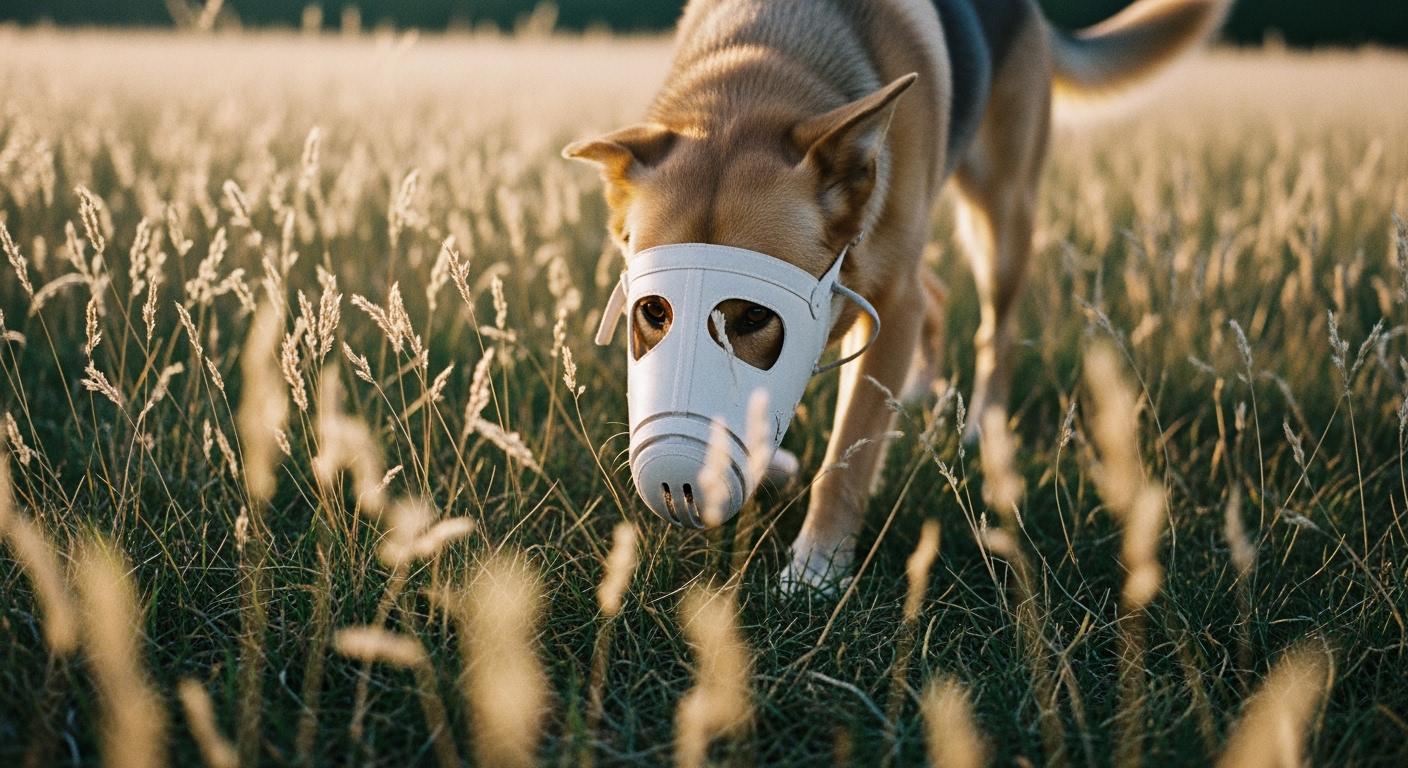
A dog drops its head into dry grass, pulls air through its nose in rapid succession, and the front mesh of the mask presses flat against the nostrils. The lower edge lifts. A gap opens. In that moment, the barrier a dog foxtail mask for grass seed nose protection is supposed to provide disappears. Not because the mask is defective. Because the fit and structure cannot hold up to how a dog actually sniffs.
Where the Mesh Barrier Fails During Field Sniffing
A foxtail mask works as a physical standoff. The mesh sits away from the nostrils. Air passes through. Seeds hit the barrier and fall away. That is the theory. In a dry field, with a dog pushing its nose downward through stiff grass stalks, two things break that standoff at the same time.
The front panel collapses. If the mask uses flat, unstructured mesh without a shaped dome or internal frame, the negative pressure of each sniff pulls the fabric inward. The same physics that draws a screen door shut in a wind gust now pulls mesh fibers against the nostril margin. Grass seed barbs, angled backward in microscopic rows like one-way ratchets, catch the weave at the point of contact. Instead of deflecting off a curved, offset surface, the seed’s barb rows engage mesh and nostril simultaneously. The next sharp inhale drives the seed deeper.
That fails fast.
The lower edge lifts. When a dog pushes its muzzle downward to investigate a scent, the lower rim of the mask meets resistance from grass and ground. If the mask lacks extended lower muzzle coverage or a secure chin-level anchor, the edge rides up. A gap opens directly below the nostrils. This is the most exposed angle of approach, and it is the angle at which dogs do nearly all of their investigative sniffing.
These are not separate problems. They compound each other. A collapsing front panel eliminates the standoff above the nose at the same moment a lifting lower edge opens a direct path from below. The nose ends up both in contact with the mesh and exposed at the bottom simultaneously.
| Real field failure | Why it happens | Observable signal | Better structure or fit choice |
|---|---|---|---|
| Nose mesh contact | Mesh collapses onto nose during inhalation | Sneezing, face rubbing, moisture on nose after walk | Shaped front dome with standoff clearance |
| Lower front gap | Edge lifts during downward sniffing | Nose protrudes below mask line, seeds reach nostrils | Extended lower muzzle coverage |
| Mask rotation | Single-point adjustment allows twisting | Mask shifts off-center, side gaps open | Multi-point stabilization at crown, cheek, and neck |
| Forward sliding | Loose rear closure, gravity pull on head drop | Mask drifts toward nose tip, exposing upper muzzle | Adjustable rear neck closure with non-slip lining |
| Restricted panting | Tight under-jaw fit, dense mesh | Heavy panting indoors, mouth cannot open fully | Breathable mesh with adequate under-jaw clearance |
| Paw-off behavior | Stiff front panel, pressure points, heat buildup | Dog paws at mask repeatedly, displaces it | Shaped front with soft edges and ventilation paths |
Design Features That Determine Whether the Barrier Holds
A mesh panel alone does not make a barrier. The difference between a mask that blocks seeds and one that channels them toward the nostrils comes down to how the structure behaves under sniffing load.
Shaped front clearance
A flat mesh panel has no resistance to inward deflection. Each sniff pulls it toward the nose. A shaped front — a dome, a slight outward curve, or an internal standoff frame — creates a fixed air gap that negative pressure cannot fully close. The mesh may flex, but the underlying geometry keeps the inner surface from reaching the nostrils.
This is not about comfort. It is about whether the barrier occupies the same physical plane as the nose. When the two occupy the same plane, grass seed barbs catch both surfaces and the seed ratchets inward. A mask whose front face curves away from the nose — even by a quarter inch — changes the approach angle of every seed that strikes the mesh. Seeds that would have lodged at the nostril margin instead glance off at a tangent.
Tip: After a 15-minute walk in dry grass, lift the mask and blot the front of the nose with a dry tissue. Moisture on the tissue signals the mesh made contact and collapsed at some point. A dry nose with moisture only inside the mask lining means the standoff held.
Lower muzzle coverage that stays anchored
The lower edge of the mask is the most vulnerable perimeter during actual use. Dogs sniff downward. The angle of approach from below, combined with grass resistance against the mask rim, creates a peeling force that lifts the lower edge away from the muzzle.
A mask with deeper lower coverage — extending further down toward the chin — resists this peeling because the longer fabric panel has more surface area in contact with the dog’s fur. Friction holds it in place. When paired with a chin-level strap or shaped under-jaw contour, the lower edge stays seated even as the dog pushes through stiff grass. Face protection fit procedures share a common requirement: the barrier must maintain clearance from the tissue it protects during the most common movement pattern — and for a foxtail mask, that pattern is the head-down sniff.
Note: During the first field walk, crouch at ground level and look upward at the mask’s lower edge while the dog sniffs downward. If the nose protrudes below the mesh line by more than a pencil’s width, the lower coverage is not deep enough for that dog’s sniffing posture.
Multi-point stabilization
A single strap behind the ears will not hold position. Each head movement — turning, lowering, shaking — torques the mask in a different direction. Without anchor points at the crown, cheek, and rear neck, the mask rotates around its single attachment axis. Rotation opens side gaps. Side gaps are entry paths for seeds that approach from any angle other than straight-on.
Three-point stabilization distributes movement forces. The crown strap resists downward sliding when the head drops. Cheek panels resist rotation during head turns. The rear neck closure resists forward drift. Each anchor point handles one axis of movement. Together, they keep the front panel centered and the lower edge seated through the full range of a dog’s head motion. Selecting head and face protection means evaluating whether the stabilization system can hold the barrier in place during the activity the dog will actually perform, not just during a static fitting.
Breathable mesh versus dense fabric
Mesh density is a tradeoff. Tighter weaves block smaller particles but resist airflow. Open weaves breathe better but let finer seeds through. A dog that cannot pant freely inside a mask will generate more moisture inside the barrier. Moisture softens skin. Softened skin is more susceptible to the abrasive action of trapped seed husks and mesh fibers rubbing during head movement.
The functional requirement is mesh that blocks foxtail-sized awns while allowing enough airflow for sustained panting. If the dog’s breathing sounds labored indoors at rest, the mesh is too dense for field use where exertion raises respiration rate. Protective gear that wraps the head or face demands different material tradeoffs than a body sleeve or leg wrap, where breathability competes with a different set of priorities. Face and head protection products sit in their own category precisely because the airflow-versus-barrier-density equation changes when the protected surface includes the airway itself.
When a Foxtail Mask Is Not Enough
A mask reduces seed exposure at the nose. It does not eliminate exposure across the rest of the body. Seeds can enter ears, embed between toes, lodge in armpits, or work into the coat at any point where fur meets vegetation. The mask addresses one entry route. It was never designed to address all of them.
After a walk through dry grass, check for these signs that a seed has bypassed the mask or entered through another route:
- Persistent, violent sneezing that does not subside within a few minutes
- Thick, colored, or bloody discharge from one nostril
- Pawing at the nose or rubbing the face against furniture or the ground
- Swelling around one nostril or along the bridge of the nose
- Sudden reluctance to eat or unexplained lethargy after a walk
These are not fit problems. They are signs that a seed has already entered tissue and begun to migrate. The backward-pointing barbs on foxtails and grass seeds mean the body cannot expel them through sneezing or nasal drainage. Each muscular contraction — each sneeze, each swallow — can ratchet the seed deeper.
Disclaimer: This fit verification assumes a dog with a standard-length muzzle and a short to medium coat. Brachycephalic breeds have compressed nasal anatomy that creates different airflow patterns, and their face proportions alter how a mask sits against the nose and lower jaw. For very flat-faced or extremely narrow-muzzled dogs, hand-check the full mask perimeter after every walk rather than relying on visual gap inspection alone. If the dog’s facial conformation falls well outside breed norms, the gap patterns described here may not capture every pressure point or entry path.
When any of the warning signs appear, the situation has moved beyond what product fit can solve. Do not attempt to flush the nostril, probe with tweezers, or wait to see if symptoms resolve. A seed lodged in the nasal passage can migrate into the sinus cavity, the throat, or in rare cases through soft tissue toward the eye or brain. Veterinary removal with sedation and specialized imaging is the only safe path at that point.
The same step-by-step logic that applies to fitting a protective sleeve — indoor test first, watch for displacement under movement, recheck after activity — transfers directly to foxtail mask use. Post-walk inspection follows the same discipline as sleeve maintenance: check the gear, then check the dog from nose to paws, every time.
Field Fit Check Before Dry Grass Walks
- Adjust all three stabilization points: crown, cheek, and rear neck. None should be tight enough to indent fur.
- Let the dog sniff freely indoors for 10 minutes. Watch the lower edge. If it lifts, the chin-level coverage is too shallow or the strap tension is unbalanced.
- Crouch at ground level and look up at the mask from below while the dog sniffs. This is the seed’s approach angle. If you see nostril below the mesh, the mask is not covering the exposure zone.
- After the indoor check, walk 10 to 15 minutes in a controlled outdoor area. Stop twice to verify the front panel has not shifted forward, the lower edge has not ridden up, and no side gaps have opened.
- After the walk, remove the mask and inspect: the inner mesh for trapped seeds, the dog’s nose for moisture or irritation, and the ears, paws, and coat for seeds that entered elsewhere.
If the mask shifts, gaps open, or the dog paws at it persistently during any of these steps, the product is not maintaining a barrier for that individual dog under those conditions. A different structure — deeper lower coverage, a more rigid front dome, different stabilization geometry — may be needed.
FAQ
Does a foxtail mask eliminate the need for post-walk inspection?
No. The mask addresses nasal entry specifically. Grass seeds and foxtails also embed in ears, between toes, under the tail, and in armpit and groin folds. A full-body check after every dry-grass walk is necessary regardless of mask quality or fit. The mask reduces one exposure route. It does not replace the inspection routine.
Can a dog pant, drink, and take treats through a foxtail mask?
A properly fitted mask covers the nose and upper muzzle only. The mouth remains fully free. If the dog cannot open its mouth completely or pants heavily within two minutes of indoor wear, the under-jaw clearance is insufficient. That tightness also signals the mask may ride up and expose the nostrils during field sniffing.
How is a foxtail mask different from a muzzle?
A muzzle restricts or prevents mouth opening. A foxtail mask covers the nose and upper muzzle with breathable mesh while leaving the mouth unobstructed. The two serve entirely different functions. A foxtail mask should never be confused with or used as a muzzle, and a muzzle provides no protection against airborne or grass-level seeds entering the nostrils.
Why does the mask sometimes fail even when it fits well indoors?
Indoor fitting tests static position. Field use adds dynamic forces: the dog’s head drops, grass pushes against the lower edge, rapid sniffing creates negative pressure cycles inside the mesh. A mask that holds position on a standing dog indoors can still collapse, gap, or rotate when those forces combine. The indoor test is a starting point. Field observation determines whether the structure actually works.
