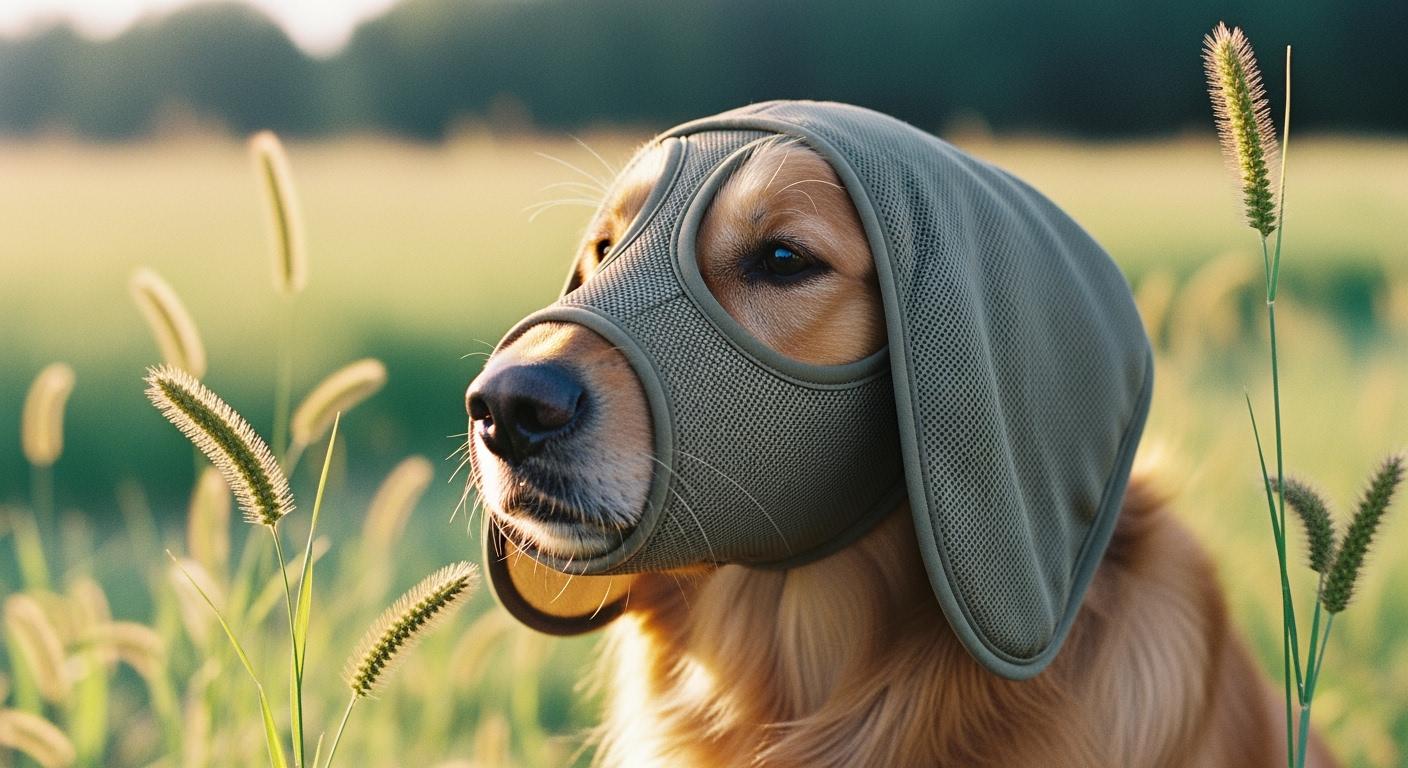
Your dog drops its head to sniff and the mask shifts. One ear tip slips below the side panel. A gap opens near the cheek. In tall dry grass, that is all a foxtail needs.
Basic head protectors fail long-eared dogs at predictable points. The side panel is too shallow. The mask rotates during movement. The rear opening leaves a path for seeds. And ear feathering — the long silky hair on spaniels, setters, and hounds — hangs outside the mesh, collecting whatever it brushes against.
A dog foxtail mask for long ears coverage is not about wrapping more fabric around the head. It is about whether the panel geometry stays ahead of the ear’s range of motion. That difference determines protection.
Where a Foxtail Mask Fails Long Ears
Long ears swing, fold, and drop as a dog moves through grass. Each motion tests the mask’s coverage boundary. Three failures repeat across breeds with floppy or heavy ears.
Ear Tips Slip Below the Side Panel
The side panel on a basic head protector typically ends above the lowest point of a long ear. At rest, the ear may stay inside. But once the dog walks, the ear swings with each stride. The tip works its way under the edge — a few millimeters per step.
That small escape is enough. A foxtail brushing against the exposed ear tip can catch on the fine hair and begin its one-way migration toward the ear canal. The barbed seed structure makes backing out nearly impossible.
Tip: After 10 minutes of field walking, stop and run a finger along the side panel edge. If you can feel ear tip or feathering below the mesh line, the panel depth is not matching that ear length.
Cheek Gaps and Rear Openings
When a floppy ear folds or shifts, it pushes against the mask from the inside. A basic mask with a fixed rear opening cannot absorb that movement. The fabric lifts near the cheek, or the rear gap widens. Foxtails enter laterally — not through the mesh, but around it.
This is a fit problem that has nothing to do with sizing. It is about whether the rear closure and cheek shaping can conform to ear movement without opening gaps. A shaped cheek panel and an adjustable rear strap let the mask move with the ear rather than against it.
Mask Rotation During Head-Lowering
A dog spends most of a field walk with its head down — sniffing, tracking, investigating. When the head drops, the mask’s center of pressure shifts forward. If the mask has only a single anchor point at the top or rear, it rotates. The ear on the high side escapes. The gap on the low side opens.
Balanced fit points — at the crown, the cheek, and the rear closure — create a three-point stabilization that resists rotation. The mask stays centered regardless of head angle.
In practice: Watch your dog lower its head to sniff during a fit check. If either ear edge peeks out or the mask tilts more than a finger’s width off center, the stabilization is insufficient for field use.
Ear Feathering Catches Seeds Outside the Mesh
Breeds with ear feathering — Cocker Spaniels, English Setters, Basset Hounds — face an additional failure. The feathering hangs long and silky. If the side panel is not deep enough, the feathering drapes outside the mesh and brushes directly against grass and seed heads.
Foxtails cling to this hair. Even if the ear itself stays covered, seeds caught in the feathering can travel upward along the hair shaft and reach the ear canal or surrounding skin. A mask that does not contain the feathering leaves a path for seeds that bypasses the mesh entirely.
| Design area | Common failure | Why it matters for long ears | Better choice |
|---|---|---|---|
| Side panel depth | Too shallow | Ear tips and feathering escape | Extended side coverage below ear length |
| Ear-tip containment | Tips slip below edge during movement | Foxtails enter under the ear | Full enclosure of ear and feathering |
| Rear neck opening | Loose, fixed-width gap | Seeds enter from rear and neck side | Adjustable rear closure |
| Cheek-side seal | Gap opens when ear shifts | Lateral seed entry | Shaped cheek contour |
| Mesh construction | Dense, low-airflow fabric | Heat buildup, panting restriction | Breathable open-weave mesh |
| Edge binding | Rough or tight trim | Rubs ear base, tangles feathering | Soft rolled edge binding |
| Mask stability | Rotates when head lowers | Ears escape on one side, gap opens on other | Three-point balanced fit |
Why Side Panel Depth and Edge Design Decide Coverage
The difference between a mask that protects and one that does not is rarely the fabric. It is the panel geometry and the edge construction. Two design decisions carry the load.
Panel Depth Is Not a Sizing Question — It Is a Motion Clearance Question
A side panel that covers the ear at rest may fail the moment the dog moves. Here is why: when a dog walks, the ear oscillates. For a long-eared breed, that oscillation can carry the ear tip an inch or more below its resting position. If the panel ends at the resting ear tip, it ends above the moving ear tip.
The structural failure is straightforward. The panel sets a static coverage boundary. The ear crosses that boundary with each stride. Each crossing works the ear tip a little further out — not because the mask is the wrong size, but because the panel depth was calculated for a stationary dog. Long ears need a panel that extends below the lowest point the ear reaches during a walking stride, not the lowest point it reaches while standing still.
After 20 minutes of field wear, lift the mesh near the cheek and touch the skin underneath. Damp or hot skin means the mesh is not moving enough air for that activity level and fabric density.
Soft Edge Binding vs. Raw-Cut Mesh
The edge that sits against the ear base determines whether the dog tolerates the mask for a full outing. A raw-cut mesh edge or a stiff binding creates a sharp contact line. On a short-coated breed, that line rubs. On a feathered breed, it catches and pulls hair.
A rolled soft edge binding distributes pressure across a wider contact area. It also creates a slight inward curve that helps guide the ear into the panel rather than letting it slide outward. This is not a comfort feature — it is a retention feature. The edge geometry directly affects whether the ear stays inside or works its way out.
The fit approach for head covers walks through how edge binding and panel shape interact during real movement — the same principles apply whether the mask is for post-surgery protection or foxtail defense.
Adjustable Rear Fit Without Choking
A rear closure that is too loose opens a seed path from behind. Too tight, and the dog panics or refuses to move. The mechanism matters: a simple elastic band applies constant pressure that increases when the dog lowers its head and the neck circumference expands. An adjustable strap with a stop point lets you set the minimum gap without creating a collar effect.
| Signal | What you see | What to do |
|---|---|---|
| Green | Ears and feathering stay covered, mask stays centered, dog pants and sees normally | Continue field use, monitor mid-outing |
| Yellow | One ear edge or feathering peeks out, mask shifts during sniffing, minor cheek gap | Adjust fit, recheck, limit grass exposure |
| Red | Dog cannot pant freely, paws at face, panics, vision blocked, ear base rubbed raw | Remove mask, inspect dog, contact vet if symptoms present |
When a Mask Is Not Enough
A foxtail mask reduces entry points around the head and ears. It does not close every path into the body. Foxtails also enter through paws, nostrils, the mouth, and thin-skinned areas on the belly. A mask is one layer of defense — not a standalone solution.
Signs That Need a Vet, Not Better Gear
Head shaking, sudden sneezing fits, pawing at the face, nasal discharge, swelling near the eyes or nose, or a sudden reluctance to move can all signal a foxtail that has already entered tissue. A mask cannot retrieve an embedded seed. Delaying veterinary care while adjusting gear wastes time that matters.
Disclaimer: This fit guidance assumes a short-to-medium-coated dog. Double-coated breeds — rough setters, thick-coated spaniels — may show subtler ear slippage and rub marks that require hand-checking rather than visual inspection alone. If your dog’s head or ear conformation falls significantly outside the breed norms these mask designs are patterned for, the fit checks described here may not catch every pressure point.
Post-Walk Inspection Still Carries the Load
Run a stainless steel comb through the coat after every walk in foxtail territory. Pay attention to the ear feathering, between the toes, under the collar, and the armpit folds. A mask does not replace the comb — it reduces what the comb has to find. Post-wear inspection and cleaning routines for protective gear follow the same principle: the gear handles what it can, and the hands handle the rest.
When to Skip the Field Entirely
During peak foxtail season when seed heads are dry and barbed, tall grass carries a risk that no mask can fully eliminate. If your dog has an existing wound, a compromised immune system, or a history of foxtail migration requiring surgical removal, the safer choice may be to avoid high-risk fields and stick to mowed paths. Gear extends your options — it does not make every environment safe.
Protective gear for dogs always works best as part of a layered approach: the right product for the specific risk, combined with a consistent inspection routine and honest judgment about when conditions exceed what gear can handle.
Pre-field fit check:
- Place the mask on the dog before entering tall grass or brush.
- Confirm both ear tips and all feathering sit fully inside the side coverage.
- Verify the ear base is not pinched and feathering is not caught in the closure.
- Let the dog lower its head, sniff, turn, and walk for at least two minutes.
- Recheck for ear slip, mask rotation, cheek gaps, blocked vision, or restricted panting.
- After the outing, remove the mask and inspect ears, feathering, eyes, nose, mouth, paws, and coat with a comb.
FAQ
Can a foxtail mask work for a short-snout dog with long ears?
It can, but the fit must be verified at two points simultaneously: the side panels must cover the ear tips while the front mesh clears the nose and allows unrestricted panting. Breeds with both a short muzzle and long ears — such as some spaniel mixes — often need a mask shaped to accommodate both dimensions without forcing a trade-off. Selecting protective gear by body shape rather than weight applies here as it does for leg and body sleeves.
Does mesh breathability affect how long a dog tolerates the mask?
It is often the deciding factor. A dense mesh traps heat around the head and can restrict evaporative cooling from panting. The check is straightforward: after 20 minutes of wear on a warm day, lift the mesh at the cheek. Dry, cool skin suggests adequate airflow. Damp or warm skin means the mesh density or material is not suited for that activity level or temperature.
What are grass spikelets and why do they matter for mask fit?
Spikelets are the seed-bearing structures of certain grasses. Each carries barbed awns that grip fur and skin, then migrate directionally — always forward, never back. A mask that does not fully enclose ear feathering lets spikelets attach to exposed hair. From there, they can travel to the ear canal, under the collar, or into skin folds. The mask must contain the hair that spikelets would otherwise catch on.
Will a foxtail mask prevent a dog from panting?
A mask built with open-weave mesh and adequate front clearance allows full panting. The fit check should include watching the dog pant with the mask on before entering a field. If the mouth cannot open fully or the dog’s breathing sounds restricted, the front panel shape or mesh placement needs adjustment — not a different product category, but a different panel geometry.
Protective masks and sleeves share a core design principle: the barrier must block what it is designed to block without blocking what the dog needs to do — breathe, move, and cool down.