
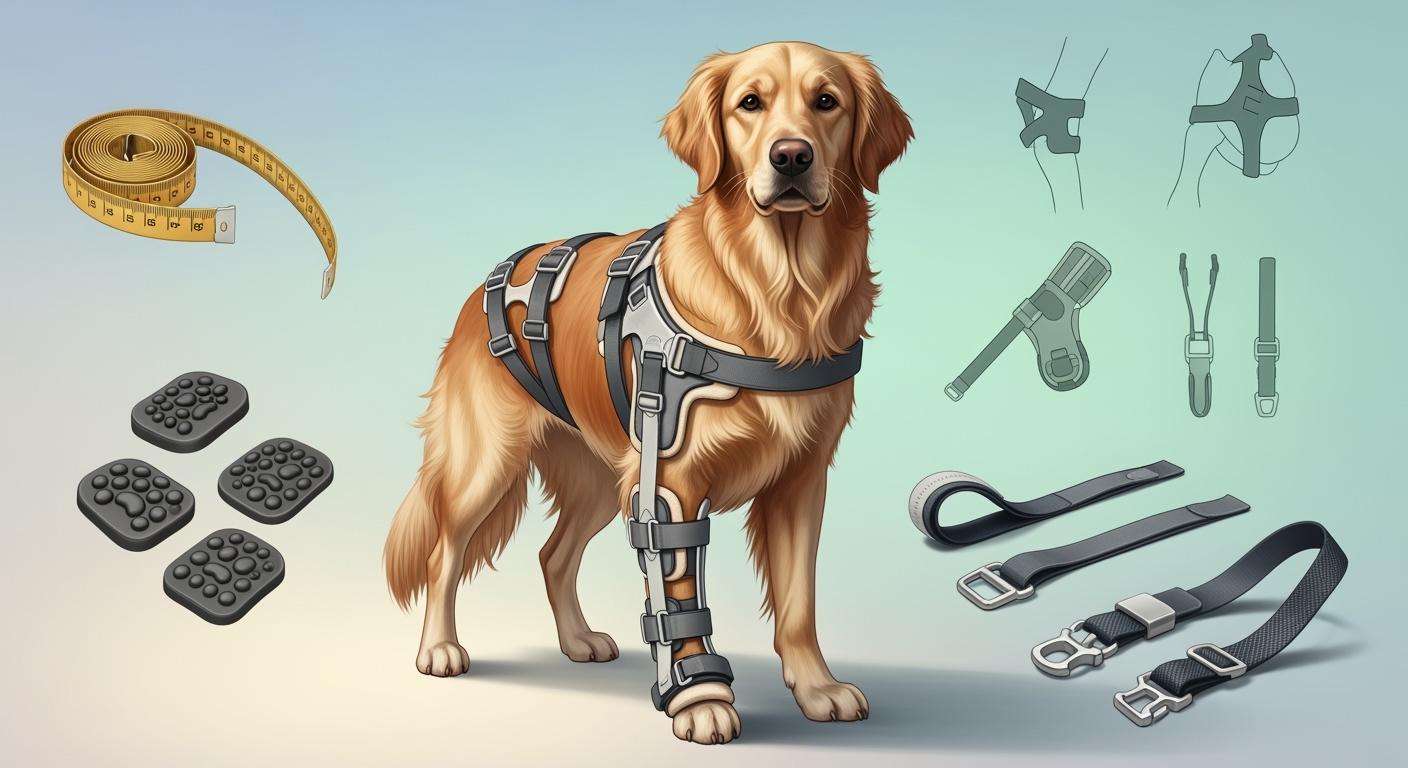
A dog front leg brace should be selected by the joint or limb area that needs support—not simply by the fact that a dog is limping on a front leg. Elbow braces, carpal braces, and full-limb supports cover different anatomical zones, control different movements, and create different fit challenges. This guide explains how those categories differ, what to check before choosing one, and how to monitor fit during daily use.
A brace can provide external support, padding, or selected movement control, depending on its structure. It does not identify the cause of lameness, replace a veterinary examination, or guarantee a particular recovery result. The first decision is therefore not “Which product looks strongest?” but “Which joint and movement pattern actually require support?”
Key Takeaways
- Elbow and carpal braces are not interchangeable: the elbow is higher on the front limb, while the carpus is the wrist-like joint lower down.
- Brace structure matters as much as the product name. A soft sleeve, padded guard, stay-supported wrap, hinged brace, and full-limb splint provide different types of physical support.
- Accurate measurements must follow the specific product’s size chart; elbow, carpal, and full-limb products do not use one universal measurement method.
- A usable fit stays aligned without pinching, restricting circulation, or creating persistent redness, rubbing, or pressure points.
- Wear time, movement limits, and post-operative use should follow the plan for the individual condition and brace design.
What Is a Dog Front Leg Brace?
A dog front leg brace is an external support worn around part of the forelimb. Depending on its shape and rigidity, it may add padding, resist selected joint motion, help keep a weak area aligned, or distribute contact over a wider surface. The term covers several product groups rather than one universal design.
| Support area | Typical product direction | Main fit concern |
|---|---|---|
| Elbow and upper front leg | Sleeve, guard, soft wrap, stay-supported or hinged elbow brace | Migration, rotation, underarm contact, and alignment around a highly mobile joint |
| Carpal joint | Soft carpal wrap, semi-rigid brace, or splint-style wrist support | Correct height, strap tension, wrist alignment, and pressure at the upper and lower edges |
| Lower foreleg and paw | Full-limb splint or extended support | Paw position, total length, toe clearance, and whether the rigid section matches the required support zone |
Because these products work on different parts of the limb, choosing a “front leg brace” without first locating the support target can lead to a product that fits the leg but does not control the relevant movement.
Elbow vs Carpal Support: The Main Difference
The elbow and carpus are separated by the forearm, so braces for these areas differ in coverage, strap path, movement control, and daily wear feel. The following comparison incorporates the useful decision framework from the narrower elbow-versus-carpal article so this guide can serve as the main front-leg support reference.
| Comparison factor | Elbow support | Carpal support |
|---|---|---|
| Target joint | Elbow joint and upper front-leg support zone | Carpal joint and lower front-leg support zone |
| Common support situations | Elbow-area instability, localized padding needs, arthritis-related support plans, or recovery situations involving the elbow | Carpal hyperextension, wrist sprains, lower front-leg weakness, or instability around the carpus |
| Movement focus | Depends on whether the product is a sleeve, guard, wrap, stay-supported brace, or hinged design | May resist excessive wrist extension or provide lower-limb alignment, depending on rigidity and length |
| Fit complexity | Usually higher because the elbow moves through a broad range and the brace must remain aligned on the upper limb | Usually more localized, but edge pressure and distal slipping still require careful measurement |
| Daily wear feel | Often broader and bulkier, with more contact around the upper leg | Usually narrower and lower on the limb, although rigid splints may extend toward the paw |
| Common selection mistake | Choosing elbow support only because the dog is limping on a front leg | Using a carpal product when the actual instability or pain is higher at the elbow |
Selection rule: Match the brace to the anatomical target and required movement control before comparing materials, price, or appearance.
Types of Dog Front Leg Braces
Elbow Sleeves, Guards, and Structural Braces
“Elbow brace” can refer to products with very different physical roles. A sleeve may mainly provide coverage and light compression. A padded guard may protect a localized contact area. A stay-supported or hinged brace may add more defined movement resistance. These products should not be treated as interchangeable simply because they are all worn near the elbow.
| Elbow product type | Primary physical role | Important limitation |
|---|---|---|
| Soft sleeve | Coverage, light contact, and material-based comfort | Provides limited mechanical control |
| Padded elbow guard | Localized cushioning over a pressure-prone area | Does not automatically stabilize the elbow joint |
| Soft adjustable wrap | Circumferential support with adjustable tension | Performance depends heavily on strap placement and migration control |
| Stay-supported brace | Adds selected resistance through semi-rigid elements | Requires correct positioning and appropriate support level |
| Hinged brace | Guides or limits motion around a defined axis | Hinge alignment and limb anatomy are critical |
For a more precise explanation of these terms, see the dog elbow brace terminology and safe-use reference. After the required support structure is clear, the dog elbow brace category can be used to compare current product formats.
Carpal Braces and Wrist Splints
Carpal products support the wrist-like joint below the elbow. Soft wraps allow more motion and may be selected when the goal is light support. Semi-rigid braces add more resistance. Longer splint-style designs can extend toward the paw and provide greater control, but they also increase the importance of total length, paw position, edge pressure, and skin monitoring.
- Soft carpal wrap: lighter support with more flexibility.
- Semi-rigid carpal brace: adds structure while retaining some joint movement.
- Rigid or splint-style support: provides more movement restriction and may extend farther down the limb.
The dog carpal brace guide explains lower-front-leg support in more detail, while the dog carpal brace category shows available wrist-support formats.
Full-Limb and Custom Front-Leg Supports
A full-limb support covers more than one local joint area and may extend toward or around the paw. It can be appropriate when the required control cannot be achieved with a short elbow or carpal product. Greater coverage does not automatically mean a better choice: longer rigid sections add leverage, weight, edge contact, and fitting complexity.
Custom construction may be considered when standard size ranges do not accommodate the dog’s measurements, limb shape, or required support geometry. “Custom” should describe how the product is built from measurements or a mold; it should not be treated as a guarantee of perfect fit or a specific clinical outcome.
Common Front-Leg Support Situations
Front-leg braces may be considered in different care plans, but the condition name alone does not determine the correct product. The same diagnosis can involve different levels of instability, swelling, range of motion, skin tolerance, or post-operative restrictions.
- Carpal hyperextension or wrist instability: may require a product that resists excessive extension at the carpus.
- Carpal sprains and strains: support level depends on severity, required motion, and the care plan.
- Elbow-area arthritis or dysplasia: product choice may range from padding and coverage to more structured support; diagnosis alone does not make every elbow brace suitable.
- Localized elbow pressure or hygroma-prone contact: padding and contact distribution may matter more than joint stabilization.
- Lower foreleg or paw instability: a longer support may be required when a short carpal brace does not cover the relevant area.
- Post-operative use: brace type, wear schedule, and permitted movement should follow the individual surgical and rehabilitation plan.
A brace should not be selected solely from symptoms such as limping, licking, reluctance to bear weight, or a changed gait. These signs can originate from the paw, carpus, elbow, shoulder, neck, or another source that a front-leg brace may not address.
How to Choose a Dog Front Leg Brace
1. Identify the Support Location
Confirm whether the support target is the elbow, carpus, lower foreleg, or paw. Do not start with a product category before the anatomical location is clear.
2. Define the Required Physical Function
Decide whether the main need is padding, light compression, selected movement resistance, rigid stabilization, or extended limb support. A sleeve and a hinged brace can cover the same area but perform very different jobs.
3. Compare Coverage and Daily-Wear Trade-Offs
More coverage can add control, but it also adds heat, bulk, strap contact, and migration risk. The usable option is the one that provides the required support while remaining aligned and tolerable during the intended activity.
4. Check Whether Standard Sizing Is Realistic
Standard products may work when the dog’s measurements fall clearly within one size range and the limb shape matches the intended design. Custom construction may be more appropriate when measurements fall between sizes, the limb has an unusual contour, or the required support cannot be achieved with a standard geometry.
Custom vs Off-the-Shelf
| Option | Potential advantage | Trade-off | Fit-risk note |
|---|---|---|---|
| Off-the-shelf | Faster selection and simpler replacement when the size chart matches | Limited ability to accommodate unusual limb shapes or complex support needs | Do not size by weight alone; verify all required measurements |
| Custom | Can be built around individual measurements, contour, and support geometry | Requires more accurate input, development time, and follow-up adjustment | Custom construction reduces some size-range limitations but does not remove the need for fit checks |
Measuring and Fitting Front Leg Braces
Use the Product-Specific Size Chart
There is no single measurement sequence for every dog front leg brace. Elbow sleeves, elbow guards, carpal braces, and full-limb splints may require different circumference and length points. Follow the size chart for the exact product rather than borrowing measurements from a harness, rear-leg brace, or another front-leg design.
- Measure with the dog standing in a neutral position unless the product instructions specify otherwise.
- Mark the exact joint line before taking circumference measurements above and below it.
- Keep the tape flat against the coat without pulling it tight enough to compress soft tissue.
- Record left and right legs separately; do not assume they are identical.
- Measure the required brace length along the limb rather than estimating from body weight.
- Account for coat thickness, swelling, bandaging, or changes in muscle mass when relevant.
- If key measurements fall into different size ranges, recheck them before choosing the tighter option.
For broader checks on alignment, strap tension, and skin tolerance, use the canine rehabilitation brace fit and safety guide.
Signs of a Usable Fit
- The brace remains centered over the intended joint or support zone during standing and controlled walking.
- Straps remain secure without creating deep indentations or distal swelling.
- Edges do not repeatedly rub the underarm, joint crease, dewclaw, paw, or bony prominences.
- The dog can place the paw without the brace rotating, collapsing, or blocking the intended range of motion.
- Skin remains clear after the product is removed, apart from brief, mild impressions that resolve promptly.
Common Fitting Mistakes
- Choosing an elbow product for a carpal problem, or a carpal product for pain higher on the limb.
- Using body weight as the only sizing input.
- Tightening straps to stop migration instead of checking brace length, contour, and anchor position.
- Ignoring the difference between padding products and movement-control braces.
- Extending wear time even when redness, heat, swelling, chewing, or gait resistance appears.
- Assuming a custom brace cannot require adjustment or follow-up checks.
Daily Use, Skin Checks, and Maintenance
Build Wear Time Gradually
Initial sessions should be short enough to evaluate alignment, strap tension, skin response, and the dog’s movement. Increase wear only when the product remains stable and the skin stays clear. A fixed all-day schedule is not appropriate for every brace or condition.
Check the Skin and Brace Position
Remove the brace regularly and inspect all contact zones. Persistent redness, swelling below the brace, damp skin, hair loss, rubbing, odor, sores, increased licking, or reluctance to bear weight are reasons to stop and reassess the fit. Simply tightening the straps is not a reliable solution to rotation or slipping.
Clean According to the Material
- Remove surface dirt and moisture after outdoor use.
- Follow the product instructions for fabric, foam, neoprene, plastic, metal stays, or hinges.
- Use mild cleaning products when allowed and let soft components dry fully before reuse.
- Check hook-and-loop fasteners, straps, stitching, padding, and rigid elements for wear or deformation.
- Do not reuse a damp brace against the skin for extended periods.
Safety Boundaries and Veterinary Guidance
A front-leg brace should be part of a defined support plan, not a substitute for diagnosis. Seek veterinary assessment when the cause of the front-leg problem is unclear, lameness is sudden or severe, the dog cannot bear weight, the limb is visibly deformed, swelling is increasing, the skin is broken, or symptoms worsen during use.
Post-operative wear, movement limits, hinge settings, use with bandages, and transitions between splints and braces must follow the individual procedure and rehabilitation plan. A general article cannot provide one fixed timetable for all front-leg injuries or surgeries.
Stop using the brace and seek guidance if it creates persistent pressure, restricts circulation, changes paw color or temperature, increases swelling, or causes a clear decline in gait or comfort.
For Brands Evaluating a Front-Leg Brace Range
A commercially coherent front-leg brace range should separate elbow padding, elbow stabilization, carpal support, and full-limb control instead of presenting them as interchangeable size variants. Product managers also need to define support level, measurement logic, left/right requirements, strap path, material contact zones, and the claims permitted for each SKU. GaitGuard’s custom dog brace manufacturing page explains the broader OEM/ODM development route for pet brands and distributors.
FAQ
What is the main difference between an elbow brace and a carpal brace?
An elbow brace covers the joint higher on the front limb, while a carpal brace supports the wrist-like joint below it. Their coverage, strap path, movement control, and fitting requirements are different.
Can one front leg brace support both the elbow and carpus?
A short local brace normally targets one area. A longer full-limb design may cover multiple zones, but it creates different leverage and fitting requirements and should not be chosen only because it provides more coverage.
How do I know which front-leg joint needs support?
The visible limp alone does not identify the joint. A veterinary examination may be needed to distinguish problems involving the paw, carpus, elbow, shoulder, neck, or another source before selecting a brace.
Should I choose a rigid or flexible brace?
Choose based on the amount and direction of movement control required. Flexible sleeves and wraps allow more motion; semi-rigid or rigid designs provide more resistance but require more precise alignment and monitoring.
Can a dog wear a front leg brace all day?
There is no universal all-day schedule. Start with shorter sessions and increase only when the brace stays aligned, the skin remains clear, and the wear plan is appropriate for the specific product and condition.
What should I do if the brace slips or rotates?
Remove it and check the measurements, product length, anchor position, strap sequence, and limb location. Do not keep tightening straps if the underlying size or geometry is wrong.
When should brace use stop?
Stop and reassess if the dog develops persistent redness, swelling, sores, altered paw temperature or color, increased lameness, chewing, or clear resistance to movement while wearing the brace.
