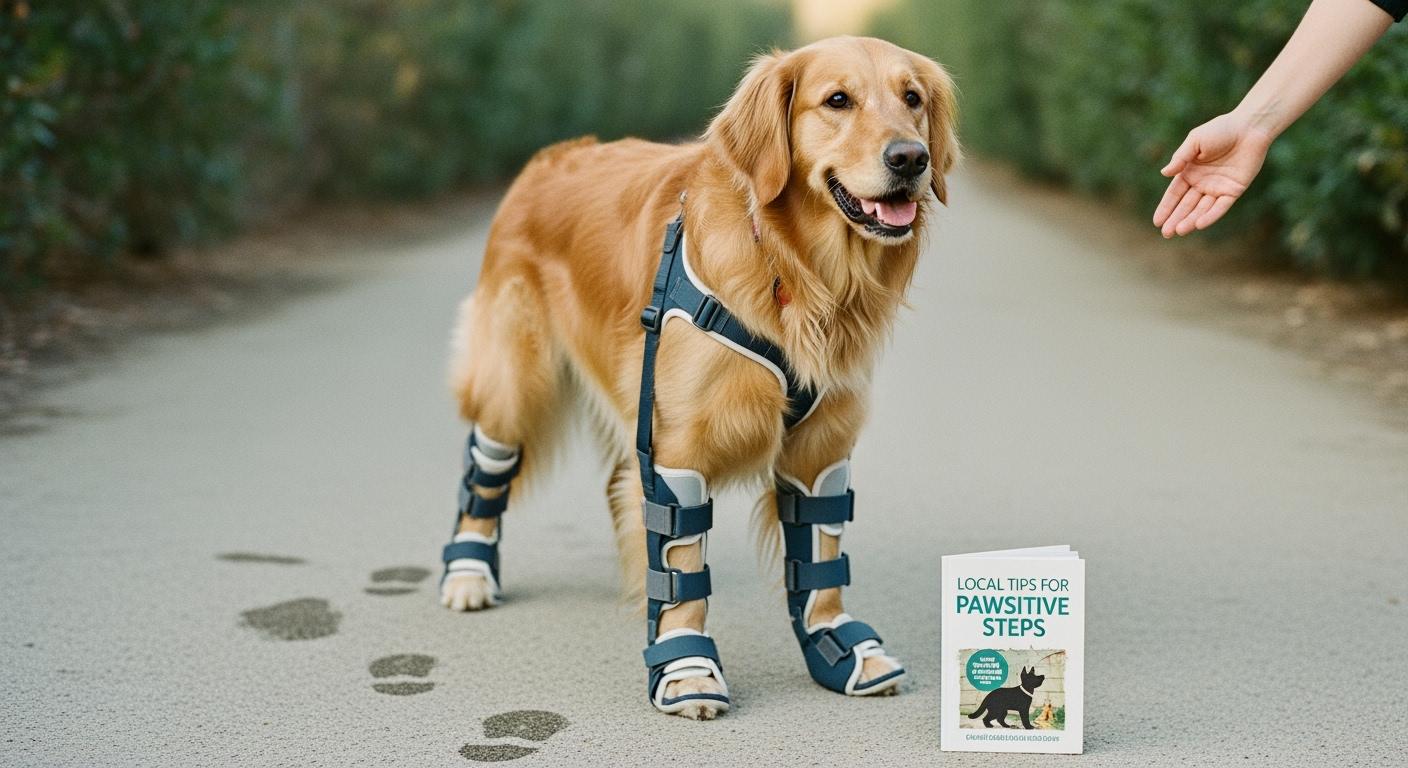
A single front leg brace has one job. Two braces on both front legs create an entirely different set of problems — problems that do not exist when only one limb is supported. One brace drifts down while the other stays put. The dog locks its elbows. Matching strap points wear matching sores on both legs. And none of this means the braces are defective. It means bilateral bracing introduces forces no single-brace fit check accounts for.
Why Two Front Leg Braces Fail in Ways One Never Does
The weight bias every dog carries up front
A dog carries roughly 60% of its body weight on its front limbs. When both forelegs are braced, that load does not simply split down the middle — it shifts dynamically with every step, every turn, every hesitation. If one brace grips slightly higher or tighter than the other, the dog redistributes weight toward the more stable side. That side now carries more than its share, the shoulder axis tilts, and the overloaded carpal joint absorbs asymmetric compression.
Here is the chain: strap tension differs → brace height mismatches → shoulder axis tilts → weight shifts onto the higher brace → carpal joint loads unevenly → the dog short-steps or locks the elbow to reduce the pressure. A half-inch difference at the top edge cascades through the entire forelimb kinetic chain.
This is not a defect. It is what happens when two support structures interact on an inherently asymmetric body. A front leg brace solution built around a single-leg model will not predict how two braces behave together.
Left and right legs are not mirrors
Measure both front legs separately while the dog stands naturally. Do not assume symmetry. Even in dogs with no visible lameness, one foreleg is frequently thicker at the mid-radius or shaped slightly differently through the carpal angle. The consequence is straightforward: a brace that fits the right leg may sit a quarter-inch lower on the left leg before the dog takes a single step.
After a 10-minute walk on level ground, compare the top edge of each brace relative to the elbow. A gap difference of more than half an inch between left and right means the braces have already shifted out of sync. That is your observable pass/fail signal. No special tools required.
Strap tension, shell contour, and lower-anchor placement each contribute. A straight-tube shell amplifies every millimeter of limb difference. A shaped shell that follows the native curve of each leg reduces it.
| What the caregiver sees | What is likely failing | Design that reduces the problem | Immediate action |
|---|---|---|---|
| One brace slides lower within minutes | Strap tension imbalance, limb contour mismatch, shell too straight | Side-specific sizing, contoured shell, anti-slip lining | Compare top-edge height; adjust lower anchor |
| Dog leans forward or locks both elbows | Cumulative rigidity exceeds the dog’s compensation range | Semi-rigid support, softer shell edges | Switch to lighter-stiffness brace; halve session length |
| Matching rub marks on both front legs | Identical narrow-strap placement on asymmetric limbs | Wider straps, padded and reinforced edges | Check skin after every session; pad the contact line |
Two braces add up to more restriction than the sum of their parts
A single semi-rigid brace allows enough joint movement for a natural stride. Put two semi-rigid braces on both front legs, and the combined restriction can cross a threshold the dog cannot compensate for. The forelimbs stop working independently. The dog begins to move as a single stiff block — short steps, locked elbows, reluctance to turn.
Test this yourself: after a 30-minute session, turn each brace’s inner lining inside out. Feel it with your hand. If one side is damp and the other is still dry, the dog is loading the tighter brace harder. That side is trapping more heat under a higher-workload limb. Asymmetry in lining moisture is a direct signal that the two braces are not sharing the load.
What a front leg brace optimized for daily wear handles alone may become unusable when doubled, not because the brace design fails, but because bilateral application changes the stiffness equation.
Design Features That Determine Whether Both Braces Work Together
Shell stiffness sets the lockup ceiling
Over-stiff shells create the highest failure rate in bilateral use. The mechanism is direct: a rigid shell on one leg restricts the carpus and elbow to a narrow range. The dog compensates through the opposite limb. Add a second rigid shell on that limb, and compensation pathways close. The dog locks up.
Semi-rigid support leaves each leg enough independent motion that the dog can still redistribute load without freezing its gait. Neoprene-based shells with flexible stays stabilize the radius and support soft tissue without eliminating the micro-adjustments that keep two braced legs walking in sync. A front leg brace type matched to the dog’s daily support needs matters more when two braces must cooperate than when one works alone.
Strap width, edge finish, and the rub-point problem
Narrow straps concentrate force into a thin contact band. On a single leg, that band may stay tolerable. On two legs, identical strap placement creates identical pressure lines — and the dog cannot shift weight away from both at once. The result is matching rub marks, matching redness, and matching hair loss at the same location on each leg.
Wider straps spread the load across more surface area. Quilted or bonded padding that stays uniform under tension prevents the fill from bunching, which keeps pressure even as the dog moves. Flat, reinforced edges stop fabric from curling under load — a curled edge becomes a cord, and a cord concentrates force into a cutting line.
| Design feature | Narrow band failure mode | Wide panel behavior | Why it matters bilaterally |
|---|---|---|---|
| Contact area | Force concentrated in a thin line | Load distributed across a broad surface | Two thin lines on asymmetric legs double the hot-spot risk |
| Padding stability | Fill bunches or migrates under shear | Padding stays uniform through the gait cycle | Shifted padding on one side throws off the load balance between braces |
| Edge geometry | Fabric curls into a cord under tension | Edges stay flat and broad | A curled edge on one brace changes that leg’s effective circumference, widening the asymmetry |
Shaped shells, not straight tubes
A straight-tube brace fits a cylinder. A dog’s foreleg is not a cylinder. It tapers, curves through the carpus, and varies in cross-section from the proximal radius to the metacarpals. When both front legs wear straight-tube shells, every millimeter of natural contour variation between left and right becomes a fit gap. One brace drifts.
Contoured shells that follow the native curve of each leg close those gaps without overtightening. Anti-slip lining — silicone dots, textured inner fabric, or rubberized strips — keeps the brace indexed to the leg so strap tension does not have to do all the work. A brace that stays in position through friction rather than compression is far less likely to slide when its counterpart on the other leg stays put, because the imbalance never starts.
Choosing between carpal-focused and full-limb front leg support changes which contours matter most, and bilateral use amplifies the consequences of getting that choice wrong.
Anti-slip lining and what it actually prevents
Anti-slip lining is not a comfort feature. It is a mechanical intervention. Without it, the only force holding the brace in place is strap compression. Every step introduces a shear vector — the brace wants to migrate downward under gravity and forward momentum. Straps fight that vector through friction, but friction requires tightness, and tightness constricts.
With anti-slip lining, shear resistance comes from the material interface between brace and coat, not from strap pressure alone. The straps can stay snug without crossing into constriction territory. This matters more bilaterally because constriction on one leg reduces venous return and subtly changes that leg’s volume during a session — which in turn changes the fit of that brace relative to its counterpart.
A leg brace built with anti-slip interior surfacing and padded edge finishing removes the variable that most often triggers the left-right divergence cascade. It is not about making the brace softer. It is about making the fit stable enough that both braces stay where they started.
When a Bilateral Front Leg Setup Makes Things Worse
Warning signs that override any fit adjustment
Some signals mean the brace combination itself is wrong, not the fit. Swelling above or below the brace edge, toes that feel cold to the touch, or skin that stays red more than 15 minutes after removal — these indicate the cumulative restriction has crossed into circulatory compromise. Remove both braces. Do not attempt to adjust and reapply.
Open sores, skin that smells foul, or any discharge at a rub point means the skin barrier has broken. A brace cannot be worn over broken skin regardless of how well it fits otherwise. The priority shifts from support to skin integrity.
Gait signals that mean the combination is failing
A dog that freezes mid-step, drags a paw, or refuses to move forward with both braces on is telling you something structural. The combined restriction has exceeded the dog’s neuromuscular tolerance. This is not stubbornness or an adjustment period. It is a hardware mismatch.
Falling, consistent paw-knuckling on one side, or a head-bob that was not present with a single brace are all failure signals. A structured fit and wear schedule for front leg braces helps catch these signals during the break-in window when the problems are still reversible.
Disclaimer: This article assumes roughly symmetric forelimb conformation. Dogs with angular limb deformities, heavily asymmetric shoulder musculature, or prior orthopedic surgery on one front leg may develop pressure patterns that visual checks alone cannot catch. In those cases, palpating under each brace edge after every session is more reliable than relying on sight lines. Double-coated breeds may show subtler rub marks that require hand-checking rather than visual inspection.
When to stop and get the plan reassessed
New or worsening lameness in either front leg while using braces is a stop signal. So is any behavior change — increased panting, lip-licking, or avoidance when the braces come out — that suggests the dog associates the braces with pain. A veterinarian needs to rule out brace-induced nerve compression, worsening of the underlying condition, or a joint alignment issue that the brace geometry is aggravating rather than helping.
Daily notes and photos make reassessment faster. Document brace position at the start and end of each session, any skin changes, and the dog’s willingness to walk. Patterns across three to five days are far more informative than a single-session snapshot.
FAQ
How do you know if both braces fit correctly?
Check that the top edge of each brace sits at the same distance from the elbow on both legs after 10 minutes of walking. You should be able to slide two fingers under every strap without forcing. The dog should walk with even stride length and paw placement — no head-bob, no short-stepping on one side.
Why does one brace slip while the other stays put?
Limb asymmetry is the most common cause. One leg may be slightly thinner, differently contoured through the carpus, or carry a subtly different muscle volume. Strap tension that feels equal to your hand may not produce equal grip on different leg geometries. Anti-slip lining and a contoured shell reduce this differential, but they do not eliminate the need to check and adjust each brace independently.
Can a dog wear two front leg braces all day?
No. Bilateral bracing demands shorter sessions than single-brace use because two braces together increase the total restriction and heat retention. Start with 30-minute supervised sessions twice daily for the first three days. Increase duration only after confirming both skin and gait checks pass across multiple sessions.
What is the most overlooked cause of bilateral brace failure?
Cumulative rigidity. Each brace may feel acceptably flexible on its own. Worn together, their combined stiffness can exceed the dog’s ability to compensate, producing a stiff, blocky gait that looks like a neurological problem. Reducing shell stiffness or shortening session length often resolves it, but the pattern must be recognized as a hardware interaction, not a fit error.