
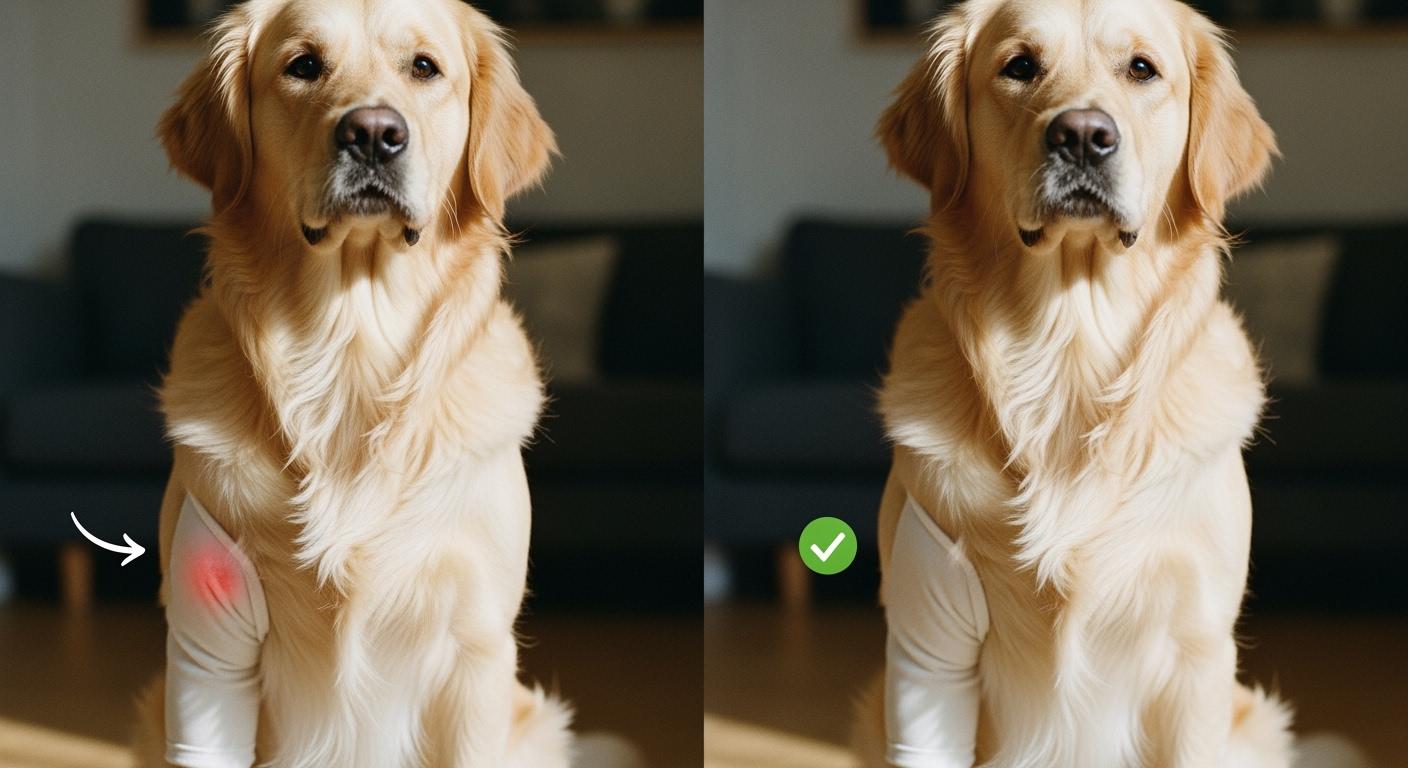
A recovery sleeve sits flush on a standing dog. The upper edge looks right. Then the dog takes three steps, drops into a sit, and the edge rides straight into the armpit fold. The owner adjusts it. Twenty minutes later, same thing.
Three mechanical forces converge at that upper edge: shoulder-driven fabric displacement, strap-tension vectors that translate horizontal pull into upward migration, and fabric stiffness that resists conforming when the dog changes position. A red crease or damp skin after 30 minutes of wear is not a sizing mistake. It is a structural mismatch between the sleeve and the shoulder motion it must survive. Front leg sleeve fit problems that show up only during movement are the hardest to catch — and the most common.
Why the Upper Edge Migrates Into the Armpit
Multi-Axis Shoulder Motion Creates a Tension Differential at the Edge
A dog’s shoulder does not hinge in one plane. During a single stride, the joint translates forward, rotates, and elevates — three force vectors competing for control of the fabric sitting over it. The upper edge receives all of them.
When the shoulder drives forward, it drags fabric with it. The chest anchor resists. The line between them — the upper edge — takes the full tension differential. It rolls. It shifts medially. If it started near the axilla, it ends inside it. During sitting, the mechanics reverse: the shoulder drops, skin around the armpit compresses into folds, and an edge sitting near that zone gets pushed deeper. Fabric that cannot stretch longitudinally bunches instead, creating a ridge that presses into soft tissue.
The causal chain: multi-axis shoulder motion → tension differential at the upper boundary → edge migrates toward the lowest-pressure zone (the axilla) → ridge or line contact against thin, folding skin. You can verify this by marking the edge position with a piece of tape on the outer fabric before a walk. After 10 minutes, measure the shift. More than half an inch of migration toward the armpit means the edge and anchor are not holding against shoulder kinematics.
| What Happens During Movement | What It Means for the Sleeve |
|---|---|
| Shoulder pulls fabric forward | Upper edge rolls or shifts medially |
| Sleeve anchor resists at the chest | Tension concentrates at the upper boundary |
| Dog sits or curls | Skin compresses, edge drops or bunches into axilla |
Strap Tension Turns Snug Into Migration
A strap tightened for security creates a force vector. Most sleeve straps wrap around the chest or shoulder. When tensioned, they pull the fabric body toward the anchor point. If the anchor sits above the sleeve’s midline, that pull has an upward component. Over minutes of movement, the sleeve creeps toward the anchor — often positioned near the armpit.
Muscle bellies expand under the fabric during walking. The effective leg circumference increases. A strap set to “snug” at rest becomes restrictive in motion. The sleeve cannot expand radially, so it migrates axially — upward. Remove the sleeve after 30 minutes of supervised wear and press a dry paper towel against the skin under where the upper edge sat. Dampness means the edge was pressing with enough contact pressure to block evaporation. That is fit pressure, not fit security.
Armpit Skin Is Structurally Different From Leg Skin
The axilla has thinner epidermis, less hair for mechanical buffering, and higher sweat gland density than the lower leg. A friction level that leaves no mark on the metacarpal region produces a visible red line in the armpit fold within 20 minutes. The skin also folds and unfolds with every stride. A sleeve edge pressing into a moving fold is a low-grade shear injury repeating at gait frequency. This is not a more-sensitive version of leg skin — it is a different tissue environment entirely.
Seams and Hardware That Concentrate the Problem
The migration described above delivers fabric to the axilla. What sits on that fabric determines whether the contact is diffuse pressure or a concentrated point load. An overlock seam creates a raised ridge on the inside face. When the edge sits below the armpit, that ridge is harmless. When the edge migrates into the axilla, the ridge becomes a linear pressure concentrator tracking with shoulder motion.
Turn the sleeve inside out and run a thumbnail along the upper edge interior. A raised ridge that catches your nail will catch skin. Flatlock stitching or seamless knit construction eliminates the ridge entirely. A side-release buckle that sits flat against the chest when standing can rotate 90 degrees when the dog curls into a sit — exposing a corner directly into the axilla. The buckle belongs on the lateral shoulder or chest, never on the medial surface where leg meets body.
Licking at the upper edge is often the first observable signal of seam or buckle pressure — the dog feels it before the owner sees it.
| What the caregiver sees | Likely cause | Why it fails | Better structure |
|---|---|---|---|
| Red line in armpit fold | Sleeve sits too high or migrates upward | Upper edge presses into thin axilla skin during movement | Lower edge placement, soft clearance zone |
| Fabric bunching near shoulder | Sleeve too stiff or lacks longitudinal stretch | Fabric cannot conform when shoulder drops in a sit | Four-way stretch fabric in shoulder zone |
| Sleeve slides upward during walking | Strap tension pulls sleeve toward anchor | Upward force vector drives edge into axilla | Loosen strap, reposition anchor below armpit line |
| Dog chews upper edge | Hard seam, buckle, or binding | Pressure point irritates axilla | Flatlock seams, seamless edge, low-profile hardware |
| Dog limps or avoids leg use | Sleeve restricts shoulder range or creates pain | Mechanical interference with joint motion | Flexible shoulder-zone fabric, no rigid components near joint |
| Skin feels damp or warm under edge | Poor breathability plus edge contact pressure | Occlusion plus friction equals moisture buildup | Breathable lining, moisture-wicking inner face |
| Signal level | What it looks like | What to do |
|---|---|---|
| Green | Sleeve stays flat, skin stays dry, dog moves without guarding | Continue use, check fit twice daily |
| Yellow | Light rubbing line, mild bunching, dog notices the edge | Adjust fit, reposition edge, monitor hourly |
| Red | Swelling, heat, wet skin, open sore, pain, limping | Stop use, consult veterinarian |
When the Sleeve Is the Wrong Choice
A sleeve that leaves a faint pink line fading within 5 minutes is in adjustment territory: lower the edge, reduce strap tension, recheck. A sleeve that leaves a persistent welt, causes damp skin, or triggers chewing — those are structural failures. No amount of repositioning fixes a design mismatch between the sleeve edge and the dog’s shoulder kinematics. Continuing to adjust a structurally mismatched sleeve exposes the axilla to cumulative friction injury. Skin abraded today is weaker tomorrow.
Disclaimer: These fit checks assume a short-coated dog where skin is visible. Double-coated breeds may show subtler rub marks that need hand-checking rather than visual inspection — run your fingers along the axilla fold after each wear session. If the dog’s leg conformation falls outside the breed norms this sleeve design was patterned for — particularly dogs with angular limb deformities or very deep chests — the edge-clearance checks described here may not catch every pressure point.
A shorter sleeve often solves the problem entirely. If the wound or bandage sits on the mid-to-lower leg, a sleeve extending to the armpit covers territory it does not need to cover — and pays with axilla friction. A leg sleeve that stops below the shoulder joint eliminates the upper-edge migration problem by eliminating the upper edge. The coverage zone should match the wound zone. More coverage than necessary introduces a failure mode that provides zero additional protection.
If red signals appear — swelling, persistent moisture, open skin, pain response — the sleeve is not safe for continued use on this dog. What works for one dog’s front leg coverage and skin tolerance pattern can fail at the upper edge on another dog with different shoulder conformation. The variable is not owner technique. It is the match between a fixed-geometry sleeve and a variable-geometry dog. When the match fails, an anti-lick alternative that does not contact the axilla may be the safer path.
In practice: The dogs most likely to fail the upper-edge clearance check are deep-chested breeds (Dobermans, Greyhounds, Great Danes) and heavily muscled shoulders (Pit Bulls, Staffordshires). The armpit sits deeper relative to the shoulder point, leaving less clearance for any sleeve edge. A sleeve that clears a Labrador’s axilla may rub a Doberman in the same nominal size — the axilla geometry is different, not the size label.
Design Features That Change Edge Performance

Four structural details determine whether an upper edge becomes a pressure point or a passive boundary.
Edge profile. A cut-and-bound edge presents a flat perpendicular face to the skin. A soft rolled edge presents a curved surface. Under the same migration force, the curved edge distributes pressure across a wider contact patch. Adding foam padding to a cut edge does not fix the pressure distribution — it pushes the same line load deeper with more comfort illusion.
Inner-face friction. A fleece lining feels soft but can grip dog skin, especially when damp. A smooth, low-friction inner face lets the edge slide during shoulder motion instead of gripping and dragging skin with it. Lower friction means less tissue shear when the edge inevitably moves.
Shoulder-zone stretch. Fabric with longitudinal stretch lets the sleeve lengthen when the shoulder extends and shorten when it flexes. The motion is absorbed by fabric deformation instead of sleeve displacement. A dedicated four-way-stretch panel at the shoulder isolates joint motion from the leg coverage zone — the leg section stays stable while the shoulder section moves.
Anchor vector. An anchor that wraps above or across the armpit guarantees tension will pull the sleeve toward the axilla. An anchor at mid-chest, with a strap path that does not cross the armpit, pulls downward and laterally — away from the axilla. Wherever the anchor pulls, the sleeve eventually goes. Recovery sleeve anchor placement that directs tension away from sensitive zones matters more than how tightly the strap holds.
| Design Feature | Performance Difference | Main Limitation |
|---|---|---|
| Soft rolled upper edge | Distributes migration pressure across a curve instead of a line | Harder to produce at consistent thickness in manufacturing |
| Low-friction inner face | Reduces tissue shear during edge movement | Slick face may feel less secure to the owner; grip is not needed at the edge |
| Four-way stretch shoulder panel | Absorbs motion through fabric deformation rather than sleeve displacement | Adds a material transition seam; each seam is a potential failure point |
| Anchor below armpit line | Directs tension vector downward and away from axilla | May require different anchor geometry per breed chest depth |
- Put the sleeve on with the upper edge at least two finger-widths below the armpit fold.
- Let the dog stand; confirm the edge sits flat without pressing into the axilla.
- Walk the dog 10 paces and watch the shoulder fold — does the edge shift upward?
- Ask the dog to sit, then lie down. Check for bunching or edge displacement each time.
- After 30–60 minutes of supervised wear, remove the sleeve and inspect the skin. Press a dry paper towel against the armpit — moisture means edge contact pressure is blocking evaporation.
- Repeat checks twice daily during the first 72 hours.
FAQ
Why does the edge look fine when standing but rubs during walking?
Standing is static — the shoulder is neutral and the skin is not folding. Walking flexes the shoulder, muscles expand under the fabric, and the strap-anchor vector pulls the sleeve body. The edge that looked right at rest migrates toward the lowest-resistance path, which is the axilla. This is sleeve kinematics, not a fit mistake.
How do I tell if the rubbing is from the edge or from a seam?
Remove the sleeve and match the mark pattern to the structure. A linear mark following the upper edge contour is edge pressure — the sleeve sits too high or migrates upward. A narrower, more defined line matching an interior seam path is seam pressure — the seam construction needs to change, and repositioning will not fix a raised ridge.
Can a recovery sleeve work for a deep-chested breed?
It can, but the clearance is tighter. Deep-chested breeds have an armpit that sits higher relative to the shoulder point. A sleeve that clears a Labrador’s axilla by two finger-widths may sit inside a Doberman’s axilla in the same labeled size. The check is the finger-width clearance on the specific dog — not the size label.
Is a shorter sleeve less protective?
Not if the wound or bandage is on the lower leg. Protection comes from covering what needs coverage. A sleeve that extends into the armpit to cover uninjured skin adds a friction risk without adding wound protection. Match sleeve length to the wound zone.
