
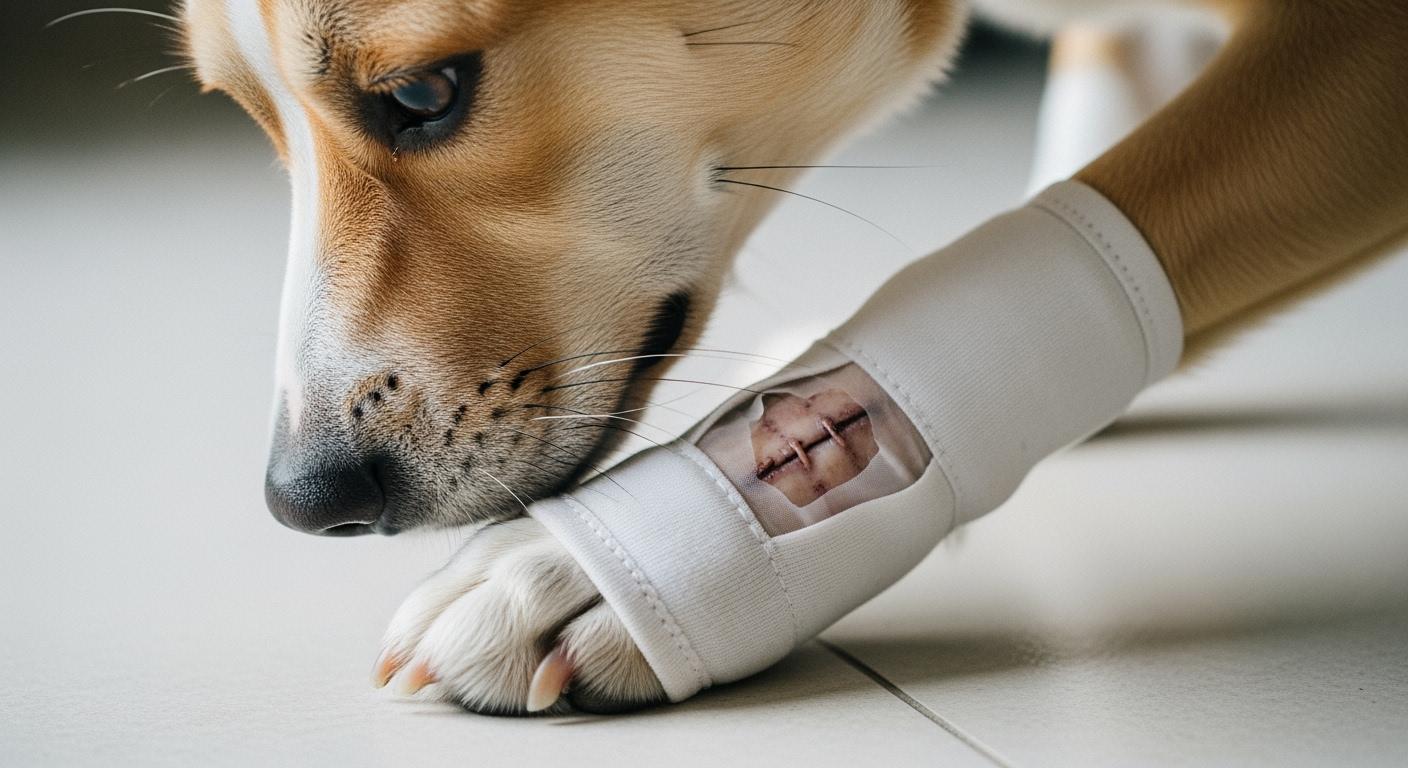
You slide the sleeve onto your dog’s front leg after surgery. The fabric sits flat. The wound zone looks covered. Twenty minutes later, the sleeve edge has shifted a half-inch. The incision margin peeks through. Your dog notices before you do—teeth find the gap, work the fabric edge, and within minutes a hole opens where the wound used to be protected.
This is not a fabric-strength problem. It is an edge-access problem. A dog front leg sleeve fails first at the incision edge because that is where movement, bunching, and moisture all converge on a single line of fabric. The dog chews through because the edge became reachable, not because the material was weak. Understanding this distinction changes which sleeve designs actually hold up in real use.
When a Dog Chews Through a Front Leg Sleeve, the Edge Gap Comes First
Dogs do not chew randomly. They target structure. A flat sleeve surface gives teeth nothing to work with. But an exposed incision edge creates a ridge—a seam, a fold, a transition where fabric meets skin and the plane changes. Teeth catch that transition.
Edge gaps form for one of three reasons. First, the sleeve rides up or rotates as the shoulder and elbow flex, pulling the hem away from the wound. Second, thin stretch fabric bunches into a raised fold near the incision—a mechanical bite point. Third, moisture from wound seepage or licking concentrates at the hem, which draws the dog’s attention back to the same line again and again.
When you run your finger along the sleeve’s inner edge after the dog has walked for ten minutes, you can feel whether the hem has migrated. More than a half-inch shift from where you placed it and the wound margin is at risk. This is the first observable check—and it matters more than how tight the sleeve feels when you first put it on.
Tip: The most useful fit metric is not “does it feel snug” but “does the edge stay where I placed it after movement.” A sleeve that feels perfectly snug at rest can still rotate enough to expose the incision within a single walk.
The mechanics are straightforward. When the shoulder flexes during walking, the front leg extends forward and the skin and sleeve stretch together. But the sleeve—if it lacks stable upper anchoring that distributes tension across the shoulder rather than concentrating it at the hem—recovers its shape differently than the skin does. The fabric snaps back to its shorter resting length while the skin remains extended. This differential recovery pulls the hem toward the shoulder by a few millimeters with each stride. Ten strides later the wound edge is visible.
Why chewing starts before the fabric tears
The dog’s sequence is predictable. First comes licking—a response to the sensation of the shifted edge, the odor of wound moisture concentrated beneath the sleeve, or both. Licking works the hem upward. When teeth replace tongue, the raised fabric edge becomes a grip point. The dog does not need to bite through in one motion. It works a small fold, pulling and releasing, fraying the edge until a hole forms.
This is a mechanical chain: movement shifts the hem → moisture and pressure create a sensation the dog responds to → licking escalates to chewing → the edge frays and tears → the wound becomes exposed. Interrupting any link in this chain—keeping the hem stationary, reducing moisture, or removing the fold the teeth can grab—can stop the process. But persistent licking often signals that the edge gap has already formed, even if the tear has not yet appeared.
Why Thin Stretch Fabric Fails at the Incision Edge Under Real Movement
Stretch fabric is comfortable. That is the tradeoff. A single-layer spandex or polyester knit conforms closely to the leg and does not restrict shoulder movement. But the same elasticity that makes it comfortable also makes it mobile—and mobility at the wound edge is precisely what creates the failure.
How elastic recovery pulls the hem off the wound
When a dog walks, the front leg cycles through extension and flexion with each stride. Each extension stretches the sleeve fabric along the length of the leg. Each flexion releases that stretch. A thin knit sleeve recovers its resting shape almost instantly—faster than the skin and underlying tissue rebound. The result is a ratcheting effect: the hem creeps upward with each stride, shortening the effective coverage zone and eventually exposing the incision.
You can observe this directly. Put the sleeve on, mark the hem position with a small piece of masking tape on the dog’s leg (not on the sleeve), walk the dog for ten minutes, and check whether the hem has migrated relative to that fixed reference point. More than a half-inch shift and the incision edge is likely within tongue reach. That is the pass/fail signal for this specific failure mode.
Thin fabric bunching and the bite-ridge problem
A thin sleeve folds differently than a structured one. When the dog bends the elbow or carpus, the excess fabric does not distribute evenly along the leg. It concentrates in a narrow band directly over the joint crease or, worse, directly over the incision—where the leg’s diameter changes most sharply. That fold becomes a ridge. A ridge gives teeth a defined edge to grip.
Thicker fabric can resist folding, but thickness alone solves nothing if the material is stiff in the wrong direction. A fabric that is thick but inelastic folds into a sharper, more rigid ridge—a better bite point, not a worse one. The relevant material property is not thickness but drape: how the fabric conforms to compound curves without forming concentrated folds. Fabrics with a soft inner knit and a tighter outer weave tend to distribute excess across a wider zone, reducing the height of any single fold.
Note: After 20 minutes of wear, flip the sleeve’s inner surface outward and check the fabric over the wound zone. If you see a concentrated crease line rather than diffuse wrinkling, the fabric is bunching into a bite-accessible ridge.
Moisture as the attention signal
Wound seepage, saliva from earlier licking, and trapped sweat all collect at the sleeve’s inner hem. The moisture migrates along the fabric edge through capillary action—the same mechanism that wicks sweat through athletic wear. This creates a damp ring directly at the incision margin. The odor of that damp ring is what draws the dog back to the edge repeatedly.
Breathable fabrics reduce the moisture gradient by allowing vapor to escape before it condenses. But breathability alone is not enough if the hem still migrates. A sleeve can be highly breathable and still fail because the damp edge is mechanically accessible. The moisture problem and the edge-access problem must be solved together—neither alone prevents chewing.
Design Choices That Change Whether a Sleeve Survives Repeated Chewing
Not all sleeve designs face the same failure path. The differences that matter in daily use are in the edge construction, the anchoring strategy, and the fabric architecture—not in marketing claims about durability.
| Design choice | Why it helps | Where it can still fail | Best-fit use case |
|---|---|---|---|
| Thin stretch fabric | Comfort and flexibility | Dog chews through fabric at edge gaps; bunches into bite ridge | Short-term supervised coverage after minor procedures |
| Thicker soft fabric with drape | Distributes fold across wider zone, reducing ridge height | May trap heat if not breathable; still mobile without anchoring | Sensitive skin or incision in high-movement zone |
| Reinforced outer overlay at wound zone | Resists fraying when teeth make repeated contact | Dog shifts chewing to unreinforced adjacent edge | Known high-licking dogs with surgical wounds |
| Smooth low-profile seam with covered edge | Reduces mechanical irritation and removes grabable lip | Seam may still shift position with movement | Incision with sensitive or reactive skin |
| Extended wound-zone coverage beyond incision margin | Creates buffer zone—hem must migrate farther before wound is exposed | Sleeve may rotate on the leg, shifting buffer zone sideways | Large surgical wound or multiple incision sites |
| Shoulder-anchored suspension | Transfers tension to body rather than leg, limiting hem creep | May loosen with extended activity if anchor is a single elastic strap | Active dogs during post-surgical recovery |
Smooth edges remove the tooth-hold
A raw-cut fabric edge, an overlock stitch, or a folded hem—each presents a different profile to a dog’s teeth. A raw edge frays immediately when wet. An overlock stitch creates a textured ridge that teeth can rasp against. A folded flatlock seam with the edge fully enclosed removes the mechanical purchase point entirely. The difference in real use is not subtle. That fails fast. A dog that works a raw edge for 30 seconds may open a hole. A dog that mouths a smooth enclosed edge for the same 30 seconds finds nothing to grip and often moves on.
Anchoring strategy determines edge stability
A sleeve that anchors only around the leg—an elastic cuff at top and bottom—fights a losing battle against shoulder movement. Every stride pulls the sleeve in a different direction, and the cuff’s grip on the leg can only resist so much before the fabric slides. A sleeve that extends to anchor across the shoulder or chest redirects the movement forces. Instead of pulling the hem across the wound, shoulder flexion pulls against the anchor point above—leaving the wound-zone fabric relatively stable.
This is where the structural difference between a leg-only sleeve and a shoulder-suspended design becomes visible in daily use. The leg-only sleeve fights the dog’s anatomy. The shoulder-suspended design moves with it. The wound zone stays covered not because the fabric is tighter but because the forces that would shift it are redirected elsewhere.
Disclaimer: These edge-stability observations assume a short-coated dog where the sleeve makes direct contact with the skin. Double-coated breeds may show subtler rub marks and edge migration because the undercoat acts as a slip layer—hand-checking the hem position is more reliable than visual inspection for these dogs. If the dog’s front leg conformation falls outside typical breed proportions—particularly dogs with angular limb deformities or disproportionately deep chests—the anchor points described here may distribute tension differently and the fit checks may not catch every pressure concentration.
| What you see | What it may mean | What to do next |
|---|---|---|
| Dog chews one specific sleeve corner repeatedly | Edge irritation or moisture concentration at that hem point | Check fit at that corner, dry the sleeve, verify wound coverage |
| Fabric hole appears directly over incision line | Sleeve edge migrated and exposed the wound; dog chewed through | Remove sleeve, protect wound with alternative barrier, notify veterinarian |
| Sleeve rotates after 10 minutes of walking | Insufficient anchoring or length mismatch for this dog’s build | Adjust anchor, test coverage in standing and sitting positions |
| Incision edge becomes visible when dog sits | Fabric bunches or shifts during joint flexion | Use wider coverage, test in all positions before leaving dog unsupervised |
| Skin beneath sleeve is red, damp, or warm | Pressure, friction, or trapped moisture under the fabric | Check inner seam placement, switch to more breathable inner layer, consult veterinarian if skin is broken |
| Dog persists in biting sleeve even after repositioning | Edge remains accessible to teeth or moisture signal persists | Stop sleeve use, switch to cone or alternative barrier while reassessing fit |
When a Front Leg Sleeve Is No Longer the Right Tool
A sleeve is a mechanical barrier. When the edge gap cannot be controlled—either because the wound location makes full coverage impossible during normal movement or because the dog’s chewing behavior outpaces any practical edge-reinforcement strategy—the sleeve has ceased to function as intended. Recognizing this point prevents wound exposure from becoming wound infection.
Signs the edge gap is beyond control
You have adjusted the sleeve. You have checked fit after standing, sitting, and walking. The hem still migrates. The dog still finds the edge. The wound edge is visible through the fabric hole, swollen, or discharging. At this point, continued reliance on the sleeve alone is a coverage failure—not a reflection of poor effort, but a recognition that this specific wound location and this dog’s movement pattern exceed what a fabric sleeve can manage.
When switching to a different barrier makes sense
A rigid cone or semi-rigid collar blocks access differently than a sleeve does: it creates a physical standoff rather than a fabric barrier. Where a sleeve relies on constant edge-to-skin contact around a moving joint, a cone simply prevents the mouth from reaching the leg. The tradeoff is comfort and mobility—but when edge-access failure is the primary problem, a barrier that does not depend on edge stability may be the correct choice for that stage of recovery.
Similarly, switching from a front-leg-specific sleeve to a broader-coverage design can sometimes solve the access problem by extending the buffer zone well beyond what teeth can reach even when the hem shifts. The decision hinges on where the wound sits relative to the joint crease—wounds directly over the carpus or elbow are harder to keep covered than mid-shaft incisions, simply because the mechanical displacement at those points is larger with every step.
FAQ
Why does my dog chew through the sleeve only at one specific spot?
Dogs target structure, not fabric. The spot your dog returns to is almost certainly an edge gap, a fabric fold, or a moisture concentration point—not a random location. Run your finger along the inner hem at that spot after 10 minutes of wear. If you feel a raised edge, a damp zone, or the fabric has migrated, that is the failure point. The solution is not stronger fabric at that spot but eliminating the structural feature that makes it tooth-accessible.
Does tightening the sleeve stop chewing?
Tightening a sleeve does not prevent chewing. It increases pressure on the leg—potentially restricting circulation or creating pressure marks—without addressing why the dog targets the edge. If the hem still migrates during movement, a tighter fit may actually worsen the problem by creating a sharper pressure gradient at the edge, which the dog senses and investigates. Edge stability and coverage width matter more than cuff tension.
Can I reinforce the sleeve edge myself to stop chewing?
Adding tape, stitching, or a DIY patch to the sleeve edge can create a stiffer, more defined ridge—a better bite point. Unless the reinforcement fully encloses the edge and extends well beyond the wound zone, it tends to shift the dog’s attention to the adjacent unreinforced fabric rather than solving the access problem. A sleeve designed with factory-enclosed edges distributes the edge profile evenly around the entire circumference in a way that field modifications rarely replicate.
How quickly should I expect a sleeve edge to show wear from chewing?
A sleeve edge that is accessible to teeth can show visible fraying within one session of determined chewing—sometimes under five minutes. If the edge is smooth, enclosed, and stays in position through movement, chewing attempts may produce no visible wear at all because the teeth find no purchase. The difference between rapid failure and no visible wear is not fabric durability. It is edge accessibility.
