
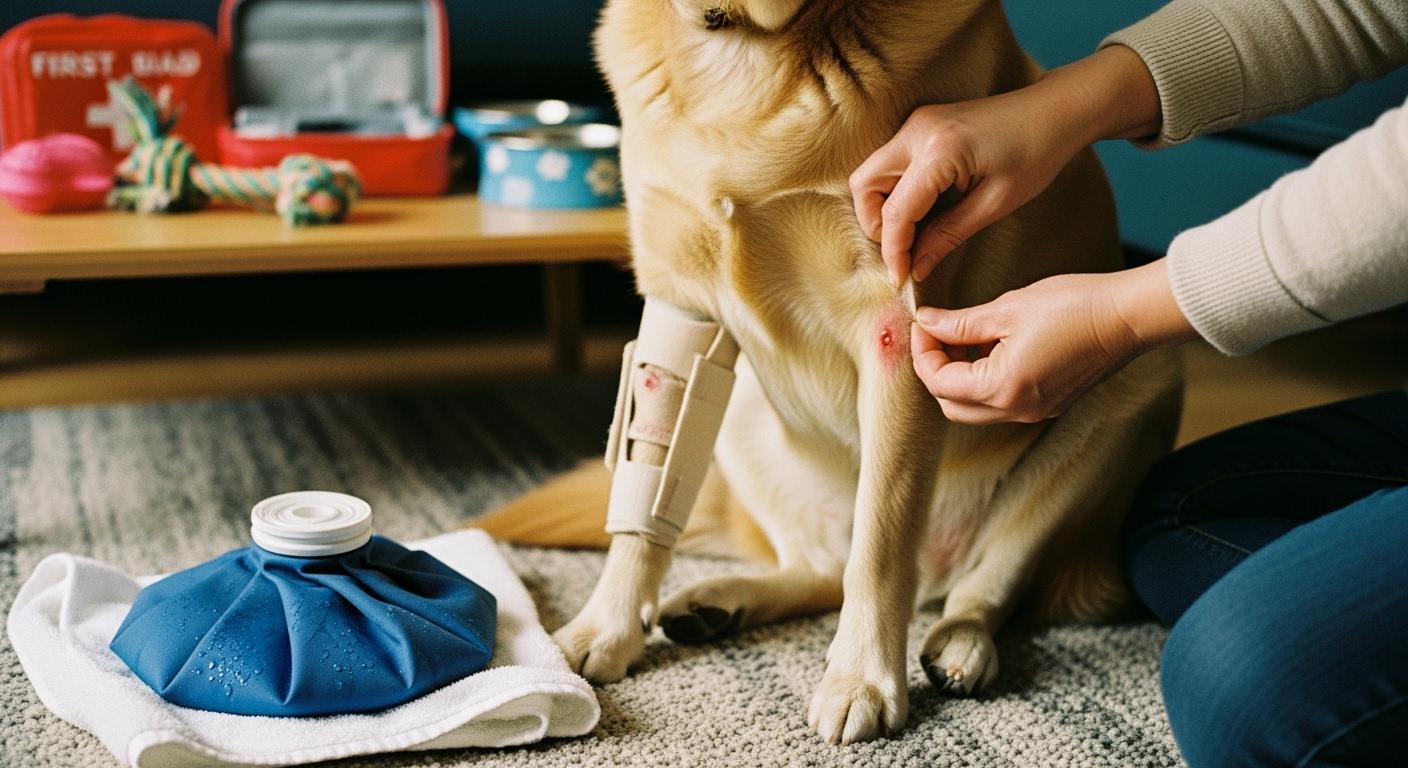
You lift the brace off after ten minutes of cold therapy. A pink line sits across the skin, exactly where the gel pack met the strap. It does not disappear when you part the fur.
That line is not a cold burn. It is a pressure signature—the mark of a strap crossing a gel pack and driving the pack edge into skin. Cold plays a role, but it is the amplifier, not the cause. The root problem sits one layer deeper: in pocket placement, strap routing, and liner material. These three design decisions determine whether a knee brace with a cold pack reduces swelling or creates a new problem.
When strap tension runs directly over a gel pack, the pack becomes a fulcrum. The strap pulls inward from above; the leg pushes outward from below. All of that force concentrates along the narrow edge where pack meets skin. Cold vasoconstriction reduces blood flow at that exact high-pressure line. The result is a defined red stripe—not diffuse pink from cold exposure, but a sharp imprint of the pack-strap intersection. A knee brace with a dedicated gel-pack pocket routes the pack away from the main strap path, spreading pressure across the pocket panel instead of letting the strap carve it into a hard edge.
Moisture is the second failure that looks like a cold problem. Condensation forms under every cold pack. If the liner cannot pass moisture through, that condensation sits against the skin for the full session. Wet skin softens—keratin swells, the outer protective layer loses structure—and even light friction from a shifting brace turns into surface breakdown. What you see afterward is glazed, damp skin, sometimes with a pink undertone that outlasts the cold. A breathable liner changes this completely: after a twenty-minute session, lift the liner edge and press a finger to the skin underneath. Skin that feels clammy or looks glossy signals a liner that traps moisture rather than passing it through. Dry, warm-to-touch skin—even right after cold removal—tells you the liner is doing its job.
Why Brace Design Determines Whether Skin Breaks Down
Three design features separate a knee brace that can handle cold-pack use from one that will cause problems. All three matter more than how cold the pack is or how long the session runs.
Pocket placement relative to strap path. If the gel pack sits under a strap, the strap transmits force through the pack thickness. The pack edge becomes a concentrated pressure line. That fails fast. A structured pocket sewn into the brace body—positioned so no strap crosses the pack surface—keeps the cold where it belongs and the pressure off the pack edges. This is not about more padding. It is about whether the strap can press the pack into skin at all.
Liner breathability. A non-breathable liner seals condensation in. The moisture softens the outer skin layer, and every micro-shift of the brace—every step the dog takes—turns into friction against compromised skin. A breathable, quick-dry liner lets vapor escape through the strap body. The difference is observable: after walking the dog for ten minutes with the brace on, remove it and check whether the skin under the liner feels dry or damp. Damp means the liner cannot keep up with the moisture load. That is the signal to shorten sessions, add a drying interval between uses, or switch to a brace built around a breathable liner.
Edge construction. Gel packs have corners. Some are hard, some are thick. If the pocket has no internal structure to distribute the pack thickness evenly, those corners press into skin as localized high points. A well-designed gel-pack pocket uses internal quilting or baffles to hold the pack flat and evenly distributed, so no single point carries more pressure than the surrounding area. The test is simple: after removing the brace, look for a square or rectangular red patch that matches the pack outline. A defined shape with sharp borders means the pack edges are doing the work the pocket should be doing. A knee brace fit guide that walks through pressure-point checks can help identify whether edge marks are coming from pack placement or from a sizing mismatch.
One more factor cuts across all three: the brace must stay in place without over-tightening. When a brace slips during movement, the natural response is to cinch the straps tighter. But tightening a strap that crosses a cold pack only increases the pressure concentration problem described above. Anti-slip design—harness-style anchoring, silicone grip strips, or multi-point strap geometry—keeps the brace positioned correctly at moderate tension. To check whether the anti-slip system is working, walk the dog for ten minutes with the brace on, then mark where each strap sits. If any strap has drifted more than half an inch, the anti-slip design is failing under motion—even if the brace felt snug when you first put it on. Tightening from that point creates a pressure problem without solving the slip problem. Sizing is often the fix: a brace sized to fit both the leg and the cold pack does not rely on strap tension alone to hold position. A knee brace that fits correctly at rest should maintain position through a full walk cycle without strap re-tightening.
How to Check Skin After a Cold-Pack Session—and Spot a Design Failure
Start by taking the brace and cold pack off completely. Do not lift an edge and peek—the fabric obscures the exact pressure zones. Remove the brace, part the fur around the knee, along every strap line, across the hinge zone, and over the gel-pack pocket area. Compare the treated leg to the untreated leg. A color difference between the two legs means something changed during the session—and the change is structural, not random.
Look for four specific signals:
- A narrow red line matching a strap path—strap crossing the cold pack.
- A square or rectangular pink-to-red patch—gel-pack edge pressure.
- Damp, glazed, or shiny skin—moisture trapped by the liner.
- Redness paired with swelling, heat, or pain on touch—pressure or cold injury beyond surface level.
Wait fifteen minutes without the brace. Recheck the same spots. Light pink that fades to normal is mild cold exposure—manageable. A defined line or patch that stays visible after fifteen minutes means the design failed that session. The force was too concentrated, the moisture too trapped, or both. Do not repeat the same setup.
The two tables below map what you see to what likely failed—and what a better brace design would do differently.
| What you see | Likely failure | What to check next | Better brace or product feature |
|---|---|---|---|
| Light pink skin that fades | Mild cold exposure | Recheck after 15 min | Soft, breathable liner |
| Narrow red strap line | Strap over cold pack | Fit and pocket placement | Wider padding, pocket away from strap |
| Red patch under gel-pack edge | Gel-pack pressure | Pocket position | Structured gel-pack pocket |
| Damp or glazed skin | Moisture, friction | Liner dryness | Breathable, quick-dry liner |
| Redness with swelling or pain | Pressure/cold injury | Swelling, pain, dog limp | Softer edges, less pressure |
| Pale, gray, blue, blistered skin | Cold injury | Vet check | Barrier layer, never direct cold on skin |
| Signal level | What it looks like | Action |
|---|---|---|
| Green | No deep mark, skin normal after recheck, dog walks normally | Continue, monitor |
| Yellow | Faint mark, mild dampness, light licking, minor brace shift | Shorten session, improve fit |
| Red | Defined red line, swelling, pain, cold hard skin, blister, chewing, worse limp, refusal to bear weight | Stop use, call veterinarian |
A practical example: a dog wears an ACL knee brace for a ten-minute cold-pack session. When the brace comes off, a defined red line sits where the pack edge met the strap. Fifteen minutes later, the line is still visible—not darker, but not fading either. That is a strap-pressure failure. Do not repeat the same setup. Stop cold use temporarily. Check whether the gel-pack pocket places the pack under the strap path. Loosen the strap tension. Dry the liner completely. If the next session produces the same mark even with adjustments, the brace design itself is working against the cold pack—and continuing with the same setup will produce the same result. A knee brace built around hot-cold gel pack use locates the pocket outside the primary strap load path as a structural design choice, not as an afterthought.
When a Knee Brace Cold-Pack Session Should Not Continue
Some skin signals mean the next session should not happen at all—not shortened, not adjusted, just stopped until a veterinarian reviews the leg. The threshold is lower than most owners assume.
Redness that does not fade or worsens after fifteen minutes. Persistent redness means the skin has sustained more than surface-level compression or cold exposure. If the area spreads, deepens in color, or develops a defined border that sharpens over time rather than softening, the tissue under the skin is reacting. Continuing cold-pack use on compromised tissue risks turning a pressure mark into a wound.
Skin that feels cold, hard, swollen, or painful to touch. Cold-hard skin with a firm texture is not normal post-session cooling—it signals prolonged vasoconstriction and possible cold injury at the tissue level. Swelling combined with redness points to an inflammatory response triggered by excessive pressure or cold. Pain on palpation—the dog flinches, pulls the leg back, or vocalizes when you touch the area—means the session crossed from therapeutic to harmful.
Chewing at the brace, worsening limp, or refusal to bear weight. These are behavioral signals that the brace is causing discomfort severe enough to override normal movement patterns. A dog that suddenly chews at a brace it previously tolerated, or that limps more after a session than before, is telling you something structural changed—the fit, the pack position, the skin condition, or all three. Ignoring these signals turns a manageable design limitation into a progressing problem.
Disclaimer: This check assumes a short-coated dog where the skin is visible after parting the fur. Double-coated breeds may show subtler rub marks that need hand-checking rather than visual inspection—run your fingertips along the strap paths and pocket edges and feel for any ridge, heat, or texture change. If the dog’s leg conformation falls outside the breed norms this brace was patterned for—particularly dogs with angular limb deformities or very deep chests that alter leg geometry—the fit checks described here may not catch every pressure point.
When any Red-level signal from the decision table above is present, the next step is not a shorter session—it is a call to the veterinarian. Cold therapy and bracing support recovery when the product design holds up under use. When the design fails, the signs are visible on the skin. Recognizing them early prevents a product limitation from becoming a medical problem. An approach to knee brace support that prioritizes stability over compression is often the better match for dogs whose skin reacts to combined cold and pressure—not because the brace is “stronger,” but because it routes force through paths that do not intersect the cold pack at all. Knowing how to size a knee brace for both the leg and the cold pack is what turns a session from guesswork into a repeatable, checkable routine.
