
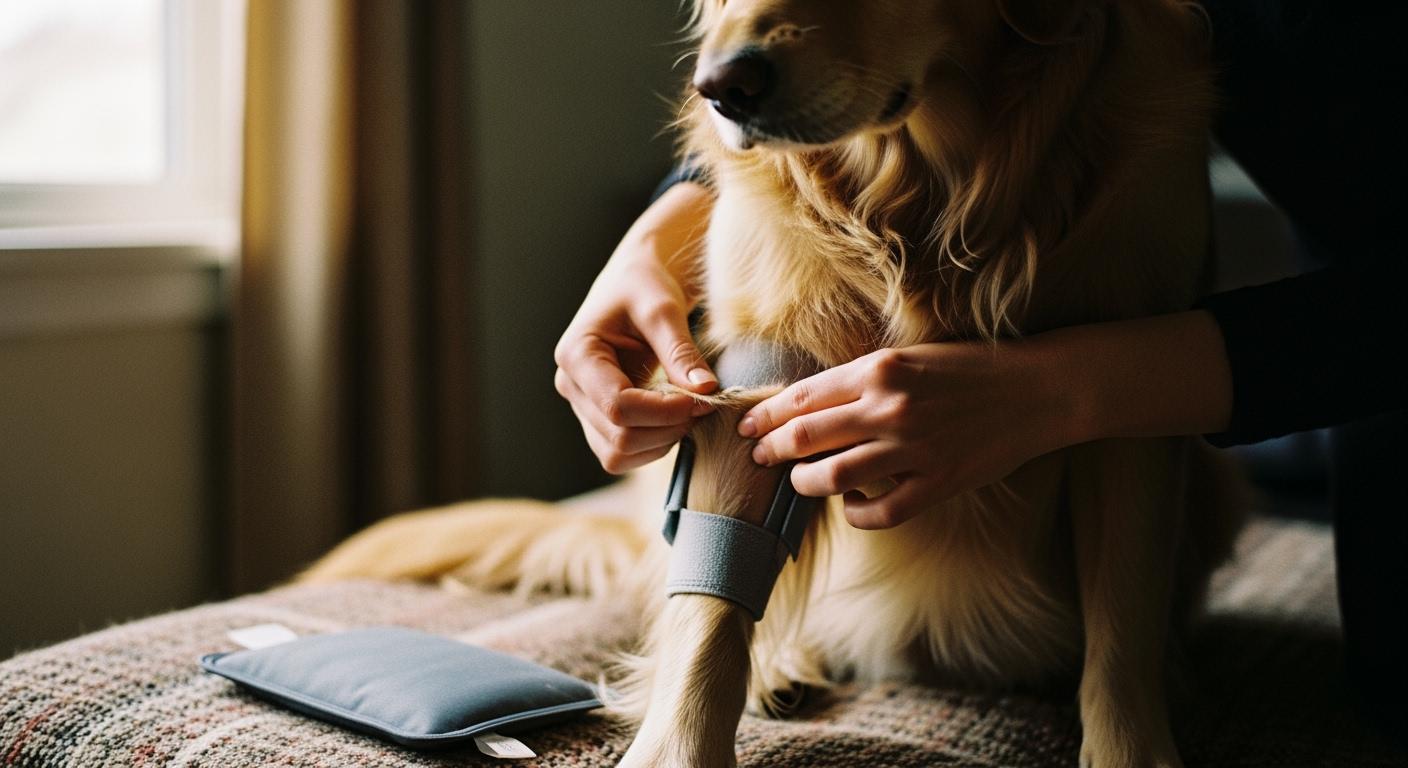
You remove the knee brace after a ten-minute heat session. The straps held, the gel pack stayed centered, and the dog seemed calm throughout. But when you lift the brace, the skin underneath tells a different story: a red stripe tracing the edge of the gel pack, dampness where the liner sat, and an area that feels several degrees warmer than the surrounding leg.
That red stripe is not a burn in the usual sense. The gel pack was warm, not hot. What caused it is the combination most caregivers overlook: heat plus pressure. A gel pack inside a knee brace does not behave like a warm compress held loosely against skin. It gets pressed into the leg by strap tension, and that pressure concentrates where the pack edge meets the skin. Narrow edge, body weight against the brace during rest, and heat softening the skin’s outer layer — together they create damage faster than any single factor alone.
Heat therapy with a knee brace can help ease joint stiffness, but the skin under the brace needs a structured check — not a glance, not a quick pat. This article walks through where the failures start, what a skin check actually catches, which brace design features reduce risk, and when heat is simply the wrong tool.
Why a Knee Brace Heat Pack Fails on Skin
Heat plus pressure is not heat plus comfort
Warmth alone dilates surface blood vessels. That is normal and temporary. But add sustained pressure from a gel pack strapped against the leg, and the picture changes. Pressure restricts capillary flow in the compressed zone. The narrow edge of a gel pack concentrates force along a line, not a surface — a half-inch-wide strip bearing the same strap tension that a wider pad would spread across three times the area.
Here is the chain: strap tension presses the pack edge into the skin at a linear contact zone → local blood flow drops under that line → the skin’s outer layer softens from the heat → cell turnover in the compressed zone slows while metabolic demand rises → the skin thins microscopically over repeated sessions → a red line appears, then a friction blister, then an open sore if the cycle continues unchecked. Each step is small. Stacked across daily sessions, the breakdown compounds.
Separately, heat or pressure might produce mild, transient redness. Together, the damage threshold drops. A gel pack used inside a knee brace turns a thermal tool into a thermal-mechanical stressor. That shift matters.
Fur hides what skin needs you to see
Most dogs have enough coat to conceal early-stage skin changes. Redness shows as a faint pink undertone under the fur — visible only if you part the hair with your fingers and look at the skin surface directly. Moisture trapped under the liner registers as a slick feel, not a visible wet spot. A hot spot forming under thick fur may present as nothing more than the dog shifting position or licking at the brace edge.
Breeds with short, single coats make visual inspection easier. Double-coated breeds add a layer of difficulty: guard hairs and undercoat together mask both color changes and subtle swelling. For these dogs, a hand-check often catches what a visual check misses.
In practice: after removing the brace, run two dry fingertips along the skin surface under the contact zone. Compare the temperature of the skin that was under the gel pack to the skin an inch above or below it. A difference you can feel immediately — not a subtle warmth, but a distinct heat differential — signals that the barrier was insufficient or the pack was too hot for that session length.
Moisture and friction: the hidden accelerator
Moisture under a brace liner does two things: it softens the stratum corneum, and it increases the friction coefficient between the liner and the skin. Softer skin abrades faster. Higher friction means every micro-movement of the brace — from the dog shifting weight, standing up, or adjusting position — scrapes the skin more than it would if the surface were dry. Over a fifteen-minute session, those micro-movements add up.
Check the skin at the strap edges and along the rim of the gel pack pocket. These are the zones where fur can hide a forming pressure mark for days before it becomes an open wound. Part the fur in a cross pattern — one pass vertical, one horizontal — and examine the intersection. If you see a pink line that blanches white under fingertip pressure, the skin is at stage one of pressure damage. Stop heat until the mark fully resolves.
What a Skin Check Catches and When to Run Each Step
A skin check is not one action. It is a sequence of three checks at three different times, each looking for a different failure mode. The before-heat check screens for pre-existing conditions that heat would worsen. The during-heat check catches behavioral signals that precede visible skin damage. The after-heat check identifies damage that has already started — and tells you whether the session crossed a line.
Each check is structured around observable pass/fail signals. If a check produces a fail, stop heat and address the root cause before the next session. The root cause is almost always one of three things: the gel pack temperature was too high, the pack placement concentrated pressure, or the liner material trapped heat and moisture rather than releasing them.
Before heat: screen for pre-existing vulnerabilities
Part the fur and inspect the skin across the entire brace contact zone. Look for any of these fail signals: swelling that was not present before the last session, redness that has not faded since the last session, small abrasions or broken skin at strap edges, or an area that already feels warmer than adjacent skin before any heat is applied. Any one of these means the skin has not recovered from the prior session. Skip heat and let the skin rest.
Also check the gel pack pocket and liner for dampness or odor. A liner that remains damp between sessions harbors bacteria and keeps the skin in a softened state between uses. This is a common trigger for what looks like a burn but is actually moisture-associated skin damage under repeated heat exposure.
During heat: behavior flags that precede tissue damage
Dogs signal pressure discomfort before skin damage is visible. The signals are behavioral: shifting weight off the braced leg, turning toward the brace and mouthing at the straps, panting that starts after the pack is applied and stops when it is removed, or a sudden stillness — the dog stops repositioning and holds unnaturally still, which often means movement hurts.
Any of these signals during a session is a fail. Remove the brace, check the skin, and shorten the next session by five minutes. If the behavior repeats at the shorter duration, the pack placement or barrier thickness needs adjustment — the dog is telling you something the skin has not yet shown.
| Check timing | What to look for | What to do |
|---|---|---|
| Before heat | Swelling, lingering redness, broken skin, pre-existing warmth | Skip session if any fail signal present |
| Mid-session | Shifting weight, mouthing brace, panting onset, unnatural stillness | Remove brace, check skin, shorten next session |
| Immediately after removal | Red lines at pack edges, damp skin, temperature differential, blistering | Stop heat if any red-zone sign; document placement |
| 15-20 min after removal | Redness that persists or deepens | Discontinue heat until mark fully resolves |
After heat: the pass/fail signals that matter
Remove the brace and immediately run three checks on the skin that was under the gel pack.
Color: pale pink or normal skin tone is a pass. A defined red line tracing the pack edge is a fail — this is pressure-line erythema. Blotchy red patches that extend beyond the pack contact area suggest a thermal burn, not just pressure, and are a hard stop.
Moisture: skin that feels dry or only slightly warm is a pass. Skin that feels slick, damp, or macerated is a fail. Moisture under a brace amplifies friction damage — a damp skin surface under a liner can sustain friction injury at far lower force than dry skin.
Temperature: press your inner wrist against the skin that was under the pack. If it feels subtly warm — about the same as skin that has been under a blanket — that is a pass. If it feels distinctly hot, as though heat is still radiating from the tissue rather than having dissipated, the pack temperature or session length exceeded what the tissue could handle. That is a fail.
The temperature check is easiest to calibrate with practice: compare the braced-leg skin to the same spot on the unbraced leg. A symmetrical temperature means the tissue handled the session. A lopsided differential means it did not.
| Failure pattern | Why it happens | What the caregiver sees | Better design or placement |
|---|---|---|---|
| Pack too hot | No wrist test before application | Blotchy red skin, dog pulls away | Test pack on inner wrist for 5 seconds; use a fabric barrier |
| Pack edge presses into skin | Tight strap tension, hard pack rim | Defined red line at pack border | Softer-edged gel pack; reduce strap tension by one increment |
| Pack sits behind knee crease | Centering drift during strap tightening | Swelling, pain on flexion, restricted stride | Center pack over the joint body, not the crease; mark position on liner |
| Pocket lets pack bunch or shift | Oversized or shallow pocket | Uneven warmth, multiple pressure marks | Deep pocket that cups three sides of the pack |
| Liner traps heat and moisture | Non-breathable inner surface | Damp, macerated skin; musty odor | Perforated or moisture-wicking liner material |
| Strap pulls pack unevenly | Narrow strap, uneven tension | Hot spots under one side of the pack | Wider strap with contoured inner face; even tension across all straps |
Brace Structure That Reduces Heat-Related Skin Risk
Removable gel pack and pocket depth
A fixed heat zone — where the gel pack is sewn into the brace and cannot be removed or repositioned — creates two problems. First, the pack cannot be tested on the wrist independently of the brace. Second, the pack position is locked relative to the brace shell, which means any shift in the brace on the leg also shifts the heat source, potentially into a bony prominence or a fold of skin.
A removable pack inside a stable pocket solves both. The pocket should be deep enough to cup the pack on three sides, preventing lateral drift when the dog shifts position. The rim of the pocket should be firm enough to act as a mechanical stop — if the pack can slide past the rim during normal movement, the pocket is too shallow or too soft. A knee brace with structured pocket depth and a contoured fit keeps the heat zone where it belongs: centered over the joint body, not drifting into the knee crease with every step.
The pack material itself also matters. Gel packs with a softer, more pliable outer shell conform to the leg contour under strap pressure. Hard-edged packs create a pressure ridge along their perimeter the moment tension is applied — that ridge is where the red line comes from.
Liner material and moisture behavior
The liner is the interface between the heated pack and the skin, even when a fabric barrier sits between them. A non-breathable liner — one that is smooth, sealed, or rubberized on the inner face — traps both heat and humidity against the skin for the entire session. As the session progresses, humidity inside the brace rises, softening the skin and increasing friction vulnerability.
A breathable liner — perforated neoprene, open-cell foam with a wicking face fabric, or mesh-backed padding — lets moisture escape and allows some evaporative cooling at the skin surface. The difference is observable: after a ten-minute session, a breathable liner feels warm and dry to the touch on the inner face. A non-breathable liner feels damp. That dampness is not just condensation — it is a signal that the skin spent the session in a high-humidity microclimate where friction damage thresholds are lower.
When evaluating brace designs for stability and skin tolerance during extended wear, the inner surface material and its moisture behavior under heat are as important as the outer shell’s mechanical support. A brace that stabilizes the joint but destroys the skin underneath is not a working solution.
Strap width and pressure distribution
Narrow straps — under half an inch wide — concentrate tension into a band that restricts circulation more than a wider strap at the same tension setting. Wider straps with a contoured inner face spread force across a larger surface area, reducing the per-square-inch pressure on the skin. Neoprene-backed straps compress more evenly than flat webbing, which tends to roll at the edges under tension and create two high-pressure lines instead of one even contact zone.
The interaction between straps and the gel pack is also structural: if the upper strap passes directly over the top edge of the gel pack, every increment of tension drives that edge deeper into the skin. A brace with hinge-aligned strap routing that avoids crossing the pack zone reduces this compounding effect. The strap should anchor above or below the pack, not across it.
| Feature | Better design | Riskier design | Why the difference matters |
|---|---|---|---|
| Gel pack | Removable, soft-edged | Fixed, hard-rimmed | Removable packs allow wrist testing and repositioning; soft edges reduce pressure-line formation |
| Deep, three-sided cup | Shallow or loose | A cupped pocket prevents lateral drift; a loose pocket lets the pack bunch or shift | |
| Liner inner face | Perforated or wicking | Sealed, non-breathable | Breathable liners release moisture; sealed liners create a humid microclimate that softens skin |
| Strap width | Wide, contoured inner face | Narrow flat webbing | Wide straps spread tension; narrow straps create high-pressure bands at the edges |
| Contact area | Shaped to joint contour | Uniform flat pad | Contoured pads match anatomy; flat pads create gaps and pressure points |
Brace fit checks during active use are not optional when heat is involved. A brace that fits acceptably at rest can shift under load, and a heat pack that shifts under load delivers thermal energy to tissue that was not assessed for heat tolerance. Check the pack position after the dog stands, sits, and takes several steps — not just while stationary.
When Heat Is the Wrong Choice
Red-zone skin signs that mean stop
Some skin signals are not warnings — they are stop signs. A red mark that deepens in color rather than fading during the fifteen minutes after brace removal means the tissue is in an active inflammatory phase and adding heat will accelerate the breakdown. Blistering, even a single small blister at a strap edge or pack rim, is a hard stop — the skin barrier is breached and heat plus trapped moisture create an entry point for bacteria.
Swelling that appears during or immediately after a session is a contraindication for continued heat. Heat increases blood flow to the area, which can worsen swelling in tissue that is already struggling to manage fluid balance. If the knee looks fuller or the skin feels tighter after a session than before it, switch to cold therapy for the next several sessions and monitor whether the swelling resolves.
Pain signals — limping that worsens after heat, reluctance to bear weight on the braced leg, or vocalization when the brace is removed — indicate that heat is aggravating the underlying condition or that the brace placement is causing joint-level stress, not just skin-level stress. Stop heat and reassess with a professional.
When swelling or acute injury makes heat the wrong tool
Heat is a vasodilator. That is useful for chronic stiffness where increased blood flow helps loosen tight soft tissue. It is harmful in the acute phase of an injury — the first 48 to 72 hours after trauma, surgery, or a flare-up — when the body is already sending excess blood and inflammatory cells to the site. Adding heat during this phase increases swelling, prolongs inflammation, and can slow tissue repair.
Cold therapy is the appropriate tool during the acute window. A gel pack chilled in the refrigerator — not frozen solid — placed in the same brace pocket provides vasoconstriction that helps control swelling without the risks of ice burn. The same skin check protocol applies: check before, watch for behavioral signals during, and inspect after. Cold can damage skin too, especially if the pack is too cold or the session runs too long.
The decision between heat and cold turns on timing, not preference. Chronic stiffness that improves with movement generally responds to heat. Acute swelling that worsens with movement generally responds to cold. If the timeline is unclear — the dog has both chronic joint changes and a recent flare — default to cold until the acute signs subside, then transition to heat.
Disclaimer: this check protocol assumes a dog with a short to medium coat where visual inspection and the temperature-differential hand test produce clear signals. Double-coated breeds may show subtler color changes and may need hand-checking rather than visual inspection — run fingertips slowly along the skin under the brace contact zone to detect warmth differences or raised areas that fur conceals. Dogs with angular limb deformities, very deep chests, or leg conformation that falls outside the breed norms this brace was patterned for may experience pressure points that the standard fit checks described here do not catch. If the dog has a known skin condition, circulatory compromise, or neuropathy that alters sensation, heat therapy should only proceed under direct professional guidance.
FAQ
How long should a heat session last with a knee brace?
Start at 10 minutes. If the skin check after removal shows no fail signals — no red lines, no dampness, no persistent heat differential — the session can extend to 15 minutes. Sessions beyond 20 minutes increase the risk of moisture accumulation and pressure-line formation without adding meaningful therapeutic benefit. The goal is tissue warming, not sustained heating.
Can the same brace be used with both heat and cold?
Yes, if the gel pack is removable and the pocket accommodates it in both states. Chill the pack in the refrigerator — not the freezer — for cold therapy. A frozen pack is too cold for direct skin contact through a thin liner and can cause cold burns that mimic heat burns in appearance. The same placement rules apply for both temperatures: center the pack over the joint body, keep it out of the knee crease, and check skin before and after every session.
What is the most common placement mistake with a heat pack in a knee brace?
Centering the pack too low, so the bottom edge sits in or below the knee crease. The crease is a high-motion zone where the skin folds and extends with every step. A pack edge in this zone acts like a dull blade under repeated flexion — it does not cut but it abrades. The pack should sit centered over the joint body, with its lower edge above the knee crease even when the leg is fully extended.
Why does skin sometimes look fine during the session but show damage hours later?
Heat damage to the deeper skin layers can take hours to become visible on the surface. The epidermis may look normal immediately after brace removal while the dermis underneath is already inflamed. This is why the 15-to-20-minute post-removal check matters: if redness appears or deepens during that window, the session crossed the tissue’s tolerance threshold even though the immediate post-removal check looked clean.
