
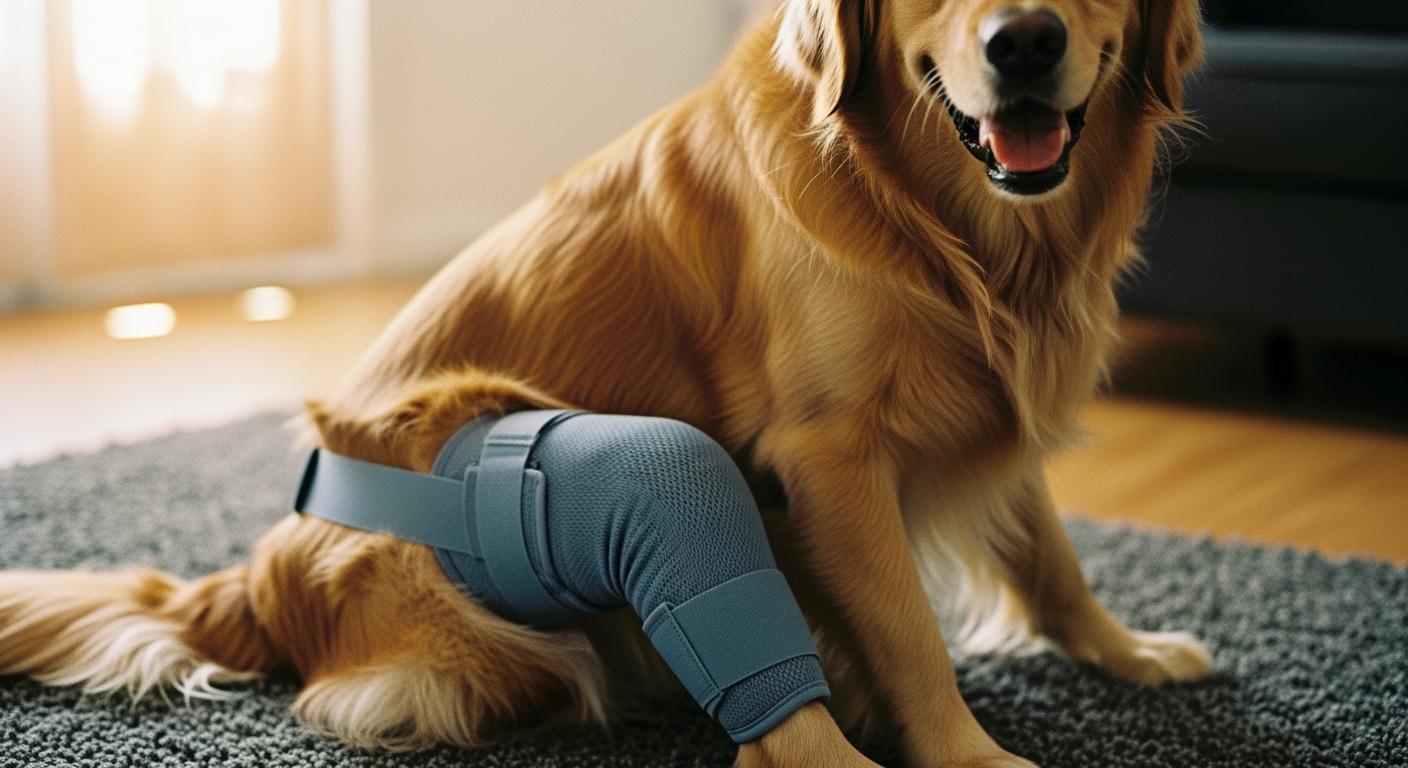
A dog stands still, the brace looks right, and everything seems fine. Then the dog sits. A flinch. A refusal to bend. The problem is not the dog being difficult. The problem sits behind the knee — in a moving fold most braces were never designed to clear. When a strap crosses that fold, every bend turns it into a pressure point. When the brace rotates, a hard edge gets driven straight into soft tissue. Dog knee brace pressure behind the knee is not a comfort complaint. It is a structural failure that repeats with every step, and tightening the straps only makes it worse.
This is where most knee braces fail — not at the hinge, not at the shell, but in the popliteal zone: the changing crease at the back of the stifle. Understanding why that zone causes trouble, and which design choices prevent it, separates a brace that supports mobility from one that the dog learns to fear.
Where Pressure Behind the Knee Actually Starts
The canine stifle is a hinge joint. Femur meets tibia. Patella glides in a groove. Ligaments check forward and backward translation. So far, clean mechanics. But the soft tissue behind the knee — the popliteal region — is not a static surface. It folds inward when the joint flexes, and flattens back out when the leg extends. The depth of that fold changes continuously through a dog’s range of motion. A strap anchored across the deepest point of that fold gets compressed with every bend. It does not slide out of the way — it gets driven deeper into the crease.
Here is the causal chain: the stifle flexes → the popliteal fold deepens → any material sitting in that fold becomes a wedge → the wedge concentrates body-weight force onto a small soft-tissue contact patch → local pressure spikes → the dog shortens stride or refuses to sit to avoid the sensation. That is not the dog being fussy. That is a brace fighting the joint it is supposed to support. An offset strap path that anchors above and below the joint eliminates the wedge entirely — the strap sits on stable tissue planes, not inside a moving crease.
Bulky rear padding creates the same wedge through a different mechanism. Instead of a strap line, you get a lump. When the knee bends, that lump bunches. It cannot compress or reposition fast enough, so it acts like a doorstop — blocking full flexion while pressing into the back of the joint. Low-bulk, tapered padding solves this. The material clears the flexion zone instead of occupying it.
Narrow straps concentrate the same anchoring force onto a thin band of skin. Force divided by contact area equals pressure. Halve the strap width, double the pressure for the same tension. A wide, soft-edged strap spreads that same anchoring force across more square inches of skin, keeping pressure below the threshold where tissue starts breaking down. This is not a comfort preference. It is a surface-area problem with a surface-area answer.
| Performance Difference | Why It Matters in Real Use | Main Limitation |
|---|---|---|
| Offset strap path vs. rear-fold strap | Eliminates compression of the popliteal fold during flexion; dog can sit and turn without pain input | Requires precise placement — if the brace shifts, the offset can migrate into the fold anyway |
| Wide soft-edged straps vs. narrow straps | Spreads anchoring force over larger surface area, reducing peak pressure under each strap line | Wider straps add bulk; in very small dogs the strap may cover more leg than the brace body |
| Low-bulk tapered padding vs. thick rear padding | Clears the flexion zone instead of wedging into it; dog maintains fuller range of knee bend | The taper must align with the dog’s specific flexion crease — a mismatch still bunches |
| Side-stabilized anti-rotation vs. wrap-only design | Stops the brace from spinning around the leg during turns so the edge stays off the knee crease | Adds structural complexity; requires correct hinge-to-joint alignment to avoid creating a new pressure point |
Fit Check or Design Failure — Telling the Difference
Here is how to check. Put the brace on while the dog stands. Note where the rear strap or rear edge sits relative to the deepest part of the knee crease. Then let the dog sit, turn in a tight circle, and walk for 10 minutes at a normal pace. Remove the brace. Flip back the lining. Run your fingers behind the knee.
What you are checking: after 10 minutes of movement, has the strap or rear edge migrated more than half an inch from its starting position? If the strap that started above the crease is now sitting inside it, the brace is rotating during use. No amount of additional tightening will stop that rotation — tightening adds tension but does not add an anti-rotation plane. A side-stabilized design resists rotation structurally, not through tension alone.
Next check: with the brace still off, press a dry finger against the skin behind the knee. Is it damp? Dampness after just 10 minutes means the lining is trapping moisture rather than passing it through. A breathable lining leaves the skin dry to the touch. Moisture that sits against skin under pressure doubles the breakdown risk — the skin softens, friction increases, and what started as a pressure mark turns into an open abrasion within days. Small dogs with less surface area behind the knee are especially vulnerable because the same strap force concentrates onto a smaller contact patch.
One more signal that separates fit from design: the strap-tightening test. If the brace stays roughly in place at moderate tension, the fit is workable. If you have to overtighten to prevent migration, the brace lacks the surface area or anti-rotation structure to anchor itself. Overtightening does not fix the problem. It trades migration for ischemia — the strap starts acting like a tourniquet, and the dog pays in swelling and skin damage downstream.
| What the Owner Sees | Likely Failure | Why It Happens | Better Structure or Action |
|---|---|---|---|
| Deep red line behind knee that persists after brace removal | Strap crosses knee fold | Strap compressed into popliteal crease during every bend | Offset strap path above/below joint line |
| Dog refuses to sit or sits sideways | Bulky rear padding | Padding bunches into a wedge blocking flexion | Tapered, low-bulk, soft-edged padding |
| Brace shifts and rotates after turning | No anti-rotation structure | Soft wrap follows path of least resistance around the limb | Side-stabilized panels, rigid anti-rotation plane |
| Skin feels warm and damp under the brace | Non-breathable lining | Lining traps moisture against skin, softening tissue | Breathable liner, post-wear drying check |
| Strap requires overtightening to stay in place | Insufficient contact surface | Tightening compensates for lack of distributed grip area | Wider soft-edged straps, correct sizing |
| Dog chews specifically at the rear strap | Pain or irritation localized behind knee | Strap edge or bulk pressing into popliteal soft tissue | Softer slimmer back straps, offset placement |
| Signal Level | What It Means | What to Do |
|---|---|---|
| Green | No mark, brace stays aligned, dog bends and sits normally | Continue use, check skin twice daily |
| Yellow | Light temporary mark that fades, mild slipping noticed, dog occasionally turns to look at the brace | Shorten wear duration, recheck fit, monitor after activity |
| Red | Swelling, heat, persistent redness, open skin, cold paw, pain response, repeated chewing, worsening gait | Stop use immediately, seek veterinary evaluation |
When a Knee Brace Is Not the Right Support
A knee brace supports the stifle joint against instability — patellar tracking, mild to moderate cruciate laxity, controlled post-surgical protection. It is not designed to stabilize a hip joint, manage a hock that collapses, or replace weight-bearing capacity in a limb that cannot load at all. When the primary instability is above or below the knee, a knee brace adds bulk and pressure to a joint that was never the source of the problem. Matching support to the right joint level is the first decision that determines whether a brace helps or hinders.
Certain leg conformations push a knee brace past its design limits. Dogs with pronounced angular limb deformities, very deep chests that force the elbows wide and change stifle angle at stance, or breeds with naturally extreme stifle angulation can present a joint geometry that off-the-shelf strap paths were not patterned for. Sizing charts based on circumference alone cannot account for these shape variations, and the result is a brace that looks correct on a tape measure but lands straps in the wrong place on the actual leg.
This is a structural mismatch, not a user error. The brace dimensions work for most dogs within a breed profile, but the dog in front of you may fall outside that profile. The observable check is straightforward: after the first 30-minute wear, the strap position relative to the knee crease should match what you saw at placement. If the straps consistently migrate toward the fold regardless of tension, the brace geometry and the dog’s leg geometry are not compatible. Continuing to use that brace on that dog is the point at which support tips into harm.
Disclaimer: The fit checks described here assume a short-coated dog where skin marks are visible without parting the coat. Double-coated breeds may show subtler rub marks that require hand-checking rather than visual inspection — run your fingertips behind the knee after each wear session and feel for heat, dampness, or any raised texture that differs from the surrounding skin. If the dog’s leg conformation falls outside breed norms — particularly dogs with angular limb deformities, very deep chests, or extreme stifle angulation — the strap paths on a standard knee brace may not clear the popliteal fold, and standard fit checks may not catch every pressure point. A brace that repeatedly causes red marks in the same location despite adjustment is not the right support for that specific dog.
Stop use immediately and seek veterinary evaluation when you see: swelling behind the knee that does not resolve within 30 minutes of brace removal, skin that has opened or is weeping fluid, a paw that feels cold to the touch relative to the other paws, or a gait that is visibly worse with the brace on than off. These are not fit-adjustment signals — they are stop signals. A knee brace built with open clearance behind the joint and side-stabilized support reduces the likelihood of reaching any of these red signals, but no brace design eliminates the need for daily skin checks and a clear stop threshold.
Disclaimer: A knee brace is a mechanical support device — it does not treat underlying disease, reverse ligament degeneration, or substitute for surgical stabilization when surgery is indicated. Dogs with complete cranial cruciate ligament ruptures and significant tibial thrust may generate forces that exceed what any externally worn brace can reliably redirect. In those cases, the brace is a supplementary tool at most, not primary management.
What Makes a Knee Brace Work Behind the Knee
The difference between a brace a dog accepts and a brace a dog resists is rarely visible when the dog is standing still. It plays out in the back of the knee during movement. Four structural choices determine which side of that line a brace falls on.
Open clearance. The brace body and strap system leave the popliteal fold unobstructed. Anchoring happens above the fold — high on the thigh — and below it — low on the tibial crest. Nothing sits in the crease itself. When the knee bends, the fold deepens into empty space. No compression. No wedge. This is not a small detail. It is the single structural decision that determines whether a dog will sit normally in the brace or refuse to sit at all.
Wide, soft-edged straps. Strap width trades pressure for grip. A strap that is three times wider delivers the same total anchoring force at one-third the peak pressure. Soft edges eliminate the sharp transition where strap meets skin — the zone where friction burns and hair loss start. In mass production, wide straps with rolled or finished edges cost more to cut and sew than narrow webbing pulled from a roll. That cost difference is the line between a strap that distributes force and a strap that concentrates it.
Breathable, low-bulk lining. Lining choices in production involve a trade-off: denser foams feel plusher to the hand but trap more heat and moisture; open-cell or perforated materials breathe better but feel thinner when squeezed. The hand-feel test at the point of purchase is misleading — what matters is whether the skin behind the knee is dry after 20 minutes of wear. A lining that holds moisture against the skin for hours turns a pressure mark into a breakdown. A lining that passes moisture through keeps the skin’s mechanical properties intact — dry skin resists shear; wet skin tears.
Side-stabilized structure. Wrap-only braces anchor through circumferential tension — squeeze the leg, hold the brace. The problem is that tension does not resist rotation. When the dog turns, lateral forces spin the brace around the limb axis. The rear edge that was safely above the crease migrates directly into it. Side-stabilized braces add rigid or semi-rigid panels that provide a second anchoring mechanism — a physical barrier against rotation that does not depend on strap tightness alone. The brace stays oriented to the joint regardless of the dog’s movement direction.
| Brace Design Detail | Common Failure Without It | What Changes With It | Why It Helps |
|---|---|---|---|
| Offset strap path | Strap compressed into popliteal fold | Strap anchors on stable tissue planes above and below joint | Eliminates wedge effect during flexion |
| Low-bulk tapered padding | Padding bunches into doorstop blocking knee bend | Material tapers away from flexion zone | Joint achieves fuller range of motion without internal resistance |
| Wide soft-edged straps | Hard pressure line, hair loss, skin breakdown under narrow webbing | Force distributed across larger contact patch | Peak pressure stays below tissue tolerance threshold |
| Side-stabilized anti-rotation | Brace spins during turns, edge migrates into knee crease | Rigid panels resist rotation independent of strap tension | Brace stays joint-oriented regardless of movement direction |
| Breathable lining | Moisture-softened skin under sustained pressure breaks down within hours | Moisture passes through instead of pooling against skin | Skin stays dry and mechanically intact under load |
FAQ
Why does my dog’s knee brace cause pain only when sitting?
Sitting requires deep stifle flexion — typically 45 degrees or more. At that angle the popliteal fold is at its deepest. Any strap, pad, or edge sitting in that zone becomes compressed between the femur and tibia. The dog feels the pressure spike and either refuses to sit fully or rocks onto one hip to offload the sensation. A dog that sits comfortably in a brace has a strap system that clears the fold entirely.
Can I add padding to stop the pressure behind the knee?
Adding padding behind the knee usually makes the problem worse. More material in the flexion zone creates a larger wedge, not a softer one. The fix is structural — an offset strap path that removes material from the fold entirely, not padding that tries to cushion the compression. Padding addresses a comfort problem. An offset addresses a design problem.
How quickly can pressure behind the knee cause skin damage?
Moisture-softened skin under sustained pressure can begin breaking down within hours of continuous wear. The first visible sign is usually not an open wound — it is persistent redness that does not fade within 30 minutes of brace removal, or a defined indentation line that holds its shape. Both are early warning signals that the pressure is exceeding tissue tolerance. Shortening wear duration or switching to a brace with wider straps buys time; changing the strap path solves the cause.
What is the difference between a knee brace and a leg brace for behind-knee comfort?
A knee brace focuses support on the stifle joint and should leave the popliteal area clear by design — its straps anchor above and below the knee fold. A leg brace covers more of the limb, often extending higher on the thigh and lower toward the hock, and distributes anchoring force across a longer contact surface. The wider distribution can mask a poor strap path because the pressure at any single point is lower. But if the rear strap on either type crosses the knee fold, the same compression problem occurs during flexion regardless of how much leg the brace covers.
