
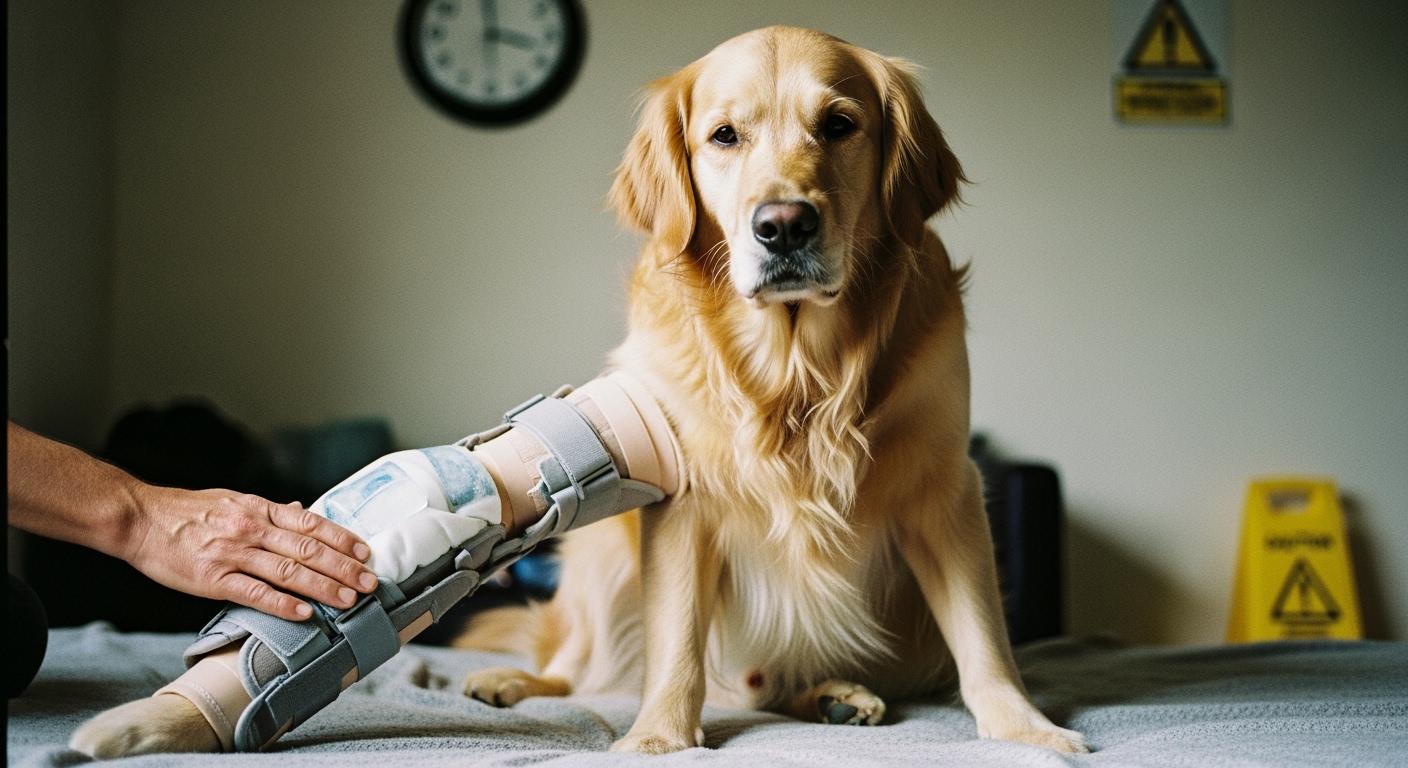
An ice pack slipped under a knee brace strap seems like a straight upgrade — cold where it counts, compression where it is needed. The problem is that brace straps are tensioned for one thickness, and a gel pack adds another few millimeters that redistribute that tension instantly. The dog knee brace with ice pack use boundary is not about session length alone. It starts at the moment the pack enters the brace and changes the pressure map under every strap. That added thickness concentrates force at the strap edges. Under body-temperature skin, cold triggers vasoconstriction. Under a compressed strap edge, the same cold reduces blood flow that is already mechanically restricted. The two conditions multiply each other. A pressure level that would leave a temporary red mark on warm skin can produce a full-thickness cold burn when circulation is halved. This is not a theoretical edge case — it is the default when a flat pack sits under a tensioned strap with no contouring pocket to distribute the load. The boundary is not a timer. It is a set of structural conditions: how the pack sits, whether the brace can accommodate its thickness without re-tensioning, and whether the dog is stationary or moving. Understanding those conditions matters more than memorizing session lengths.
Where the Use Boundary Fails First
Most failure signals appear within the first five minutes, but they are easy to miss if you are only watching the dog’s face. The earliest sign is at the strap edge — not under the pack itself. When a gel pack sits inside a knee brace without a structured pocket, strap tension no longer distributes across the full strap width. Force concentrates at the edge where the strap bends over the pack. That edge becomes a linear pressure point. On short-coated dogs, you can see it: after five minutes, lift the strap and look for a defined line of paler skin running parallel to the strap edge. If that line is visible, the pressure under that edge is already above what skin tolerates safely during cold exposure. Remove the pack and let the skin return to normal color before re-fitting the brace for movement. This is the difference between a knee support brace designed for stability and recovery — where strap geometry is calculated for joint alignment — and an improvised cold-delivery system where the same straps now do double duty as pack retainers. A brace strap is not a cold-pack fastener. Asking it to be both changes the fit equation that the brace was sized for. The second failure point is pack migration. Without a pocket, the gel pack drifts. A dog shifting weight from hip to hip while resting can slide the pack a half-inch laterally in under three minutes. That half-inch means the cold zone moves off the joint capsule and onto soft tissue that does not benefit from icing — while the original target area is now under an un-cooled strap. You can verify this by marking the pack edge position with a small piece of tape on the brace fabric at the start of the session, then checking whether the pack has moved relative to that mark after five minutes. Movement of more than a quarter-inch means the retention method is not adequate for that dog’s resting posture.
| Failure setup | Why it fails | Safer structure or routine |
|---|---|---|
| Loose ice pack under straps | Strap tension concentrates at pack edge, creating a linear pressure band | Removable pocket with soft lining that distributes force across its full surface |
| Pack used while walking | Brace fit geometry designed for joint alignment, not for added thickness under load | Cold therapy only during supervised rest |
| Pack pressed behind the knee | Hard gel edge against the popliteal fold where skin is thin and vessels are superficial | Rounded pocket edges with no rigid corners near the joint crease |
| Direct ice against skin | No thermal buffer; cold transfer rate exceeds tissue tolerance within 3-5 minutes | Fabric barrier or integrated sleeve between pack and skin |
| Cold session longer than 20 minutes | Sustained vasoconstriction under mechanical pressure produces ischemic conditions | 10-15 minute supervised session |
| Gel pack left inside after therapy ends | Ongoing low-grade pressure on cooled tissue without active monitoring | Remove pack immediately after session |
The third failure is gait alteration after pack removal. A brace that felt correctly fitted before the cold session may sit differently afterward. Cold temporarily stiffens the gel pack material and the dog’s periarticular soft tissue. When the pack comes out, the straps — which were tensioned over the pack-plus-leg volume — now sit looser by the thickness of the removed pack. A dog walking on a brace that is suddenly a few millimeters looser will adjust its stride. You can observe this: after removing the pack and refitting, watch the dog take ten steps on a hard floor. If the brace side stride shortens by more than a half-inch compared to the pre-session walk, the fit needs re-tensioning before any activity beyond a leash walk. This is why knee brace fit and traction during recovery depend on consistent strap tension. A brace that changes effective volume session to session cannot maintain the joint alignment it was positioned for.
| Signal level | What you see | What to do |
|---|---|---|
| Green | Calm dog, skin color unchanged at strap edges, pack position stable against reference mark, normal paw temperature | Continue routine |
| Yellow | Pale line at strap edge, pack shifted over ¼ inch from reference mark, dog turns head toward knee repeatedly, brace feels tighter than pre-session fit | Remove pack, check skin, reposition or shorten session |
| Red | Cold toes, blanched or blue-toned skin, swelling, worse limp after pack removal, chewing at brace, leaking gel, open skin, discharge, odor | Stop immediately, discontinue cold therapy, contact veterinarian |
When a Knee Brace With Ice Pack Makes Sense
Cold therapy through a knee brace is not useful across the full arc of recovery. It works in narrow, defined windows where the benefit of localized cooling outweighs the fit disruption it introduces. Outside those windows, the tradeoff reverses. The first appropriate window is the 72 hours after injury or surgery, when swelling is driven by acute inflammatory fluid shift rather than chronic joint effusion. During this phase, cold reduces metabolic demand in the tissue immediately around the joint capsule. But the window closes fast — once the swelling transitions from acute to subacute, cold constricts vessels that now need circulation for waste clearance. Continuing to ice past this point slows the cleanup phase without providing a meaningful anti-inflammatory benefit. The second window is post-activity, when the joint has been loaded through controlled walking or rehab exercise and micro-edema forms in the periarticular soft tissue. A 10-15 minute cold session after activity — with the dog fully resting, not standing or weight-shifting — can reduce that transient swelling. The key condition is that the dog must be stationary. Walking with a pack inside the brace does not deliver therapeutic cold; it delivers uneven pressure on a moving joint, which is a different thing entirely. A knee brace with hot and cold gel pack works within these windows only when the pack is in a structured pocket that holds its position without strap re-tensioning. If inserting the pack requires loosening and re-tightening straps, the fit reset introduces a new variable each session. Consistency of strap placement session-to-session matters as much as the cold itself, because the brace’s joint-stabilization function depends on predictable strap geometry.
Disclaimer: The fit checks described here — strap-edge skin inspection, pack-position marking, and post-session stride comparison — assume a short-coated dog where skin changes are visually accessible. Double-coated breeds may show subtler compression marks that require hand-checking rather than visual inspection. If the dog’s leg conformation falls outside the breed norms this brace was patterned for — particularly dogs with angular limb deformities, very deep chests that alter hind-leg stance, or dogs with significant muscle atrophy on the braced limb — the pressure distribution under a cold pack may differ from the patterns described here, and the standard boundary checks may not catch every pressure point.
What never works: icing overnight, icing while unsupervised, icing during transport, or using cold as a substitute for rest. A knee brace fit and daily use plan separates cold therapy from brace support as distinct processes with different rules. The brace stabilizes during movement. The cold pack works during stillness. Mixing the two produces an outcome that belongs to neither category.
Design Features That Create a Safer Use Boundary
Why a Gel Pack Can Shift Inside the Pocket
A dedicated pocket reduces the risks created by a loose pack, but it does not guarantee stable retention. The outer brace may remain aligned while the gel pack moves inside the pocket. In that situation, tightening the brace straps does not solve the underlying problem because the movement occurs between the insert and the pocket.
| Fit factor | How migration develops | What to verify |
|---|---|---|
| Pocket depth | A shallow pocket lets the pack lift or rotate; an oversized pocket leaves room for it to drop or fold. | The full pack sits inside the pocket without reaching the crease behind the knee or floating in unused space. |
| Pack thickness | A thicker or colder pack may bulge under a strap, while a thinner replacement pack may move inside the same pocket. | The pocket is validated with the intended pack dimensions and temperature condition. |
| Lining and condensation | A slick lining and moisture can reduce friction, allowing the pack to slide when the dog changes resting position. | The lining remains smooth, manages moisture, and provides enough surface control without creating pressure ridges. |
| Pocket closure | A loose opening allows the upper edge to rise or rotate around one retained corner. | The closure controls the pack without placing a bulky seam or exposed hook-and-loop edge against the leg. |
| Strap path | A strap crossing one side of the pocket can pull the compartment diagonally and rotate the insert inward. | The pocket retains the pack independently; the brace straps stabilize the brace rather than act as pack fasteners. |
Pack stability should be checked while the dog is resting and supervised. Normal walking should begin only after the gel pack is removed and the brace has been returned to its standard support fit. For product teams, this means evaluating the pocket, insert, lining, closure, and strap architecture as one controlled system rather than treating the gel pack as a universal accessory.
A removable pocket — as opposed to a loose pack slipped under straps — solves the pressure-concentration problem at its source. When the pack sits inside a sewn pocket, the strap bears on the pocket’s outer face, which distributes force across the entire pocket surface area. The pack inside floats within a defined compartment rather than creating its own edge against each strap. This is a manufacturing distinction that matters: a pocket with perimeter stitching creates a uniform load-spreading surface; a loose pack creates a variable number of pressure edges equal to the number of straps crossing it. For a typical three-strap knee brace, that is six linear pressure edges versus one distributed surface. Soft lining inside the pocket — typically a brushed knit or looped terry fabric rather than a slick nylon shell — provides two functions beyond comfort. First, it creates a slight friction coefficient that resists the gel pack’s tendency to migrate when the dog shifts weight during rest. Second, it absorbs condensation. A gel pack fresh from the freezer collects moisture from the air immediately; without an absorbent lining, that moisture pools against the skin inside a closed brace environment. Moisture plus pressure plus cold produces skin maceration faster than any of the three conditions alone. After a session, you can verify lining performance by touching the inner pocket surface — it should feel damp but the skin beneath should be dry. Rounded pocket edges prevent the hard-corner problem behind the knee. The popliteal region — the fold behind the stifle joint — has thin skin, superficial vessels, and a natural crease that traps any protruding edge. A rectangular gel pack with square corners will find that crease. A pocket with radiused corners and a flexible gel fill allows the pack to contour rather than impinge. This matters acutely for using hot and cold therapy with a cruciate ligament brace, where the therapy target is the front and sides of the joint, not the vessel-rich area behind it. Easy removal — a pocket that opens at the top or side without requiring strap disassembly — determines whether the cold session ends when it should or drags on because removal is inconvenient. If taking the pack out requires undoing and redoing three straps, the temptation to leave it in “just a few more minutes” is real. A top-loading pocket with a simple closure makes the end of the session a single motion. That design choice affects outcomes more than the gel formulation inside the pack ever will. A brace that accommodates these features tends to have a different strap architecture than a brace built purely for stabilization. The straps sit slightly wider, the shell has a dedicated pocket compartment rather than relying on strap retention, and the inner face uses materials selected for moisture management rather than grip alone. These are not interchangeable design philosophies — they represent different priorities in the manufacturing process. A brace designed for adjustable fit during break-in and activity management already accounts for volume changes across a wear cycle; adding a cold pack introduces another volume variable that the adjustment system must handle without losing joint alignment.
FAQ
How long should an ice pack stay inside a dog knee brace?
10 to 15 minutes, with the dog stationary and supervised. Longer sessions do not produce better anti-inflammatory effects — cold-induced vasoconstriction peaks within the first 10 minutes, and continuing beyond 15 adds tissue risk without additional therapeutic benefit. Remove the pack immediately after and check the skin at every strap edge before re-fitting for movement.
Can a dog walk with the ice pack inside the brace?
No. Walking introduces joint motion under altered fit geometry — the pack changes the effective internal volume of the brace, which shifts the hinge-to-joint alignment that the brace relies on for stabilization. Cold therapy requires stillness; brace support requires correct fit. Combining them under motion means neither function works as designed.
What is the earliest sign that the ice pack is causing a problem?
A defined pale or white line at the edge of any strap crossing the pack area. This appears before the dog shows discomfort and before skin texture changes. Lift the strap edge and check after five minutes. If the line is visible, the pressure under that strap is too high for cold-exposed tissue, and the pack should be removed.
Does the pack need a fabric barrier even inside a pocket?
Yes. The pocket’s outer fabric is the structural layer that distributes strap pressure; the inner layer that contacts skin needs a separate, softer material. If the pocket’s inner face is the same nylon or neoprene as the brace shell, add a thin cotton layer between pocket and skin. Condensation on a non-absorbent surface accelerates skin breakdown under pressure.
