
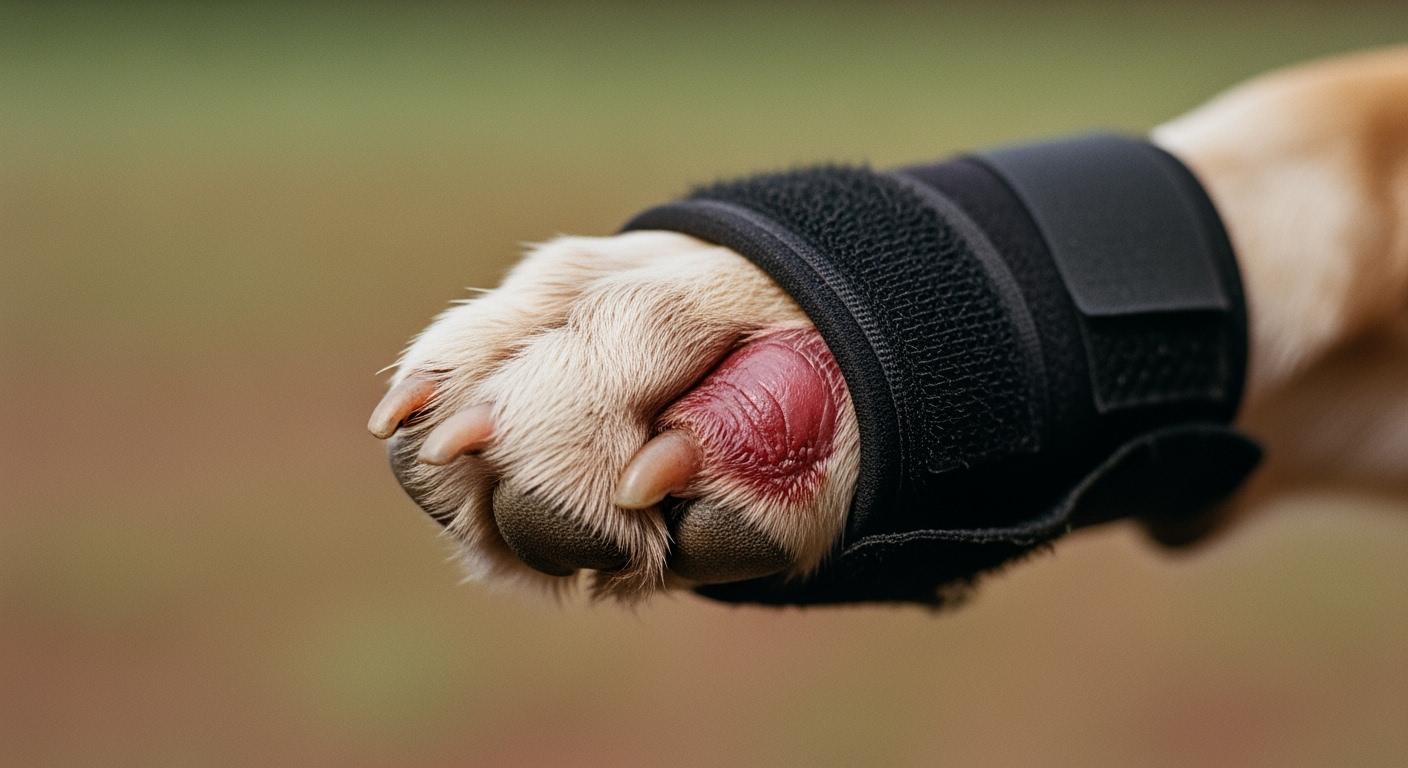
You pull the toe strap tighter, hoping to stop the paw from dragging. Fifteen minutes into the walk, the toes look swollen. The nails spread apart. A deep red crease sits where the strap crossed the skin. And the paw still drags. This is what happens when a dog knuckling brace toe strap is too tight: more tension did not produce more lift. It produced compression. Compression applied through a narrow strap wrapped around small toes creates a set of failures that tightening only accelerates — and that no amount of additional tension can reverse.
Why Tightening the Toe Strap Feels Like Support but Creates a Different Force
A strap pulled tight applies circumferential force. The force vector wraps around the toe cluster, squeezing inward — perpendicular to the skin surface. Toe lift requires a different vector entirely: upward, parallel to the leg axis, pulling the paw toward a neutral walking position. These two force directions are not interchangeable, yet the instinct to tighten treats them as if they were.
When you increase strap tension, you increase radial compression on the digital vessels. A narrow strap under moderate hand tension easily exceeds the pressure needed to slow venous return. Blood flow drops. Tissue fluid accumulates in the interstitial space — swelling. That swelling itself increases internal tissue pressure, which the strap now compresses against. Tighten → compress vessels → swell → tighter effective fit → more compression. The toes grow larger and more vulnerable while the paw continues to drag. That is not lift. That is a tourniquet.
Knuckling itself is a neurologic signal — the brain and limb have lost smooth communication, and the paw folds under during walking. A strap cannot restore nerve conduction any more than it can regenerate a spinal pathway. What the brace can do is guide the paw into a functional position so the dog clears the ground. But that guidance requires an upward force vector distributed across enough surface area to stay below tissue-damage thresholds. The distinction matters because it determines whether the brace helps or harms.
Observable check: After 20 minutes of wear, remove the brace and press a fingertip against the skin where the strap sat. If the skin blanches white and stays white for more than 2–3 seconds before pink returns, capillary refill is delayed — circulation is compromised. Compare to the same spot on the opposite paw. A healthy paw refills in under 1 second. This single check separates compression from lift faster than any spec sheet can.
| What you see | Likely failure | Why tightening makes it worse | Better design response |
|---|---|---|---|
| Swollen toes within 15–30 minutes | Venous return restricted by strap compression | More tension increases radial squeeze on digital vessels | Wider padded toe contact distributing force across more skin area |
| Deep strap crease lasting >20 minutes after removal | Narrow strap path concentrating load on a thin contact line | Sharp edge pressure exceeds tissue recovery threshold | Rounded edge profile, soft lining with low-friction inner face |
| Toe drag still happening despite high strap tension | Force vector is compressive, not lifting — direction is wrong | Additional tightening increases compression, not upward force | Adjustable multi-point tension with stable upper anchor maintaining lift-line alignment |
| Dog chews at the strap or freezes mid-walk | Pain or nerve compression from excessive local pressure | Dog attempts to remove the source of discomfort | Softer contact material, broader force distribution, shorter initial wear sessions |
| Brace rotates sideways during walking | Loose or unstable upper anchor allowing rotation under load | Asymmetric strap pull shifts the lift line off-axis | Anti-rotation anchor zone keeping the lift vector centered through the gait cycle |
Structural Reasons Toe Straps Fail in Knuckling Braces
A strap that looks fine on a product page can fail within the first half-hour of walking. The failures are structural — they start in the geometry of the strap path, the stability of the anchor, and the distribution of work between the strap and the sole. Understanding where each one breaks down makes the difference between a brace that supports and one that injures.
Narrow Strap Path Concentrates Force on a Thin Contact Line
A strap that is 8 millimeters wide concentrates the entire lifting force onto an 8-millimeter band of skin. When the dog places weight on the paw during walking, ground reaction force travels up the leg and meets the strap’s resistance at that narrow contact line. The force per unit area scales inversely with strap width — halve the width, double the pressure. A narrow strap also acts as a pivot point. Lateral forces during turning or uneven ground cause the strap to roll at its edges. That rolling motion creates shear stress in the skin layers, which produces friction blisters and skin breakdown faster than pure compression alone. Wider padded contact zones distribute the same lifting force across more square centimeters of skin. The force per unit area drops, the edge pressure drops, and the rolling tendency drops — all from a geometric change that costs nothing in lift effectiveness.
Upper Anchor Rotation Redirects the Lift Vector Away From Vertical
The toe strap does not work in isolation. It pulls against an upper anchor — a cuff or strap higher on the leg. When that anchor rotates under load, the lift line tilts off-axis. Instead of pulling the paw straight up, the strap now pulls diagonally. That diagonal force has a smaller vertical component — less actual lift — and a new horizontal component that drags the strap across the skin. You feel the brace shifting. The paw still drags. The natural response is to tighten the toe strap to compensate for the lost vertical lift. But tightening cannot correct a vector problem. It only increases the magnitude of a force that is now pointing in the wrong direction. The fix is an anti-rotation anchor zone — a wider, shaped upper contact that resists twisting during the stance phase of gait.
Missing Sole Grip Forces the Strap to Carry the Entire Workload
A smooth sole on a hard floor leaves the paw with nothing to push against. Each step produces a micro-slide — the paw skids forward a few millimeters as weight transfers onto it. The only structure resisting that forward slide is the toe strap. So the strap tightens dynamically with every step, jerking against the toes at each footfall. Over hundreds of steps, this repetitive micro-trauma produces swelling and pain that no static fit check would predict. A sole with traction zones or a grip patch absorbs the forward shear, reducing the peak load on the strap by sharing the work between two structures — the sole resists sliding, the strap guides lift. When only one structure does both jobs, it fails faster.
Observable check: Walk the dog on a hard floor for 10 minutes. Mark the upper anchor position with a small piece of tape at the start. After 10 minutes, measure whether the anchor has shifted more than half an inch. Rotation or downward slide means the lift line is no longer vertical — the toe strap is now pulling at an angle, and that angled pull creates shear stress that produces blistering and strap chewing faster than pure compression.
| Weak design | Better structure/material | Performance difference | Main limitation |
|---|---|---|---|
| Thin narrow toe loop | Wider padded toe contact panel | Pressure per unit area drops; edge digging eliminated | Wider panels need breathable material to avoid heat buildup |
| Single pull point anchored mid-leg | Multi-point adjustable tension with anti-rotation cuff | Lift line stays vertical through gait; less compensation-tightening | Multi-point systems require more careful initial setup |
| Smooth flat sole | Traction outsole or textured grip patch | Forward slide reduced; peak strap load cut by sharing shear-resistance work | Aggressive tread patterns may collect debris on rough terrain |
| Hard unlined strap edge | Rounded edge profile with soft inner lining | No sharp pressure lines; friction reduced at the edge boundary | Soft linings require regular cleaning to prevent bacteria buildup |
| Single-axis upper cuff | Shaped anti-rotation anchor zone | Stable lift throughout stance phase; reduces sideways brace migration | Dogs with unusual leg taper may still need fit adjustments |
Better Strap Design That Works Without Relying on Compression
Wider Padded Contact Spreads the Load Across More Skin
Moving from a thin strap to a wider padded contact panel changes the physics: the same lifting force now distributes across three to four times the surface area. Peak pressure under the contact zone drops proportionally. The edge — the part that digs in and leaves creases — becomes a rounded transition rather than a sharp cutoff. Breathable padding addresses a secondary problem: trapped heat and moisture soften the skin’s outer layer, making it more vulnerable to friction damage. A contact zone that stays cooler and drier under load maintains skin integrity across longer wear sessions, which matters for dogs that need the brace for multiple walks per day.
Adjustable Multi-Point Tension Keeps the Lift Line Stable
A single pull point creates a single load path. If that path misaligns with the dog’s paw geometry — and paw geometry varies across breeds more than most sizing charts capture — the lift force pulls at an angle from the start. Multi-point adjustable tension lets the force enter the paw through two or three distributed attachment points. Each point carries a fraction of the total load. The lift line can be tuned to match the dog’s specific toe alignment rather than forcing the paw to conform to the strap. Getting this alignment right during the first fit session prevents the cascade of compensation-tightening that turns a brace into a compression device.
Traction Zones Share the Workload With the Strap
A sole with grip zones addresses the micro-slide problem at its source. When the paw can push against the ground without skidding forward, the strap is not jerked tight with each step. The peak dynamic load on the toes drops because the sole absorbs the horizontal shear component that a smooth sole would transmit directly to the strap. A knuckling brace with integrated traction splits the job into two independent mechanisms — one for ground contact stability, one for paw guidance — rather than asking a single strap to handle both. When two structures share one job, neither operates at its failure limit.
Soft Lining and Rounded Edges Protect Skin During Repeated Use
Hard strap edges concentrate bending stress at the material-skin boundary. Each step flexes the strap slightly, and at that flex point, the edge digs in — not enough to cause immediate pain, but enough to produce cumulative friction damage over hundreds of steps. A rounded edge profile eliminates the sharp boundary. A soft, low-friction inner lining reduces the shear transmitted to the skin surface when the strap does move slightly during gait. These are small differences in material specification that compound into large differences in skin tolerance over weeks of daily wear.
When to Stop Using the Brace and Reassess the Approach
Some signals mean the current brace setup is not working — and that no amount of adjustment will make it work for this dog. Recognizing those signals early prevents skin breakdown, behavioral aversion to the brace, and setbacks in mobility.
Red Signs That Require Immediate Pause
Stop use immediately if you see: swollen toes that stay puffy after brace removal, toes that feel cold to the touch compared to the opposite paw, deep strap creases lasting beyond 30 minutes, purple or blue discoloration of the nail beds or toe pads, the dog freezing, refusing to walk, or chewing through the strap, or limping that is worse with the brace than without it. These are not minor fit issues. They indicate that the brace is applying force at a magnitude or direction that exceeds tissue tolerance — and continuing to wear it under those conditions leads to skin ulcers and nerve compression that can take weeks to resolve, far beyond the original knuckling concern.
Disclaimer: This check assumes a short-coated dog where skin color changes and strap marks are visible on inspection. Double-coated or very thick-furred breeds may show subtler rub marks that require hand-checking rather than visual inspection — run your fingers along the skin surface under the coat at each strap contact point. If the dog’s leg conformation falls outside typical breed norms this brace was patterned for — particularly dogs with angular limb deformities, very deep chests affecting forelimb angle, or significantly asymmetric paw size between left and right — the fit checks described here may not catch every pressure point. In those cases, shorter initial wear sessions and more frequent skin checks are warranted.
When a Different Brace Structure May Be the Safer Choice
A dog that shows red signs on the first walk with a narrow-strap design is unlikely to adapt to it. The problem is not the dog. The problem is the force-distribution geometry. Switching to a brace with wider padded toe contact, multi-point tension, and a traction sole changes the physics — lower peak pressure, stable lift line, distributed workload. That geometry works with the dog’s anatomy instead of fighting it. If the dog has open wounds, severe pre-existing swelling, or a history of chewing through braces, a toe-loop design of any kind may not be appropriate. In those cases, a different support pathway — one that does not apply force directly across the toes — is the safer starting point.
FAQ
How quickly can a too-tight toe strap cause visible damage?
Swelling and deep strap creases can appear within 15 to 30 minutes of walking. Skin that stays compressed beyond its capillary refill threshold begins accumulating interstitial fluid almost immediately. The damage window is shorter than most wear schedules assume — which is why the first supervised session matters more than the product description.
Why does my dog still drag the paw even with the strap pulled as tight as it goes?
Because the strap is applying compression, not lift. When the upper anchor rotates or the strap path is too narrow, the force vector points diagonally or radially inward rather than vertically upward. Tightening increases the magnitude of a misdirected force. The paw drags because the vertical component of the force is too small to clear the ground — not because the strap is too loose.
What is the single most reliable check for safe strap tension?
The capillary refill test: remove the brace after 20 minutes, press the skin where the strap sat, and time how long the white blanched spot takes to return to pink. Over 2–3 seconds means tissue perfusion is compromised. This test works regardless of strap brand, material, or dog size — it measures what is happening in the tissue, not what the product claims.
Can I use the same brace on both front and hind paws?
Front and hind paw geometry differs — the angle of the pastern versus the hock changes the effective lift-line alignment. A brace designed for a hind-limb knuckling pattern may sit at a different angle on a front limb, altering the force vector enough to create a pressure point that did not exist on the hind leg. Check fit separately for each limb, and do not assume symmetry.
How do I know whether the problem is the strap or the anchor?
Mark the anchor with tape before a 10-minute walk. If the anchor has shifted more than half an inch after walking, the problem originates at the anchor — rotation there redirects the strap’s pull off-axis. If the anchor stays put but the toes still show redness or swelling, the problem is at the strap level — likely a contact area that is too narrow or a material edge that is too sharp.
