
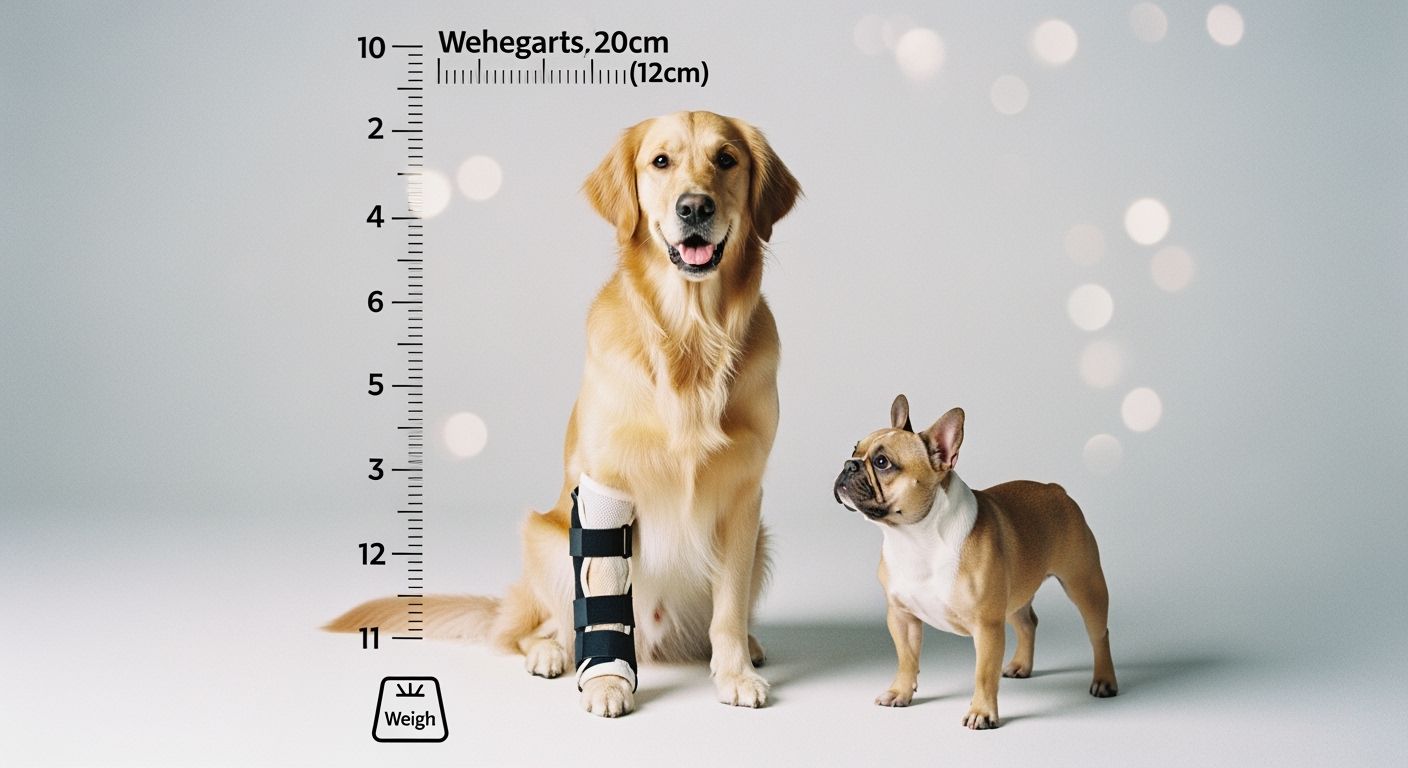
A dog leg brace sizing chart by breed and weight is not a final fit assignment. For a brand developing or sourcing canine orthopedic supports, breed and weight can narrow the likely size range, but joint circumference, brace length, and body proportion must confirm the final selection. The chart also affects SKU count, inventory planning, packaging variants, and the dimensional controls a supplier must follow.
Before committing to samples, product teams need a sizing framework that explains what breed and weight can indicate, where those inputs become unreliable, and which joint-specific measurements control the finished brace size.
What a Sizing Chart Locks In Before Production Begins
A sizing chart sets commercial decisions that affect procurement, inventory planning, and wholesale support before the first production run. Each size band becomes a separate SKU with its own production, packaging, and warehousing requirements. Adding left- and right-leg variants or different support structures can multiply that SKU count further.
Breed and weight are useful screening inputs because they help estimate body frame and likely demand by size tier. They are not reliable final measurements. Two dogs at the same weight may have different limb lengths, joint circumferences, and muscle distribution. Dogs within the same breed can also fall outside the expected body proportions.
| Screening Input | Commercial Use | Limitation | Final Confirmation |
|---|---|---|---|
| Breed or body type | Helps estimate likely frame and limb proportion | Individual dogs and mixed breeds can vary substantially | Joint circumference and brace length |
| Body weight | Helps narrow the likely size band and plan inventory | Does not show where body mass is distributed | Measurement at the target joint |
| Front- or hind-leg application | Identifies the relevant product family | Different joints on the same leg require different patterns | Joint-specific reference points |
| Body proportion | Helps resolve overlap between adjacent sizes | Cannot be represented accurately by weight alone | Circumference, length, and intended joint position |
Weight ranges may overlap between adjacent size bands because real body proportions do not divide into clean categories. A dog near a boundary may need one size for circumference and another for length. The chart should state which measurement has priority and when the case falls outside the standard grading system.
For wholesale ordering guides and product pages, the sizing workflow should therefore use breed and weight for preliminary screening, followed by joint-specific measurement confirmation. This distinction also determines which diagrams and instructions must appear on packaging and distributor materials.
Supplier check: Ask why adjacent size bands overlap and which anatomical reference points define each boundary. A chart that lists sizes without explaining the grading logic does not provide enough information for sample approval or production control.
Why Every Joint Requires Its Own Sizing Chart
Each target joint requires its own measurement reference points and sizing chart. A stifle brace, hock brace, carpal brace, and elbow brace wrap different anatomical structures and must remain aligned around different movement points. Applying one unified size matrix across all joint types can produce a nominal circumference match while placing the support area or product edge incorrectly.
A knee brace may use upper-leg circumference and knee-to-hock length to control joint position. A hock brace normally needs measurements above and below the joint because the lower leg tapers toward the paw. A carpal brace must account for paw clearance. A bilateral elbow design may also require torso-related measurements that do not apply to rear-leg products.
| Brace Category | Primary Measurements | Secondary Inputs | Common Sizing Error |
|---|---|---|---|
| Knee or stifle brace | Upper-leg circumference and knee-to-hock length | Lower-leg circumference, body weight, left or right side | Using weight without confirming joint or hinge position |
| Hock or tarsal brace | Circumference above and below the hock | Hock-to-paw height and intended coverage | Selecting by total leg length without confirming the joint location |
| Carpal or wrist brace | Circumference above and below the carpus | Distance from the carpal pad to the paw | Extending the brace too low and interfering with paw movement |
| Elbow brace | Upper-leg circumference and elbow-to-carpus length | Chest width and bilateral strap distance | Ignoring torso dimensions in a two-leg configuration |
A product line covering several joint types is therefore managing separate measurement diagrams, graded patterns, sample sets, packaging instructions, and SKU matrices. This should remain visible in the technical documentation rather than being compressed into one generic dog leg brace chart.
Sourcing note: A supplier should be able to explain why each joint uses different reference points and how a change in sleeve depth, strap angle, or coverage affects the size system. That explanation is more useful than a chart limited to Small, Medium, and Large.
Validating a Size Chart Across Body Types and Production Batches
A size chart that works in a spreadsheet still needs physical validation across different body frames. Compact builds, long-limbed dogs, heavy-boned large dogs, and mixed breeds can expose different fit problems even when their weights fall within the same published band.
Construction samples should first confirm seam placement, closure range, strap position, and finished dimensions against the specification. Revised samples should address observed rotation, bunching, edge pressure, or incorrect joint position. Once approved, a retained sample can serve as the physical reference for later production inspections.
Fit observation should include standing, walking, turning, sitting, and resting. A brace that appears aligned while the dog is standing may shift behind the joint during movement or bunch when the dog lies down. These observations help separate a size-selection problem from a pattern, strap-layout, or material-response problem.
| Quality Metric | Reference | Inspection Method | Release Requirement |
|---|---|---|---|
| Sleeve circumference | Approved technical specification | Flexible tape measurement at defined points | Within the supplier-approved dimensional tolerance |
| Brace length | Graded pattern and approved sample | Flat measurement between fixed reference points | Maintains the intended joint and edge position |
| Strap length and angle | Pattern specification | Flat measurement and closure-range check | Provides the approved adjustment range without distortion |
| Material response | Approved material specification | Incoming-material and production-batch comparison | Matches the range confirmed during sample approval |
| Finished-product alignment | Approved retained sample | Side-by-side construction review | No unapproved shift in joint position, seam placement, or coverage |
The exact dimensional and material tolerances must be confirmed in the technical pack for the selected construction. They should not be copied from another brace category or presented as universal values. A small sleeve, a hinged knee brace, and a multi-strap elbow support do not respond to dimensional variation in the same way.
Before locking the chart for production, product teams should confirm that breed and weight are used only to narrow the likely range, that each brace category has defined measurement reference points, that overlap cases have a clear resolution rule, and that finished products are inspected against approved specifications and retained samples.
Brands evaluating a leg-support range can compare this framework with the measurement logic on the dog leg brace solutions page and the available dog leg brace product specifications. For knee-specific measurement workflows, the dog knee brace fit and sizing guide provides a narrower reference.
