
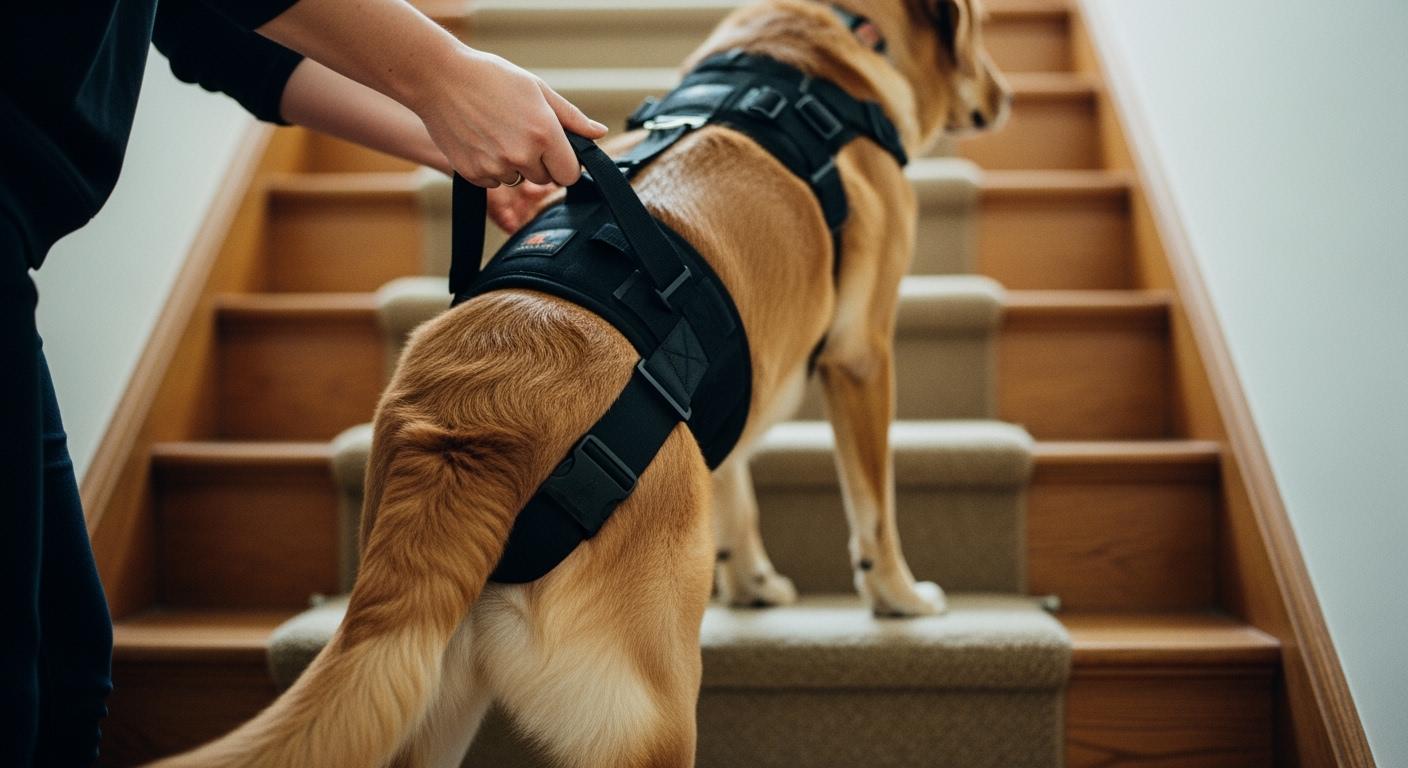
A dog lift harness for stairs should help the handler guide the dog without tipping the body forward, pulling unevenly, or suspending the dog from the handles. Stair use changes the dog’s balance point from one step to the next, so handle position, support-zone alignment, harness fit, and the amount of upward assistance all matter.
This guide focuses on lift-harness handle control after stair use has already been considered appropriate for the dog. For surgery-specific activity restrictions, recovery timing, and warning signs, see the dog stairs after surgery guide. For a broader comparison of front, rear, and full-body lifting support, start with the dog support sling guide.
- Sudden loss of balance during step-up or step-down movement
- Uneven loading through the chest, shoulders, abdomen, or hips
- Harness rotation, strap migration, or support panels moving away from the intended lift zone
- Excessive upward force that changes the dog’s natural step pattern
A suitable dog lift harness for stairs should remain centered under light assistance, match the body area that actually needs support, and allow the dog to place each foot without being pulled off balance. Dogs with weak hind legs may need a different setup from dogs that require front-and-rear assistance. The dog lift harness solution for hind leg weakness explains how support needs can differ across walking, bathroom breaks, transfers, and stairs.
Key Takeaways
- The correct handle position depends on whether the harness is designed for rear, front, mid-body, or full-body support.
- A harness that shifts, twists, crowds the shoulders, or slides toward the abdomen is not stable enough for stair assistance.
- The handler should provide only the amount of lift needed to steady the dog, not carry the dog’s full weight through the handles.
- Stop stair use if the dog tips, drags a foot, freezes, vocalizes, shows sudden weakness, or cannot remain level with light support.
Handle Control in a Dog Lift Harness for Stairs
Why the Intended Lift Zone Matters
There is no single handle position that works for every dog or every harness. A rear-support harness should transfer assistance through the pelvis or hindquarter support panel. A front-support harness should load the chest area without pulling across the throat or shoulders. A full-body harness should distribute light assistance across both ends without forcing the dog into a nose-up or rear-up posture.
If the handler grips a point that is too far from the intended support zone, the harness may rotate or pull the body out of alignment. Before using stairs, apply gentle upward tension on level ground and check whether the dog remains level, the panels stay centered, and the straps remain flat.
Tip: Use the handle connected to the body area the harness is designed to support. Do not lift from a leash ring, decorative loop, or attachment point that is not intended to carry lifting force.
Signs of Poor Handle Control
Poor handle control may show up as a change in the dog’s body position or step pattern rather than an obvious equipment failure. Watch for:
- The front feet sliding forward while the rear is lifted too high
- The shoulders rising while the hindquarters lag behind
- The harness rotating toward one side or moving toward the abdomen
- Shortened, irregular, or missed steps after upward tension is applied
- The handler needing continuous heavy lifting to keep the dog upright
These signs indicate that the support zone, fit, harness type, or stair plan needs reassessment. Increasing lifting force is not a substitute for correcting an unstable setup.
Handle and Support Features to Check
| Feature | What to Check |
|---|---|
| Dedicated lift handle | The handle is attached to a reinforced support area rather than only to a leash ring. |
| Support-panel position | The panel sits under the intended chest, mid-body, pelvic, or full-body support zone. |
| Adjustable straps | Straps can be adjusted without crowding the shoulders, rubbing behind the elbows, or sliding toward sensitive areas. |
| Front-and-rear handles | Separate handles allow balanced assistance when both ends need support, provided the handler can coordinate them. |
| Handle length and grip | The handler can stand close enough to guide the dog without stooping excessively or pulling from a delayed angle. |
For an example of a front-and-rear support layout, review the lift harness for front and hind legs. Use the product structure as a comparison point rather than assuming every dog needs full-body assistance.
Support Balance and Harness Selection
Rear, Front, and Full-Body Support
A rear-support setup may be appropriate when the hind legs need assistance but the front legs remain steady. Front support may be needed when the shoulders or front limbs cannot control the step safely. Full-body support may be considered when weakness affects both ends or when rear-only lifting causes the body to tip.
The more support zones a harness uses, the more important coordination becomes. Two handles do not automatically create better control. They must remain aligned with the dog’s body, and the handler must apply similar timing without pulling one end higher than the other.
Fit Checks Before Stair Use
- Center the support panels under the intended body areas.
- Confirm that straps lie flat and do not press into the armpits, groin, incision area, or throat.
- Apply light upward tension on level ground and check for rotation or strap migration.
- Watch the dog take several level-ground steps before approaching the stairs.
- Recheck the skin after use for redness, hair disturbance, moisture, or pressure marks.
A harness that fits while the dog is standing may still shift when upward tension is applied. Always test the loaded fit on level ground first.
When a Different Support Plan May Be Needed
| Observation | What It May Indicate |
|---|---|
| Tipping or swaying | The current support zone may not provide enough front-to-rear balance. |
| Harness sliding or rotating | The fit, strap routing, or harness shape may not match the dog’s body. |
| Heavy continuous lifting required | The dog may need a different mobility plan, a second handler, a ramp, or avoidance of stairs. |
| Sudden pain, dragging, collapse, or new weakness | Stop stair use and seek veterinary guidance rather than continuing to adjust the harness. |
Some dogs need a different harness layout, a second handler, a ramp, or complete stair restriction. The harness should not be used to push through pain, sudden neurological changes, panic, or loss of limb control.
Using Lift Harness Handles Without Over-Lifting on Stairs
Handle Position and Grip Sequence
- Confirm that stair use is appropriate for the dog and that the stair surface provides adequate traction.
- Position the harness and test light upward tension on level ground before approaching the stairs.
- Stand close enough to keep the handle nearly vertical above the intended support zone rather than pulling backward from a distance.
- Apply only enough assistance to steady the dog and help complete the next step. Do not lift the dog clear of the stair unless the equipment and handling plan are specifically designed for carrying.
- Pause after each step if the dog needs time to place the feet and regain balance.
- When two handlers are required, agree on simple cues such as “ready,” “lift,” “step,” and “stop” before moving.
The IVDD dog lift harness guide provides additional context on straight-line assistance, transfers, and avoiding twisting during controlled movement. Follow the dog’s individual veterinary restrictions rather than using a general mobility routine as a substitute.
How to Recognize Over-Lifting
Over-lifting occurs when the handler changes the dog’s body position instead of simply supporting balance. Common signs include:
- The dog hangs from the support panels instead of placing weight through the feet.
- The pelvis rises above the shoulders or the shoulders rise above the pelvis.
- The feet slide, swing, cross, or miss the stair edge after tension is applied.
- The dog shortens the stride, stiffens, or resists moving forward.
- The handler must keep pulling upward continuously rather than providing brief assistance at each step.
If these signs appear, reduce the lift, return to level ground if possible, and reassess the fit and support plan. Do not compensate by tightening straps excessively.
Common Handle-Control Errors
| Error | Safer Adjustment |
|---|---|
| Pulling from a leash attachment | Use only a reinforced handle or attachment identified for lifting support. |
| Standing too far behind the dog | Move closer so the lift is directed through the intended support zone. |
| Raising one end too high | Reduce upward force and keep the body as level as the dog’s condition allows. |
| Continuing after the harness shifts | Stop, return to stable ground, and reposition the harness before continuing. |
| Handling a large unstable dog alone | Use a second trained handler or a different access plan when one person cannot maintain control. |
Pre-Use and Post-Use Checklist
- Confirm that stair use is allowed under the dog’s current care plan.
- Check the harness for damaged stitching, worn handles, loose buckles, or twisted straps.
- Test the loaded fit on level ground.
- Use a stable, non-slip stair surface and keep the route clear.
- Support only as much as the dog needs to remain balanced.
- Stop if the dog tips, sways, drags a foot, freezes, vocalizes, or shows sudden weakness.
- After use, inspect the skin and check whether the harness moved away from the intended support zone.
If you need to compare rear-support and full-body product layouts, review the dog lift harness range. For a wider recovery-support pathway across braces, lifting aids, anti-lick protection, fit checks, and related guides, visit the Dog Recovery Support Guide.
FAQ
How do you use handle control on stairs with a dog lift harness?
Grip the reinforced handle connected to the intended support zone, stand close to the dog, and apply only enough upward assistance to maintain balance. Pause between steps when needed and stop if the harness rotates or the dog’s body tips.
Where should the lift handle sit?
The correct location depends on the harness design. Rear handles should transfer assistance through the hindquarter support area, front handles through the chest support area, and full-body handles through their respective front and rear zones. The handle should not be selected only because it sits near the dog’s middle.
Can you use any dog lift harness for stairs?
No. The harness should have stable body coverage, an appropriate support zone, reinforced lifting handles, and a fit that remains centered under light tension. An ordinary walking harness with a grab handle may not provide suitable lifting support.
How can you tell if a lift harness is over-lifting your dog on stairs?
Possible signs include the rear rising above the shoulders, the front feet sliding forward, the dog hanging from the support panels, irregular steps, or the handler needing continuous upward force. Reduce the lift immediately and reassess the support zone, harness fit, and whether stair use remains appropriate.
What should you do if your dog still struggles with a harness?
Stop stair use if the dog tips, freezes, panics, drags a foot, vocalizes, or cannot remain level with light support. A different harness layout, a second handler, a ramp, or stair avoidance may be more appropriate. Sudden pain, collapse, or new weakness requires veterinary guidance.
