
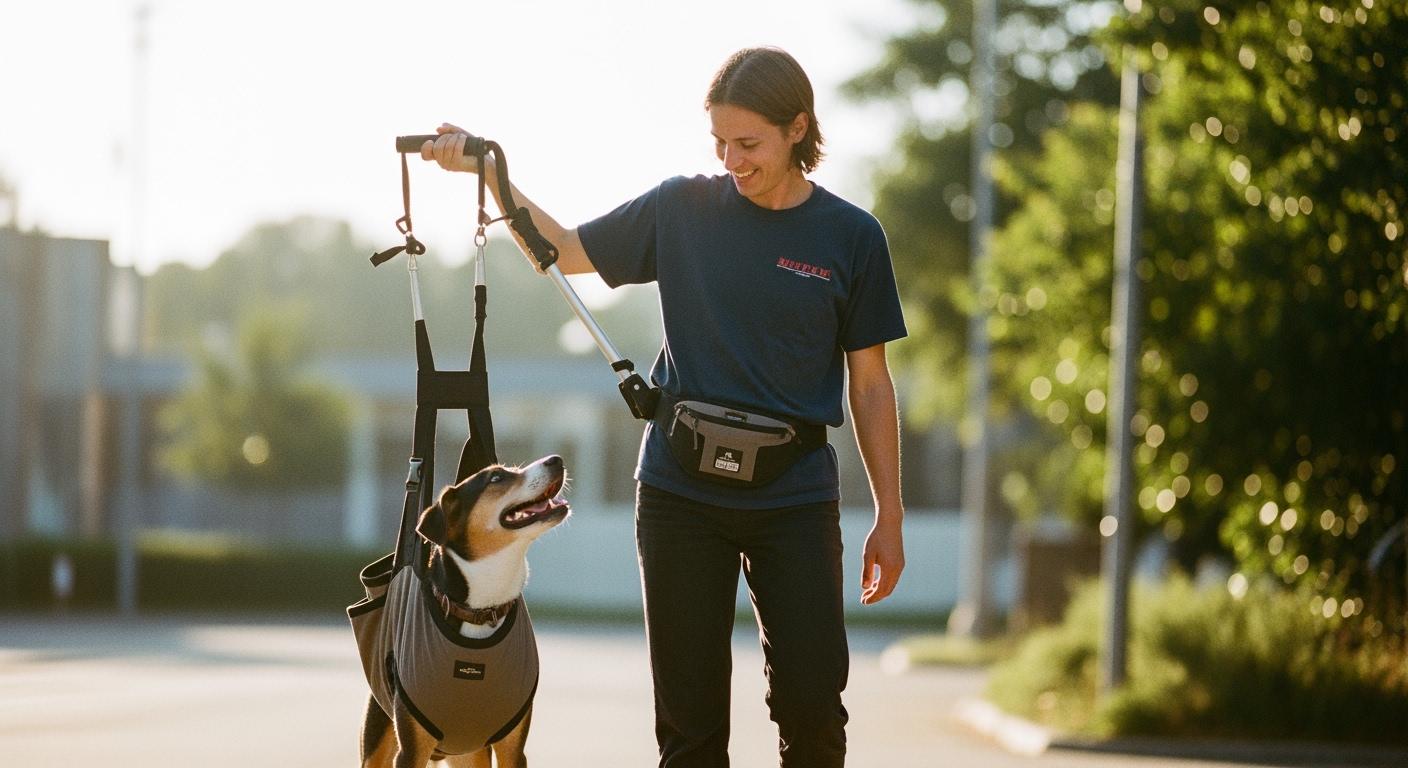
A handler over six feet tall reaches down to grip the handle of a hindquarter sling. The dog is positioned, the rear panel is in place. But the handle sits at a height designed for someone five-foot-eight. To reach it, the handler bends forward at the waist. That bend changes everything.
The lift vector tilts. The rear panel shifts. The dog redistributes weight onto limbs that may not be ready to take it. This is not a comfort complaint. It is a mechanical mismatch between handle length and handler height, and it produces failures that look like dog instability but are actually built into the sling at the design level.
What Handle Height Changes About the Lift
A hindquarter sling is a force-transfer device. The handler’s hand applies upward force through the handle, into the strap or webbing, and finally into the rear support panel under the dog’s hips. When the handler stands upright with elbows close to the ribs, the force vector points nearly straight up. The panel distributes that vertical lift across the rear underside.
When a tall owner must reach down to a fixed-length handle, the geometry changes. The hand is ahead of the shoulder instead of below it. The force no longer travels vertically. It travels diagonally—upward and forward. That off-axis input converts a portion of the intended lift into forward shear on the panel.
Here is the causal chain: diagonal pull shifts the rear panel toward the belly. The effective support zone under the hips narrows. The dog shifts weight onto the thoracic limbs to compensate. If those limbs are weak, front-leg trembling or buckling follows. A handle-height mismatch at the grip end cascades straight through to joint loading at the dog’s end. None of it is the dog’s fault. None of it is poor handling. Fixed handle length is fighting handler height.
Dogs with hind-leg weakness benefit from rear lift support, but only if the lift vector stays close to vertical. The moment it turns diagonal, the support becomes a destabilizer.
Too short: the panel shifts, the front legs pay
A handle that is too short forces the tall owner into a forward-leaning posture. In that position, the arms do not lift—they pull. The rear panel, designed to sit square under the ischial tuberosities, now receives force at a forward angle. If the panel lacks a high-friction inner surface or sufficient width to resist rotation, it begins to migrate.
Watch for this: after 10 assisted steps on flat ground, stop and check whether the rear panel is still centered under the hip bones. Mark the panel’s starting position against a bony landmark—the greater trochanter, for instance. If it has crept forward more than half an inch, the handle height or panel design is failing. That is observable, not subjective.
As the panel slides forward, the support zone under the hips narrows. The dog compensates by loading the front legs more heavily. In a dog with arthritis or recovering from surgery, this load shift can trigger trembling, buckling, or refusal to move forward. The handler interprets it as the dog being uncooperative or too weak for assisted walking. The sling itself redirected the load onto the wrong set of limbs.
This failure mode is most visible in the 30-second standing hold. Support the dog on flat ground and watch the topline from the side. A level back means the lift vector is close to vertical. A back that slopes downward toward the front—withers lower than hips—means the rear is being lifted more than the front can counterbalance. The handle is likely too short, putting the panel into forward migration and dumping weight onto the forelimbs.
In practice: The standing-hold test reveals the mismatch before the dog takes a single step. If the topline is not level within 30 seconds of support, stop and adjust. A dog that cannot hold a level topline under static rear support cannot walk safely under it.
Too long: delayed force, rear sway
A handle that is too long produces a different but equally consequential failure. The tall owner stands upright—good posture—but the excess handle length introduces slack into the force-transfer path. When the handler begins to walk, that slack must be taken up before any lifting force reaches the dog.
The result is a delay. The handler moves first, and for a fraction of a second, the dog feels no support. Then the sling engages abruptly. That lag-to-jerk sequence is especially destabilizing for dogs with proprioceptive deficits or weak hind limbs. They hesitate because they have learned that the first moment of a step comes without support.
The second problem is sway. A long handle creates a longer lever arm between the handler’s grip point and the rear panel. Small lateral movements at the grip amplify into larger swings at the panel. During gait, the dog’s hind end sways side to side instead of tracking straight. On stairs, that sway shifts a paw off a step edge.
The design-level cause is the same: fixed handle length without an adjustment mechanism. Tall handlers compensate by gripping the strap below the handle—which narrows the grip and concentrates pressure into a smaller hand surface—or by wrapping the excess length around their wrist. Both are workarounds for a product that was not built with handle-height range in mind. A lift harness with an adjustable handle drop eliminates this slack at the design stage rather than asking the handler to improvise a solution mid-walk.
| Handle-length failure | What the handler observes | What happens to the dog | Pass signal |
|---|---|---|---|
| Fixed short handle | Handler bends forward, back strain within minutes | Rear panel shifts bellyward, front-leg load increases | Handler stands upright, dog’s topline stays level in standing hold |
| Fixed long handle | Delayed engagement, lateral sway at the grip | Hind end swings during gait, hesitation at first step | Force transfer is immediate, rear tracks straight through 10 steps |
| Narrow rear panel | Pressure concentrates under a small area, handler feels dog pulling away | Groin or inner-thigh pressure, skin irritation under panel edges | Panel extends from hip to hip without folding or rolling at edges |
| Non-adjustable handle drop | Handler must grip strap instead of handle, hand fatigue | Inconsistent support through the gait cycle | Handle adjusts to keep elbows bent at approximately 90 degrees |
Better Sling Design for Tall Handlers
The handle-height problem is not solved by coaching the handler to stand differently. It is solved in the product structure. Three design features matter most, each with its own trade-off.
Adjustable handle drop
An adjustable handle lets the handler set the grip point to match their standing height. When the handle is at the right height, the elbow stays at roughly 90 degrees, the wrist is neutral, and the force vector runs close to vertical. No forward lean to compensate. No slack to take up before the lift engages.
But adjustability alone is insufficient. The adjustment mechanism—a buckle, a ladder-lock, a cam—must hold under dynamic load. A buckle that slips one notch during a stair transfer is worse than a fixed short handle, because the handler has no warning before the length changes mid-lift. The stitch pattern anchoring the adjustment hardware matters more than the hardware itself. A bartack that runs perpendicular to the load line resists peel forces better than a straight stitch that can unzip under tension.
The difference between sling types for daily mobility support often comes down to this hardware-and-stitching interface, not just the presence of an adjustable strap.
Wide padded panel with anti-slip inner surface
A narrow strap under the hips concentrates pressure into a band roughly one to two inches wide. Under diagonal pull—which a tall owner with a fixed short handle generates—that narrow band becomes a pivot line. The panel rotates around it.
A wide panel distributes the same force across a larger surface. More critically, it provides a longer resistance arm against rotation. When the diagonal force vector tries to slide the panel forward, the rear edge of a wide panel digs in against the dog’s body farther back, creating a counter-moment that resists migration. Width is not about padding for comfort. It is about rotational stability in the sagittal plane.
An anti-slip inner surface adds shear resistance at the panel-fur interface. Without it, even a wide panel can drift on a short-coated dog. With it, the panel holds position through turns, stops, and step-ups. Material choice matters: a silicone-dotted mesh resists shear in one direction better than a uniform neoprene lining, but the silicone pattern must be dense enough that the dots do not become individual pressure points under load.
How to check: after a full assisted walk—not just the 10-step test—flip the panel back and check the skin underneath. Dry skin with no pattern marks from the anti-slip surface means ventilation and pressure distribution held up through the session. Damp skin or a grid of red dots mirroring the anti-slip pattern means either the material trapped heat or the dots concentrated pressure under load.
Handle grip shape
A straight webbing loop concentrates hand pressure into a thin line across the palm. Under sustained load—supporting a sixty-pound dog through a stair sequence—that line becomes painful within minutes. The handler shifts grip, the angle changes, and the lift vector tilts.
A padded U-shaped or D-shaped grip bar distributes load across the full palm and allows the handler to switch hand position without changing the effective handle length. The grip stays at the set height even when the wrist angle changes. For tall handlers who need to maintain support through multiple stair segments or longer outdoor walks, this grip design extends the usable support window before hand fatigue forces a break.
A support sling with an ergonomic grip performs differently on stairs than a flat-handle harness, and the difference is most pronounced for handlers whose hand sits well above the dog’s backline—exactly the tall-owner scenario.
Fit Check Before Stairs: Observable Pass/Fail Signals
30-second standing hold
Place the sling under the dog’s hips on a flat, non-slip surface. Adjust the handle so you can stand upright with your elbow at roughly 90 degrees. Support the dog’s rear weight for a full 30 seconds. Watch the dog’s back from the side.
Pass: Topline stays level from hips to shoulders for the full 30 seconds. Your posture stays upright. The panel has not visibly shifted against the dog’s body.
Fail: Topline slopes downward toward the front within the first 15 seconds. The rear panel has crept forward. You feel the need to lean back or brace to maintain position.
Disclaimer: These fit checks assume a dog with roughly proportional leg-to-body conformation. Dogs with angular limb deformities, very deep chests, or breeds with a pronounced roach back may show false positives on the panel-shift test—the panel can appear to creep forward even when handle height is correct, because the reference landmarks sit differently against the sling. In those cases, rely on gait symmetry and willingness to weight-bear through the hind limbs rather than panel position alone.
10-step flat-floor walk
Walk 10 assisted steps at a slow, steady pace. Keep your grip fixed—do not adjust your hand position mid-test. After step 10, stop and check the panel.
Pass: Panel is within half an inch of its starting position. Dog tracked straight without sidestepping. No hesitation at step initiation. Your shoulder and lower back feel neutral.
Fail: Panel has shifted forward or twisted. Dog’s hind end swayed or fishtailed during forward movement. You needed to regrip or adjust your arm angle to maintain control.
A handle that provides stable control on flat ground is the prerequisite for stair use. If the 10-step test does not pass, do not proceed to the low-step test.
Single low step
If the flat-floor tests pass, try one low step—a curb, a single stair riser, a threshold. Support the dog through the full up-and-down motion.
Pass: The dog steps up or down without the rear end lagging or swinging. You feel continuous, unbroken support through the handle—no slack followed by a jerk as the sling re-engages.
Fail: The rear end swings laterally during the step. The dog pauses mid-step and redistributes weight. You feel a break in handle tension followed by a sudden load as the slack snaps out.
A rear lift harness that passes the pressure-point check during static fitting may still fail under the dynamic conditions of a stair transfer. That is why the low-step test exists—it is the first dynamic check where handler and dog are on different planes.
Note: If the dog shows new pain, refuses to bear weight, or the front legs buckle during any of these tests, stop. These observations are outside the scope of handle-height adjustment and warrant veterinary evaluation.
FAQ
Does a longer handle give me more control?
No. A longer handle increases the distance between your grip and the rear panel, which amplifies small hand movements into larger panel swings. It also introduces slack that must be taken up before lifting force reaches the dog. The result is delayed engagement and reduced precision, not more control.
Can I just grip the strap below the handle instead?
You can, but it narrows the pressure into a thin line across the hand rather than distributing it across a shaped grip. Under sustained load, hand fatigue forces grip changes, and each change risks altering the effective handle length and lift angle mid-walk. An adjustable handle built for that range solves this at the product level.
How do I know whether the problem is handle height or panel width?
Run the 30-second standing hold. If your posture is upright but the panel still shifts, the problem is panel width or inner-surface friction, not handle height. If you need to bend to reach the handle, the problem is handle height first—fix that, then recheck panel position.
When is a full-body harness the better choice over a rear sling?
When the dog’s front legs cannot independently support weight during the standing hold. If the front legs tremble or buckle within 30 seconds of rear-only support, the dog needs weight distribution across both the front and rear. A rear sling in that scenario is not underperforming—it is the wrong support type for the dog’s current limb strength.
