
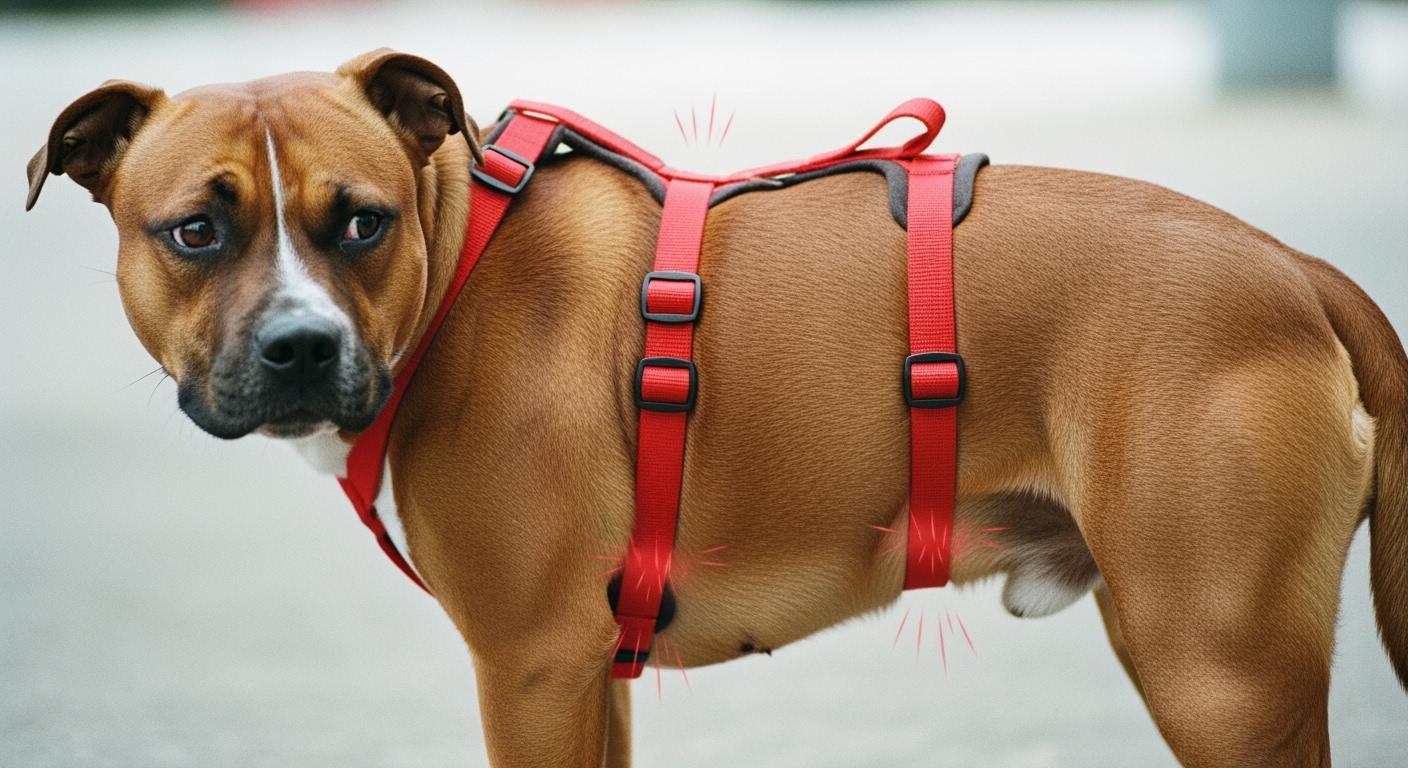
The dog steps forward. The strap rolls. And suddenly the lift turns into a pressure point. That is the moment most narrow-belly-strap harnesses fail — not when stitching gives out, but when force concentrates into a thin line across soft abdominal tissue and the dog freezes, bites at the strap, or refuses to take another step. Dog lifting harness pressure on belly is not a fit problem first. It is a load-distribution problem.
Why Belly Pressure Happens in a Dog Lifting Harness
Thin Contact Areas Concentrate Force
A strap that is one inch wide under a 60-pound dog channels partial body weight into a narrow band. Same force, smaller area, higher pressure. The causal chain runs like this: under tension, webbing edges curl inward, effective contact width shrinks to half an inch or less, pressure per square inch climbs, the strap rolls forward or backward seeking the path of least resistance across the curved belly, the harness rotates off-axis, the handler pulls harder to compensate, the strap digs deeper. The dog tenses, resists, or stops moving.
A panel spanning four to six inches of belly width turns the same force into a fraction of the pressure per square inch. It also resists rolling — its width creates a rotational moment arm the dog’s body geometry blocks. A one-inch strap has no such resistance.
In practice: after five minutes of assisted walking, lift the harness edge and check the belly skin. A red line that stays visible for more than 30 seconds means contact pressure exceeded what tissue can dissipate. A faint mark fading in under 10 seconds signals the load spread wide enough.
Soft Abdominal Tissue Cannot Bear Load Like Bone-Backed Structure
Bone transmits force. Soft tissue deforms under it. The sternum and ribcage form a rigid platform for load transfer. The ventral abdomen between ribcage and pelvis has no such platform — it is muscle, fat, and connective tissue suspended between two bony landmarks. When a single belly strap carries most of the lift weight through this unsupported span, the strap sinks deeper as tissue compresses, and the upward displacement restricts diaphragmatic movement. The dog’s breathing shallows during the lift, adding respiratory stress to mechanical discomfort.
The main support strap belongs under the chest, near the sternum. A secondary belly strap works as a stabilizer — it prevents rotation — but should not carry the majority of the lift. If the primary lift axis sits under the belly rather than the chest, the pressure problem is built into the geometry, not the fit.
Pressure Shifts When the Dog Stands, Steps, or Squats
Static fit is not dynamic fit. A harness that sits flat on a standing dog shifts the moment the dog crouches to urinate or rocks forward to climb a stair. Each movement changes the angle of lift force relative to the belly contact surface. A strap centered during a static check can slide two inches toward the groin during a squat — enough to move from tolerable to painful. On slippery floors, the dog’s hind legs splay for traction, rotating the pelvis and pulling belly skin taut. A narrow strap follows the skin tension into the flank crease, concentrating pressure at a single edge.
Common Use Situations and Solutions
| Use Situation | What Goes Wrong with Belly Pressure | Why It Fails | Better Structure to Look For |
|---|---|---|---|
| Standing up from lying down | Strap digs into belly | Narrow contact, rolls under load | Wide, padded belly panel |
| Assisted potty break | Strap presses on soft tissue | Panel slips or bunches | Anti-bunching, cleanable panel |
| Walking across slippery floor | Harness rotates, dog resists | Thin strap, poor fit | Wider panel, adjustable handles |
| Climbing stairs | Dog hesitates, strap marks appear | Pressure shifts, strap slides | Full body harness, load sharing |
| Getting into a car | Dog refuses, deep marks after lift | Strap path wrong, too much pressure | Chest and hip support, wide panel |
How to Judge Belly Pressure
| Status | What You See and Feel |
|---|---|
| 🟢 Green | Support feels stable, no belly guarding, no deep marks, dog moves normally |
| 🟡 Yellow | Mild strap shifting, light rubbing, dog slows down or looks back at the belly area |
| 🔴 Red | Swelling, heat, pain, deep marks, refusal to walk, chewing the strap, new limping |
Narrow Belly Strap vs Wide Belly Support Panel in a Lifting Harness
What a Narrow Strap Does Under Load
A narrow belly strap under tension behaves like a cable, not a support surface. Webbing fibers align along the load axis, edges curl, and the contact patch collapses to a thin pressure line against ventral tissue with no skeletal backing. The failure is progressive. First, strap edges leave defined indentations after removal. Then the dog braces during setup — turning away, sitting down. Then the strap rolls forward during use, pulling the harness off-axis. A dog that refuses the harness after three sessions is not being stubborn. The harness is communicating its load-distribution failure.
Why Padding Alone May Not Solve a Bad Strap Path
Padding adds thickness. It does not add width. A padded one-inch strap still concentrates force into the same one-inch band — the padding compresses under body weight and effective contact width barely changes. Think of it as a cushion on a rope: the surface feels softer to the hand, but under 30 pounds of lift force, the cushion flattens and the rope geometry dominates.
The strap path matters more than the padding material. A strap routed under the belly midpoint — the most compressible, least bone-backed section — will cause pressure regardless of how much neoprene wraps it. Move the primary lift contact forward, closer to the sternum, and belly pressure drops even with thinner padding, because the load moves to tissue backed by bone. Padding also introduces a secondary failure: bunching. Thick padding not mechanically locked to the strap can slide independently, fold, and press into the groin during a squat — worse than no padding at all.
When a Wide Panel Spreads Support Better
Thirty pounds of lift across 24 square inches of panel contact produces roughly 1.25 pounds per square inch. That same force across a one-inch strap with four inches of contact length — four square inches — produces 7.5 pounds per square inch. A sixfold difference from the same lift. But area is only half the story. A wide panel resists rolling because its edges sit against the lateral body wall. The body blocks rotation passively, keeping the lift vector aligned with the dog’s center of mass. An adjustable panel with anti-bunching reinforcement holds that alignment through repeated transfers.
Cleanability matters in practice. A belly panel contacting urine or damp fur during a potty break stays against the skin for the rest of the session. Materials that trap moisture accelerate irritation — the same pressure tolerable on dry skin becomes problematic on softened, damp skin. A quick-drying surface reduces this cumulative effect across multiple daily transfers.
When a Full Body Lift Harness Works Better Than a Simple Sling
Front and Rear Balance Problems
A simple sling lifts from one axis at mid-body. Dogs with hind-end weakness drop their front end to compensate, tilting the sling forward. The front edge of the belly strap — often a single seam or binding — then carries disproportionate load and presses into soft tissue behind the ribcage. The dog feels forward pressure and braces against it, worsening the tilt. A full-body harness adds front and rear handles so the handler controls the lift angle. The chest handle stabilizes the front, the hip handle guides the rear, and the belly panel acts as a connecting stabilizer rather than the primary load carrier.
Chest, Abdomen, and Hip Load Sharing
Three contact zones change the physics. A chest strap transfers part of the lift to the sternum — bone-backed, structurally rigid. Hip support guides the rear without pulling upward on the groin. The belly panel connects the two and handles the remainder. This multi-point load-sharing approach matters most during transitions: sit-to-stand, stair climbing, car entry. In a sit-to-stand, the dog rocks forward and front-end load spikes. With only a belly strap, that spike transfers entirely to soft tissue. With chest and hip support, the belly panel sees perhaps 40 percent of the total — the difference between a tolerable transfer and one the dog learns to dread.
Dogs That Need More Stability Than Rear-Only Support
Deep-chested breeds, dogs with angular limb deformities, and dogs recovering from spinal surgery often cannot tolerate mid-body-only lifting. Their body geometry demands that the lift force bypass the vulnerable midsection. A structured lift harness distributes weight differently than a simple sling — the sling cinches under the belly and pulls up; the harness cradles the chest and hips and translates the lift into forward-and-up motion tracking the dog’s natural center of mass.
Disclaimer: this check assumes a short-coated dog; double-coated breeds may show subtler rub marks needing hand-checking rather than visual inspection. If the dog’s leg conformation falls outside breed norms this harness type is patterned for — particularly dogs with angular limb deformities or very deep chests — the fit checks described here may not catch every pressure point. Palpate the belly skin after each session regardless of whether visual marks appear.
Fit Signs the Harness Is Pressing the Belly

Skin and Coat Signs
After removing the harness, check the belly before the coat resettles. Defined red lines matching strap edges indicate pressure concentrated at the perimeter rather than spread across the panel face. Warmth persisting more than five minutes after removal means friction heat built up from strap shifting. Broken or crimped hair along the strap line is a slower signal — it means the harness micro-shifts against the coat with each step, wearing hair shafts and irritating follicles. If the coat along the strap line looks thinner than surrounding areas, the panel is sliding. A wider panel or anti-bunching layer addresses the cause; conditioning the coat does not.
Movement and Behavior Signs
A dog that braces, turns away, or sits down during harness setup is not being difficult. That is learned avoidance — the dog has associated the harness with belly pressure. Mid-walk, the dog may slow, look back toward the belly, or take stutter-steps where hind legs move but front legs hesitate. These happen at the point in the gait cycle where belly strap tension peaks — typically mid-stance of the rear leg on the handler’s side.
| Behavioral Change | What It Suggests About Harness Pressure |
|---|---|
| Avoids having the harness put on | Dog has learned to anticipate discomfort at setup — pressure memory from prior sessions |
| Freezes, flinches, or tucks tail when wearing | Static pressure already uncomfortable before movement begins; strap path or width likely the cause |
| Pulls harder or lags behind during walks | Dynamic pressure spikes at specific points in the gait cycle; strap is shifting or rolling |
Strap Marks After Assisted Walking
A mark fading within 30 seconds of harness removal is normal compression — the tissue rebounded. A mark staying visible for several minutes means tissue was compressed past its elastic limit. That is the threshold: if the strap outline is still visible two minutes after removal, contact pressure was too high for that duration. It does not matter whether the dog appeared comfortable. Tissue response is objective. Check in consistent side lighting — overhead light hides indentations that side light reveals. Consistency in how you check removes the biggest variable in self-reporting.
FAQ
How do I tell whether belly pressure or something else is causing my dog to resist the harness?
Run a two-session comparison. Session one: put the harness on, do not lift, walk the dog on a loose leash for five minutes. Session two: same harness, add assisted lifting for the same duration. If the dog resists equally in both sessions, the static fit is the problem — the harness presses even without load. If resistance appears only in session two, dynamic load distribution is failing. This isolates pressure from other causes like sound sensitivity or handling aversion. It takes less than 15 minutes total.
Why does a wide panel reduce belly pressure more effectively than adding padding to a narrow strap?
Padding compresses. Width does not. Under 30 to 40 pounds of lift force, even dense neoprene flattens to a fraction of its resting thickness, and the effective contact width of the underlying strap still governs pressure distribution. A wide panel changes the denominator in the pressure equation — force divided by area — because its contact width is structural, not dependent on uncompressed material loft. Padding changes how the surface feels to the hand at rest. Width changes how force reaches the tissue under load. Those are two different mechanisms, and only the second one holds up across a full assisted-walking session.
