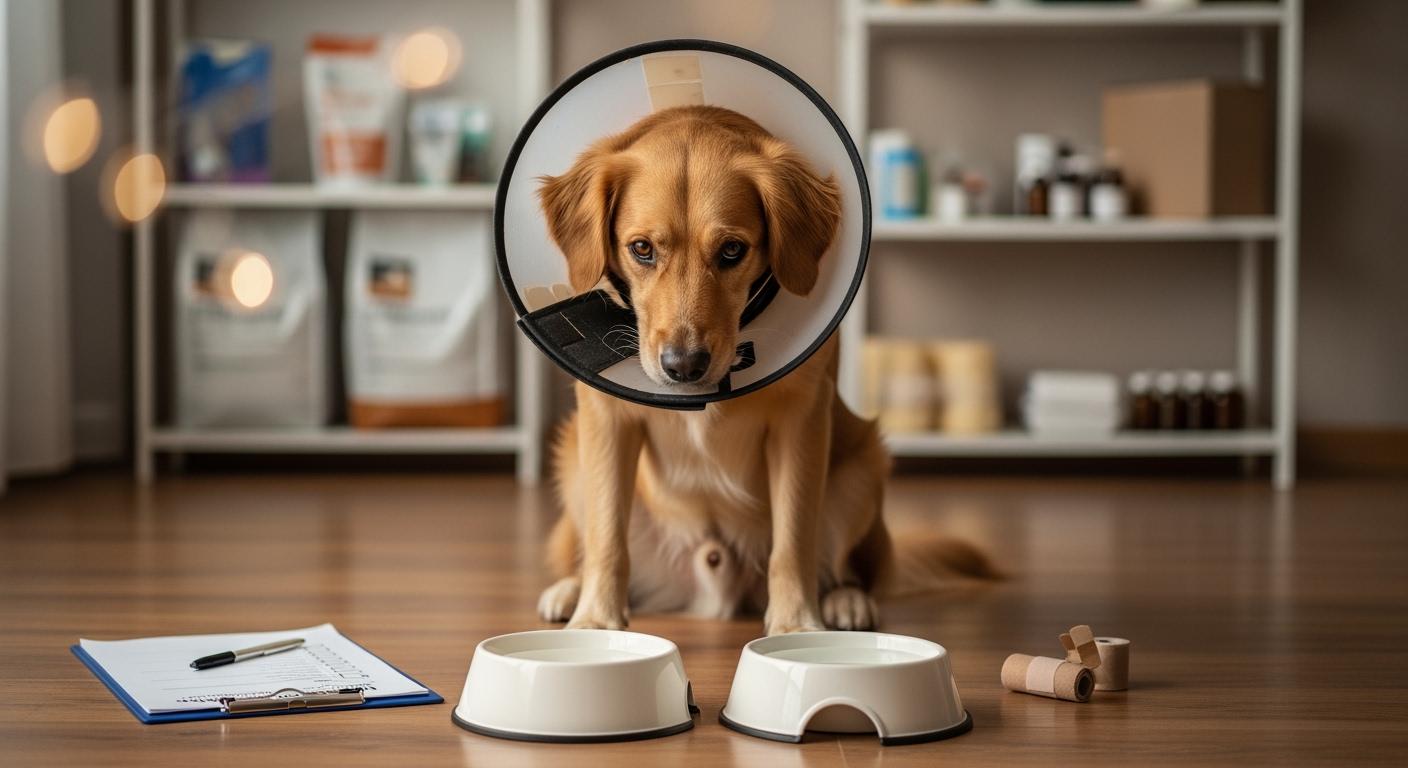
A dog stands still and the neck brace looks fine. The straps sit where they should. Nothing shifts. Then the bowl goes down.
The dog lowers its head. The front edge of the brace meets the bowl rim. The jaw cannot reach the food. The dog backs away, coughs, or stares at the water without drinking. That is not a refusal to cooperate. It is a clearance failure built into the brace geometry.
A dog neck brace that blocks eating and drinking typically fails at two points that have nothing to do with strap tightness or sizing charts. The front edge sits too tall to clear the bowl. Or the throat panel compresses during swallowing and makes the act feel unsafe. Both are structural problems. Both are visible at the first meal if you know where to look.
The Front Edge Failure: When Jaw Clearance Decides Whether a Dog Eats
The most common reason a dog neck brace blocks eating and drinking is not that the brace is too tight. It is that the front edge geometry never accounted for what happens when a dog lowers its head to a bowl.
Here is the chain. A dog lowers its head to eat. The neck flexes forward and down. The brace, anchored around the neck and chest, should stay in place while the chin drops below the plane of the front edge. If the front edge is tall and rigid, the brace forms a wall between the jaw and the bowl. The dog cannot physically close the distance. It tries, hits the brace against the bowl rim, and stops.
You can verify this in under a minute. With the brace fitted and the dog standing calmly, place a shallow raised bowl at chest height. Watch the dog lower its head. If the chin clears the front edge by at least half an inch and the mouth reaches the food without the brace touching the rim, clearance is adequate. If the brace hits the bowl before the mouth reaches it — or if the dog stops short and stares — the front profile is too tall for this dog at this bowl height.
This is why the front edge contour matters more than overall brace height on a sizing chart. A brace can measure correctly around the neck circumference and still fail at the bowl because the front panel cut is vertical instead of scooped. Tall vertical front edges maximize coverage for wound protection or lick prevention — but that same height becomes a barrier the moment the head drops. A scooped or lower front profile trades a few millimeters of upper-neck coverage for the ability to eat and drink without removing the brace. For most dogs in recovery, that trade is worth making.
| What the caregiver sees | Likely failure point | Why it happens | Better structure or setup |
|---|---|---|---|
| Dog cannot reach food | Front edge too tall | Jaw blocked at bowl | Lower front profile, jaw clearance |
| Dog backs away from water | Throat panel presses | Swallowing feels unsafe | Shaped throat relief, padding |
| Dog coughs or gags | Throat compression | Pressure on airway | Softer, pressure-spreading front |
| Brace hits the bowl rim | Rigid front design | No clearance for mouth | Shallow dish, lower rim |
| Brace shifts sideways | Poor anchoring | Brace moves at bowl | Stable anti-shift anchoring |
| Dog eats only when removed | Overall poor geometry | Multiple blockages | Adjustable closure, easy removal |
Throat Compression During Swallowing: Why a Flat Panel Creates Refusal
The second failure point is harder to spot from across the room. It happens after the dog reaches the food or water — during the swallow.
A swallow requires the throat to expand and contract. If the brace’s front panel is flat and rigid, it does not move with that motion. Instead it resists it. The dog feels pressure against the throat at the exact moment it needs to complete the swallow. It coughs. It gags. It backs away. After two or three repetitions, the dog may stop approaching the bowl entirely while the brace is on.
The mechanism is straightforward. A flat panel distributes force across a single plane — when the throat expands during swallowing, the panel pushes back uniformly. A contoured or shaped throat relief panel curves away from the trachea and spreads the contact force across a larger, curved surface area. The difference in perceived pressure can be significant even when the brace is not overtightened. The dog does not know the brace is correctly fitted. It knows swallowing hurts.
You can observe this during the first supervised water test. Fit the brace to a calm, standing dog. Offer water in a raised bowl. Count five full drink-and-swallow cycles. If the dog completes all five without coughing, gagging, or pulling away, throat clearance is likely sufficient. If the dog pauses mid-swallow, lifts its head abruptly, or coughs after drinking, the front panel is compressing during the swallow. That brace — regardless of how well it fits by the strap checklist — is not safe for unattended meals.
This is where cervical support brace designs diverge meaningfully. A brace built primarily for immobilization tends to use stiffer, flatter front panels — the priority is restricting neck range of motion. A brace designed with daily function in mind adds contouring at the throat, often with a pressure-spreading foam layer that compresses under expansion rather than resisting it. The support level may be similar; the difference is whether the dog can swallow comfortably while wearing it.
| Design area | Risky design | Better design direction |
|---|---|---|
| Front edge height | Tall, rigid, blocks jaw | Lower, contoured, jaw clearance |
| Throat padding | Flat, hard, compresses | Shaped, pressure-spreading |
| Side panel stiffness | Stiff, restricts movement | Flexible, allows safe rotation |
| Strap anchoring | Loose, shifts at meals | Stable, anti-shift anchoring |
| Closure adjustability | Fixed, hard to adjust | Adjustable, easy to remove |
| Breathability and cleaning | Bulky, traps heat/moisture | Breathable, easy to clean |
When a Neck Brace Is the Wrong Setup for Meals

Not every neck brace blocks eating and drinking. And not every eating problem with a brace is a design defect. Some combinations of dog conformation, bowl setup, and brace geometry simply do not work together — and recognizing that early prevents days of frustration.
When the Bowl Setup Works Against the Brace Geometry
A floor-level bowl demands the dog drop its head well below shoulder height. Most neck braces are built around a near-neutral neck position — the posture the dog holds while standing or walking. The further the head drops from that neutral plane, the more the front edge of the brace pivots into the path of the jaw. This is not a brace defect; it is a mechanical mismatch between the brace’s designed working range and the bowl’s position.
The fix is not always a different brace. A raised bowl stand that brings the food and water to chest height can resolve the clearance problem for many dogs — provided the front edge profile was reasonable to begin with. If the brace still blocks the jaw even with the bowl at chest height, the front edge geometry is the limiting factor, not the bowl.
Bowl depth matters too. A deep, narrow bowl forces the dog to insert its muzzle vertically, which increases the angle between the head and the brace. A wide, shallow dish lets the dog approach from a flatter angle, reducing the front-edge interference. For dogs in rigid neck braces, a mobility support setup that accounts for restricted head range of motion often means rethinking the entire feeding station — bowl height, bowl width, and even the surface the bowl sits on.
When the Brace Must Come Off for Meals
Some brace designs prioritize full immobilization over daily function. If the recovery protocol requires zero neck flexion — for example, after cervical spinal surgery or during the acute phase of an IVDD episode — the front edge will necessarily be tall and rigid, and jaw clearance at the bowl may not be possible without compromising immobilization. In those cases, the brace is not failing. It is doing exactly what it was designed to do. The correct response is not to modify the brace but to remove it for supervised meals and replace it immediately afterward, following the veterinary guidance that prescribed the brace.
The distinction matters. A brace that blocks eating because of poor front-edge contouring is a design limitation. A brace that blocks eating because the medical requirement demands full immobilization is a use-case constraint. Confusing the two leads to unsafe modifications.
Disclaimer: The clearance checks described here assume a short-coated dog where brace-to-bowl contact is visible. Double-coated breeds may show subtler interference — the fur can mask the point where the brace rim meets the bowl. For thick-coated dogs, run the jaw-clearance test with a hand on the brace edge to feel for contact that eyes might miss. If the dog’s neck conformation falls outside typical breed proportions — particularly dogs with very short, thick necks or angular cervical deformities — the fit observations in this article may not catch every pressure point.
Signs the Setup Is Unsafe
After a few meals with the brace, you will have a clear pattern. The table below organizes what you see into three categories. Green means the current setup works with monitoring. Yellow means adjust bowl height, try a shallower dish, or shorten brace wear during meals. Red means stop and get veterinary guidance before the next meal.
| Sign level | What you see at the bowl | What to do |
|---|---|---|
| Green | Dog reaches food and water, swallows without coughing, brace stays in place, no skin marks after meals | Continue monitoring twice daily |
| Yellow | Hesitation at the bowl, slow eating, minor throat-clearing, brace shifts slightly, mild rub marks | Raise bowl, switch to shallow dish, check strap tension, shorten wear time during meals |
| Red | Cannot reach food or water, repeated coughing or gagging, refusal to approach bowl, breathing distress, skin injury under brace | Stop brace use, contact veterinarian before next meal |
The pattern usually declares itself within the first two meals. A dog that eats and drinks comfortably with the brace on day one tends to continue doing so, provided the fit stays consistent as the dog’s body condition changes during recovery. A dog that hesitates, coughs, or refuses from the first bowl rarely adapts — the geometry is wrong, not the dog’s attitude.
Brace anchoring also influences mealtime reliability. A neck brace without chest strapping or body anchoring tends to rotate when the dog lowers its head — the rear edge lifts, the front edge drops, and the entire brace shifts toward the bowl. Head and neck recovery products that incorporate anti-shift body connections keep the brace oriented correctly even as the head moves through its full eating range. Without that anchoring, each meal becomes a variable geometry problem where the brace position at bite one is not the same as the position at bite five.
FAQ
Why does my dog back away from the water bowl while wearing a neck brace?
Backing away during drinking is almost always throat compression. When the dog lowers its head and begins to swallow, a flat or rigid front panel presses against the throat at the moment of expansion. The dog associates drinking with that pressure and avoids the bowl. Check whether the brace front panel is contoured away from the trachea or sits flat against it. A five-swallow water test makes the problem visible within minutes.
Can a raised bowl fix a brace that blocks jaw clearance?
It depends on how tall the front edge is. If the brace front edge barely catches the bowl rim when the dog lowers its head, raising the bowl two to four inches often resolves it. If the front edge sits well below the jawline and still blocks access — meaning the brace geometry itself is the wall — no bowl height will fix it. The front profile needs to be lower or scooped.
Should I remove the neck brace for every meal?
For braces designed with mealtime clearance — lower front profile, shaped throat relief — most dogs can eat and drink without removal once the bowl setup is dialed in. For full-immobilization braces where the medical requirement demands a tall, rigid front panel, removing the brace for supervised meals and replacing it afterward is standard practice. The brace type determines which path applies, not a universal rule.
What skin signs suggest the brace is pressing too hard during meals?
After a meal, check under the front edge and along the throat panel. Red marks that fade within ten minutes are typical contact pressure and not necessarily a problem. Marks that persist beyond thirty minutes, any broken skin, or damp patches that indicate trapped moisture under the panel suggest the pressure or material is not tolerable for mealtime wear. For most dogs, persistent skin marks after meals mean the brace should come off for feeding until the fit or the brace itself is changed.
How quickly should a dog adapt to eating with a neck brace?
Most dogs that can physically reach the bowl and swallow without compression adapt within one to two meals. If the dog still hesitates, coughs, or refuses after the third supervised meal with an optimized bowl setup, the brace geometry is likely incompatible with eating for that dog. Continuing to force the setup rarely leads to adaptation — it tends to build avoidance that persists even after the brace is removed.