
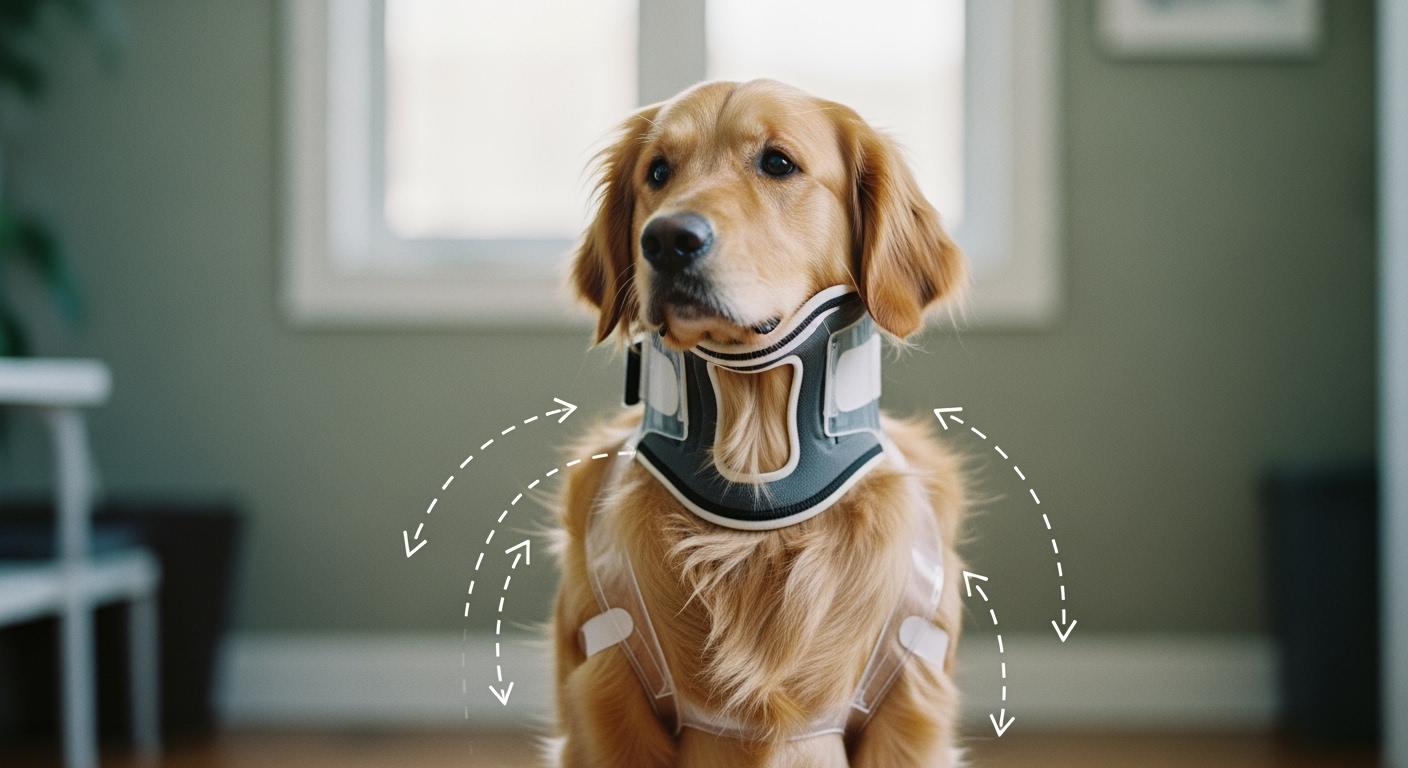
A dog neck brace that looks correctly positioned at first can slide down within minutes. The lower edge drops until it rests on the shoulders instead of the cervical area it is meant to support. The brace is no longer controlling the region it was fitted for.
This failure is rarely about choosing the wrong size. It is about whether the brace shell, strap angles, and lower anchor work with the dog’s actual neck shape under movement — or fight against it.
Why a Dog Neck Brace Slips Toward the Shoulders
The primary reason a dog neck brace slips toward the shoulders is geometric. Most dogs have a downward taper from the base of the neck into the shoulder slope. When a brace shell is flat or uniformly curved, the lower edge sits on that slope like a block on an incline. Gravity and movement do the rest.
Here is the force chain that turns a small mismatch into a complete migration. When the dog lowers its head, the cervical spine extends and the soft tissue at the front of the neck compresses. The brace shell — designed to sit against a static contour — now faces an angled surface. The lower edge of the shell loses perpendicular contact with the body. At that moment, the only thing resisting downward drift is friction between the lining and the coat. Friction alone cannot hold. The edge begins to slide. As it slides, the upper straps go slack, the shell rotates slightly off-axis, and the contact patch shrinks further. Within a few steps the entire brace has migrated onto the shoulders.
This progression is visible if you know what to look for. After ten minutes of normal walking, place a small piece of tape on the fur at the brace’s lower edge, then check again after another ten minutes. If the brace edge has drifted more than half an inch below the tape, the lower anchor has functionally failed — regardless of how snug the straps feel.
The shoulder slope as a migration ramp
The slope from neck base to shoulder top varies by breed. A Greyhound has a long, gradual taper. A Bulldog has a short, steep drop-off. Both shapes create a ramp effect, but they demand different shell geometries to resist it. A brace with a flat lower rim will slide on either.
What stops migration is not a tighter strap. It is a lower contact zone shaped to engage the upper chest — a panel that extends below the slope and creates a mechanical stop. Without that chest-facing surface, the brace has nothing to push against as gravity pulls it down. The entire stability budget gets spent on strap friction, and strap friction is not a structural solution.
A cervical brace designed with a contoured lower panel distributes the holding force across the sternum and upper chest, not just the narrow band of the neck. This load-sharing approach turns the chest into a structural anchor point rather than relying on circumferential squeeze.
Neck taper and chest depth mismatch
A brace that fits a dog with a thick neck and shallow chest will gap badly on a dog with a narrow neck and deep chest. The mismatch creates two distinct failure modes.
First, the brace feels tight at the top near the throat but loose at the bottom edge — a condition where the dog experiences discomfort and the brace experiences uncontrolled rotation. Second, the girth-to-length ratio of the brace no longer matches the dog, so the entire assembly shifts as a unit during movement rather than staying centered on the cervical spine. The dog may paw at the brace, shake its head repeatedly, or refuse to lower its head toward food — all signs that the brace is fighting the dog’s anatomy instead of tracking with it.
The same fit principles apply across different brace types. As discussed in the context of hind leg brace fit and slipping patterns, a brace that cannot match the underlying bone and muscle contour will always drift toward the path of least resistance — regardless of which body part it is designed for.
Why standing-still checks miss the problem
A brace checked only on a stationary dog has not been checked at all. When a dog stands relaxed, the neck muscles are at rest length and the skin surface is smooth. As soon as the dog walks, the muscles engage, the skin shifts, and the brace faces forces it never encountered during the standing fit check.
Head lowering creates the most dramatic geometry change. The ventral neck surface shortens while the dorsal surface lengthens. Any brace that depends on a static contour for positioning will either slide, rotate, or both. The only meaningful fit check happens during movement — ideally within the first ten to fifteen minutes of supervised wear, with the dog walking, lowering its head, and resting in sequence.
Why Tightening the Straps Makes the Problem Worse
The instinctive response to a slipping brace is to pull the straps tighter. That is the wrong response. Tightening a brace that migrates because of poor structural fit adds compression without adding stability. The brace still slides — it just slides while squeezing the throat harder.
Compression does not equal stability
Stability in a cervical brace comes from geometric congruence between the shell and the dog’s neck-chest profile. A brace that matches the contour stays put with moderate strap tension because the shell itself resists displacement. A brace that does not match the contour has no inherent resistance — all the holding work falls on the straps alone.
Here is what happens when strap tension is the only stabilization mechanism. The straps create a circumferential squeeze that compresses the soft tissue of the neck. That compression may hold the brace briefly while the dog is still. But the moment the dog moves, the tissue compresses further on one side and rebounds on the other. The brace shifts. The owner tightens again. The cycle repeats, with the brace compressing tissue harder each time while delivering progressively less positional control. The dog experiences increasing throat pressure for decreasing support.
Note: A brace that is too tight can cause serious health risks. Documented risks from veterinary literature include:
| Risk Type | Description |
|---|---|
| Pressure-related injuries | A small amount of pressure can injure areas with thin soft tissue layers. |
| Ischaemic necrosis | Prolonged pressure can lead to tissue death. |
| Nerve function suppression | Just over 2 g of weight can suppress nerve function by up to 50%. |
| Development of pressure sores | Pressure and time together increase the risk of sores. |
Edge marks and throat pressure are not “breaking in”
Red marks near the shoulder top, hairless patches, or a persistent dent in the coat after removing the brace are not signs the dog is adjusting. They are signs the brace edge is bearing concentrated pressure under migration. That concentrated edge pressure is the direct result of the brace riding the shoulder slope — the lower rim digs in as it slides, abrading the skin in a narrow band.
A simple check reveals whether the lower edge is truly load-sharing or just pressing in. After the dog has worn the brace for ten minutes of mixed activity, slide your finger under the lower edge at the front of the chest. If you can lift the edge more than a fingertip’s width away from the body, the contact zone is not transferring load — the brace is hovering above the chest and relying entirely on neck compression. If you cannot get a finger under the edge at all and see a deep red crease, the pressure is excessive and the brace needs immediate removal.
Dogs signal throat pressure in specific ways. Coughing, gagging, extending the neck to breathe, or switching to abdominal breathing are all red flags. Small breeds and flat-faced dogs are at higher risk because their airway anatomy leaves less margin for external compression. A systematic approach to fit evaluation — checking for pressure marks, rotation, and the dog’s breathing pattern during wear — applies regardless of whether the brace is on the hip, leg, or neck.
Design Choices That Stop Shoulder Migration
A brace that stays in place does so because the shell shape, strap geometry, and load-distribution surfaces work as a system. No single feature prevents migration. Three structural elements must work together: the cervical panel contour, the lower anchor surface, and the strap path layout.
Shaped cervical panels versus flat shells
A flat shell contacts the neck along a single plane. When the neck angle changes — the dog lowers its head, turns, or lies down — that single plane no longer aligns with the body surface. Edge contact replaces surface contact, and the brace pivots around that edge.
A shaped cervical panel follows the compound curve of the neck. It maintains surface contact across a range of neck positions because the shell curvature approximates the neck’s natural contour rather than fighting it. The difference in manufacturing terms is that a shaped panel requires a three-dimensional mold pattern matched to anatomical data, not a flat-cut sheet folded into a cylinder. This is the kind of production-level decision that separates braces that track with movement from braces that wait for the dog to move and then drift.
A neck support brace with a contoured cervical shell uses a shaped lower contact zone to engage the sternum and upper chest, creating a mechanical stop that resists downward migration without relying solely on strap tension.
Anti-rotation strap paths
Strap placement determines whether the brace resists rotation or encourages it. Narrow straps placed close together create a single axis of tension. When the dog turns, the brace can rotate around that axis — the strap becomes a pivot, not a restraint.
Wide straps with separated proximal and distal anchor points create two distinct tension axes. The distance between them resists torque. When the dog turns, one strap goes into tension while the other holds position. The brace stays centered. Wide straps also distribute pressure across a larger surface area, reducing peak pressure under any single point — which matters for dogs that need to wear the brace for extended periods.
| Performance Difference | Why It Matters | Main Limitation |
|---|---|---|
| Wide straps (1.5 in or more) | Lower peak pressure, longer comfortable wear time | Can bunch in skin folds on very short-necked breeds |
| Widely spaced proximal and distal straps | Resists brace rotation during turns and direction changes | Requires enough neck length between jaw and shoulder for placement |
Edge padding and breathable lining
Padding serves two distinct functions that are easy to confuse. The first is comfort — soft material against the skin. The second, more critical function is edge pressure distribution. A padded edge spreads the force that would otherwise concentrate along a narrow rim. But padding alone does not prevent migration. A poorly shaped shell with thick padding still slides; it just slides with softer edges.
Breathable lining addresses a different failure mode: moisture buildup. A brace worn against the neck traps heat and humidity. Over time, damp skin softens and becomes more vulnerable to friction damage. A lining that wicks moisture and allows airflow reduces this risk. The observable difference is straightforward — after twenty minutes of wear, flip the lining outward and feel the inner surface. If it is dry or only slightly damp, the material is managing moisture. If it is wet to the touch, heat and humidity are accumulating against the skin.
For dogs that need extended daily brace wear, the principles discussed in canine rehabilitation brace fit and comfort guidance apply directly — comfort during long wear sessions depends as much on moisture management and edge design as on the underlying support structure.
When the Brace Is Not the Right Choice
Not every dog’s anatomy works with every brace design. Recognizing when a brace is structurally unsuitable prevents the cycle of tightening, adjusting, and watching it fail again.
Repeated slipping after multiple fit adjustments is the clearest signal. If the brace has been checked in standing, walking, and head-lowered positions and still migrates, the shell geometry and the dog’s neck profile are fundamentally incompatible. Continuing to use it trades cervical support for a false sense of security.
Pressure marks that do not fade within ten minutes of removal, breathing changes during wear, or a dog that panics when the brace is approached are all stop signals — not adjustment cues.
| Visible Failure | Why It Happens | Poor Fix | Better Design or Fit Response |
|---|---|---|---|
| Slips toward shoulders | Shoulder slope, weak lower anchor, flat shell | Tighten brace more | Shaped cervical panel, chest-facing anchor zone |
| Rotates during head lowering | Neck-chest mismatch, poor strap angle | Ignore rotation | Test fit during head lowering, adjust strap path |
| Stays only when very tight | Stability depends on compression, not structure | Over-tighten brace | Wider load path, padded edges, adjustable straps |
| Leaves red marks near lower edge | Migration plus edge pressure | Add more padding | Stop use, reassess size, edge finish, strap path |
| Dog resists wearing it | Discomfort, poor fit, heat buildup | Force brace on | Reassess fit, check lining, consider alternative support |
| Signal Level | What the Caregiver Sees | Action |
|---|---|---|
| Green | Brace stays centered, no throat pressure, no rubbing, dog rests normally | Continue use, monitor twice daily |
| Yellow | Slight slipping, mild edge marks, repeated adjustment needed | Reassess fit, adjust straps, monitor closely |
| Red | Breathing change, gagging, swelling, heat, panic, new limping, repeated shoulder migration | Stop use, consult veterinarian |
Disclaimer: The fit checks described here assume a short-coated dog where brace edges are visible against the skin. Double-coated breeds may show subtler rub marks that require hand-checking — run your fingers under every edge after each wear session rather than relying on visual inspection alone. If the dog has angular limb deformities, a very deep chest outside breed norms, or a neck shape that falls significantly outside the measurements the brace was patterned for, these fit checks may not catch every pressure point.
A cervical brace is one piece of a broader support strategy. Understanding how dog braces provide stability and mobility support across different body regions helps clarify when a neck brace is the appropriate tool and when the dog’s needs call for a different approach entirely.
A shaped cervical panel with a chest-facing anchor zone, breathable lining, anti-rotation strap geometry, and edge padding designed for pressure distribution rather than just softness — these are the structural elements that determine whether a brace supports the neck or migrates to the shoulders. Anything less, and the brace is asking strap tension to do work that only shell geometry can perform.
FAQ
Why does my dog’s neck brace keep sliding down even after I tighten it?
Tightening addresses strap tension, not shell geometry. If the brace shell is flat and the dog’s neck has a shoulder slope, the brace will slide regardless of how tight the straps are. The lower edge needs a chest-facing contact zone that creates a mechanical stop — strap friction alone cannot hold against gravity and movement.
How do I know if the brace lower edge is actually load-sharing with the chest?
After ten minutes of mixed activity, slide a finger under the lower edge at the front of the chest. If you can lift the edge more than a fingertip’s width away from the body, the contact zone is not transferring load — the brace is hovering and relying on neck compression alone.
How quickly should I see migration to know the brace does not fit?
Significant migration within the first ten to fifteen minutes of normal walking and head-lowering signals a structural mismatch. A brace that drifts more than half an inch in that window will not stabilize with more wear time or tighter straps.
What is the difference between edge pressure from migration and normal wear marks?
Normal wear leaves a light, even impression that fades within minutes of removal. Migration edge pressure creates a narrow red band concentrated along the lower rim, often darker on one side. A dent that persists more than ten minutes after removing the brace signals excessive compression.
