
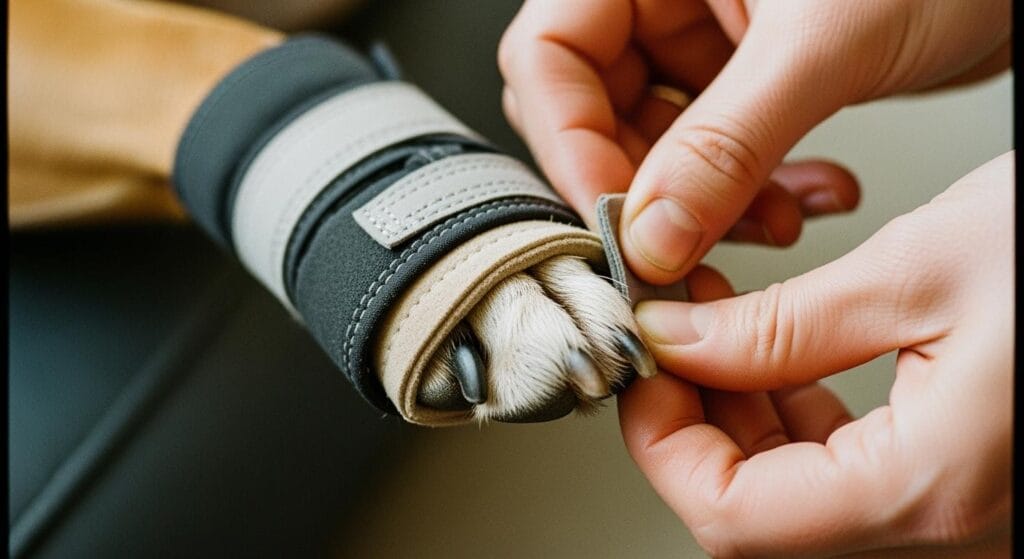
You fit the no-knuckling boot, the toes lift, and the paw looks right. Ten minutes into a walk, there is a red line under the toe lift strap. Or the boot has rotated and the strap pulls sideways, and the toes drag again. That red line is not a cosmetic mark. It is contact pressure concentrated onto a strip of skin half an inch wide, cycling with every step. This article works through why a dog no knuckling boot toe lift strap rubs, what product-level failures drive it, and which design features actually reduce the problem.
Why the Toe Lift Strap Leaves a Mark After Walking — Not During Fitting
During a static fitting the strap feels fine. The paw is stationary. The tension you set holds evenly across the strap path. Then the dog walks.
Movement changes everything. Each stride cycles the strap through load and release. The strap does not stay where you placed it — it micro-shifts. A narrow strap, maybe 8 mm wide, puts the full lift force onto a contact patch no wider than a pencil line. On a wider strap the same lift force spreads across two or three times the surface area. Pounds per square inch drop by half or more.
Here is the chain: a narrow strap under tension → force concentrates onto a thin contact line → fur compresses and skin takes the full load cycle → repeated stride shear breaks down the outermost skin layer within minutes → the red line appears. It is not a burn. It is mechanical abrasion from a pressure concentrator.
Fur loss and hot spots follow if wear continues. A hot spot is the skin signaling that the surface barrier has failed and bacteria now have a path in.
In practice: After 10 minutes of walking on flat indoor flooring, remove the boot and run a fingertip along the full strap path. Any spot warmer than the surrounding skin signals a pressure zone — the strap is concentrating force there, regardless of how centered it looked during fitting.
| What you see | Likely product failure | Why it happens | Better design response |
|---|---|---|---|
| Straight red line under the strap | Strap too narrow or off-center | Pressure not spread across enough surface area | Wider, centered strap with padding |
| Fur rubbed away near strap path | Strap edge too rough or sharp | Friction concentrated at edge during stride | Smooth, rolled strap edges |
| Boot rotates outward during walking | Single-point anchor or loose fit | Boot lacks rotational resistance | Multi-point closure, structured boot upper |
| Toes still drag with strap tensioned | Strap path not mechanically effective | Strap pulls sideways and loses vertical lift | Centered cord path, stable anchor |
| Dog bites or shakes boot off | Discomfort from rubbing or pressure | Pain triggers removal behavior | Softer padding, reduced contact pressure |
| Paw swollen, cold, or painful | Circulation restricted | Strap tension exceeds skin perfusion pressure | Release tension, stop use, seek veterinary assessment |
Rubbing that fades within 10 minutes of removal is mild surface irritation. Redness that persists past 30 minutes means the strap has been driving into the same tissue repeatedly — the skin needs a break and the strap path needs repositioning or a different strap design entirely. When a no knuckling boot fits and supports a dog through daily movement, toe-up control depends on keeping the cord path stable across the full stride cycle, not just at standstill.
Design Flaws That Turn a Toe Lift Strap Into a Pressure Point
Four product-level failures recur across dog foot braces. Each one makes rubbing more likely, and each traces back to a specific design choice.
Narrow Straps That Concentrate Force
A strap that is 8 mm wide delivers roughly double the contact pressure of a 16 mm strap at the same lift tension. The math is straightforward: same force, half the area, twice the pounds per square inch. That concentrated pressure compresses fur, flattens the skin’s outermost layers, and with each stride the strap edge shears across the same tissue plane. The result is predictable — mechanical skin breakdown along a line that mirrors the strap edge exactly.
Dogs with thin coats or short fur have less natural padding between strap and skin, so the same strap design causes faster irritation on a Greyhound than a Golden Retriever. Breed and coat type are not afterthoughts here. They change the effective contact pressure a strap delivers.
Rough Seams and Hard Edges Along the Strap Path
A strap can be wide and still cause damage if the edge is cut square and left unrolled. Square-cut strap edges function like a dull scraper — they do not glide, they drag. After a few hundred stride cycles, the outermost fur shafts fracture and the skin beneath reddens. Padding helps only if it stays in place. Thin foam that compresses flat after five minutes of walking exposes the hard strap edge beneath it.
The manufacturing reality is that rolling or beveling a strap edge adds a secondary production step. It costs more. Skipping it saves money and produces a strap that abrades skin predictably. Daily fit checks for a dog foot brace should include running a finger along strap edges — not just checking tension — because edge finish quality determines whether the contact is friction or shear.
Single-Point Anchors That Let the Boot Rotate
A toe lift cord anchored at a single point can pivot. When the dog plants the paw and pushes off, ground reaction force transmits up through the boot. If the boot has only one anchor resisting rotation, it twists. The toe lift cord — originally pulling straight up — now pulls at an angle. Vertical lift drops. Sideways pull increases. The strap edge digs in on one side only.
This failure is positional, not tension-based. Tightening the strap does not fix boot rotation; it just adds more pressure on the already-overloaded side. What fixes it is a multi-point closure that resists torque — two or more anchor points create a couple that counters the rotational force from paw push-off.
Note: Slip a flat fingertip under the strap after a 10-minute walk. If the finger meets resistance or the skin under the strap is visibly redder than surrounding tissue, tension is too high — regardless of how secure the boot felt during fitting.
Over-Tightening That Compensates for Poor Traction
When a boot slides on smooth flooring, the instinct is to pull the strap tighter. That instinct is wrong. The boot slides because the outsole lacks adequate grip for the surface, or because the boot upper is too loose to transmit leg motion to the sole. Tightening the toe lift strap does not fix either problem. It only increases contact pressure at the strap line.
The outsole and the strap are independent systems. A strap cannot compensate for a slippery sole any more than a seatbelt can compensate for bald tires. Rear paw drag and skin safety both depend on getting these two systems right independently — outsole grip for ground contact, strap design for toe lift — rather than treating the strap as a universal tightness knob.
When a No-Knuckling Boot Is Not the Right Product
A no-knuckling boot lifts the toes. That is its one job. It does not correct carpal hyperextension, it does not stabilize the hock, and it does not provide knee or hip support. Using it for conditions it was not designed to address introduces failure modes that no amount of strap adjustment can fix.
Dogs with angular limb deformities — where the leg deviates from the straight mechanical axis the boot was patterned for — may find that a centered strap path is anatomically impossible. The strap will always cross a bony prominence or sit at an angle. For these dogs, the fit checks described here may not catch every pressure point, because the underlying geometry does not match the boot’s design assumptions.
Dogs with very heavy body weight relative to paw size concentrate more ground reaction force through a smaller contact area. A strap that functions well on a 30-pound dog may fail rapidly on a 90-pound dog with the same paw dimensions, because the stride forces are three times higher while the strap contact area stays the same.
Disclaimer: This check assumes a short-coated dog. Double-coated breeds may show subtler rub marks — the undercoat can mask early redness. Hand-checking with a fingertip along the strap path is more reliable than visual inspection alone for these breeds. If the dog’s leg conformation falls outside the breed norms this boot was patterned for — particularly dogs with angular limb deformities or very deep chests — the fit checks described here may miss pressure points that only emerge under sustained walking loads.
Knuckling itself can signal underlying neurologic issues that a boot alone cannot address. If the paw knuckles even without the boot, the problem may originate higher in the nerve pathway, and a foot brace changes only the paw position, not the root cause.
Strap, Anchor, and Outsole Features That Reduce Rubbing
Better design is not about adding more features. It is about getting a few mechanical details right so the boot does its job without creating new problems.
Centered Toe-Lift Cord Path
A centered cord path keeps the lift force vertical. When the cord runs straight from the dorsal paw surface to the anchor, the force vector is perpendicular to the paw — lifting the toes without pulling them sideways. An off-center cord path introduces a lateral force component. That lateral component is what drags the strap edge across the skin, creating the shear that produces the red line.
The manufacturing challenge is that paw anatomy varies by breed. A cord path centered for a Labrador is not centered for a Whippet. Boot designs that offer adjustable cord positioning — not just adjustable cord tension — can center the path across a wider range of paw shapes.
Low-Friction Lining and Rolled Strap Edges
A strap with a low-friction inner face glides over fur instead of gripping and dragging it. This is a material choice — a smooth woven face versus a cut edge of unlined webbing — and the performance difference is measurable in the field: remove the boot after 10 minutes and check whether fur shafts near the strap path are bent or broken. Broken shafts mean friction. Bent-but-intact shafts mean the strap face slid without gripping.
Rolled or beveled strap edges eliminate the sharp transition where a square-cut strap meets skin. That transition line is where most fur loss begins.
Multi-Point Anchors That Resist Torque
Two anchor points spaced apart create a rotational couple. When the paw pushes off and ground force tries to twist the boot, that couple resists. The toe lift cord stays aligned. Single-point anchors cannot provide this resistance — a single point is a pivot, not a couple, and the boot will rotate around it predictably.
Outsole Grip Balanced for the Surface
Too little grip and the boot slides, shifting the strap. Too much grip and the outsole catches, twisting the boot. The right balance prevents sliding without introducing rotational catch points. On smooth indoor flooring, a softer compound with moderate tread depth usually performs better than an aggressive lug pattern designed for trail use — the lugs catch on flat surfaces and create the same rotational force the multi-point anchor is trying to resist.
| Design area | Weak design | Better design |
|---|---|---|
| Toe lift strap | Narrow, square-cut edge, fixed position | Wider, rolled edge, adjustable cord path |
| Strap anchor | Single attachment point, free to pivot | Multi-point closure, resists rotational torque |
| Strap padding | Thin foam, compresses flat under load | Dense padding that holds shape across stride cycles |
| Boot upper | Unstructured, collapses or over-constrains | Flexible with enough structure to stay aligned |
| Outsole traction | Slippery hard compound or overly aggressive lugs | Moderate tread depth, compound matched to indoor surfaces |
| Closure system | Single strap, difficult to fine-tune | Multi-point, independently adjustable |
Knuckling brace solutions that support paw placement and walking stability depend on getting these design layers right simultaneously — a centered cord path, anchors that resist rotation, an outsole that grips without catching, and strap edges that glide rather than scrape. When any one of these fails, the strap rubs. When the strap rubs, the boot comes off. And when the boot comes off, the toe lift stops entirely.
A no-knuckling boot brace that stays centered, maintains cord alignment through the stride, and spreads lift force across a wide enough contact area can reduce the rubbing that stops dogs from tolerating the boot. The difference is not a brand — it is whether the strap, anchor, and outsole are designed as a coordinated system or as independent parts that happen to be on the same boot.
FAQ
Why does rubbing show up after walking when the strap feels fine during fitting?
A static fitting loads the strap once. Walking loads and unloads it with every stride. That cyclic loading micro-shifts the strap, and a narrow or off-center strap concentrates the full lift force onto a small contact patch. Within minutes the repeated shear breaks down the outermost skin layer. The red line is the result of dynamic loading, not static fit.
Can I add padding under the strap to stop the rubbing?
Adding padding changes the effective circumference under the strap, which can increase tension unless you readjust. Padding that compresses flat after a few minutes — thin open-cell foam, for example — exposes the strap edge and may make rubbing worse. If padding is used, it should hold its thickness under repeated compression and the strap tension must be rechecked after the padding is in place.
When should a no-knuckling boot be stopped immediately?
Stop use and seek veterinary assessment if the paw becomes swollen, cold to the touch, shows open skin or bleeding, develops a foul odor, or if the dog’s gait worsens suddenly. These signs point to compromised circulation or infection, not routine rubbing, and require professional evaluation.
