
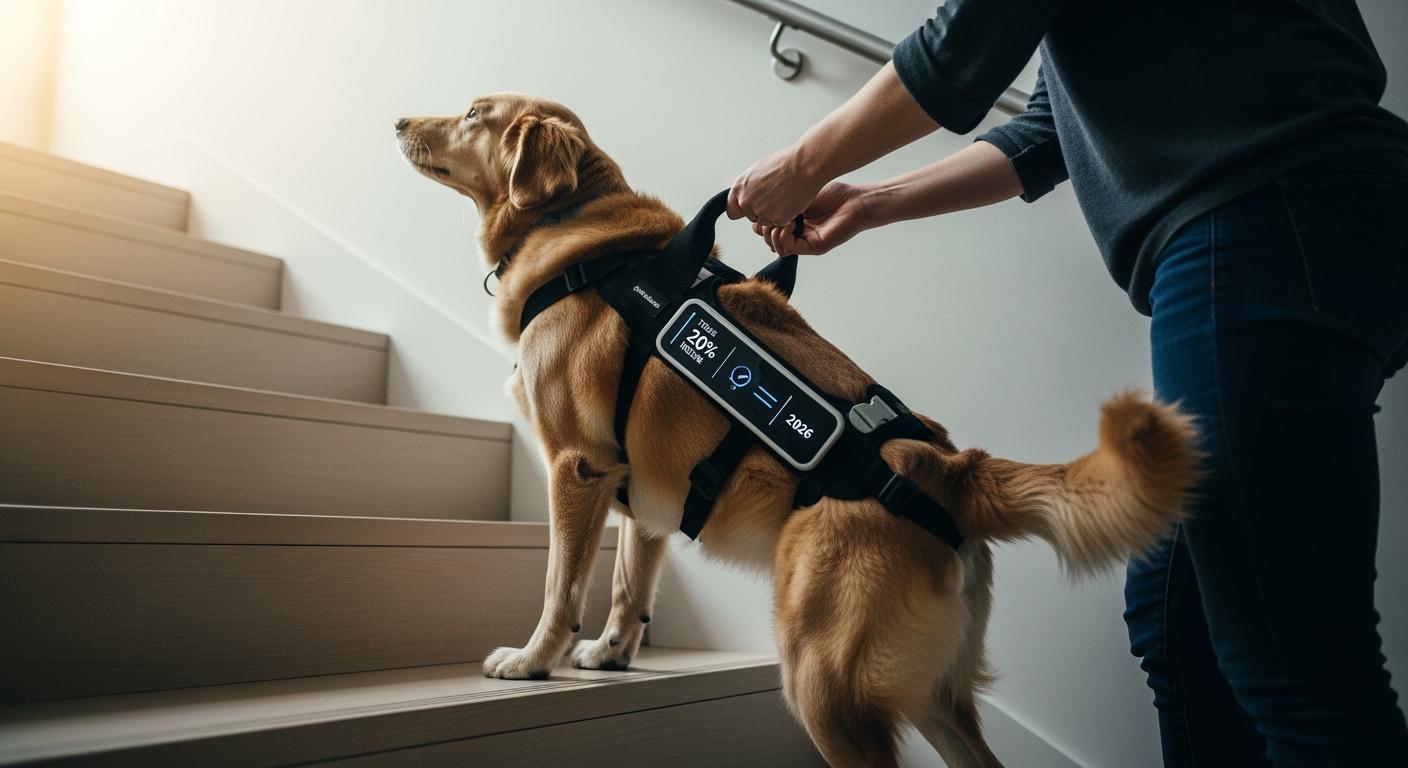
The harness fits. The dog stands steady. You walk to the stairs. On the very first step, the rear sling slides forward—hips to belly in under a second. The dog freezes. That failure is not about lifting strength. It is about where the lift force travels once the angle changes.
A dog rear support harness for stairs with weak back legs faces two problems that flat-ground use never exposes: the sling shifting forward as lift force bypasses the hips, and the front legs becoming the entire braking system on descent. Stairs turn a simple lift into a balance equation the harness either solves or makes worse.
Why Stairs Expose Rear Support Harness Failure That Flat Ground Hides
On level ground, lifting the rear is straightforward. The force vector runs nearly vertical. The harness has little reason to migrate. Stairs change the angle. The moment the dog steps up or down, the lift vector tilts. A narrow rear panel with no shaped cradle cannot redirect that tilted force back under the hips. The sling rides forward.
The causal chain is physical, not mysterious. Lift at an angle creates a horizontal force component. That component pushes the sling toward the path of least resistance—forward, where the belly offers a wider, softer landing zone than the hip cradle the harness should be gripping. A wide rear panel with a contoured hip cradle creates enough surface area perpendicular to that horizontal force to cancel it. A narrow strap does not. The difference between a sling that stays put and one that migrates mid-stair is mostly rear panel width and cradle contour—not strap tightness.
Going down punishes design weaknesses harder than going up
Descending stairs shifts roughly 60% of the dog’s body weight onto the front legs. When the rear harness lifts too much—or lifts from the wrong contact zone—the front legs are left to brake the entire body mass on a decline. If those front legs are already weak, the dog tips forward. Sometimes it scrambles. Sometimes it freezes mid-stair with the rear elevated and the front collapsing.
That is not a training problem. It is a structure problem. A harness with overly long handles lets the handler over-lift without feeling the resistance change. Short, adjustable handles transmit feedback faster. Handle length directly determines how quickly a handler can correct sling position before the dog reacts—a six-inch handle gives near-instant response; a twelve-inch strap adds enough lag that the sling has already shifted by the time the handler feels it.
Tip: After 10 minutes of stair use, run a hand under the rear panel edge. If the panel has moved forward more than half an inch from where you positioned it on flat ground, the cradle contour is not holding against the lift angle.
Two Core Failure Modes: Sling Shift and Front-Leg Braking Overload
A rear harness fails on stairs in two predictable ways. Both trace to structure, not handler error.
| Stair-use problem | Why the rear harness fails | Better structure or support choice |
|---|---|---|
| Rear sling slides forward | Lift force travels into belly | Wider rear panel, shaped cradle, anti-slip lining |
| Dog tips forward on descent | Front legs cannot brake body | Front guide, front-and-rear support |
| Front legs shake or over-brake | Rear lift raises back end too much | Short handles, balanced lift |
| Inner thigh or groin rubbing | Narrow sling edge or wrong position | Broad padded contact area |
| Handler has to over-lift | Handles too long or unstable | Short adjustable handles |
| Dog freezes mid-stair | Pressure, fear, poor traction | Non-slip lining, slower step timing |
Sling shift: when lift force lands in the belly instead of the hips
As the stair angle tilts the lift vector, a narrow rear strap presents almost no surface area perpendicular to the horizontal force component. The strap edges become the only thing resisting forward migration. Edge pressure concentrates on a thin line of skin. The dog feels a pinch. The handler feels the sling move. The dog stops trusting the support—and freezes.
A wide rear panel distributes that horizontal force across a larger contact patch. A shaped hip cradle creates a contour that mechanically resists forward travel because the force would need to lift the cradle up and over the hip structure rather than sliding across it. The structural difference between these two designs determines whether stair use is possible at all for a dog with weak hind legs.
Front-leg braking overload: when the rear lift unbalances the descent
Lift the rear too high—or lift from a sling that has already migrated forward—and the dog’s center of mass shifts onto the front legs. Descending stairs, those front legs now have to brake the full body on every step. For a dog with hind-leg weakness, the front legs may not be strong enough to compensate. The result: forward tipping, scrambling, or a dog that simply refuses to move down.
This is where short handles matter. A long handle lets the handler unconsciously over-lift because the leverage masks how much force is being applied. A short handle—four to six inches from the sling body to the grip point—transmits the dog’s weight directly. The handler feels the resistance change the moment the dog shifts weight and can adjust before the front legs overload.
Note: Walk the dog on flat ground for 30 seconds before approaching stairs. If the rear panel has shifted forward at all on level ground, it will fail on the first stair angle change. Fix the fit on flat ground first.
When a Rear-Only Harness Is Not Enough for Stair Safety
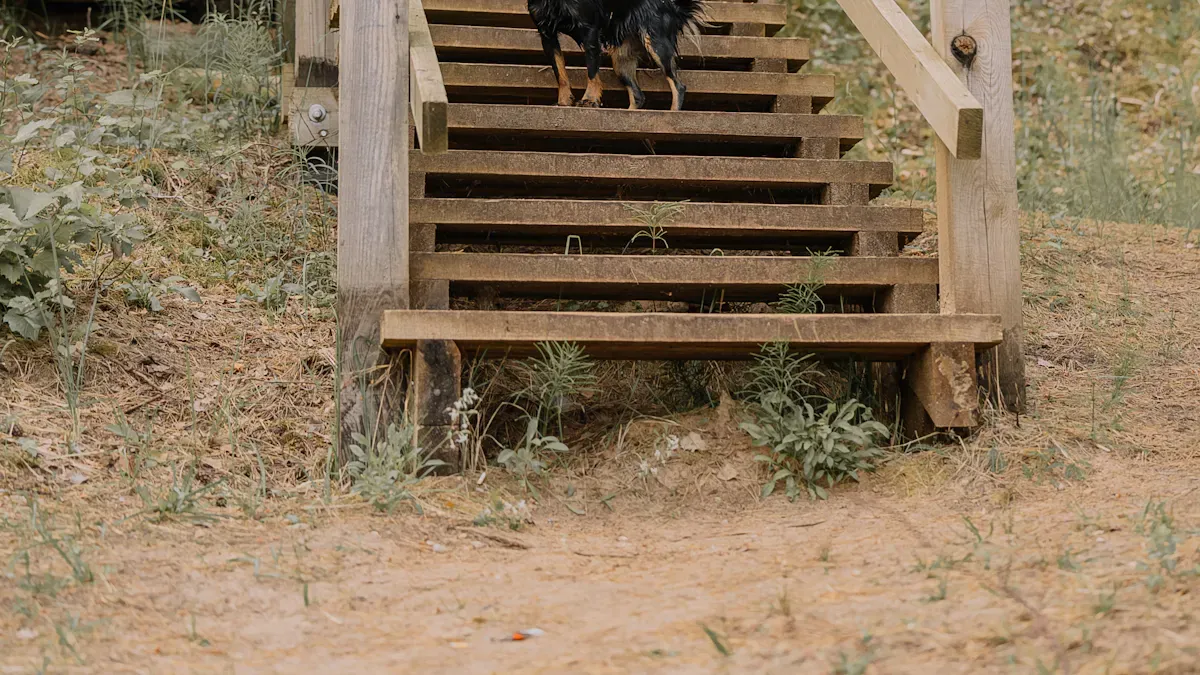
A rear-only harness assumes the front legs can steer and brake. When they cannot, the harness itself becomes a liability—lifting the rear while the front collapses forward. Recognizing that boundary is the difference between a tool that helps and one that creates a new problem.
Signs a rear-only harness is outmatched
The dog freezes at the top of the stairs and will not step down even with rear support. The front paws slide forward on each step because the legs cannot grip and brake simultaneously. The rear rises noticeably higher than the shoulders on descent. Any of these means the front end cannot handle the braking load the rear lift is transferring to it.
Choosing between rear-only and front-and-rear support comes down to whether the front legs can still brake independently under the dog’s full body weight on a decline. If the answer is no—and it often is for large breeds with progressive hind-leg weakness—a full-body harness distributes the braking load across both ends. The handler guides the chest while lifting the rear, and the dog stays level through the entire stair sequence.
When stairs are not the right answer
Some dogs cannot safely use stairs even with a correctly fitted harness. The observable signals are unambiguous: the dog’s topline breaks level by more than an inch on every step, the front paws consistently slip forward, or the dog vocalizes or pants heavily within the first three steps.
A rear lift harness can stabilize a dog with partial hind-leg function on stairs, but it cannot create front-leg braking power the dog does not have. When the braking deficit is too large, a ramp or single-level living arrangement is the safer path. The harness becomes a flat-ground mobility tool instead.
| Color | What you see |
|---|---|
| Green | Dog steps slowly, rear support stays stable, front paws place normally, no panic |
| Yellow | Slight hesitation, minor sling shift, mild rear drop, handler needs more control |
| Red | Slipping, scrambling, forward tipping, pain, collapse, panic, repeated refusal |
Disclaimer: This stair-safety check assumes a short-coated dog where sling position and skin contact are visually verifiable. Double-coated breeds may show subtler rub marks that require hand-checking under the fur rather than visual inspection alone. If the dog’s leg conformation falls outside typical breed proportions—particularly dogs with angular limb deformities or very deep chests—the fit checks described here may not catch every pressure point.
FAQ
Why does the harness stay in place on flat ground but slide forward on stairs?
The lift force on flat ground is nearly vertical, pushing the sling straight up into the hips. On stairs, the angle tilts the force vector, creating a horizontal component that pushes the sling forward. A wide rear panel with a shaped cradle provides enough surface area perpendicular to that horizontal force to resist it. A narrow strap does not.
What is the difference between handle length affecting stair control?
Long handles—roughly ten inches or more from sling to grip—add leverage that masks how much force the handler is applying. The dog’s weight shift reaches the handler’s hand with a delay. Short handles, four to six inches, transmit weight changes instantly. On stairs, where balance shifts with every step, that response time determines whether the handler corrects before or after the sling migrates.
Can a rear support harness be used for dogs with front-leg weakness too?
A rear-only harness lifts the hind end, which transfers more body weight onto the front legs. If the front legs lack the strength to brake that load on a stair decline, the dog tips forward. A full-body harness that supports both ends distributes the braking demand more evenly across the dog’s frame.
How can you tell if the rear panel is wide enough for stair use?
After 10 minutes of stair use, check whether the rear panel has moved forward from its original position. If it has traveled more than half an inch toward the belly, the panel width or cradle contour is insufficient for the lift angles stairs create. Mark the starting position with a piece of tape on the fur before the session to make the check precise.
