
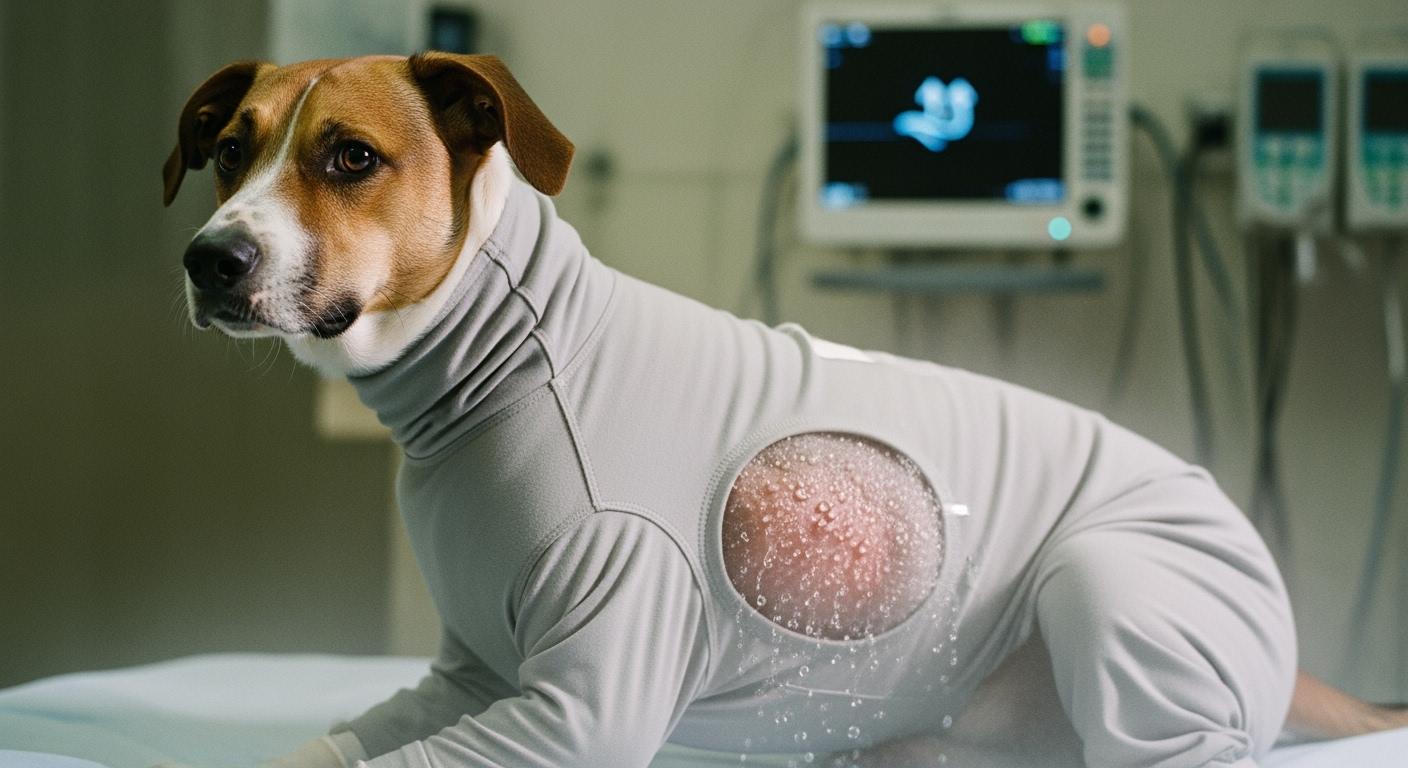
You take the recovery suit off and the skin underneath is damp. Not just warm. Damp. The suit did what it was supposed to do — it blocked licking. But it also sealed in heat and discharge, and the wound sat in that for hours. That is the core failure this article picks apart: a dog recovery suit covers the wound but traps moisture, and the gap between “covered” and “protected” comes down to fabric, fit, and how the coverage matches the actual wound zone.
How a Recovery Suit Traps Moisture Against the Wound
A recovery suit works as a physical barrier. That is not the problem. The problem starts when the barrier does not let air through. Non-breathable fabric pressed against the wound traps transepidermal water loss and wound exudate in a closed pocket. The temperature under the suit rises. Moisture cannot escape. Here is the chain: trapped moisture saturates the outer stratum corneum → skin loses its barrier integrity → the softened epidermis becomes mechanically fragile → microscopic fissures open → bacteria that were sitting harmlessly on the surface now have an entry point. That sequence — fabric barrier → zero airflow → moisture pocket → skin maceration → bacterial access — is what turns a recovery suit from a protective layer into a wound complication. It is not rare. It is the predictable result of pairing a non-breathable textile with a healing wound.
This failure gets worse when the suit covers far more skin than the wound requires. A three-inch incision on the flank does not need the dog’s entire torso wrapped in fabric. Every square inch of healthy skin under that suit generates heat and transepidermal water loss that the fabric traps. The dog’s own thermoregulation adds to it — panting raises core temperature, the body vasodilates near the skin surface, and that heat is now sealed inside the suit. Over-coverage is not just wasteful. It multiplies the moisture load on the wound environment. A well-designed recovery suit program built for post-surgery protection balances coverage against airflow, using mesh panels and quick-dry knits that let vapor escape while keeping the wound shielded from licking and debris.
| Real-use failure | Why it happens | What you see | Better product design |
|---|---|---|---|
| Damp skin under suit | Non-breathable fabric blocks evaporation | Clammy, pale, or wrinkled skin | Breathable mesh panels, quick-dry knit |
| Fabric bunching over wound edge | Loose cut, flat patterning | Redness, linear pressure marks | Body-shaped panels, smooth flat seams |
| Full-body suit for a small wound | Over-coverage, wrong product type | Dog overheats, healthy skin damp | Localized lick sleeve for limb-only wounds |
| Potty area soiling | Poorly shaped or shifting opening | Wet, stained fabric, odor | Stable potty cutout, quick-removal design |
| Limb cuff holding moisture | Tight or absorbent cuff material | Swollen or damp limb | Quick-dry, non-compressive cuffs |
Note: Moist wound healing under a veterinary dressing is a controlled clinical method. Uncontrolled moisture trapped under a recovery suit is a different condition entirely — one accelerates repair, the other breaks skin down.
Where Moisture Builds First — and How to Catch It
Moisture does not build evenly under a recovery suit. It pools in specific zones where airflow is lowest and skin contact is tightest. Knowing where to look — and what to look for — matters more than how often you check.
The belly and groin sit under the thickest fabric and get the least ventilation. After abdominal surgery, these zones collect the most discharge. A simple observable check: remove the suit, press two fingers flat against the skin inside the groin fold for five seconds. Lift and look at your fingers. If they come away glossy or the skin underneath looks pale and wrinkled, moisture has been sitting there long enough to begin softening the outer skin layer. Dry equals safe. Glossy equals a problem starting.
The chest and shoulders are the next failure zone, but for a different reason. Dogs shift their shoulders with every step. That movement bunches fabric into folds. Each fold becomes a microclimate — heat and humidity trapped against a crease of skin. Run your hand along the inside of the suit after the dog has been moving for ten minutes. If you feel fabric ridges lined up with pink marks on the dog’s skin, the suit is bunching and rubbing. A suit with body-shaped panels and smooth flat seams reduces this dramatically by giving the fabric fewer places to gather. The difference between a fabric sleeve that fits well and one that shifts and bunches is explored in more depth when matching recovery sleeve fit to the specific wound location, particularly for dogs with non-standard leg proportions.
The limb cuffs are the third failure point — and the one most often missed. Cuffs sit directly against the leg. If they are made from absorbent material or cut too tight, they wick wound discharge and hold it against the skin. After twenty minutes of wear, slide a finger under each cuff. Dampness there means the cuff is trapping rather than wicking. A properly designed cuff moves moisture outward and dries quickly once the dog is at rest.
| Zone | Common failure | Observable check | Better design |
|---|---|---|---|
| Belly / Groin | Pooled moisture, poor airflow | 5-second finger press — glossy or dry? | Mesh panels, quick-dry fabric |
| Chest / Shoulder | Fabric bunching into folds | Check for pink ridge marks after 10 min of movement | Body-shaped panels, flat seams |
| Limb cuffs | Absorbent, tight cuffs holding discharge | Slide finger under cuff after 20 min — damp or dry? | Quick-dry, non-compressive cuffs |
Alert: Remove the suit immediately if you find damp, smelly, or discharge-stained fabric in any of these zones. Do not reuse the suit until it is completely dry.
One more thing about checking: through-the-fabric checks do not work. Fabric can feel dry on the outside while the skin underneath is damp. You must remove the suit and inspect the skin directly. Twice daily is the minimum. The recovery and anti-lick product category includes designs with quick-release closures specifically to make these checks fast — wide soft Velcro strips and full-length zippers that release in seconds rather than multiple small fasteners that slow you down and make you less likely to check as often as needed.
When a Full Recovery Suit Is the Wrong Coverage Choice
Not every wound needs a full-body suit. Choosing the wrong coverage creates moisture problems that did not need to exist. The decision turns on one question: how much healthy skin are you covering to protect the wound?
A full recovery suit makes sense when the wound is on the trunk — a flank incision, an abdominal surgical site, or multiple hot spots across the belly and chest. In those cases the suit is covering skin that is near the wound zone anyway. The coverage-to-wound ratio is reasonable. But when a single limb has a wound, a full suit drapes fabric across the entire torso, both hind legs, and the groin — all for a four-inch incision on one hock. Every inch of unnecessarily covered skin adds heat and moisture to the environment around the wound. A localized lick sleeve covers only the affected limb and keeps the rest of the body open to air — the trade-off is explored when comparing anti-lick recovery sleeves against broader coverage options, where the moisture risk difference becomes measurable even within a single wear session.
Choosing between a recovery suit and a lick sleeve is not about which is “better.” It is about matching coverage to the actual wound zone. Measure the wound, add a one-inch margin around it, and select coverage that protects that zone without wrapping healthy skin that does not need it. This is how the fit check process for sizing a recovery sleeve for small dogs accounts for body proportion — the sleeve grips above and below the wound without extending onto the body, keeping wear tolerance high and moisture risk low.
| Coverage type | Works for | Moisture risk | Main limitation |
|---|---|---|---|
| Full recovery suit | Trunk, belly, multi-zone wounds | Moderate to high | Overheats healthy skin, traps moisture broadly |
| Lick sleeve | Single-limb wounds | Low to moderate | Only protects one limb; may shift if poorly sized |
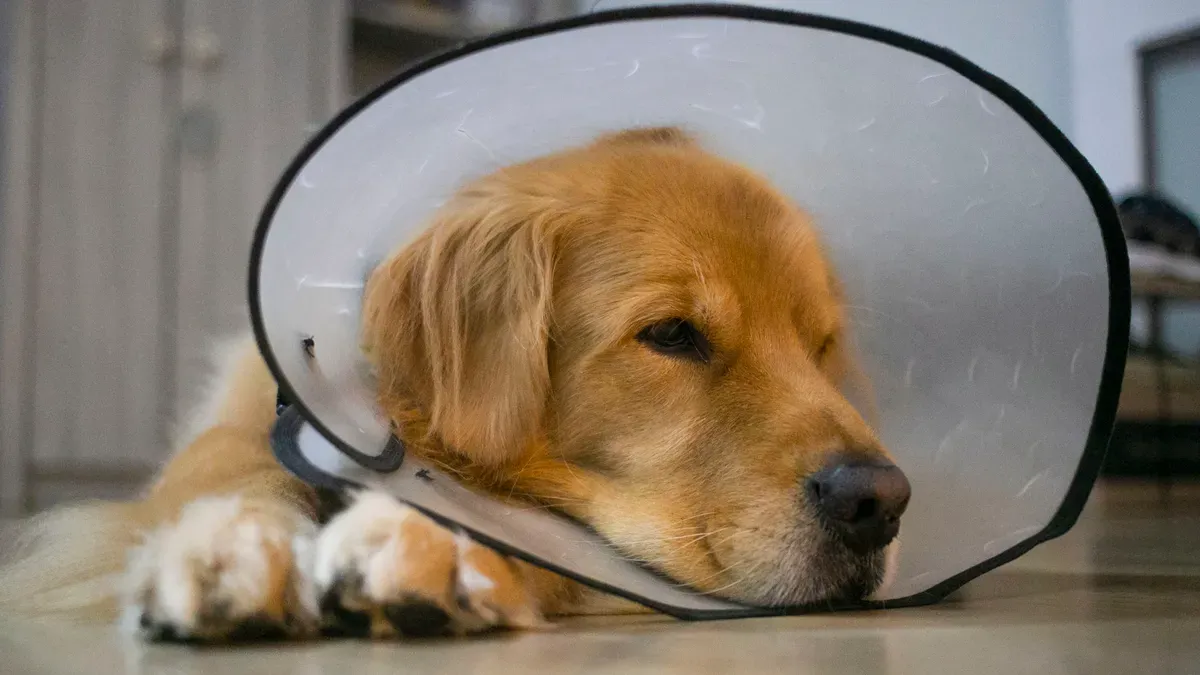
| Recovery collar | Face, head, persistent fabric-chewers | Low | Does not protect wound from environmental contact |
And sometimes fabric coverage is not the answer at all. A dog that persistently chews through the suit or sleeve needs a barrier that cannot be defeated by teeth — a recovery collar, not because suits are bad products, but because the dog’s behavior defeats the fabric barrier faster than the wound can heal.
Disclaimer: The observable checks described here assume a short-coated dog where skin is visible and accessible without parting dense fur. Double-coated breeds and dogs with very thick undercoats may show subtler moisture signs — dampness is often felt before it is seen, and redness hides under the coat. For these dogs, hand-checking through the coat down to the skin surface is more reliable than visual inspection alone. If the dog’s body conformation falls well outside typical breed proportions — particularly dogs with very deep chests or angular limb deformities — the standard fit zones described here may not catch every pressure or moisture point.
Design Features That Change the Moisture Equation
The difference between a suit that protects and a suit that creates a moisture problem often lives in a handful of design decisions — most of them invisible until you know what to look for.
Fabric is the first and largest lever. Breathable knit constructions — cotton-blend jerseys, lightweight mesh panels, and technical polyester knits — let water vapor escape while blocking liquid and debris. The distinction matters: a fabric can be washable without being breathable. Polyester-spandex blends with a tight weave repel water well but trap vapor. Open-knit cotton or mesh panels positioned over heat-prone zones let moisture move outward. The observable test: wear the suit for twenty minutes indoors in a normal-temperature room, remove it, and check whether the inner fabric feels humid to the touch. If it does, that humidity is what the wound sat in. The full wash-dry cycle matters too — proper sleeve washing, air drying, and skin check routines keep the garment performing at its designed moisture-wicking capacity cycle after cycle.
Seams are the second lever — and the one most overlooked. A raised seam running across the wound edge is an abrasion point. Every time the dog shifts position, that ridge drags across healing skin. A suit with flat-lock or covered seams lays smooth against the body and does not create a linear pressure point. In production, flat-seam construction costs more and requires more precise patterning, but it eliminates the single most common physical irritant under a recovery garment.
Closures are the third lever. They need to hold the suit in place during movement without compressing. When a closure squeezes the fabric against the skin, it creates a ring of trapped moisture around the closure point. Wide soft fasteners spread holding force across a larger area and let the fabric underneath breathe. Narrow straps or elastic bands concentrate pressure and moisture in a thin line — the skin underneath stays wet while everything around it dries.
The fourth lever is washability combined with rotation. A single suit, no matter how well-designed, will get wet or soiled. If there is no backup, the choice becomes: reuse a damp suit or leave the wound uncovered. A two-suit rotation — one on the dog while the other washes and dries — eliminates that trade-off. Quick-dry fabrics help, but nothing replaces having a dry garment ready.
Disclaimer: No recovery suit design eliminates the need for direct skin checks. Fabric breathability, seam construction, closure type, and rotation reduce moisture risk — they do not remove it. If the wound status changes — increased discharge, new odor, spreading redness — remove the suit and have a veterinarian evaluate the wound before the suit goes back on.
FAQ
How long can a recovery suit stay on before moisture becomes a problem?
There is no fixed number. The answer depends on the fabric’s breathability, the wound’s exudate level, and the ambient temperature. A suit worn in an air-conditioned room on a dog with a dry incision may stay dry for hours. The same suit on the same dog outdoors in humidity may trap moisture in under thirty minutes. The only reliable method is a direct skin check — remove the suit, touch the skin, and decide whether it is dry enough to continue.
What is the fastest way to tell if moisture is building up?
Press a dry fingertip against the skin under the suit for five seconds. If the skin feels tacky or your finger comes away glossy, moisture is trapped. Dry skin feels smooth and matte. This check takes less than ten seconds and catches the problem before redness or odor appear.
Does a lick sleeve trap less moisture than a full suit?
In most cases, yes — a lick sleeve covers less total surface area, so less healthy skin contributes heat and moisture to the enclosed environment. But the sleeve must fit correctly. A sleeve that is too tight or made from non-breathable fabric can trap as much localized moisture as a poorly designed full suit.
Can you dry a damp suit and put it back on the same day?
Only if the suit is completely dry — inside and out. A suit that feels dry on the surface but holds residual moisture in the inner layer or seams transfers that moisture back to the skin within minutes. Rotating between two suits eliminates this problem entirely.
