
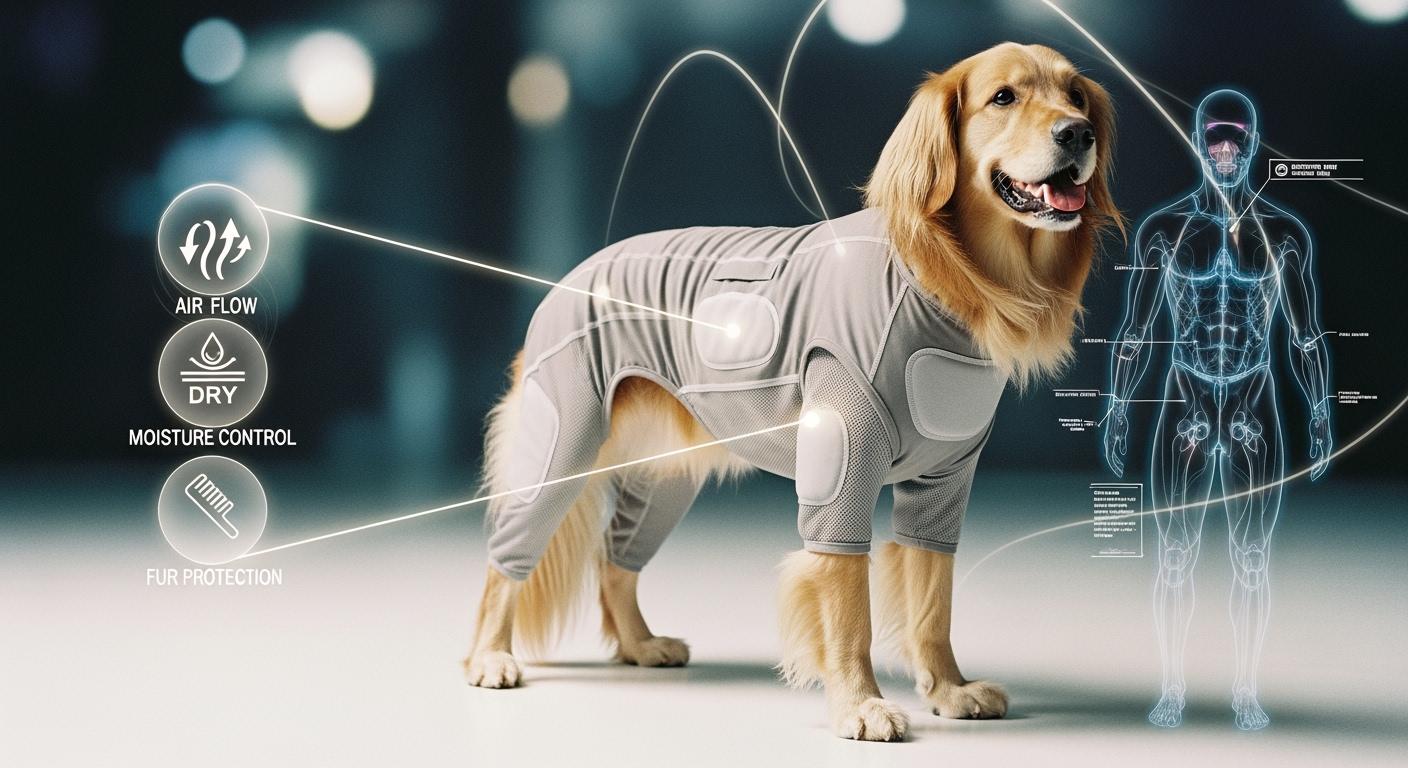
A dog recovery suit for long haired dog matting protects a surgical site or wound, but the same fabric that blocks licking also sets up the exact conditions that weld long hair into mats. Friction from movement, body heat sealed under the panel, and moisture trapped against the skin combine into a mechanical process that no amount of brushing alone can outrun. The question is not whether a suit can cause mats — it is which design features make matting inevitable, and which ones give the coat a fighting chance.
Recovery suits sit at an uncomfortable intersection: they must stay in place on a moving dog, yet the forces that keep them in place — compression, close fit, fabric-to-coat contact — are the same forces that mat long hair. Understanding that trade-off is the difference between a recovery that stays clean and one that trades a healed wound for a shaved-down coat.
Why Long-Haired Coats Mat Under a Recovery Suit
Three forces converge under the fabric. Each one alone tangles hair. Together, they lock it into knots that tighten with every step the dog takes.
The Friction-Moisture-Compression Cascade
Here is the failure chain, step by step. A narrow cuff edge exerts lateral force across a thin contact band. As the leg cycles through walking, hair fibers roll over that edge rather than sliding past it. The rolling motion twists individual hair shafts. At the same time, trapped body heat softens the keratin structure of the hair, making each twist set permanently instead of springing back. Moisture from normal skin respiration then bonds adjacent twisted fibers together. Finally, suit compression presses the bonded mass flat against the skin.
What began as a few crossed hairs becomes, within hours, a dense mat welded to the skin side of the coat. This is not a grooming failure. It is a physical process — friction inputs mechanical twist, heat locks the deformation, moisture creates adhesion between fibers, compression cures the bond. A suit that traps all four forces will mat a long coat regardless of how carefully the dog is brushed beforehand.
You can verify whether moisture is already pooling under the panel: slide a finger under the belly fabric 20 minutes after the dog has been wearing the suit. Damp skin means the fabric is not breathing enough for that coat type. Dry skin means air is moving through the material. This check takes seconds and tells you more about matting risk than any spec sheet.
Why Static and Fabric Type Accelerate the Problem
Fabric choice determines how much friction the coat experiences per movement cycle. Synthetic fabrics with a napped or brushed inner face — common in low-cost suits — create a high coefficient of friction against dog hair. Each stride generates micro-static charges that lift individual hairs toward the fabric surface, where they catch on the nap. Cotton and cotton-blend liners produce less static and a lower friction interface, but they absorb and hold moisture instead of passing it through. There is no perfect fabric. The trade-off is friction versus moisture management, and the right call depends on whether the dog’s coat is dense and curly (moisture-dominant risk) or fine and silky (friction-dominant risk).
| Suit Area | Why Long Hair Mats There | What Failure Looks Like | Better Structure or Fit Detail |
|---|---|---|---|
| Front armpit opening | Multi-axis friction during walking and lying down — highest cycle count of any zone | Tight knots buried under surface hair, hidden until removal | Flat seams, soft binding, correct body length |
| Rear groin opening | Friction during sitting, squatting, and curling postures | Clumped hair, skin redness at fold lines | Covered seams, soft edge, roomy cut |
| Sleeve cuff | Leg flexion rolls long hair over a narrow edge hundreds of times per hour | Matted cuff line, mid-shaft hair breakage | Soft wide cuff, smooth inner surface |
| Belly panel | Sustained compression plus trapped heat and moisture — all three forces at once | Flat dense mats, hair sticky to the touch | Breathable fabric, flat seams |
| Zipper or snap line | Mechanical hair capture at closure — single strands pulled into teeth or snap housing | Linear knots beside closure track, localized hair loss | Low-profile closure, internal hair guard flap |
| Shoulder/hip transition | Suit tension cycles as the dog shifts between standing, sitting, and curled positions | Mats concentrated at seam lines, hair bunching at stretch boundaries | Stretch panel inserts, correct body length |
| Option | Better For | Matting Risk | When to Switch |
|---|---|---|---|
| Full recovery suit | Torso or multi-zone wound coverage | High — full-body friction, heat, moisture, and compression on most of the coat | When the wound needs full coverage; monitor mats at every check |
| Recovery sleeve | Localized limb coverage only | Lower — reduced body coverage limits friction and heat to one zone | When mats form under a full suit repeatedly, or only one limb needs protection |
| Cone or collar | Preventing licking and chewing | None — zero fabric contact with the coat | When the dog bypasses the suit, or the wound needs unrestricted airflow |
Note: No suit eliminates matting risk entirely on a long-haired dog. The right design reduces the four forces — friction, heat, moisture, compression — but daily inspection is the only way to catch what the fabric hides.
Where the Suit Fails First on Long-Haired Dogs
You can verify which zones are at risk on your dog with a simple movement check. After 10 minutes of normal walking, unfasten one cuff and part the hair at the cuff line. If the hair has shifted more than half an inch from its original lay, the cuff is rolling the coat with every stride. Shifted hair in that zone means mats are forming at a rate proportional to wear time. No shift means the cuff-to-coat interface is stable for that dog’s movement pattern.
Armpits and Groin Openings
These openings are the highest-risk zones for a structural reason: the edge of the suit crosses a joint that flexes through a wide range of motion. Every degree of joint movement slides the fabric edge across a fresh section of coat. On a dog that walks, sits, and curls up repeatedly over a 12-hour wear period, a single armpit opening can accumulate thousands of edge-to-coat passes. The hair at that opening has no chance to recover its natural lie between passes.
Check these zones by parting the hair at the opening edge after the dog has been moving for 30–60 minutes. Look for hair that has twisted from its natural growth direction, clumped strands, or any redness on the skin beneath. These are the early signals — visible before a full mat locks in.
Cuff Edges and Closure Tracks
Cuff edges concentrate lateral force onto a narrow band. The narrower the cuff, the higher the pressure per linear inch, and the more aggressively it rolls hair. A cuff that is a quarter-inch wide applies roughly four times the per-fiber pressure of a one-inch cuff at the same overall tension. That is why wide, soft-bound cuffs are not a comfort feature — they are a mechanical necessity on long-coated breeds.
Closure tracks create a different failure mode: mechanical capture. When a zipper tooth or snap housing sits in a high-motion zone, individual hair strands get pulled directly into the mechanism. The damage is linear and localized, following the closure line. A sleeve that shifts and bunches during wear can create similar linear friction patterns along its edges. The fix is a low-profile closure with an internal hair guard flap — a strip of fabric that sits between the zipper teeth and the coat, preventing direct contact.
Belly Panels and Compression Zones
The belly panel is where all three forces — friction, heat, and moisture — operate under constant compression. Unlike the armpit, which sees intermittent friction during movement, the belly panel maintains steady pressure whether the dog is walking or lying down. That sustained compression accelerates every stage of the matting cascade described earlier.
After removing the suit, run your fingers against the grain of the coat across the entire belly. If any patch feels tacky or resists your hand, moisture has been pooling there. That patch is a mat in progress. Let the coat air-dry fully — mats that are caught at the “tacky” stage can usually be worked out with a pin brush. Mats left to the next wear cycle will likely need to be cut out.
In practice: Rotating two suits — one on the dog, one clean and dry — cuts the moisture-half of the matting equation nearly in half. A damp suit put back on a dry coat restarts the cascade immediately. This is why a single suit, no matter how well designed, gets outrun by moisture on dense-coated breeds.
Design Features That Reduce Matting vs. Ones That Cause It
Inner Fabric: Smooth vs. Textured
The inner face of the fabric determines the baseline friction level. A napped, brushed, or fleece-like inner surface acts as a micro-grip on long hair — each fiber of the nap is a potential snag point. On a dog that moves, the inner fabric cycles across the same coat band repeatedly. A textured inner face creates hundreds of micro-snags per cycle. A smooth, tightly woven inner face lets the hair glide instead.
The trade-off: smooth fabrics manage friction well but absorb less moisture. Textured fabrics wick moisture but grip hair. For a double-coated breed in a humid climate, moisture management may outweigh friction reduction. For a silky single-coated breed in a dry climate, friction reduction is the priority. There is no universal best — only the right match for the coat type and environment. The recovery suit designs that perform best on long-haired dogs tend to prioritize the friction side of this trade-off because matting — not dampness — is the primary failure mode for long coats.
Seam Construction: Flat vs. Raised
A raised seam is a linear snag line. On a moving dog, that seam rubs the same narrow band of coat hundreds of times per hour. The contact is concentrated — all the force between the suit panel and the dog’s body channels through that raised ridge. Hair fibers caught under that ridge get twisted and compressed with every movement cycle. Flat seams or covered seams distribute contact force across a wider surface, so no single line of hair absorbs the full abrasion load.
Run your thumb along the inside seams of a suit before putting it on a long-haired dog. If you can feel a ridge, the coat will feel it more. That ridge is a mat-forming tool in waiting.
Cuff Binding: Wide and Soft vs. Narrow and Firm
Cuff binding is the single most consequential design choice for long-haired dogs. The physics is straightforward: cuff tension divided by cuff width equals pressure per linear inch on the coat. A narrow firm cuff concentrates the full opening tension onto a quarter-inch contact band. That band works like a hair roller — twisting, compressing, and locking every hair fiber it touches. A wide soft cuff spreads the same tension over an inch or more, reducing per-fiber pressure enough that the hair retains its natural lie through the full range of leg motion.
After 30 minutes of wear, run a finger under each cuff. If the hair feels crimped or bent at the cuff line, the binding is too narrow for that coat density. The damage accumulates with wear time.
When a Recovery Sleeve Is the Safer Choice
A recovery sleeve limits coverage to a single limb, which eliminates matting risk everywhere else on the body. If the wound is on one leg and the dog’s coat mats quickly under full-body fabric, a sleeve plus a cone for licking prevention may produce a cleaner recovery than a full suit alone. The sleeve leaves the chest, belly, and opposite limbs exposed to air — the dog can thermoregulate, moisture can evaporate, and inspection takes seconds instead of minutes.
Signs that a sleeve is a better match than a full suit:
- The wound is on a single limb, not the torso.
- Mats repeatedly form under the belly panel or armpits despite twice-daily checks.
- The dog pants, scratches at the suit, or shows signs of heat stress within the first hour of wear.
- You cannot inspect or access the covered coat without fully removing the suit.
The choice between a sleeve and a cone comes down to whether the wound needs fabric contact at all. A cone applies zero fabric to the coat — zero matting risk. A sleeve applies fabric to one zone only. A full suit applies fabric to most of the body. Each step up in coverage increases protection and increases matting risk in lockstep. For long-haired dogs, the rule is simple: cover the smallest area that still protects the wound adequately. More fabric is not better — it is just more friction surface.
Disclaimer: The fit checks and zone inspections described here assume a short-to-medium coated dog with a straight or wavy coat texture. On double-coated breeds with a dense undercoat — particularly huskies, malamutes, Samoyeds, and similar Arctic breeds — mats may form between the undercoat and guard hair layers where visual inspection cannot see them. On these breeds, hand-checking by feel (running fingers against the grain under the suit) is more reliable than visual inspection. If the dog’s leg conformation falls outside typical breed proportions — particularly dogs with angular limb deformities or very deep chests — the cuff and opening pressure points described here may shift, and fit checks may not catch every pressure concentration.
Daily Inspection: What to Check and When to Stop
A dog recovery suit for long haired dog matting demands a specific inspection rhythm — not generic “check your dog” advice, but checks timed to the matting cascade itself.
Before the suit goes on: brush and separate coat down to the skin across every zone the suit will cover. Smooth all hair in the direction of growth. Any hair left twisted or crossed before the suit goes on will become the seed of a mat within hours.
After 30–60 minutes of wear: remove the suit. Part the hair at every opening edge — armpits, groin, cuffs, neckline. Check the belly panel zone by feel. If the hair lies flat and smooth in the growth direction, the suit-to-coat interface is stable. If any patch resists your fingers or feels tacky, the cascade has started.
First day: repeat the full removal-and-inspect every 2–4 hours. This establishes a baseline for how fast the dog’s coat responds to that specific suit. Some coat types show no change at 4 hours. Others show early tangles at 2. The baseline tells you the inspection interval for the remaining recovery period.
Ongoing: twice-daily full removal and inspection — once in the morning, once in the evening. Remove loose hair from the suit’s inner surface before every wash. Air-dry the suit; heat from a dryer can shrink or warp binding materials, changing cuff pressure in ways that are not visible but are mechanically real.
Stop using the suit and switch to a cone or sleeve if: mats tighten against the skin and cannot be worked out with a brush, skin under any contact zone turns red or feels hot, the wound area changes in appearance, or the dog begins chewing at the suit obsessively. These are not fit problems — they are signals that the risk-reward balance of full-body fabric has tipped too far toward risk for that particular dog, coat, and wound combination. Browse the full range of anti-lick and recovery products to evaluate alternatives that may match the dog’s coat type and wound location more precisely.
FAQ
Why does my long-haired dog still get mats under a recovery suit even with daily brushing?
Brushing removes tangles before the suit goes on, but it does not stop the friction-moisture-compression cascade that runs continuously under the fabric. The suit generates new tangles faster than daily brushing can clear them, especially if the inner fabric is textured, the cuffs are narrow, or the seams are raised. The fix is not more brushing — it is a suit with design features that reduce the rate at which new tangles form, combined with twice-daily inspection to catch them at the “tacky” stage before they lock.
Which areas mat first — and why those zones specifically?
| Suit Area | Why Mats Form | What Failure Looks Like | Better Structure or Fit |
|---|---|---|---|
| Armpit opening | Multi-axis friction — highest cycle count of any zone | Tight knots, hidden under surface hair | Flat seams, soft binding |
| Groin opening | Friction plus moisture concentration in body folds | Clumped hair, skin redness | Covered seams, roomy opening |
| Sleeve cuff | Narrow edge rolls hair with every leg flexion | Matted cuff line, hair breakage | Soft wide cuff |
| Belly panel | Sustained compression plus trapped heat and moisture | Flat dense mats, sticky texture | Breathable fabric, flat seams |
| Zipper line | Mechanical hair capture in closure teeth | Linear knots, localized hair loss | Low-profile closure, hair guard flap |
| Shoulder/hip | Tension cycles as posture changes | Mats at seam lines, bunching | Stretch fabric, correct body length |
When should I switch from a full suit to a recovery sleeve or cone?
Switch when mats tighten against the skin despite regular inspection, when skin under contact zones turns red or hot, or when the dog chews or scratches at the suit persistently. A sleeve protects a single limb and eliminates matting risk everywhere else. A cone eliminates fabric contact entirely. Both are valid downgrades in coverage that increase matting safety. Ask a veterinarian whether the reduced coverage still protects the wound adequately before making the switch.
What design features actually reduce matting on long-haired dogs?
Four features matter most. A smooth, tightly woven inner fabric reduces the baseline friction that initiates tangles. Flat or covered seams eliminate the linear snag lines that raised seams create. Wide, soft-bound cuffs spread tension across enough surface area that hair retains its natural lie through movement. An internal hair guard flap behind zippers and snaps prevents mechanical capture of individual strands. These are not comfort preferences — they directly reduce the four forces (friction, heat, moisture, compression) that drive the matting cascade on long coats.
