
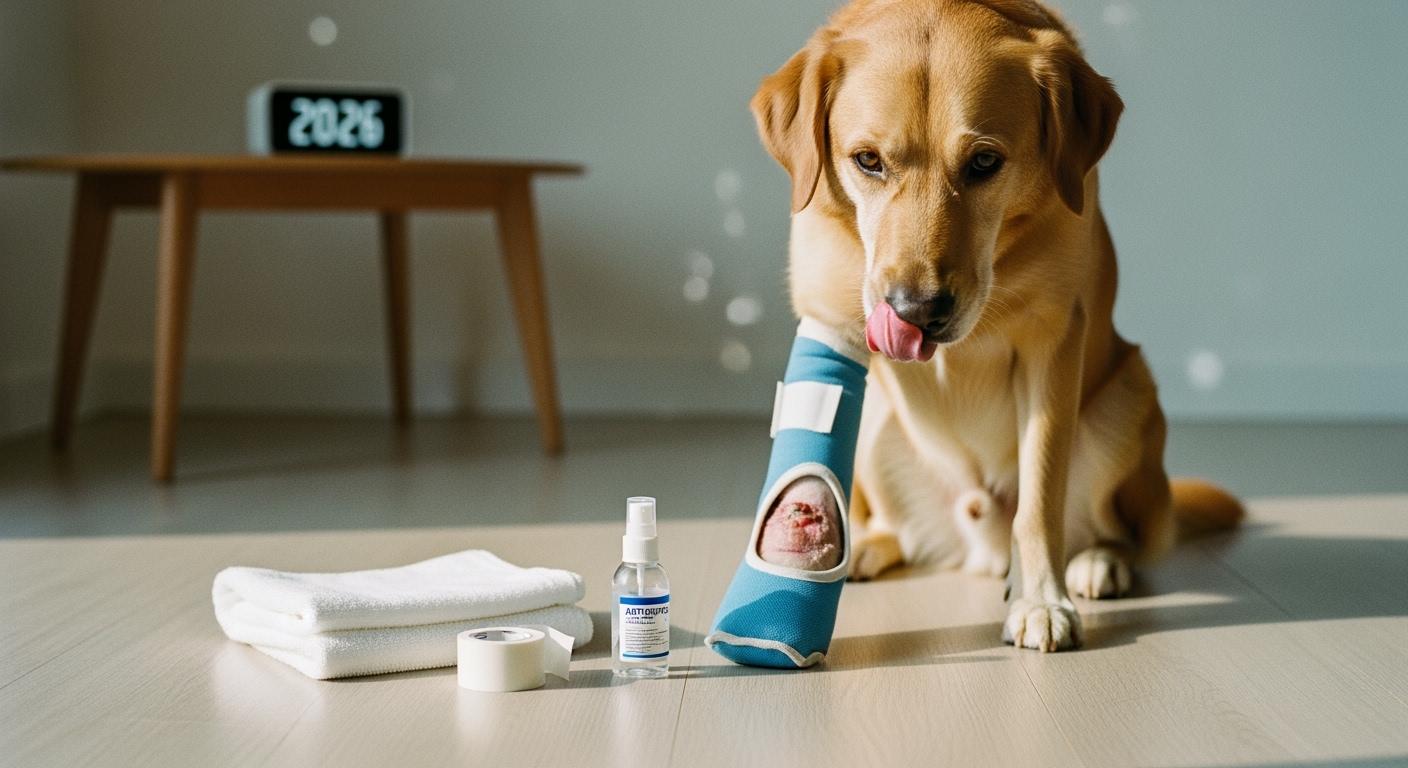
The sleeve looked secure when the dog stood up. An hour later the fabric over the incision is damp. Not soaked through from water. Wet from saliva.
That changes everything about how you evaluate the product. A dry sleeve that stays dry means the barrier is working. A wet sleeve means the dog found a way in. The question is not “how do I wash this.” The question is which access route the tongue used—and whether the sleeve’s design can ever block it.
Veterinary instructions always override general product guidance. If redness, swelling, discharge, or odor accompany the wet fabric, contact a veterinarian before troubleshooting the sleeve.
Wet Fabric Over an Incision Is a Barrier Failure, Not a Laundry Problem
Moisture sitting against a surgical site does two things at once. It softens the protective scab layer that seals the wound from bacteria. And it signals that the physical barrier—the sleeve—has been breached. The fabric that was supposed to block the tongue became the surface the tongue worked through, under, or around.
This is not about washing frequency. Washing removes bacteria that have already colonized the damp fabric, but it does nothing to close the access route. Put a freshly laundered sleeve back on a dog that can still reach the incision, and the fabric will be wet again within the same wear session.
The causal chain is a mechanical one, not a hygiene one. Every route a tongue takes through or around a sleeve follows predictable physics. A knit with low stitch density under tension from a dog’s curled posture opens micro-channels between yarns—channels wide enough for moisture transfer in both directions. Saliva wets the outer face, capillary action pulls it through to the inner face, and the incision gets damp. The sleeve did not “get dirty.” It transmitted moisture because the fabric structure, under the load condition of a curled dog, lost its barrier density.
The same mechanical logic applies to edge gaps. When a sleeve cuff sits perpendicular to the leg at standing inspection, it looks sealed. But when the dog tucks the leg under its body, the thigh circumference changes. If the cuff lacks independent elastic recovery—meaning the elastomeric component cannot return the fabric to its original circumference after stretch—the edge opens a crescent-shaped gap. The tongue finds it fast. Checking fit only while the dog stands misses every posture-driven gap that matters.
Keep in mind: recovery sleeve fit depends on posture, not just standing measurement. A sleeve that passes a standing inspection can fail completely when the dog curls up.
Three Access Routes: How the Tongue Beats the Sleeve
Through the fabric
Not all knits block a tongue. Lightweight single-jersey fabric, common in budget sleeves, stretches easily under wet conditions. When saliva saturates the yarn, the fiber swells slightly but the stitch structure elongates—the loops slide past each other rather than holding their interlock. The result is a fabric that is thinner when wet than when dry. A tongue pressing against it repeatedly does not need to tear anything. It just works moisture through the thinned knit, one pass at a time.
How to check: after 20 minutes of wear, run a dry fingertip across the inside of the sleeve directly over the incision site. Dampness on the inner face confirms penetration. Dry inner face with damp outer face means the outer got wet incidentally. Damp inner face means the tongue reached through.
Under the edge
The edge that matters most is the one closest to the incision. If that edge sits within an inch of the wound, the dog does not need to be flexible. A simple chin tuck brings the tongue to the fabric boundary. If the edge lacks an anti-roll construction—a folded hem with internal elastic or a bonded silicone grip line—body heat and movement cause it to curl outward. The curl creates a small ramp. The tongue rides up the ramp and under.
Edges also fail when the sleeve length was sized for a standing dog but the wound sits near a joint. Knee and hock incisions are particularly vulnerable because joint flexion changes the distance from the wound to the nearest fabric edge with every step. A sleeve that covers the incision with a half-inch margin at full extension may leave zero margin at full flexion.
How to check: after the dog sits, curls, and lies down, mark the sleeve edge position relative to a fixed anatomical landmark—a joint prominence, a skin fold, a visible vein. Walk the dog for five minutes and check again. If the edge has moved more than half an inch relative to that landmark, the sleeve is shifting under normal use and tongue access is likely.
After the sleeve shifts
Shift is distinct from edge roll. Edge roll is local—the cuff curls. Shift is global—the entire sleeve migrates down the leg. The mechanism is usually anchor-point failure. A sleeve held only by top and bottom elastic bands creates two narrow friction rings. Under the cyclic shear of walking, those narrow bands rotate. One band rotates clockwise, the other counterclockwise, and the fabric tube between them twists and slides.
Wider anchor bands distribute shear across more fabric surface area. A three-inch top band resists rotation better than a half-inch elastic because the torque from leg movement must overcome friction across a larger contact patch. Sleeves with a mid-panel anchor point—a third elastic segment positioned between joints—create a triangulated hold that resists both rotation and linear migration.
Here is a table to help identify which failure mode is active:
| Problem seen | Why it fails | Better structure or product direction | When to stop and call the vet |
|---|---|---|---|
| Sleeve wet directly over incision | Knit density too low; fabric thins when wet; tongue penetrates without tearing | Denser knit with wet-strength retention; double-layer panel over wound zone | Redness, swelling, discharge, odor |
| Sleeve wet near an edge | Edge lacks anti-roll construction; cuff-to-wound margin insufficient during joint flexion | Folded hem with internal grip; extended coverage so margin stays positive in all postures | Wound opening, pain, repeated licking |
| Sleeve slides or twists after walking | Narrow anchor bands rotate under cyclic shear; no mid-panel stabilization | Wide anchor zones; third anchor point between joints; elastic recovery that returns to original circumference | Bleeding, wound exposed, swelling |
| Fabric shows tooth marks or fraying | Material lacks tear resistance for the dog’s bite force | Heavier denier yarn; tighter weave structure; supplemental barrier layer | Chewing persists, wound damage |
| Belly or torso incision exposed | Sleeve geometry designed for limb only; no trunk coverage | Recovery suit for abdominal wounds; lick sleeve solutions match specific wound locations | Any sign of infection or wound opening |
| Wet fabric returns after every wash and refit | Barrier design cannot block the dog’s access route regardless of cleanliness | Switch product category; add physical barrier like a cone; combining a sleeve with a cone closes more access paths | Licking continues, wound not healing |
What Coverage and Fit That Actually Hold Up Look Like
Fit stability depends on more than circumference matching. A sleeve cut from a straight tube of fabric will slide on any leg that is not itself a straight cylinder—which is every dog leg. The thigh tapers. The hock angles. A cut that accounts for anatomical taper, with graduated circumference from top to bottom, creates natural resistance to downward migration. It also eliminates the loose fabric pocket that forms above a narrow ankle band—a pocket the dog can mouth and pull.
Hind-leg sleeves fail most often from a combination of taper mismatch and insufficient anchor width. A sleeve that stays put on a front leg may slide immediately on a rear leg because the muscle profile and joint angles differ. The product shape has to match the limb it is designed for—front-leg and hind-leg geometries are not interchangeable.
Material choices matter in ways that only become visible under sustained use. A polyester-spandex blend knit at the right stitch density holds its barrier property when wet because polyester fibers absorb less than 1% of their weight in moisture—they do not swell and distort the knit structure. Cotton blends, by contrast, absorb far more and swell enough to either loosen the knit or tighten it unpredictably. In production, polyester-spandex knits also offer more consistent stitch density from batch to batch, which means the barrier performance of the sleeve is reproducible at scale rather than varying with each fabric roll.
Here is a signal-level table for evaluating sleeve performance during use:
| Signal level | What you see | Decision direction |
|---|---|---|
| Green | Sleeve stays centered after sitting, curling, and walking; inner face stays dry over incision; dog ignores the sleeve | Continue supervised use with posture-change checks every wear session |
| Yellow | Sleeve slides less than one inch; edge dampness but inner face dry; brief licking that stops when redirected | Adjust fit, shorten wear interval, verify coverage margin in curled position |
| Red | Fabric damp on inner face over incision; edge has shifted more than one inch; tooth marks; swelling, heat, discharge, or odor at wound | Remove sleeve, switch to backup garment, contact veterinarian |
Washing and drying between uses restores hygiene but does not restore barrier integrity if the fabric structure has been degraded. Check the knit under bright light after every wash: stretched-out areas, thinned patches, or distorted elastic sections mean the sleeve should be replaced, not reused.
When a Lick Sleeve Is Not the Right Barrier
A lick sleeve works within a defined envelope. Limb incisions on the front or hind leg, positioned away from joints, with the incision length fully covered and at least an inch of margin at both edges in the dog’s tightest curl—that is the envelope. Outside it, the product is the wrong tool for the job.
Belly and torso incisions fall outside the envelope. A limb sleeve cannot anchor to the trunk, cannot follow the compound curvature of the abdomen, and cannot maintain coverage when the dog lies flat. A recovery suit that wraps the torso and fastens along the back provides coverage that moves with the body rather than fighting against it. Anti-lick products designed for torso wounds use a different anchoring strategy entirely—the closure runs along the dorsal line, which stays relatively stable regardless of leg position.
Multiple wounds also push past the envelope. A sleeve sized for a stifle incision leaves the hock exposed. A suit sized for a spay incision leaves a foreleg wound uncovered. Two separate products may be needed, or a combination of sleeve and suit. Standing fit checks will not reveal coverage gaps across separate wound sites—each wound must be checked independently in standing, sitting, and curled positions.
Some dogs defeat fabric barriers regardless of design quality. Deep-chested breeds with long necks can reach hind-limb incisions that are geometrically inaccessible to shorter-necked dogs. A dog with pronounced hind-leg angulation can curl tightly enough to bring the mouth within tongue-reach of a wound that a typical conformation dog could not touch. In these cases, a fabric-only barrier is the wrong approach. Adding a cone or similar rigid barrier closes the access path that anatomy keeps open.
Disclaimer: The fit checks and margin guidelines described here assume a short-coated dog where fabric edges and skin landmarks remain visually trackable. Double-coated or densely furred breeds may hide subtle rub marks, pressure points, or small edge gaps behind the coat—these require hand-checking by running fingers under the sleeve edge rather than visual inspection alone. If the dog’s leg conformation falls well outside breed-typical proportions, particularly in dogs with angular limb deformities or very deep chests relative to leg length, the standard margin recommendations may not catch every pressure point or tongue-access gap. In these cases, shorter supervised wear intervals with more frequent inner-face dryness checks are the safer baseline.
FAQ
Why does the sleeve stay dry all day and then suddenly get wet in one spot?
Intermittent wetness usually points to posture-dependent access. The dog only reaches the wound in one specific position—often when curled for sleep. The sleeve fits well in every other posture, so the fabric stays dry until that one gap opens. Identify the position where licking happens by checking the sleeve immediately after the dog changes posture from sleeping to standing.
What is the difference between a sleeve that fails at the edge and one that fails through the fabric?
Edge failure produces wetness concentrated near a cuff or hem boundary. Through-fabric failure produces wetness directly over the wound center, with no obvious edge gap. The fix for edge failure is coverage extension or anti-roll construction. The fix for through-fabric failure is higher knit density or a double-layer wound-zone panel. Swapping solutions without identifying which failure is active tends to repeat the same wet-sleeve result with a different product.
Can a recovery suit replace a lick sleeve for a leg incision?
Not directly. Recovery suits cover the torso well but most do not extend far enough down the leg to cover stifle or hock incisions. A full-coverage suit paired with an integrated leg sleeve can work, but a standalone limb sleeve remains the more targeted choice for leg-only wounds—provided the sleeve’s coverage margin and anchor stability hold up in the dog’s range of postures.
