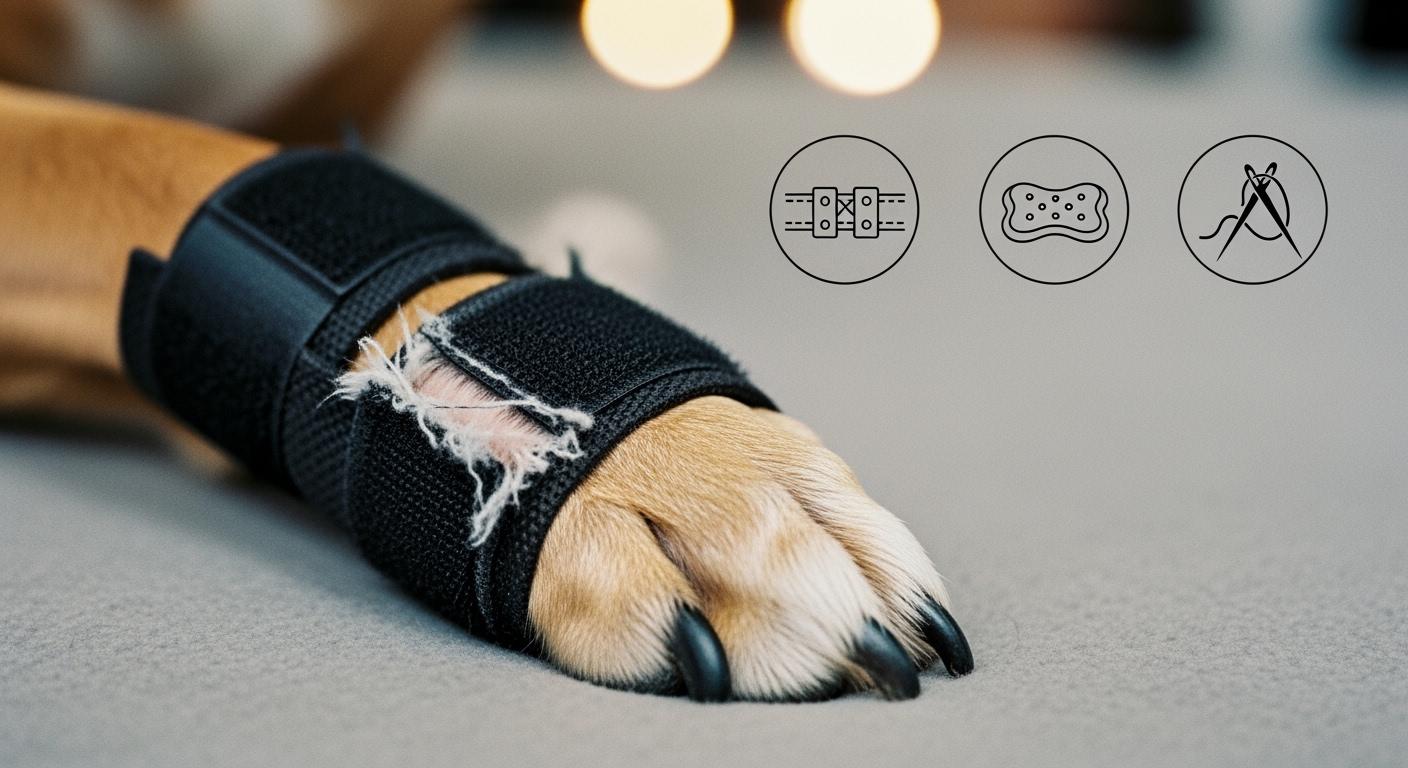
The strap on a toe dragging brace faces a load test every step the dog takes. Each time the paw drags, tension spikes at the anchor point. Dirt, grit, and repeated friction work the lower edge. Within a few walks the strap frays, stretches, or tears clean through at the stitching. You tighten it. The paw still scrapes. The strap fails again, faster this time.
The breakage is not random. It follows the same two patterns across most toe dragging braces: stress concentration at a narrow anchor, and abrasion along a strap path that sits too close to the ground. Once you see which pattern is at work, the fix becomes obvious. Often it is not more tension.
Why the Strap Breaks During Real Walks
A toe dragging brace strap breaks for two reasons that compound each other. The first is mechanical: every step that drags the paw converts forward motion into a sharp pull at the anchor. The second is environmental: if the strap rides low enough to touch the ground, that same pull becomes an abrasive event.
Toe drag turns every step into a strap load test
When the paw drags, the strap must lift the toes against the ground. That lifting force travels up the strap and concentrates at the anchor point. A narrow anchor focuses the entire load onto a few millimeters of stitching. That stitching sees peak tension on every stride. Over hundreds of strides per walk, the thread fatigues. A strand parts. The surrounding stitches take the extra load. The tear propagates.
Rotation makes it worse. If the brace shifts on the leg, the strap pulls at an angle instead of straight up. The lifting force now has a lateral component the anchor was never designed to handle. Stitches peel apart rather than holding in-line tension. A strap that rotates even 20 degrees off center loses meaningful vertical lift. At 45 degrees, nearly a third of the lifting force redirects sideways. The paw still drags, but now the strap is also twisting against its attachment.
A narrow strap under moderate hand tension easily exceeds the pressure needed to slow venous return in the digital vessels. Blood flow drops. Fluid accumulates in the interstitial space. That swelling increases internal tissue pressure, which the strap now compresses against. Tighten. Compress vessels. Swell. Tighter effective fit. More compression. The paw grows larger and more vulnerable while it continues to drag.
Ground friction damages the lower strap edge first
When the strap path sits low, the lower edge contacts the ground on every drag stride. Hard strap edges focus bending stress right where the material meets skin. Abrasion starts as surface fuzz, then deepens into broken fibers, then a tear. A rounded edge profile reduces this stress concentration. A soft inner lining decreases the shear forces transmitted through the material during ground contact.
The check is simple. After a 10-minute walk, run your thumb along the lower strap edge. If it feels rough or fuzzy compared to the upper edge, ground contact is the cause. On rough concrete or gravel, this damage accumulates in a single walk. On smooth floors it may take weeks. But the pattern is the same: the strap wears from the bottom up.
Tightening harder can accelerate the failure
The instinct is to pull the strap tighter when the paw still drags. That instinct is wrong. Tighter tension increases the load on the anchor stitching on every stride. It also increases the compressive force on the paw, which can trigger swelling. A swollen paw occupies more volume inside the same strap circumference, which means the effective fit gets tighter still. The strap is working harder, under worse conditions, and failure comes sooner.
A better knuckling support solution spreads that load differently. Instead of a single narrow anchor fighting every drag stride, a wide anchor zone distributes tension across multiple attachment points. The difference is the difference between pulling on a single thread and pulling on a woven panel.
Failure Diagnosis Table: Common Strap Breakage Patterns and Causes
| What you see | Most likely failure reason | Why tightening may not fix it | Better design direction |
|---|---|---|---|
| Strap snaps near the anchor | Narrow anchor, weak stitching | Tension overloads a small area | Wider anchor, reinforced stitching |
| Strap frays underneath | Strap contacts floor, friction | More tension increases ground abrasion | Raised strap path, abrasion-resistant layer |
| Strap loosens after minutes | Elastic fatigue, poor closure | Tighter fit may still slip or stretch | Stable buckle, non-slip adjustment |
| Paw still drags | Wrong tension direction, poor grip | Tighter strap does not align lift | Aligned toe-lift path, traction outsole |
| Brace twists sideways | Narrow strap, poor anchor | Tighter strap increases twisting force | Multi-point anchor, wide strap |
| Dog chews the strap | Rubbing, pressure, poor fit | Tighter strap increases discomfort | Stop use, reassess fit and comfort |
Fit Problems That Make Strap Breakage More Likely
A strap does not fail in isolation. The fit of the brace determines how much load the strap sees, at what angle, and against what surfaces. Three fit problems show up repeatedly when a toe dragging brace eats straps.
The strap path sits too low and touches the floor
A strap routed close to the walking surface takes abrasion on every drag stride. The lower edge frays. Fibers separate. The effective cross-section of load-bearing material shrinks, which means the stress on what remains goes up. The failure accelerates toward the end.
You can check this in 30 seconds. Walk the dog 10 minutes on pavement. Kneel down. Look at the strap from the side. If the lower edge sits closer than a quarter inch to the ground at mid-stride, it is making contact. A properly routed toe-up strap path keeps the strap elevated above the walking surface through the full stride cycle. The lift still works. The abrasion disappears.
The brace rotates and pulls the strap sideways
Rotation is a strap killer. When the brace body twists on the leg, the strap no longer pulls along its intended axis. Instead of lifting the toes, it pulls diagonally. The anchor stitching experiences peel force rather than shear force. Peel force separates stitches one by one. Shear force loads them all together.
The check: after 10 minutes of walking, sight down the front of the brace. The strap should track straight up the center of the leg. If it has drifted more than half an inch left or right, rotation is the problem. A brace with a wider contact patch resists rotation better because the larger surface area increases static friction against the leg. A knuckling brace with a wide anchor zone prevents the pivot effect that turns a narrow strap into a twisting lever.
The anchor point is too narrow for repeated toe-lift force
A single narrow attachment point puts every pound of lifting force through a stitching area measured in millimeters. The math is unforgiving. A 60-pound dog dragging a paw can generate momentary tension spikes several times body weight at the anchor. Spread across a half-inch anchor, that is moderate stress. Concentrated on an eighth-inch seam, the same force tears through in days.
Wide anchor zones change the equation. The same tension distributes across more stitches, more material, and a larger bonded area. Individual stitches stay below their fatigue threshold longer. The anchor does not become the failure point.
The dog may need more than a simple toe-up strap
Some dogs need more paw protection than a strap-only brace can deliver. If the dog drags hard enough that the paw surface itself scuffs raw, a simple toe-up strap is the wrong tool. It lifts but does not shield. A boot-style brace wraps the paw and keeps both the strap and the paw surface off the ground. Dogs with proprioceptive deficits that cause heavy, uncontrolled paw placement often do better with this approach than with strap-only lift.
But the trade-off is real. A boot adds bulk, retains more heat, and some dogs reject the enclosed feel. The decision comes down to whether the primary failure mode is strap abrasion or paw-surface damage. If both are happening, the boot addresses both. If only the strap is failing and the paw surface stays intact, a raised-path strap design usually solves it with less intrusion.
Disclaimer: The fit checks described here assume a short-coated dog where strap position and skin condition are visible. Double-coated breeds may hide early rub marks under fur. For those dogs, rely on hand-checking: run a finger under the strap after every walk. Any moisture, warmth that persists more than 20 minutes, or texture change on the skin surface is an early warning sign that visual inspection alone will miss.
Design Features That Reduce Strap Failure
Wider anchor zones spread the pulling force
A wide anchor turns a point load into a distributed load. The same tension that snaps stitches on a narrow anchor settles evenly across a broad one. The anchor also resists rotation: a larger contact patch means more static friction against the leg, which means the brace stays put and the strap pulls straight.
Multi-point adjustable tension takes this further. Instead of one strap path pulling from one direction, the load splits across two or three paths, each with its own anchor. No single stitch line bears the full force of a drag stride.
Reinforced stitching protects high-stress points
Not all stitching is equal. A single row of straight stitches under repeated tension fails by stitch elongation: each strand stretches slightly with every load cycle until gaps open between stitches. Once gaps appear, the remaining stitches take concentrated load and part in sequence.
Bartack and box-x patterns resist this mode of failure. By running stitches in multiple directions through the same anchor zone, the load distributes across intersecting thread paths. A stitch that would elongate under straight-line tension is now locked in place by cross-stitches. The seam holds its geometry longer. This is a manufacturing choice with direct real-world consequences: the stitch pattern at the anchor determines whether the strap fails in weeks or months.
Raised strap paths avoid floor abrasion
The strap should never touch the ground. A raised path routes the strap higher on the leg, away from the walking surface, while maintaining the same lift angle on the toes. The pulling force stays focused on lifting the paw, not on dragging strap material across concrete.
You can verify this without tools. Walk the dog on a sidewalk for 10 minutes. Check whether the lower strap edge shows any discoloration from surface contact. A properly raised path stays clean through the entire walk.
Rubber traction soles reduce sliding and paw scuffing
A smooth outsole turns every drag stride into a slide. The paw skids, the strap jerks, and the shock load at the anchor spikes. A rubber traction sole grips the floor. The paw plants instead of sliding. The strap sees steady tension rather than repeated impact spikes.
The check: walk the dog on a smooth floor. If you hear a scraping sound on every stride, the outsole lacks grip. That scraping sound is the strap taking a shock load. Dogs with neurologic knuckling patterns that cause inconsistent paw placement benefit disproportionately from traction soles because they cannot compensate for a sliding paw the way a dog with normal proprioception can.
Replaceable straps make daily rehab practical
Even with good design, straps wear. A replaceable strap module means you swap the strap, not the entire brace. This matters for dogs in daily rehab protocols where the brace sees use multiple times a day. You keep a spare strap. You check the active strap before each walk. When the lower edge shows early fraying, you swap it before it fails. The brace stays in service.
Non-replaceable straps turn a worn strap into a brace replacement. That creates a perverse incentive: you keep using the failing strap longer than you should because replacing the whole brace feels like a bigger decision. A replaceable strap removes that friction. You change it when it needs changing.
Design Comparison Table: Weak vs. Improved Strap Features
| Weak design for toe dragging | Why it fails | Better design choice |
|---|---|---|
| Thin elastic only | Stretches, breaks under load | Wide, reinforced webbing |
| Low strap path near floor | Frays from ground contact | Raised strap path |
| Small single anchor point | Focuses stress, breaks easily | Multi-point, wide anchor zone |
| Exposed hook-and-loop tail | Loosens, collects dirt | Protected closure, stable buckle |
| Smooth outsole | Increases sliding, paw scuffing | Rubber traction sole |
| Non-replaceable strap | Hard to maintain, fails quickly | Replaceable strap module |
When to Replace the Brace or Switch Support Type
Not every strap failure means the brace is defective. Some mean the brace type is wrong for the dog. Knowing which is which prevents cycling through replacements that all fail the same way.
When strap damage is a safety issue
Replace the strap or the brace immediately if you see broken fibers across more than half the strap width, torn stitching at the anchor exposing the attachment point, or elastic that has stretched and does not rebound. A strap in any of these conditions can part mid-stride. The dog steps on the loose end. The trip risk alone warrants replacement.
When toe dragging continues after adjustment
If the strap stays intact but the paw keeps scraping, the issue is not strap durability. It is lift geometry. The strap may be pulling at the wrong angle, or the dog’s knuckling pattern may exceed what a strap-only brace can correct. Foot braces with structured toe-up control provide a rigid lift path that a flexible strap cannot match. If adjustment and repositioning do not stop the scraping within two walks, the brace type itself needs reconsideration.
When a boot-style brace is safer than an open strap
A boot-style brace becomes the better choice when the paw surface is taking damage alongside strap wear. The boot encloses the paw, shields the dorsal surface from ground contact, and routes the lifting force through a structured shell rather than an exposed strap. Dogs with heavy proprioceptive deficits, severe dragging that persists across surfaces, or thin skin on the paw dorsum are the clearest candidates. The trade-off is more material, more warmth, and a longer acclimation period.
Red-Yellow-Green Safety Table: When to Keep Using, Repair, or Replace
| Signal Level | What you see |
|---|---|
| Green | Strap sits above ground, paw clears, no rubbing, dog walks calmly |
| Yellow | Light fraying, mild rotation, paw scuffs sometimes, dog licks strap after use |
| Red | Strap snaps, toe drag worsens, skin is red or swollen, dog refuses to walk |
A yellow signal means adjust and monitor. Check the strap position before and after the next three walks. If it stays yellow or worsens, move to a better design feature set. A red signal means stop. Continuing on a failed strap risks injury that takes longer to resolve than the strap break did to cause.
Disclaimer: If the dog’s leg conformation falls outside the breed norms this brace type was patterned for — particularly dogs with angular limb deformities or very deep chests that alter leg angle at the ground — the fit checks and strap position guidelines described here may not catch every pressure point. In those cases, work with a rehab professional who can assess strap routing against the dog’s specific limb geometry.
FAQ
How often should you check the strap?
Before and after every walk. Run your thumb along the lower edge for roughness. Pull gently at the anchor stitching to check for gaps. A 15-second check catches problems days before they become failures.
What surfaces cause the most strap wear?
Rough concrete and gravel produce the fastest abrasion because the surface grit acts like sandpaper on the lower strap edge. Asphalt is next. Smooth indoor floors cause the least direct wear but can create higher shock loads if the outsole lacks grip and the paw slides.
Can you wash the strap?
Hand-wash with mild soap and cold water. Air dry completely before use. Dirt embedded in the strap fibers accelerates internal abrasion as the fibers flex against each other during walking. A clean strap lasts longer than a gritty one.
When does a strap problem mean the brace type is wrong?
If the strap breaks in the same location after two replacements, the brace design is the problem, not the strap. If the paw surface is scuffing raw while the strap stays intact, the brace type is wrong — the dog needs paw coverage, not just toe lift. If the dog refuses to walk despite good strap condition and fit, the brace itself may be causing discomfort that strap design cannot solve.